Visible Wounds

A sweet friend made sure I had Nicholas Wolterstorff’s book, Lament for a Son, in my hands just days after Dominic’s accident.  And it was one of the most helpful, kindest gifts I ever received.  It still lives by my chair and I look at it often.

It might have been the similarities in circumstances that took our sons-his died in a mountain climbing accident, mine in a motorcycle accident-or it might have been our shared theology, but when I read his words, they spoke my heart.

A professor of philosophy and a believer in Christ, he refuses to gloss over the hard edges of grief and pain.  He faces the questions head-on and brings me with him into the dark chamber of sorrow, letting me sit in silence and feel the heaviness of loss.

He does not wrap his experience up into a tidy package.

It may be counter-intuitive to those who have not experienced child loss to know that I find his lack of tidy ending MORE encouraging than the books I read that try to tell me it will all be just fine.

Because my heart screams that it will NOT be “fine” this side of heaven.  I will NOT understand this side of heaven.  I WILL NOT be satisfied with any answer this side of heaven.

There are many quotes from this book that speak to my heart, but this one sums up so much of what I am learning through loss:

If sympathy for the world’s wounds is not enlarged by our anguish, if love for those around us is not expanded, if gratitude for what is good does not flame up, if insight is not deepened, if commitment to what is important is not strengthened, if aching for a new day is not intensified, if hope is weakened and faith diminished, if from the experience of death comes nothing good, then death has won. Then death, be proud.

So I shall struggle to live the reality of Christ’s rising and death’s dying. In my living, my son’s dying will not be the last word. But as I rise up, I bear the wounds of his death. My rising does not remove them. They mark me. If you want to know who I am, put your hand in.

~Nicholas Wolterstorff, Lament for a Son

As I wrote on Dominic’s first Remembrance Day, April 12, 2015:

Two truths have been burned on my Soul. One, broken hearts still beat. We are surrounded by wounded people. Walking gently through this life is the greatest blessing we can give to one another.

And two, LOVE WINS. There is no force as strong or attractive or eternal as love. God’s love for us and our love for Him and one another will be the song we sing forever. It would behoove us all to learn it here on earth.

I am not who I was [ten] years ago.  

My heart has been both broken and made larger.

My eyes see the pain in the eyes of those around me.  My ears hear the strain in a muttered, “I’m fine.”

I have no patience for petty disputes and silly games.  I am more empty of envy and more full of love.

And my arms reach further and wider to embrace and encourage the wounded.

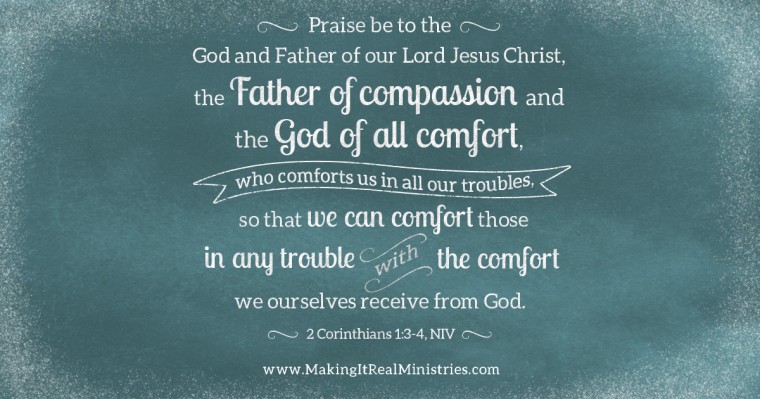
As I have been comforted, I want to comfort others.

Blessed [gratefully praised and adored] be the God and Father of our Lord Jesus Christ, the Father of mercies and the God of all comfort, who comforts and encourages us in every trouble so that we will be able to comfort and encourage those who are in any kind of trouble, with the comfort with which we ourselves are comforted by God. For just as Christ’s sufferings are ours in abundance [as they overflow to His followers], so also our comfort [our reassurance, our encouragement, our consolation] is abundant through Christ [it is truly more than enough to endure what we must].

2 Corinthians 1:3-5 AMP
Stronger

If you meet me now at the grocery store or pass me in church, I probably won’t cry.

I will most likely ask you how you are, what you’ve been doing and smile when you share the latest family news even if in the midst of the words a thousand alarms go off in my head, reminding me of Dominic.

Because I’m stronger.

There’s a common misconception about grief among those who have never experienced the loss of a close loved one.

It goes something like this:  The first few weeks, months and the first holidays celebrated without them are the hardest.  But once the bereaved make it through THOSE, things get EASIER.

I’m here to tell you that, at least for me, it’s just not true.

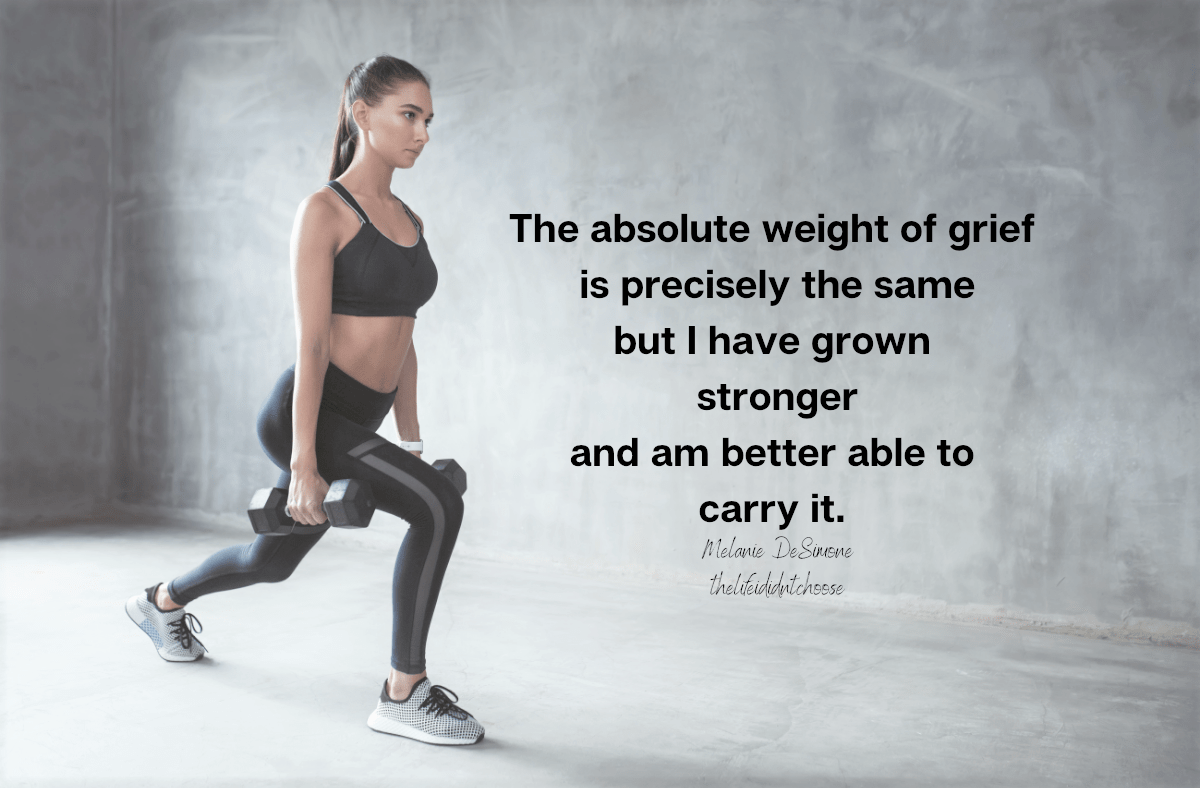
A better picture of how I am continuing in this grief journey is to think of it as weight lifting.   I started with a 250 pound barbell raised over my head-no warning, no training-that knocked me to my knees and threatened to press the life out of me.  But friends and family came alongside and helped me lift the heavy weight for a season.

And I survived.

Each day, I have to get out of bed and lift that weight.

  • Over time, my muscles have grown stronger.
  • Over time, I’ve become more adept at keeping my grip.
  • Over time, I’ve learned a few tips and tricks to balance the bar more evenly, to situate myself more strategically beneath it and to breathe through the lifting so that I don’t become light-headed and faint.

But there are still days, still moments, when my balance is off and I can be crushed by the weight of grief.  There are times when life adds a few more pounds onto the bar and even my stronger arms are unable to lift it up and carry on.

And in those moments or on those days, the full weight of sorrow and pain and longing overwhelm me.  That’s when I understand how Paul felt when he wrote:

We are pressed on every side by troubles, but not crushed and broken. We are perplexed because we don’t know why things happen as they do, but we don’t give up and quit. We are hunted down, but God never abandons us. We get knocked down, but we get up again and keep going. These bodies of ours are constantly facing death just as Jesus did; so it is clear to all that it is only the living Christ within who keeps us safe.  

2 Corinthians 4: 8-10

I sit in my floor and cry out to God for mercy, cry out to Him for strength, cry out to Him for grace to rise and carry on.

I am thankful that it’s no longer every day.  I’m relieved that I can do routine things more easily.  I can smile. I can even laugh.

I am stronger.  I am more capable.

But I am never completely free of the load.  

Understanding Acceptance: Loving Well Series

There is a lot of misconception around the notion of “acceptance” in the grief community. Sometimes among the very people counseling those walking this valley of loss.

It’s not a once-and-done realization or commitment or decision.  It’s a process…

Sometimes those that walk alongside the bereaved are biding time, waiting for that “final” stage of grief: Acceptance.

And some therapists, counselors and armchair psychiatrists are certain that if the grieving mother can simply accept the death of her child, she can move on–that she can get back to a more “normal’ life.

But this notion is as ridiculous as imagining that welcoming a new baby into a household doesn’t change everything.

Read the rest here:  Loving well: Understanding “Acceptance”

Just Say His Name: Loving Well Series

As a bereaved mother, I long desperately to know that my son is still remembered and that he still matters.  Of course, he matters to me-but it is a great gift to know that he matters to others as well. 

Death is scary.  Even for us who trust Jesus.  And the death of a child just trashes the notion that we are in control, that we can fully protect the ones we love from all harm.

But you are frightened of what you cannot comprehend.

I am living the reality of your greatest fear.

Read the rest here:  Loving Well: Just Say His Name

Transitioning from “Good-bye” to Grief: Loving Well Series

I wrote this post in an effort to help the nonbereaved understand that funerals and memorials and other outward symbols of “good-bye” are only the BEGINNING to our sense of loss and sorrow.  And that while everyone else walks away and goes back to the life they had the day before, we stand on the threshold to a different life we are unprepared for, know nothing about and do not want.

“A funeral or memorial service seems like a final chapter.  We close the coffin, close the doors and everyone goes home.

But for bereaved parents and their surviving children, it’s not an end, it is a beginning.

Much like a wedding or birth serves as the threshold to a new way of life, a new commitment, a new understanding of who you are, burying a child does the same.

I walked away from the cemetary overwhelmed by the finality of death–not in a theological sense–I believe firmly that my son lives with Jesus–but with the undeniable fact that he is no longer available to me on this earth.”

Read more: Loving Well: Transitioning From “Good-bye” to Grief

Choosing Transparency

I’ve had two conversations in as many days that revolved around how hard it is to be transparent in relationships.

And it seems that the difficulty lies not only in our own desire to present ourselves in a way that casts a positive light on our actions, thoughts and feelings but also because of an unspoken rule in social transactions that demands (and I don’t think “demand”is too strong a word) we conform to the “I’m doing just fine” standard that is prevalent everywhere you turn.

All around me, people are faking life.

They are acting as if there are no hurdles, no burdens, no wounded places in their own hearts.  They run around proclaiming, “this is my best life now!” somehow convinced that if they say it loud enough and long enough it will be true.

But everyone sees what we think we are hiding.

Many know what we think we’re not saying.

And we all walk around, seeing and knowing but never acknowledging the truth:  we are not as strong or as perfect as we wish we were.

All this fake life is costly.  It’s costly to us who try so very hard to keep up appearances-it robs our lives of energy that would be better used in loving and serving others.  It is costly to the people around us because as long as we play the game, they feel like they must play along too.

And everywhere, hurting people hurt alone.  Scared people remain isolated in their fear.

That is not the life Jesus came to give us.  That is not the way to build true community among His called-out ones.  That is not the way to teach our children how to lean into and hold onto the strength and hope that Christ died to bring.

When I lost Dominic, many feelings overwhelmed me-sorrow, pain, disbelief-and, to my surprise, humility.

For the first time in my life it made sense to me why in many cultures bereaved people sit in the dirt and tear their clothes.  Because I remember saying over and over, “I am cast to the ground, and ashes are my food.”

And while that feeling is no longer as strong as it once was, it still echoes in my heart and mind.  I carry it with me wherever I go.  It has freed me from the game of “let’s pretend” that held me hostage to other people’s expectations of how I should act or what I should hide from public view.

Let’s just STOP.

Let’s be honest.

Let’s refuse to hide our scars, our tears, our fears and our failures.

If those of us who love Jesus refuse to acknowledge our weakness, how do we expect others to acknowledge their need for a Savior?

“The Christian often tries to forget his weakness; God wants us to remember it, to feel it deeply. The Christian wants to conquer his weakness and to be freed from it; God wants us to rest and even rejoice in it. The Christian mourns over his weakness; Christ teaches His servant to say, ‘I take pleasure in infirmities. Most gladly …will I…glory in my infirmities’ (2 Cor. 12:9)’ The Christian thinks his weaknesses are his greatest hindrance in the life and service of God; God tells us that it is the secret of strength and success. It is our weakness, heartily accepted and continually realized, that gives our claim and access to the strength of Him who has said, ‘My strength is made perfect in weakness”

― Andrew Murray, Abide in Christ

Making Space for Brokenness at the Table of the LORD

As we enter the week on the Christian calendar when most churches celebrate the death, burial and resurrection of Jesus Christ, I am reminded that often we race past the road that lead to Calvary and linger at the empty tomb.

But to understand the beauty of forgiveness and the blessing of redemption, we MUST acknowledge the sorrow of sin and the burden of brokenness.

When our sacred spaces draw boundaries around what we can bring to the Lord’s Table, we exclude the very ones who are desperate for the bread and cup.  When we treat the path as unimportant and only acknowledge the destination, we discourage those that are struggling to keep up.  When we welcome only the triumphant, we exclude those that are trying.

Let’s throw open the doors to the church and

Clear the way for the Lord in the wilderness [remove the obstacles]; Make straight and smooth in the desert a highway for our God. (Isaiah 40:3 AMP)

Let’s invite the outcasts, the limping, the hurting and the broken to the table.

Let’s declare to the wounded that in Christ there is healing!

As I’ve written before: “The truth is that none of us escape hardship in life.  All of us have hidden heartache.  We all have cracks in our polished persona.”

Read more:  Beautiful Broken


Defining Moments

I recently read a young bereaved mother’s blog post and it saddened me.  She had suffered two pre-term losses and in addition to bearing that pain, she had been pressured to dismiss her babies’ deaths as unimportant.

This grieving mama was told that she was “not defined by her tragedies” and encouraged to “rise above them” and to “move on”.

Along with the natural questions about God that arise in the wake of loss, her believing friends didn’t offer the support she needed to persevere in faith.  She now defines herself as “faith-less”.

I told her I was so very sorry that this was her experience.  And that we ARE defined by our tragedies, just as we are defined by our joyful moments, our exciting moments and our fearful moments.

Only people who have never suffered a great and deeply scarring loss can afford to say something as flippant as that.

I am a wife.  I wasn’t always a wife.

But one day I went into the church in a white dress and walked out of the church a wife. No one would argue that the moment my husband and I stood before God and witnesses didn’t redefine both of us in ways we wouldn’t fully comprehend for years.

I am a mother.  I wasn’t always a mother.

But one day a little life began growing inside me and nine months later, my daughter was in my arms.  Three sons followed soon after. Even though they are all grown and one son lives in heaven, I AM STILL A MOTHER.

I am a college graduate, a Southerner, a shepherd, a follower of Christ–all parts of who I am that were declared in a moment, that define who I am today and will continue to shape who I am tomorrow.

So when my son died suddenly in an accident and a deputy came to my door to give me the news,  it changed me.  It modified who I am and who I will be.

Bereavement became part of the fabric of my life, altered the color of the threads and changed the pattern of the weave. It is impossible to pull out that thread without unravelling the whole cloth.

I can make choices about HOW tragedy will define me, but I can’t pretend it didn’t happen or that it doesn’t affect my very soul.

It’s easier to acknowledge pleasant milestones and moments because they affirm our hope that life will be joyful and happy.  We wear symbols to remind us of them–wedding rings, school rings, crosses–and invite people to share how life has changed because of choices made.

It’s much harder to offer hospitality to the hurting heart.  It takes more energy to listen to the tragic tale.  It requires more understanding to allow a broken soul into our living room and bear witness to the pain.

But the most beautiful art is defined by contrast between light and dark. The most moving music contains major and minor keys.  The most compelling story includes tragedy and triumph.

There are many things that define me and bereavement is only one of them.  But it IS one of them. My life can only be understood by including them all.

SCHeart1-main


Taking a Breather

The sun is shining in Alabama and I’m going to try to plant a garden again this year for the first time since losing Dominic.  I haven’t had the energy to invest in tending to growing things before this Spring. I pray it is good therapy and that seeing things sprout and bloom will encourage my heart.

So I’m going to share again a couple of posts that were popular. Some of you may have read them but there are a number of new followers that might have missed them.

I hope you are enjoying the warming weather too.  New posts coming soon!

One day a few weeks ago, I decided to simply make a list of the things grief is teaching me. I think I could add a few lines to this post, because I am learning something new every day…

To read more:

Things I’m Learning

Dropping the Mask

Despite my commitment to authenticity, I do have a plastic smile I can pull out of my pocket and slap across my face.

Sometimes I just don’t want to have to have to answer the question, “How are you?” with more than a nod and a wave.

I tell myself that it demonstrates maturity and self-control.

And I actually think that’s OK. I don’t always need to spill my guts to every unsuspecting stranger I meet.

But if I allow it to become a habit or use it as camouflage to keep my distance from my fellow man, it is unhelpful.  It gives the false impression that life is mostly smooth sailing, when that’s just not true so much of the time.

And it builds a wall between me and others.

Because if the people I meet think that I have it all together all the time, they are going to be much less likely to admit that they don’t.  And let’s be real, none of us have it all together.

We all have at least one place in our lives that hurts and that needs healing.

Everyone has scars.

Losing a child is teaching me many things.  One of the things I am learning is that I am not self-sufficient.  I am not capable of meeting my own needs or bearing my burdens alone.  I need companionship in this journey.

When I walk around with my mask on, I isolate myself from the very people that might help me heal.

It is humbling and sometimes frightening, to let others SEE my brokenness.

I might be inviting judgment and condemnation.  But I am also welcoming love and companionship.  I am opening my heart to the gift of friendship.

When I refuse to pretend, I give permission for others to take off their masks too.

Being real creates space for authentic healing.

It unlocks doors to sharing truth.

Jesus came as God in the flesh so that He could experience our trials, our temptations, our joys and our sorrows. He came to KNOW.

But He also came to make the Father KNOWN.

And He has left His followers to continue making the Father known in the world.

If I want to minister to the painful places in the lives of others, I have to let them see the painful places in my own. I have to drop the mask and reveal my face.  When I do, I invite them to let me help carry their load and to let them help me carry mine.

Bear ye one another’s burdens, and so fulfil the law of Christ.

Galatians 6:2