What I Want You to Know About My Grief

I am so very thankful I live in a country where the vast majority of parents do not know what it’s like to bury a child.

I am part of a relatively small group.  Bereaved parents make up a tiny segment of the population.

It’s possible that you may never be close friends with someone who has lost a child.

And because death and dying are unpopular subjects, and because grieving parents can become very good at hiding the pain, even if you DO meet someone whose child has died, they may never tell you about it.

So, so many of the friends I have made on this journey live each day bearing the weight of grief AND the heavy burden of being misunderstood-at work, in church, even in their own extended families.

One of the first posts I wrote was born out of this angst-birthed in pain as I realized that even well-meaning friends and family members who have not experienced child loss really don’t have any idea how it feels :

People say, “I can’t imagine.

But then they do.

They think that missing a dead child is like missing your kid at college or on the mission field but harder and longer.

That’s not it at all.

Read the rest: What Grieving Parents Want Others to Know


Being a Friend: Loving Well Series

Oh, the blessing of true friendship when your world is full of pain!  There is no substitute for loving companionship when all you see is darkness.

There are those who are brave and reach out to me and offer words or hugs or prayers and their efforts give me strength and comfort.

Read the rest here:  Loving Well: Being a Friend

Understanding Acceptance: Loving Well Series

There is a lot of misconception around the notion of “acceptance” in the grief community. Sometimes among the very people counseling those walking this valley of loss.

It’s not a once-and-done realization or commitment or decision.  It’s a process…

Sometimes those that walk alongside the bereaved are biding time, waiting for that “final” stage of grief: Acceptance.

And some therapists, counselors and armchair psychiatrists are certain that if the grieving mother can simply accept the death of her child, she can move on–that she can get back to a more “normal’ life.

But this notion is as ridiculous as imagining that welcoming a new baby into a household doesn’t change everything.

Read the rest here:  Loving well: Understanding “Acceptance”

Understanding the Grieving Heart: Loving Well Series

I don’t want pity.

I don’t want people passing me in the street or in the sanctuary secretly shaking their head and thinking, “poor woman”.

I would like to be understood-at least as well as anyone standing on the outside of child loss can understand…

A bereaved parent’s grief doesn’t fit an easy-to-understand narrative. And it flies in the face of the American “pull yourself up by your bootstraps” mentality.

Read the rest here:  Loving Well: Understanding the Grieving Heart

Extravagant Love-Tales of Friendship and Encouragement After Losing a Child: Loving Well Series

I asked other bereaved parents to share from their experience the things that were helpful and not so helpful to them after losing a child.  I was amazed by the answers!

What follows is a combination of their words and mine–blended together to help others in this journey.

If you are a bereaved parent, and have wanted to gently remind amily and friends what is helpful and what isn’t-sharing a post to Facebook can be a non-threatening way to let them know using someone else’s voice.

“When I asked other bereaved parents to share the things people did that blessed them in the wake of losing a child, I didn’t expect so many stories of extravagant love–of acts surpassing anything I could have thought of or imagined.”

Read the rest:  Extravagant Love: Tales of Friendship and Encouragement After Losing a Child

Loving Well: Being a Friend

I’ve thought a great deal about friendship since losing Dominic.  I’ve been blessed by those who have chosen to walk with me and dismayed by some who have walked away.

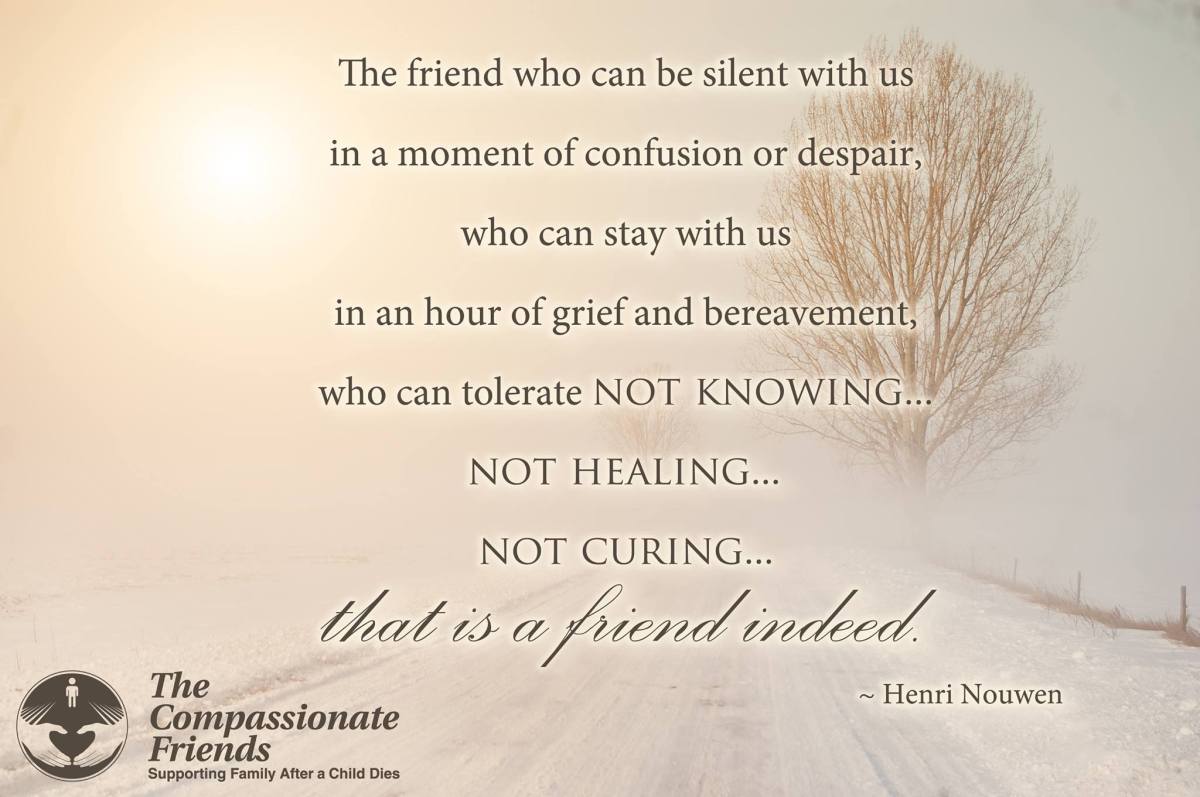
It takes great courage to sit in silence with those who suffer. We must fight the urge to ward off their pain with chatter. Quiet companionship requires that we allow our hearts to suffer too.

For fifty years I was on the “other side”-the one where I looked on, sad and sometimes horror-stricken, at the pain and sorrow friends or family had to bear.

I wanted to help.

I wanted to say the “right thing”.  I wanted to express how very much my heart hurt for them and that I badly wished I could carry some of their load.

Sometimes I think I did a pretty good job of reaching out and touching the wound and offering a little bit of comfort.  But other times, I would say nothing because I didn’t know what to say.

Now I am the one bent under the burden of grief-my heart and body and soul laboring to carry the weight of burying a child.  And there are those who are brave and reach out to me and offer words or hugs or prayers and their efforts give me strength and comfort.

Walking through the Valley of the Shadow of Death, these gestures are lights in the darkness, hope for my heavy heart and encouragement for a weary body.

“Two are better than one, because they have a good reward for their toil. For if they fall, one will lift up his fellow. But woe to him who is alone when he falls and has not another to lift him up! Again, if two lie together, they keep warm, but how can one keep warm alone? And though a man might prevail against one who is alone, two will withstand him—a threefold cord is not quickly broken.”

Ecclesiastes 4:9-12

It’s tempting to avoid someone when their world is dark.

It’s uncomfortable to choose to enter their pain.  But Jesus has called us to walk beside the suffering, to encourage the disheartened and to lift up the ones who stumble.

There are no magic words to erase heartache.

Only presence.

And isn’t that why Jesus came?

We are most like our Savior when we are willing to leave our place of comfort and venture into the threatening world of another’s pain and suffering.

“Christ Jesus, who, being in the form of God, did not consider it robbery to be equal with God, but made Himself of no reputation, taking the form of a bondservant, and coming in the likeness of men. And being found in appearance as a man, He humbled Himself and became obedient to the point of death, even the death of the cross”

(Philippians 2:5-8)

Loving Well: Relational Acts of Kindness

Focusing on “Loving Well” has reminded me again of the dear friends and sisters who consistently, compassionately and sacrificially love me just when I need it most. They came last week for a visit and spoke courage to my heart once again.

Loving well takes time and effort and is costly.  But I think we represent Jesus best when we love extravagantly.

“You can always give without loving, but you can never love without giving.”

– Amy Carmichael

I have two very special friends.

After Dominic died and the meals and visits and cards had dwindled and the silence and heartbreak had become oh-so-overwhelming, they came out to spend the day with me.

The whole day.

With me.

With this crying, couldn’t hold it together, didn’t know what to say mama who had buried her son just weeks ago.

They brought lunch.  And let me talk–or not. They didn’t try to fix me, didn’t offer platitudes or Bible verses to smooth things over when conversation lagged.  They hugged me and listened.

And they have been doing this every few weeks since.

It costs them a whole day and it’s 60 miles each way–but they keep coming and keep lifting me up so that grief and sorrow don’t drown me.

Social networks buzz with posts and tweets and Instagrams of “random acts of kindness”. That’s a good thing.

But on a scale of 1 to 10, those are easy.

We pick a stranger, discern a way to help (maybe paying for a meal or a coffee) and then both walk away feeling warm and fuzzy. No relationship, no comm

Relational Acts of Kindness are much harder.

We can’t just do our thing and leave.  Our hearts and resources are going to get tangled up with theirs.

It might get expensive.

That’s what my friends did.  They leaned into relationship with me even though it was messy, and hard, and costly.

So my challenge to you is this:  who do you know that could use a relational act of kindness?  A neighbor?  A distant relative? Someone who sits alone in a pew?

There is no greater kindness than coming alongside someone at just the moment they feel their strength is gone.

I know that without these friends I would not be able to bear my grief nearly so well.  I pray that God will bless them abundantly as they have been a blessing to me.

“Help carry one another’s burdens, and in this way you will obey the law of Christ.”  

~Galatians 6:2 GNT


Loving Well: Just Say His Name

I know you are afraid.

You think that speaking his name or sharing a memory or sending me a photo will add to my sorrow.

I understand.

But even when it costs me a split second of sharp pain, it is truly a gift to know that Dominic lives on in the hearts and minds of others.  It gives me courage to speak too.  It creates space where I can honor my son.

It helps keep him alive.

“I mean, they say you die twice. One time when you stop breathing and a second time, a bit later on, when somebody says your name for the last time.” ~Banksy

I know you’re busy.  I know your life is full and bustling with so many people and activities demanding attention that you don’t have any to spare.

It is easy to forget.

He wasn’t your child. The date of his homegoing isn’t etched into the marrow of your bones, it isn’t scribed on the inside of your eyelids.

Every time the calendar screams “12” I make one more chalkmark on my heart counting the days since I saw him last.

But please remember.  Please don’t let the day slip by and not acknowledge that it is as important a milestone to me and my family as his birthday.

I know you’re scared.

Death is scary.  Even for us who trust Jesus.  And the death of a child just trashes the notion that we are in control, that we can fully protect the ones we love from all harm.

But you are frightened of what you cannot comprehend.

I am living the reality of your greatest fear.

Be brave.  Step out and welcome me in.

Give space for the longing to hear my son’s name, to know my son matters, to relive some of the happy moments and funny times and even some of the hard days.

I can sit by myself and remember him.

But sharing him with you breathes life into the recollection and speaks hope to my heart.

It fuels the fire that helps me see that even when I’m not here to carry him into the land of those still living, someone else will do it for me.

Love is stronger than death even though it can’t stop death from happening, but no matter how hard death tries it can’t separate people from love. It can’t take away our memories either. In the end, life is stronger than death.

—Anonymous


Loving Well: Understanding the Grieving Heart

In my last post I shared the difference between mourning and grief. While the outward ceremonies have long passed, the inward struggle to embrace and understand the pain and sorrow of losing my son continues.

If you love someone who has lost a child, perhaps these thoughts might help you understand a bit of their pain and how completely it changes the way bereaved parents encounter the world.

Please be patient.  Please don’t try to “fix” us.  Please be present and compassionate. And if you don’t know what to say, feel free to say nothing–a hug, a smile, an understanding look–they mean so very much.

A bereaved parent’s grief doesn’t fit an easy-to-understand narrative. And it flies in the face of the American “pull yourself up by your bootstraps” mentality.

You can’t beat it–it’s not a football game-there is no winning team.

You can’t lose it–it’s not the extra 10 pounds you’ve been carrying since last Christmas.

You can’t get over it–it’s not a teenage love affair that will pale in comparison when the real thing comes along.

You can only survive it.  You can heal from it, but it will take a lifetime and require very special care.

I have a young friend whose first child was born with a life-threatening heart defect.  At just a few months of age, her little girl received a heart transplant.  Without it, she would have died.  With her new heart, this sweet baby will live-but her parents must observe careful protocols to protect that heart and she will never outgrow the scar from the surgery that saved her life.

Burying Dominic wounded my heart so deeply that while I know it will heal–it is beginning to, I think–it will bear the scars and require special handling as long as I walk this earth.

So when I thank you for an invitation, but choose not to go…I’m not rejecting you, I’m protecting my heart.  Please ask again–tomorrow might be a better day, and going somewhere or being with someone could be just what I need.

If you call and I don’t pick up…I might be crying, or about to, and I choose not to burden you with my grief.  Call in a day or two or next week–keep trying.

A text or email or card is so helpful.  I can read these when I’m ready and respond when it’s easier for me to think.

And please, please, please don’t look for the moment or day or year when I will be “back to my old self”.  My old self was buried with my son.  I am still “me”–but a different me than I would have chosen.

I know it makes you uncomfortable–it makes me uncomfortable too.

But because I trust in the finished work of Christ, I know that one day my heart will be completely healed.

I hurt but I have hope. This pain will be redeemed and my scars will be beautiful.

“For just as Christ’s sufferings are ours in abundance [as they overflow to His followers], so also our comfort [our reassurance, our encouragement, our consolation] is abundant through Christ [it is truly more than enough to endure what we must]”  2 Corinthians 1:5.


Loving Well: Transitioning From “Good-bye” to Grief

A funeral or memorial service seems like a final chapter.  We close the coffin, close the doors and everyone goes home.

But for bereaved parents and their surviving children, it’s not an end, it is a beginning.

Much like a wedding or birth serves as the threshold to a new way of life, a new commitment, a new understanding of who you are, burying a child does the same.

I walked away from the cemetary overwhelmed by the finality of death–not in a theological sense–I believe firmly that my son lives with Jesus–but with the undeniable fact that he is no longer available to me on this earth.

And in the days afterward, I was struck by the inadequacy of a funeral or memorial service to make space for the deep and ongoing sense of loss and pain and sorrow.

There is a difference between mourning and grief.  Although before losing Dominic I never bothered to notice.

I think we confuse the two on a regular basis.  I know I did.

Mourning is defined as “the outward signs and rituals associated with sorrow for a person’s death.  It is usually limited in time by social conventions or community expectations”.   

Mourning is the more or less public (depending on the family’s choices) “Good-bye” to their loved one.  It’s a circumscribed set of things we do and time we spend welcoming others into the space where we remember, make final arrangements for a body and celebrate the life that has left us.

In most North American communities, we have dispensed with the tradition of draping pictures, windows and ourselves for six months to a year to mark the home and heart of someone who has suffered loss.

What used to be a longer span of time allowing for special accommodations due to grief has now been squeezed into about two weeks.

Our hyper-drive world insists that even parents who bury a child show up to work, begin to participate and act like they have it “together” in public much sooner than our frail human bodies and broken hearts can manage.

Grief is more than a feeling.  It invades your heart, your mind, your body and your soul

Grief is the deep and poignant distress caused by bereavement..

It cannot be circumscribed by time and refuses to limit itself according to the expectations of others or even myself.  It will last (though perhaps not with the same intensity) as long as I live.

Because unlike a funeral, missing my son will not come to an end until I am reunited with him in heaven.

And we need to talk about this.

We need to help ourselves and others understand that grief changes who we are.  It changes how we perceive the world.  It alters our sense of self and impacts our relationships with others.

I am not as fragile as I was just weeks or months after Dominic’s death.  I have learned to put on a smile and pass by his favorite food in the grocery store without crying.  I can remember funny things he said or did without simultaneously experiencing gut-wrenching pain that he is no longer here to do them.

But I am still grieving.  

I am still working out how this missing is weaving itself into the fabric of who I am.

And it is WORK.

Much of the work I have to do on my own–I have to think about and feel and embrace the changes that have been thrust upon me.  But for some of the work, I need the help of others.  I need to be able to speak aloud my thoughts and feelings and receive feedback so that I’m not stuck in unfruitful inner dialogue.

It requires energy and resources.

While I am doing this grief work, my physical, mental, emotional and spiritual energy is largely consumed by it.  I am unavailable more often.  I have a smaller capacity to absorb sudden change and unexpected events. I’m uncomfortable in crowds.  I tire more easily.

And it takes TIME.  

I have discovered that no matter how much I want to speed up this process, it will not be hurried along.  And it proceeds in a “two-steps-forward-one-step-back” fashion so even when I feel I am making progress, I discover I’m not as far along as I think I am or would like to be.

So how to love well at this stage in my grief journey?  When I’m transitioning from “good-bye” to grief?  When I’m trying to understand this new life I never expected to live?

  • Acknowledge my ongoing pain and struggle.
  • Encourage me by allowing me to share honestly.
  • Be patient.  I want to heal but I don’t have control over how long it will take.
  • Don’t shut me out or shut me down.  Grief is uncomfortable for both of us.
  • Remember my son.  I need to know that others miss him too.

Rejoice with those who rejoice [sharing others’ joy], and weep with those who weep [sharing others’ grief].

Romans 12:15 AMP