Making Space for Brokenness at the Table of the LORD

As we enter the week on the Christian calendar when most churches celebrate the death, burial and resurrection of Jesus Christ, I am reminded that often we race past the road that lead to Calvary and linger at the empty tomb.

But to understand the beauty of forgiveness and the blessing of redemption, we MUST acknowledge the sorrow of sin and the burden of brokenness.

When our sacred spaces draw boundaries around what we can bring to the Lord’s Table, we exclude the very ones who are desperate for the bread and cup.  When we treat the path as unimportant and only acknowledge the destination, we discourage those that are struggling to keep up.  When we welcome only the triumphant, we exclude those that are trying.

Let’s throw open the doors to the church and

Clear the way for the Lord in the wilderness [remove the obstacles]; Make straight and smooth in the desert a highway for our God. (Isaiah 40:3 AMP)

Let’s invite the outcasts, the limping, the hurting and the broken to the table.

Let’s declare to the wounded that in Christ there is healing!

As I’ve written before: “The truth is that none of us escape hardship in life.  All of us have hidden heartache.  We all have cracks in our polished persona.”

Read more:  Beautiful Broken


Defining Moments

I recently read a young bereaved mother’s blog post and it saddened me.  She had suffered two pre-term losses and in addition to bearing that pain, she had been pressured to dismiss her babies’ deaths as unimportant.

This grieving mama was told that she was “not defined by her tragedies” and encouraged to “rise above them” and to “move on”.

Along with the natural questions about God that arise in the wake of loss, her believing friends didn’t offer the support she needed to persevere in faith.  She now defines herself as “faith-less”.

I told her I was so very sorry that this was her experience.  And that we ARE defined by our tragedies, just as we are defined by our joyful moments, our exciting moments and our fearful moments.

Only people who have never suffered a great and deeply scarring loss can afford to say something as flippant as that.

I am a wife.  I wasn’t always a wife.

But one day I went into the church in a white dress and walked out of the church a wife. No one would argue that the moment my husband and I stood before God and witnesses didn’t redefine both of us in ways we wouldn’t fully comprehend for years.

I am a mother.  I wasn’t always a mother.

But one day a little life began growing inside me and nine months later, my daughter was in my arms.  Three sons followed soon after. Even though they are all grown and one son lives in heaven, I AM STILL A MOTHER.

I am a college graduate, a Southerner, a shepherd, a follower of Christ–all parts of who I am that were declared in a moment, that define who I am today and will continue to shape who I am tomorrow.

So when my son died suddenly in an accident and a deputy came to my door to give me the news,  it changed me.  It modified who I am and who I will be.

Bereavement became part of the fabric of my life, altered the color of the threads and changed the pattern of the weave. It is impossible to pull out that thread without unravelling the whole cloth.

I can make choices about HOW tragedy will define me, but I can’t pretend it didn’t happen or that it doesn’t affect my very soul.

It’s easier to acknowledge pleasant milestones and moments because they affirm our hope that life will be joyful and happy.  We wear symbols to remind us of them–wedding rings, school rings, crosses–and invite people to share how life has changed because of choices made.

It’s much harder to offer hospitality to the hurting heart.  It takes more energy to listen to the tragic tale.  It requires more understanding to allow a broken soul into our living room and bear witness to the pain.

But the most beautiful art is defined by contrast between light and dark. The most moving music contains major and minor keys.  The most compelling story includes tragedy and triumph.

There are many things that define me and bereavement is only one of them.  But it IS one of them. My life can only be understood by including them all.

SCHeart1-main


Am I Normal?

Believe me, no one wonders more than I if the things I’m feeling, the things I’m doing and the rate at which I am healing is “normal”.

I belong to a couple of bereavement support groups and a recurring theme is, “Am I crazy?  Is this the way it is supposed to be?”

Sometimes grieving parents wonder these things because of their own misgivings.

But often, we question our feelings and experience because of external pressure.

And that is unfortunate and unfair.

When a mom brings her new baby home from the hospital, people are quick to remind her that life “will never be the same”.

She is encouraged to seek advice and help from friends and family and given space and time to figure out this new way of being.  As the years pass, she might express frustration and concern over the challenges of going back to work, sleepless nights, feeding issues, potty training, and dozens of other, everyday struggles that result from welcoming this little person into the family.  And that is just the beginning. 

No one thinks it strange that the ADDITION of a child is a life-long adjustment.

So, why, why, why is it strange that the SUBTRACTION of a child would also require accommodation for the rest of a mother’s life?

My heart grew larger when Dominic was born and the space that is his cannot and will not be filled by anyone or anything else.

I am learning each day to work around this empty spot.  I am becoming stronger and better able to carry the weight of grief that I must bear.

I can do many of the things I used to do before the only place I could visit Dominic was at the cemetary.

But I have to do them differently.  I need more help.  It takes more time. And sometimes I find after I plan to go somewhere that I am just not able to go after all.

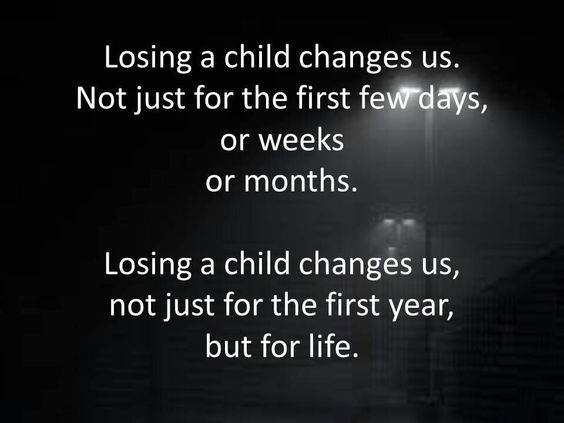
I will never “get over” burying my son.

There will always be another mountain to climb, another loss to mourn, another hurdle to clear in this grief journey.

Dominic is part of me.  That didn’t change when he went home to be with Jesus.

The absence of his presence is EVERYWHERE.

And just for the record–missing the child I love for the rest of my life is perfectly normal.


Taking a Breather

The sun is shining in Alabama and I’m going to try to plant a garden again this year for the first time since losing Dominic.  I haven’t had the energy to invest in tending to growing things before this Spring. I pray it is good therapy and that seeing things sprout and bloom will encourage my heart.

So I’m going to share again a couple of posts that were popular. Some of you may have read them but there are a number of new followers that might have missed them.

I hope you are enjoying the warming weather too.  New posts coming soon!

One day a few weeks ago, I decided to simply make a list of the things grief is teaching me. I think I could add a few lines to this post, because I am learning something new every day…

To read more:

Things I’m Learning

What if Tomorrow Never Came?

I know, I know, we’ve all heard it–no one is guaranteed tomorrow. Depending on the setting, and depending on your age when (usually) an older person says it, this admonition is easier or harder to ignore.

But I am here to sound the trumpet:  There might not be a tomorrow for you or for someone you care about!

So if there is something you need to say, something you need to do, please, please, please–for the love of LOVE, say it or do it!

My family will tell you that I’ve always been one of those people who says things on the phone and writes things in cards that most folks just think about but never put into words.

And since Dominic’s death, I am even bolder.

Because we had NO CLUE that the last time each of us spoke with him, or texted him, or exchanged emails with him was going to be the LAST TIME. He wasn’t sick or going off to war, so there was no reminder of the brevity of life the day before he died.

Don’t get me wrong, we are not always roses and buttercups around here.

We have plenty of disagreements and misunderstandings.  And every one of us has strong opinions about almost everything.  But we refuse to stay angry for more than a few minutes.  Even when all that can be said or done is a text, “I’m sorry.  I love you.  Let’s talk about this later when we’re not so worked up.”

That’s what we do.  

That’s what we’ve always done.

And we are not shy about blessing one another either:  “Great job!”  “I knew you could do it!”  “Sorry you are having a bad day-praying.”

Who decided that smiley face stickers were only for kindergartners?  We all need encouragement every day.

I can’t bring Dominic back.  

I can’t get one more second, one more minute, one more day with my third born child to tell him I love him and that I am so very proud of him and that he was witty and a wonderful drummer and a good, good friend to so many people.

But I know he knows.

Because even though I can’t tell him now, I told him then.

I told him often and I told him in ways that were meaningful to him.

So, I carry the burden of missing him.  I carry the weight of sorrow that comes from burying a child.  But I am free from the awful cross that I might have been forced to bear if I didn’t know that I had loved him well.

And for that, I am grateful.


Another Confession

Emboldened by my confession of fearing the dark, I’m here to make another one:

I really want to finish well-and I’m afraid I might not.

Foolishly perhaps, I had imagined the years on the other side of the Great Divide of fifty to be ones in which I could coast a bit.  As one sweet lady I knew used to say, “It’s great to be over the hill-that means it’s all downhill from here!”

And in some ways I am coasting.

I no longer struggle with the angst of being comfortable in my own skin. Since I’m not in the market for cosmetic surgery I have made peace with the fact this body is the only one I’ll have (until that wonderful day when I get my glorified body!).

I’ve decided that as long as I am kind about it, I am entitled to express my own opinion, even if I’m the only one who holds it.  I don’t have to receive affirmation for my convictions to be true.

Doing the regular chores of life come naturally and I can accomplish them without toddlers or teenagers undoing my work in one room while I’m making progress in another.

But on the spiritual front…well, that’s another matter entirely.

Losing a child has forced me to re-engage questions I thought I had settled long ago.  It has made me less certain of some ideas I once held tightly with both hands.

And it has made plain that these last years are going to be just as hard as the early ones in which I dug deep in Scripture to sort through what I had heard or been taught and compare it with what the Word actually says.

I am learning that God is not as easy to comprehend as our Sunday School tag lines make Him seem.  I am coming to understand what Job declared:

“I had heard of You [only] by the hearing of the ear, But now my [spiritual] eye sees You.”

Job 42: 5 AMP

Knowing now, by experience, that the road ahead may be just as hard and just as bloody as the one I leave behind, it would be easy to give up.

In my family, quitting was never an option.  My dad used to say, “You can do anything you want to do if you want to do it badly enough.”

But in this battle to keep going, I am too weak to continue by myself-too beaten down to make it to the finish line in my own strength.

I want to be faithful until the end.

I am purposing to refuse simple explanations and easy answers that tickle my ears but may not reflect truth.  And I will admit that I often just don’t understand–that I am wholly dependent on the God Who made me to keep me.

I want to let God mold me and shape me until I am a prize He is pleased with.

I want to present Him to others as the One Who has upheld me and keeps upholding me, even in this struggle to finish well.

So I go directly to Him. I go straight to His Word.  I will lean on, rely in and place my full trust in Jehovah:

“I’m convinced: You can do anything and everything.
    Nothing and no one can upset your plans.
You asked, ‘Who is this muddying the water,
    ignorantly confusing the issue, second-guessing my purposes?’
I admit it. I was the one. I babbled on about things far beyond me,
    made small talk about wonders way over my head.
You told me, ‘Listen, and let me do the talking.
    Let me ask the questions. You give the answers.’
I admit I once lived by rumors of you;
    now I have it all firsthand—from my own eyes and ears!
I’m sorry—forgive me. I’ll never do that again, I promise!
    I’ll never again live on crusts of hearsay, crumbs of rumor.”

Job 42:1-6 MSG

God of the Day and God of the Night

I was afraid of the dark until I was almost forty years old.

My fear was rooted in scary childhood moments and even years of adult experience could not rip it from the soil of my psyche. I never could convince my heart what my head knew to be true: there was nothing in the dark that wasn’t also there in the light.

It was fear, not darkness, that controlled me.

There is great darkness in grief.  So many unanswerable questions, so much anquish, so much pain.

And there is darkness in many other painful, unchangeable circumstances.

The darkness can hide things that I see clearly in the light.  And if I’m not careful, I  can allow the darkness to foster fear and keep me from venturing futher.

In my own strength, depending on my own resources, I am afraid.

But when I call out from my scary place to the God Who made me, I can face the fear in confidence He hears and cares.

When I am afraid, O Lord Almighty, I put my trust in you.

Psalm 56:3 GNT

Sometimes believers in Christ can convince themselves that admitting their world is dark with pain or suffering or questions diminishes the power of God–that it speaks ill of God or that it means God is insufficient to uphold us in our weakness.

If I pretend that I’m never afraid, or that I never experience darkness, I am denying others my aid.

Even worse, I may be shaming them to silence, sending the message that if they are experiencing pain, something is wrong with THEM.

How many people are sitting in our pews with broken hearts and broken lives, afraid to reach out for help because–in addition to the pain of their broken life–they live under condemnation?

Life is full of pain and darkness.  Even for those who follow Jesus.

When I deny that truth, I also refuse to testify to God’s power to help me carry on and give me the courage to face my fear.

God is the God of the day AND the God of the night.  

I do not diminish Him by admitting that I experience both.

He invites me to lean into Him and to hold hands with His children as I journey on, even when it’s dark.

“Christians with this unflinching faith in the sovereign God do not deny grief. But even in their darkest hours, they borrow God’s strength. In their tears and pain they cling to God who will never let them go. What the Savior has done for others He will do for you. When you are shaken, and you know that life will never be the same again, you can trust and not be afraid. You can live in HOPE with the sturdy confidence that God will dry your tears and put you on your feet again.”

“Grief, Comfort for Those Who Grieve and Those Who Want to Help” by Haddon W. Robinson


denial

To deny the presence of pain is to diminish the power of the cross.  

Dying, Jesus honored His mother’s courage by acknowledging her pain. She was losing the Son she loved and it hurt in a way that only mothers can comprehend.  He didn’t tell her that it would “be alright” or that “the ending is ultimately victorious”.

Instead, He looked upon her trembling figure and saw her broken heart.

He made what practical provision He could by telling John to care for her. He knew it would not undo her sorrow.

Some in the church preach that pain and suffering are anomalies–that they are aberrations in the “victorious Christian life”.

And we place great emphasis on the idea that even though we may have trouble in this life–“We know the REST of the story! Jesus WINS!

Yes. He. does.

But some of our earthly stories-the ones we are living right now- do not have tidy, happy endings:

Some are burned in the fire.

Some die of cancer.

Some fall headlong into mental illness.

And some bury their children.

What to do when you are confronted by undeniable pain in your own or someone else’s life?

Acknowledge it.

Look with mercy on the broken heart.

Allow suffering to flow from the cracks unchecked and unjudged.

Be still and be love.

Offer practical aid without strings attached.  Be mindful of what is actually helpful even if it doesn’t make sense to you.  Come alongside for the long haul.

There is no greater gift to the one who is suffering than a faithful friend who refuses to be frightened away.

Loving burden-bearers help those of us living with no-happy-ending earthly stories cling more securely to the hope of ultimate victory in Christ.  

And by doing so, declare the power of the cross.  

For the message of the cross is foolishness [absurd and illogical] to those who are perishing and spiritually dead [because they reject it], but to us who are being saved [by God’s grace] it is [the manifestation of] the power of God.

I Corinthians 1:18 AMP

A Daily Struggle

I despise the platitude plastered across social media memes:  “Hard times either make you bitter or better”.

It makes it sound so simple.

As if all I have to do is make a single choice between two equally available paths.

Enduring deep pain and unchangeable circumstances requires continued commitment to face the fork in the road over and over, and to choose well each time.

Every day I am forced to confront my heart’s tendency to turn inward and embrace loneliness and isolation in an attempt to protect myself from further and perhaps greater pain.

Each moment I have to choose whether I will lean into despair or hold onto hope.

And I just don’t agree that there are only two possible outcomes of a life that endures hardship or grief.

Bitterness is certainly an option.

If I allow myself to rehearse the reasons why my son should not have died, why my family doesn’t deserve this grief, why my life is so much harder than it should be–then the case for bitterness grows strong and becomes attractive.  I can pack my briefcase full of evidence and pull it out at every opportunity when confronted with yet another “happy moment” splashed on Facebook.

Bitterness is always a temptation, and I must refuse it everyday.

But “better” implies that I lacked something that I have now gained.

Better diminishes my grief and gives the impression that I’d do it all over again because my painful experience has wrought amazing results.

Losing my son, regardless of what I have learned, is not the same as sticking to a diet or working up to a marathon run or getting a master’s degree.

The subtle danger in declaring myself “better” is that I can decide I’m a measuring rod for others to judge their grief journey.  Or I can become like the reformed smoker who forgets how many tries it took to quit or how hard it was to finally stop smoking and instead mocks those who are still struggling.

I am not “better”.

I am broken.  

I am bankrupt of any illusion that I am the captain of my ship.  I understand by very, very painful experience that there are no earthly guarantees life will turn out according to plan. I embrace with both hands the notion that the most precious gift is people we love and no matter how long we have with them, it will never be enough.

I can’t claim a final victory of faith over doubt, of good out of bad, of lessons learned from effort expended.

Instead I extend my empty hands and hurting heart to be filled with grace and mercy.

I choose love and refuse hate.

I continue to engage this broken world from my broken perspective and offer compassion and understanding to those who are broken too.

Blessed [be] the God and Father of our Lord Jesus Christ, the Father of compassions, and God of all encouragement; who encourages us in all our tribulation, that we may be able to encourage those who are in any tribulation whatever, through the encouragement with which we ourselves are encouraged of God.

2 Corinthians 1:3-4 DARBY


Dropping the Mask

Despite my commitment to authenticity, I do have a plastic smile I can pull out of my pocket and slap across my face.

Sometimes I just don’t want to have to have to answer the question, “How are you?” with more than a nod and a wave.

I tell myself that it demonstrates maturity and self-control.

And I actually think that’s OK. I don’t always need to spill my guts to every unsuspecting stranger I meet.

But if I allow it to become a habit or use it as camouflage to keep my distance from my fellow man, it is unhelpful.  It gives the false impression that life is mostly smooth sailing, when that’s just not true so much of the time.

And it builds a wall between me and others.

Because if the people I meet think that I have it all together all the time, they are going to be much less likely to admit that they don’t.  And let’s be real, none of us have it all together.

We all have at least one place in our lives that hurts and that needs healing.

Everyone has scars.

Losing a child is teaching me many things.  One of the things I am learning is that I am not self-sufficient.  I am not capable of meeting my own needs or bearing my burdens alone.  I need companionship in this journey.

When I walk around with my mask on, I isolate myself from the very people that might help me heal.

It is humbling and sometimes frightening, to let others SEE my brokenness.

I might be inviting judgment and condemnation.  But I am also welcoming love and companionship.  I am opening my heart to the gift of friendship.

When I refuse to pretend, I give permission for others to take off their masks too.

Being real creates space for authentic healing.

It unlocks doors to sharing truth.

Jesus came as God in the flesh so that He could experience our trials, our temptations, our joys and our sorrows. He came to KNOW.

But He also came to make the Father KNOWN.

And He has left His followers to continue making the Father known in the world.

If I want to minister to the painful places in the lives of others, I have to let them see the painful places in my own. I have to drop the mask and reveal my face.  When I do, I invite them to let me help carry their load and to let them help me carry mine.

Bear ye one another’s burdens, and so fulfil the law of Christ.

Galatians 6:2