When grief was fresh, the pain was raw and my heart was oh, so tender, I desperately needed a safe space to talk about the nitty-gritty of child loss.
And I found it in online bereaved parents’ groups.
I’m so thankful that they exist, that they are maintained by people who give time and energy to keeping them safe and that-for the most part-participants are kind, compassionate and encouraging.
There is something I’ve noticed now that I’ve been here awhile. Many parents tend to drop out of active participation when they get a little further along in their journey.
As an introvert (who can, if pressed pretend not to be!) my energy is restored when I interact with one or two folks or no one at all. A dream afternoon is writing while listening to nothing louder than the wind chimes outside my door.
I treasure solitude.
Since Dominic ran ahead to Heaven, I find I need even more alone time than before.
That quiet place is where I do my most effective grief work, undisturbed by interruptions and distractions.
But I need to be careful that solitude doesn’t shift into isolation.
I have to remind my heart that spending time with others keeps me from falling so deeply down the well of despair that all I see is darkness.
I need human interaction to keep me connected to a world that, quite frankly, I might sometimes just as soon leave behind.
So how can I tell the difference between solitude and isolation?
Here are a few questions that help me figure that out:
Do I feel lonely, neglected or abandoned? If my alone time feels less like a gift and more like an unwelcome burden then it may be isolation rather than solitude.
Where are my thoughts taking me? Being alone is often the only way to “hear” my own thoughts without having to block out the noise and activity of other people. If I am sitting with myself, processing hard things or even beautiful things, resolving internal conflict, conjuring new ways to deal with difficult relationships or situations then solitude is doing its work. If, instead, I find my mind tangled up in fearful knots, filled with negative self-talk or unable to break a downward spiral into despair then I probably need to find someone to talk to.
Am I getting stronger or being drained? After the holidays or other hectic seasons I need time alone to recharge my batteries. Often it is almost a day-for-day exchange. I can feel tension melting away and strength returning. My mind begins to clear and life doesn’t feel so overwhelming. Solitude grants space for my body, mind and soul to be refreshed. When it slides into isolation I can feel the shift. Instead of waking refreshed and eager to greet a free day, I wake to dreading another long one alone. Instead of energy rising in my spirit, I can feel it draining away. Instead of thinking kindly of friends and family who choose to leave me be, I’m resentful no one has checked up on me.
Is there a helpful rhythm to my days alone or am I counting the hours until sundown? When I’m enjoying solitude, the hours feel like a welcome opportunity to do things (or not do things!) at my own pace and according to my own preferences. I sit with pen in hand and jot down a list knowing that if I complete it or if I don’t the only person I have to answer to is myself. No pressing appointments and no worrisome commitments. When I’m isolating, the hours feel like a long march through deep mud-every step tedious, treacherous and exhausting. I’m alone but I’m not getting any benefit from it. If I’m enduring instead of enjoying then I’m isolating.
Do I have an endpoint in mind? When I look ahead at a week on my calendar, I try to balance alone time with social commitments. A day or two alone (or with limited human interaction) is solitude. A week holed up in the house is isolation. If I find myself pushing off needed outings (to the grocery store, to run errands) then I ask myself, “why?”. Often it’s because I’ve drifted from solitude (helpful alone time) to isolation (unhelpful hiding).
I can shift myself out of isolation by choosing just one small social interaction.
I might text or message a friend, go to the grocery store and make a point of speaking to the clerk, call someone or show up at a church or community event even if I sit in the back and slip out early.
I’m never going to be that person who is up for every outing. That’s just not how I’m made and child loss has intensified my need for solitude.
But I don’t want to be alone and lonely, sinking deeper and deeper into a pit of my own making.
An isolated heart is especially vulnerable to discouragement and despair.
When I first found myself on this path, I only knew a handful of moms who were walking it too. They were kind and helpful but they weren’t close enough (by relationship or physical distance) to make sharing my daily ups and downs easy or comfortable. I had so many questions. I had so many fears.
And I really didn’t have anyone to ask.
Someone suggested I look for a grief group meeting in my area. But I live in a rural county and there were none. Someone else suggested I start one. But I was in no position to shepherd other hearts or facilitate discussion when I could barely form words around my own feelings.
So I turned to social media. I searched Facebook for bereaved parent groups.
And it’s there I learned the language of loss and experienced the blessing of community.
❤ Melanie
How do you speak of the unspeakable?
How do you constrain the earth-shattering reality of child loss to a few syllables?
How do you SAY what must be said?
I remember the first hour after the news. I had to make phone calls. Had to confirm my son’s identity and let family know what had happened.
I used the only words I had at the time, “I have to tell you something terrible. Dominic is dead.”
Over, and over, and over.
Until others could pick up the chant and spread it to the ends of the earth.
And then silence.
Such a deep wound requires silence.Because there are no words for the ache inside a mother’s heart, the pain that burrows into her bones, the sorrow that sucks the breath from her body.
It was some months before I found a community of bereaved parents who began to give me a vocabulary for my experience.
And it was more than helpful, it was liberating!
As I began to speak aloud what was hidden inside, it broke chains I didn’t realize held me hostage.
As long as my feelings are secret, they trap my heart and mind in an endless cycle of regret, fear, sorrow, pain and anxiety. When I speak them aloud, I can recognize them and fight them and overpower them. And when I share them, I find that I am not alone.
Others come alongside and say, “Me too!” Validation makes me stronger. Understanding makes me brave.
I hate the fact that my son is dead.
I hate the pain that his death has inflicted on me and on my family.
There are days I wish I could run away and hide, that I could pretend this never happened, that I could undo the broken that permeates my life.
But I can’t.
There’s no way through but through. I have to face the awful truth, I have to consider the ways it is changing me and remaking who I am.
I need words to process the pain because that’s how I can disarm its power over me.
It’s tempting to try to ignore the hard parts of our stories thinking that we are getting away from them.
But we aren’t.
The harder the season, the more profound the wound or bitter the struggle the more time it takes to process.
The firststep is learning the words and finding community in which to speak them.
Here are links to two online communities for bereaved parents:
If you have lost a child and are looking for a place to learn the language of grief and loss, a safe space to share your pain with others who understand it, see if one of these groups might be the place for you.
This is a common question in bereaved parent groups.
We hear the term “grief work” bandied around and while it means different things to different people, I use the phrase to encompass the mental, physical, psychological, emotional and relational work (and it is work!) a grieving heart must do in order to process and learn to carry sorrow and missing.
I won’t pretend to be an expert (except on my own experience) I do have a lot to say about what has helped, what has hurt and what I’ve learned over the eleven years since Dominic left us.
Some of these posts have been shared before, some will be brand new because I’m always growing and learning new ways grief impacts my life and the life of my family.
I’d love to hear from YOU in the comments-let me know what you’re struggling with, what has helped your own heart and what questions still keep you up at night.
Together we are stronger.
❤ Melanie
I have used the term for years and only recently has someone asked me to define it.
I guess I never realized that in all the writing about it, I’d never really explained what it meant.
So here goes.
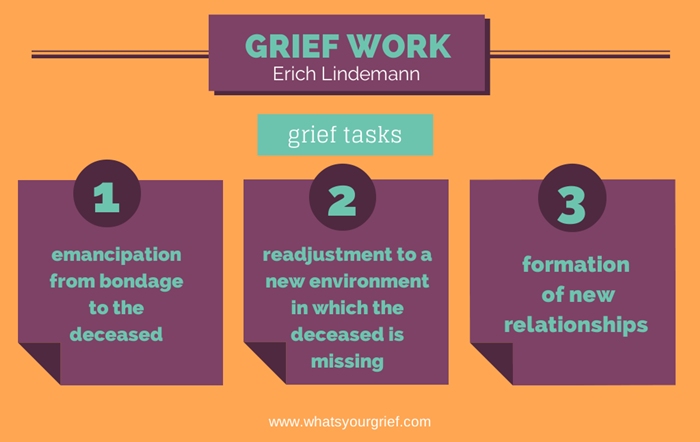
The term was coined by psychiatrist Erich Lindemann in the 1940s. He worked with survivors of the Cocoanut Grove tragedy and observed that grievers experienced common symptoms, feelings and faced similar challenges. Through his work, he developed a theory of grief incorporating his observations and his technique for walking grievers through these common issues.
Today the term has been expanded and is used widely to describe almost any approach to grief that includes specific techniques for helping someone walk the path of loss.
I use “grief work” to mean all the ways I (and others) must actively seek to identify, face, process, and ultimately incorporate the feelings, trauma and changes loss force upon us.
Grief work (in no particular order) can include but is not limited to:
Attending sessions with a professional, spiritual or lay counselor. Some people find it helpful to have a safe person outside the immediate grief circle to discuss feelings, concerns and relationship challenges that are generated by loss or exacerbated by loss. It’s best to find a counselor who specializes in grief, preferably child loss and/or traumatic loss (all child loss can be classed as traumatic loss). Other counselors may be too quick to label a bereaved parent’s grief as “abnormal” or “too lengthy” or “complicated” when it is, in fact, closely following observed timelines for dealing with child loss. If the first counselor you find isn’t a fit, try another. It’s OK to insist that you are heard, your feelings respected and your loss recognized for the life-shattering event that it is.
Finding, joining and participating in online or in person support groups. There are literally dozens of online support groups for bereaved parents. Some are designed to meet the needs surrounding specific types of loss such as sudden death, suicide, drug overdoses or loss to cancer or another disease or condition. Some are organized around certain faiths. Others may be rooted in geographic proximity and the online group might have a monthly or quarterly face-to-face meeting in the area. While it can sometimes be overwhelming to see the number of parents in such a group, it’s also extremely helpful to have a safe space to share things only another bereaved parent can understand.
Setting aside quiet time to think, process and possibly journal feelings. So much grief work must be done alone. Counselors can equip me with tools, support groups can give me real-life examples and encouragement but only I can do the nitty-gritty labor of teasing apart all the feelings and change grief brings with it. Journaling has been very helpful for me in putting words to what can sometimes be rather nebulous thoughts swirling around in my head. When I name what I’m feeling or experiencing, I can better construct a strategy for processing and living with it.
Walking back through memories, noting regrets, forgiving yourself and making peace with the past. We ALL have things we would have done differently. Death, being final, forces a heart to face that there is no chance to atone for past behavior. Words unsaid, things undone, opportunities missed are carved in the stone of yesterday. I spent many nights recounting my shortcomings as a mother, berating myself for what I didn’t do. Eventually I was able to rest on the simple fact that one thing I DID do was make sure Dominic knew he was loved.
Setting boundaries to give yourself and your family space and time to do grief work as well as to conserve emotional, relational and physical energy that’s in limited supply after child loss. So many of us live with few or no boundaries-responding to every request with a “yes”, adding things to the calendar without a thought to how exhausted we might be at the end of a day or week. Some of us are overtaxed at work or school. Some of us are hyper-involved in our churches, civic organizations or local politics. There are dozens of ways to be extended and just as many ways to live with that constant drain. Child loss forced me to recognize that I could no longer BE that person. I couldn’t afford the time, energy, mental space and emotional burden of saying “yes” anymore. I learned that “NO” is a complete sentence and began using it.
Practical considerations regarding your child’s belongings and other personal property. Many people might not consider this part of grief but it is. So many details to take care of, so many times I had to repeat the words, “My son was killed in an accident. I need to close this account.” So many copies of his death certificate mailed out to different agencies or companies, documenting the awful reality that he was never coming home again. Then there are questions of what to keep, what to store, what to give away. Should a room remain untouched if your child still lived at home? We had to clean out Dominic’s apartment only a few days after his funeral. It felt like I was boxing up everything beautiful about my boy.
Learning how to do holidays, birthdays, family gatherings, vacations and other gatherings. The empty chair looms larger when all the others are filled. If you have been the primary organizer of such events, it might surprise you to find the rest of the family still expecting you to be that person. Even if you aren’t the host for holidays, you will need to communicate to others if or how you feel comfortable participating.
Maintaining or regaining health after loss. Stress is one of the greatest contributors to so many health issues. Child loss is an unbelievably stressful experience. So it’s no wonder that many parents find themselves post loss with new or aggravated health problems. I had an appointment with my rheumatologist just one month after Dominic ran ahead to Heaven. It was critical that I tell her of my loss because in addition to whatever medical interventions she was prepared to prescribe, she needed to know I would be experiencing an extended period of intense stress that might necessitate closer observation and follow-up. As difficult as it may be to talk about, it’s important to inform your healthcare providers of your loss and to be absolutely honest about changes you’ve noticed in your body as a result.
There are probably a dozen or more subcategories of grief work I could list and some of you might think of ones I wouldn’t.
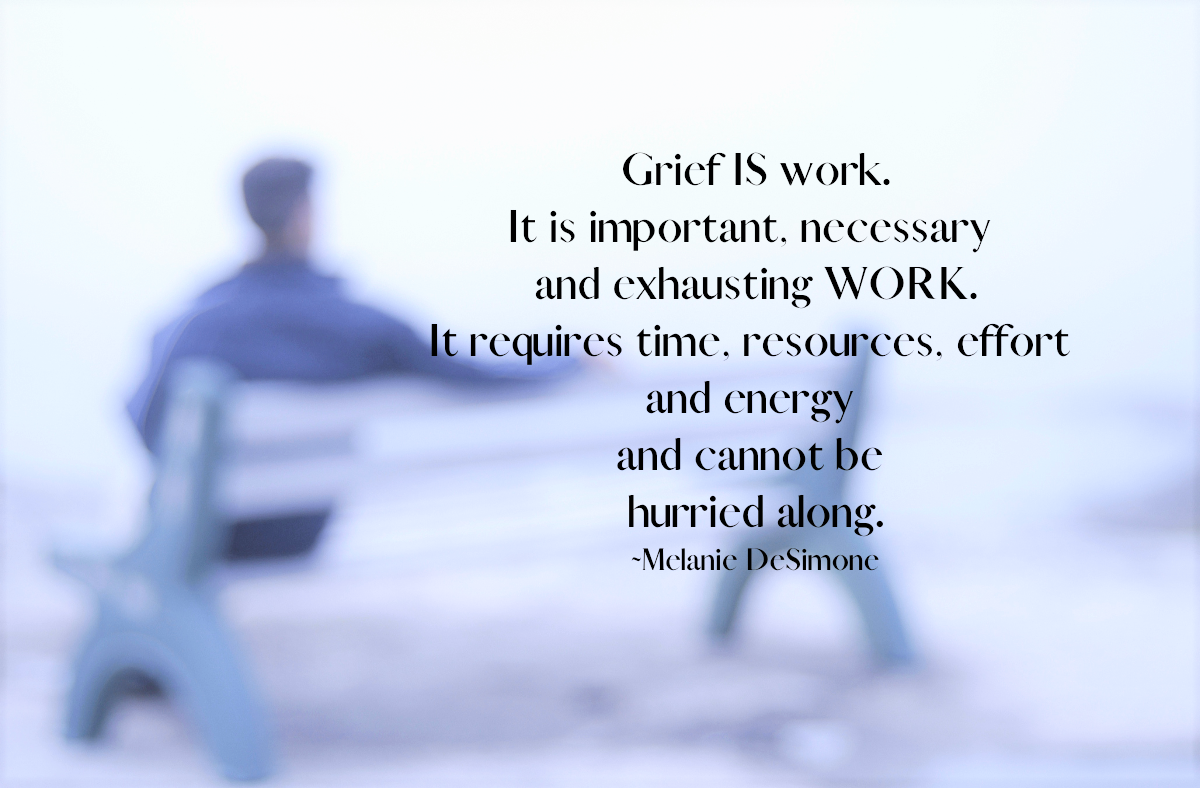
Grief IS work.
It is important, necessary and exhaustingWORK.
It requires time, resources, effort and energy and cannot be hurried along.
But it is the only way a heart can begin to put the pieces back together.
It’s not uncommon for clients to be asked by their counselor, “What does happiness look like for you?”.
Because, let’s face it, few of us seek counseling unless we are unhappy or dissatisfied with our current life.
Unlike physical healing, mental, spiritual and emotional healing are rather subjective and it’s important to know what we’re aiming for when seeking help in moving our hearts toward wholeness (or at least, “less brokenness”).
So it’s not surprising that another bereaved parent was asked this question during a session recently. She brought it to the greater community because she felt that she didn’t have a good answer or, really, any answer at all.
I get it.
Child loss is devasting.
In the early days after Dominic ran ahead to Heaven, the idea of “happiness” was as foreign to me as living on Mars. Possible, maybe, but highly improbable and not something I wanted to pursue.
Before death walked through my door, I didn’t find it necessary to parse the difference between happiness, contentment and joy.
Now, I find it absolutely critical.
Happiness is a feeling that everything is going my way-sunshine and roses, no uncomfortable circumstances, no insurmountable challenges. If I’m honest, even before child loss, I wasn’t always happy. It’s easy to idolize my “before” life into somethin it was not.
Contentment, on the other hand, is a settled trust in God’s goodness, mercy and love regardless of my current circumstances. I, like Paul, can LEARN to be content when I focus on the eternal story the Lord is writing that will proclaim His glory for ever and ever. I have to remind my heart every day of truth-even when it doesn’t want to hear it.
Joy is a burst of sweetness and delight-like biting into a perfect strawberry or being greeted with a slobbery kiss from a toddler who has stood by the window, waiting for your arrival. I can choose to make much of these moments or overlook them.
Eleven years on this road, while I find happiness elusive and contentment a work-in-progress, I find looking for joy rewarding.
I live on acreage that is mostly native grasses and weeds. Sometimes when I look out at the rough, uncut vista all I see is a raggedy mess. It is so unlike the tidy, mowed, landscaped lawns I grew up with as a child.
But when I WALK through the fields and look closely, there are dozens of different wildflowers tucked amid the weeds.
That’s how I’ve come to think of life after my son ran ahead to Heaven.
Life itself isn’t what I want or how I thought it would be- not predictable or beautiful (by my earlier standards of beauty). But there are STILL beautiful moments, relationships and events that I can treasure.
I’ve learned to focus on those and hold them close.
Most days are pretty good now but this habit continues to feed my soul.
When a particularly hard day comes, it helps me from falling so far down the rabbit hole of despair that I can’t climb back out.
May the Lord help all of us find the beauty and blessing that remains even as we miss our children and look forward to seeing them again in Heaven.
My life is filled with lots of different kinds of people.
Because of this ministry, I message or talk to bereaved parents every day but I also message and talk to friends and family who have no clue what living with child loss looks like.
I learn something from all of them.
I try to be open to support and encouragement even when it comes from unlikely sources.
I remember the first early, very tender, very emotional days, weeks and months when I felt like a walking nerve. Any stray word or look was likely to bring tears to my eyes and drive me into seclusion for hours.
I couldn’t imagine that anything anyone who hadn’t walked this path could say would be helpful.
How could it be when they just. didn’t. know?????
And yet…over time, my heart softened by pain and sorrow and I realized that while others may not know my particular brand of suffering, they are often carrying a burden as well.
Even if the size and shape of their load is different than mine, they are learning from the journey and some of their wisdom might help me just as some of mine might help them.
Self-care, good boundaries, safe friends who allow us to share openly when we are struggling, grace, helpful, healthy habits-all those things are useful regardless of what we are going through.
If I close myself off and refuse to share life with anyone who isn’t situated precisely as I am in this life I didn’t choose I will miss oh, so very much!
I love, love, love the deep friendships I’ve formed with other bereaved parents (although I hate, hate, hate the way we found one another).
Online groups, the community around this blog, at retreats and through book and Bible studies, these parents form the foundation of strength and encouragement that has helped my heart hold on to hope.
But I also have beautiful nonbereaved friends who listen to my stories, share my tears and fears and who have walked and continue to walk beside me on this rocky road.
So don’t overlook or undervalue support regardless of where it comes from.
Look around.
Listen closely.
You might just be blessed more than you think.
If your heart is struggling and longing for companionship, here are some online communities that might be just what you’re looking for:
Heartache and Hope: Life After Losing a Child (closed group)
My heart hurts every time a name is added to this awful “club” no one wants to join.
One more family knows our pain.
One more family has an empty chair at holiday gatherings.
But I am thankful for the moms and dads that share their hearts in bereaved parents’ groups. I’m thankful for the safe space to speak honestly about what this life feels like and the challenges that greet us in this Valley.
A fellow waiting mom, Brenda Ehly, shared this on her personal Facebook page. I asked her if I could post it here and she graciously gave me permission:
“So, every now and then, I am asked, ‘How are you?’
Just in case any of them meant, ‘What is it like to be grieving a child during the holiday season?’ let me try to explain:
First, imagine you have stepped into a bear trap.
It hurts.
A lot.
Sadly, it’s a magical bear trap, that you will never be able to remove. (That’s your initial loss). Weirdly, after awhile, you sort of (not exactly) get used to it.
Now, imagine that at completely random intervals, a large bear suddenly appears, and, mistakenly thinking that you’re the one who’s been setting bear traps in the forest, repeatedly punches you in the nose.
Hard.
This bear throws one heck of a punch. (This is what happens when you go shopping at the grocery store and Andy Williams croons, “It’s the Most Wonderful Time of the Year!” at you).
So, is it all miserable, all the time?
Absolutely not; every now and then, an adorable, enchanted raccoon brings you a tall mocha and a blueberry scone, and that is very nice, because even if you’re stuck in a magical (and excruciatingly painful) bear trap, a tall mocha and a fresh scone are still welcome and refreshing.
I first shared this years ago when I was reflecting on half a decade of living without one of my children beside me. I’ve now had more than another half decade to think about why or IF I’ll continue to write.
Every so often I take a day or two to consider whether I want to keep posting. I have to admit sometimes that I wonder if I bang the same drum for too long it will sound loud and obnoxious to some people’s ears.
But then I get a message or a comment from someone fresh on this journey and they feel seen, heard, validated and safe.
So I write on.
And I find that writing brings clarity and comfort to my soul. I still have things to say and I hope what I say still brings some small measure of light, love, life and hope to other hearts.
❤ Melanie
I was one of those people years ago who set her sights on starting and maintaining a blog.
I thought I would post a few times a week and share anecdotes about my family and critters, insight into daily living and inspiration from Scripture and interesting quotes.
No, not THIS blog-the other two I started and quickly abandoned to who-knows-where in cyberspace.
Trouble was that the subject matter, while near and dear to my heart, wasn’t personally compelling enough to keep me disciplined and actively writing.
If someone had said, “Pick any topic to write about”, child loss wouldn’t have been in the first million choices.
No one CHOOSES child loss (Thus the name of the blog: The Life I Didn’t Choose).
But untold numbers of parents EXPERIENCE it every year. This very day, parents somewhere got a knock on the door or a phone call or sat next to a hospital bed as life slipped slowly from their child’s tired body.
Since I was already journaling and had walked this Valley for nearly a year and a half, it dawned on me that the ramblings I’d put down might be helpful to another heart. So I started THIS blog in September, 2015.
And I’ve been here ever since.
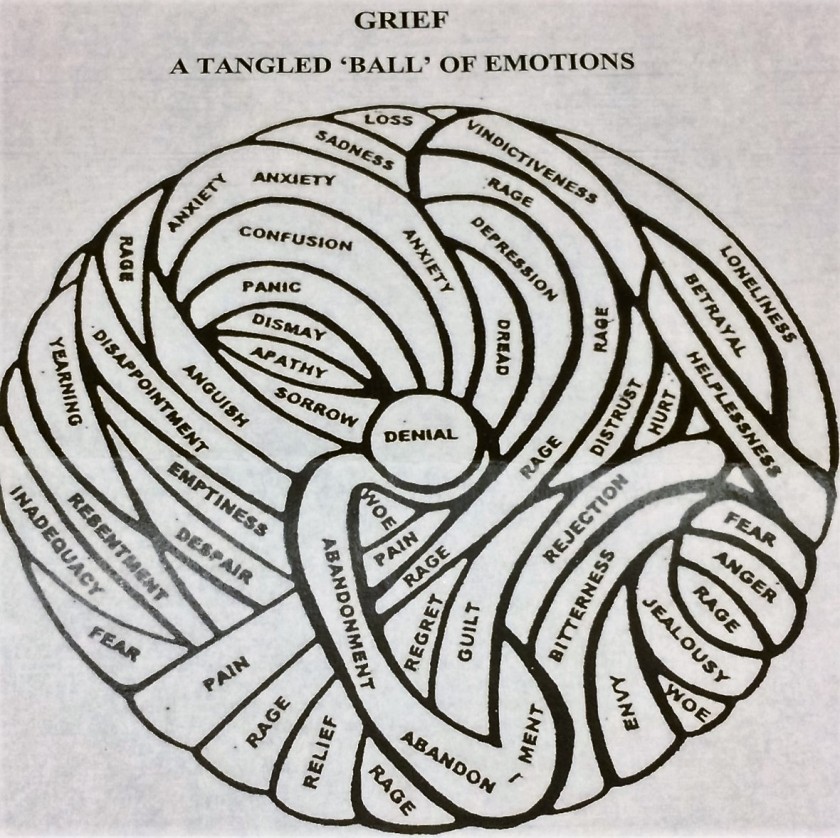
I’m not in the raw, breathless place I once was. But grief and loss are part of every breath I take, part of every moment I experience.
I miss Dominic. I still consider death an enemy. Every day I hate what was stolen and long for what was. I mourn the changes grief has wrought in my family. I wish things were different. I discover new ways loss impacts my life and new ways of coping with it.
So I keep writing.
I don’t want anyone to feel alone in this journey. I don’t want anyone to think there’s no way to survive. I don’t want a single broken heart to doubt that God is here and that He will help you hold onto hope.
I’ll spill my heart out in words until the words are exhausted.
There’s a kind of relational magic that happens when people who have experienced the same or similar struggle get together.
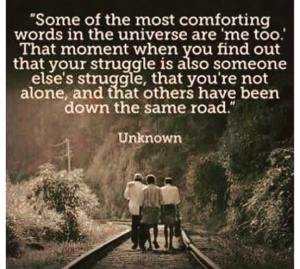
In an instant, their hearts are bound in mutual understanding as they look one to another and say, “Me too. I thought I was the only one.”
It was well into the second year after Dominic ran ahead to heaven that I found an online bereaved parent support group. After bearing this burden alone for so many months, it took awhile before I could open my heart to strangers and share more than the outline of my story.
But, oh, when I did! What relief! What beautiful support and affirmation that every. single. thing. that was happening to me and that I was feeling was normal!
I have learned so much from these precious people.
Here’s a few of the nuggets of wisdom I carry like treasure in my heart:
Everyone has a story. No one comes to tragedy a blank slate. They have a life that informs how or if they are able to cope with this new and terrible burden. Not everyone has the same resources I do-emotional, spiritual or otherwise. Don’t put expectations on someone based on my own background. Be gracious-always.
Everyone deserves to be heard. Some folks really only have one or two things that they insist on saying over and over and over again. That’s OK. If they are saying them, it’s because they need to be heard. Lots of folks do not have a safe space to speak their heart. But it’s only in speaking aloud the things inside that we can begin to deal with them.
Everyone (or almost everyone) is worried that they aren’t doing this “right”. Society brings so much pressure to bear on the grieving. “Get better”, “Get over it”, “Move on”. And when we can’t, we think there is something dreadfully wrong with us. But there isn’t. Grief is hard and takes time no matter what the source. But it is harder and takes a lifetime when it’s your child. Out of order death is devastating. “Normal” is anything that keeps a body going and a mind engaged in reality without being destructive to oneself or others.
Everyone can be nicer than they think they can. Here’s the deal: I THINK a lot of things. I don’t have to SAY (or write!) them. I’ll be honest, sometimes my first response to what someone shares is not very nice. But when I take a breath and consider what might help a heart instead of hurt one, I can usually find a way to speak truth but also courage. Snark is never helpful. If I can’t say anything nice, then I just scroll on by.
Everyone has something to give. I’ve learned that even the most broken, the most unlovely, the least well-spoken persons have something to offer. It may take a little dusting off to find the beauty underneath, but my heart is stretched when I take time and put forth effort to truly listen to what’s being said instead of just ignoring it because of how it’s said.
Everyone deserves grace. Because I am the recipient of grace, it is mine to give-without fear of running out-to every other heart I meet. Sometimes I forget this. I want to apply a different measure to others than I want applied to me. But grace is the oil that greases human relationships. Freely given and freely received, it provides a safe space for hearts to experience healing.
Everyone is standing on level ground when we gather at the foot of the cross. There’s no hierarchy in God’s kingdom. We are all servants. I am responsible to my Master for walking in love and doing the good works He has prepared beforehand for me to do. My works are not your works and your works are not my works. I need to keep my eyes on Jesus, not on others always trying to see if I(or they!) “measure up”. The standard is our Shepherd and only grace and mercy can help me strive for that goal.
Everyone needs courage. When Jesus gave His charge to the disciples He told them it was “better for you that I go”. What??? How could that be better? But it WAS. Because when Jesus returned to the Father, He sent the Holy Spirit as the personal, indwelt connection to Himself. He knew they would need courage to make it through. The Spirit calls courage to our hearts. And we are given the privilege of calling courage to one another. The bravest among us quivers sometimes. You’d be surprised how often one word is the difference between letting go and holding on.
There are dozens more things I could share.
I have met some of the kindest, wisest and most grace-filled people this side of child loss.
They have been the purest example of the Body of Christ I’ve ever known.
I was reminded yet again when I spent time with other bereaved parents over the past couple of weeks at two different events how very, very, VERY helpful it has been to do just that.
In the earliest days after Dominic ran ahead, a couple of local moms whose children were also in Heaven came to see me. How I hung on every word! How I longed for a glimmer of hope that I, too, could somehow survive this devastation!
It was much later that I discovered online support groups. And it opened a whole new world of experience, understanding and freedom to ask the questions that had been burning in my heart: “Is what I’m feeling normal?” “Did you still cry every day after months?” “Why can’t I remember anything anymore?”
Almost ten years ago I started writing here and found another level of compassion and companionship when y’all joined me and practically shouted, “Keep sharing!”.
At every turn I have been amazed that so many whose hearts are broken choose to reach out when I know from bitter experience it would be oh, so easy to withdraw.
Thank you, thank you, thank you, my precious wounded healers.
❤ Melanie
There have been many well-meaning but woefully uninformed people who offered advice. Some of it was helpful but most of it was predicated on misinformation and lack of real-life experience.
TheMOSThelpful advice has come from fellow bereaved parents.
They share their hearts and their hopes, their failures and their victories, their fears and their faith. They don’t have to-they could simply focus on their own pain and refuse to offer aid.





















 thelifeididntchoose