Father’s Day 2026: Insights From a Bereaved Dad

I belong to a number of closed online bereaved parent groups.  

I’m not sure if it is a function of gender or not, but the moms seem to be a bit more willing to share their feelings and to respond to the feelings of others.  

Every now and then, a dad speaks up. When he does, I usually pay close attention to this male perspective.

Wes Lake is a bereaved dad in our group who often has thoughtful posts that touch my heart.  This one in particular was a beautiful, true and helpful reflection so I asked him for permission to share.

He graciously agreed.  

” [I was] just thinking about 5 years down this road and some of the things I’ve learned:

Grief doesn’t usually kill you.

For a long time I wished the Lord would take me but apparently he had other plans because I’m still here. So if I’m still alive what choice do I have but to pick up the pieces of a shattered life and learn to live again. Yes, I’m severely disabled but I need to make the best of what I have.

It is not the hand your dealt, it is about how you play the cards.

world-doesnt-stop-for-your-grief

I have learned not to trust my emotions.

I will have the blackest of black days and a day later the world will look like there is hope. Nothing in child loss good or bad is forever other than the loss of our child.

On the bad days I hold out hoping for a better day.

good day bad day god is in all days lucado

Time does heal but not in a way that most people think.  

Time shows you all the sides of grief. Time teaches you your limitations.  Time helps you to stuff the grief so you can function again.  Time shows you how to interact with a non-grieving world.

You don’t grieve any less, but your life gets easier.

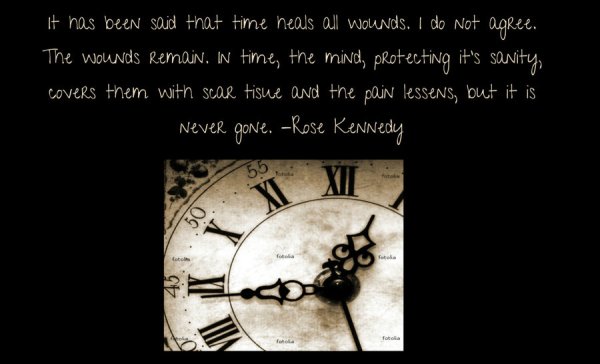
it has been said that time heals all wounds rose kennedy clock

One other one not part is of the OP [overall process]-I had to come to grips with being happy.

For a long time I felt that experiencing the slightest sliver of joy was somehow being unfaithful to my daughter. I’m here to tell you that is a huge lie of grief. Just because you are experiencing good things does not mean you miss your child any less.

Being a martyr gets you no place good.”

~ Wes Lake, bereaved dad

grieving person is going to laugh again

Grief Work 2026: What Exactly IS Grief Work?

A few years ago I was encouraged to assemble some of my posts into a series I titled “Grief Work”.

They definitely do NOT cover everything I would want to share with a bereaved parent but they are a place to start if you are early on this journey and you can explore any topic further by using the search bar any time you’d like.

I’m sharing again for those who may need them now or may want to pass these on to someone else who needs them.

❤ Melanie

I have used the term for years and only recently has someone asked me to define it.

I guess I never realized that in all the writing about it, I’d never really explained what it meant.

So here goes.

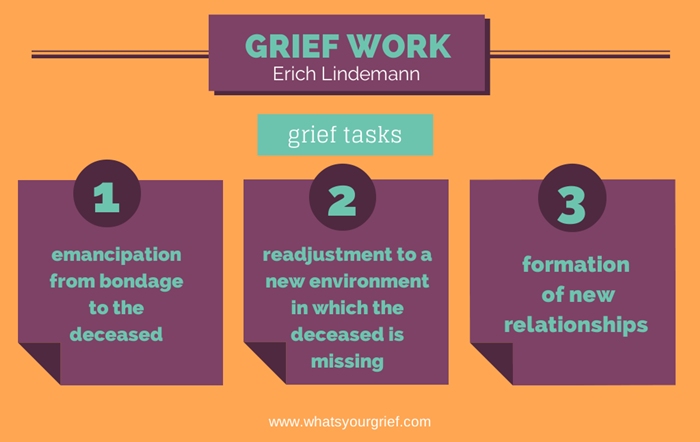
The term was coined by psychiatrist Erich Lindemann in the 1940s. He worked with survivors of the Cocoanut Grove tragedy and observed that grievers experienced common symptoms, feelings and faced similar challenges. Through his work, he developed a theory of grief incorporating his observations and his technique for walking grievers through these common issues.

Image result for six stages of grief erich lindeman

Today the term has been expanded and is used widely to describe almost any approach to grief that includes specific techniques for helping someone walk the path of loss.

I use “grief work” to mean all the ways I (and others) must actively seek to identify, face, process, and ultimately incorporate the feelings, trauma and changes loss force upon us.

Grief work (in no particular order) can include but is not limited to:

  • Attending sessions with a professional, spiritual or lay counselor. Some people find it helpful to have a safe person outside the immediate grief circle to discuss feelings, concerns and relationship challenges that are generated by loss or exacerbated by loss. It’s best to find a counselor who specializes in grief, preferably child loss and/or traumatic loss (all child loss can be classed as traumatic loss). Other counselors may be too quick to label a bereaved parent’s grief as “abnormal” or “too lengthy” or “complicated” when it is, in fact, closely following observed timelines for dealing with child loss. If the first counselor you find isn’t a fit, try another. It’s OK to insist that you are heard, your feelings respected and your loss recognized for the life-shattering event that it is.
  • Finding, joining and participating in online or in person support groups. There are literally dozens of online support groups for bereaved parents. Some are designed to meet the needs surrounding specific types of loss such as sudden death, suicide, drug overdoses or loss to cancer or another disease or condition. Some are organized around certain faiths. Others may be rooted in geographic proximity and the online group might have a monthly or quarterly face-to-face meeting in the area. While it can sometimes be overwhelming to see the number of parents in such a group, it’s also extremely helpful to have a safe space to share things only another bereaved parent can understand.
  • Setting aside quiet time to think, process and possibly journal feelings. So much grief work must be done alone. Counselors can equip me with tools, support groups can give me real-life examples and encouragement but only I can do the nitty-gritty labor of teasing apart all the feelings and change grief brings with it. Journaling has been very helpful for me in putting words to what can sometimes be rather nebulous thoughts swirling around in my head. When I name what I’m feeling or experiencing, I can better construct a strategy for processing and living with it.
  • Walking back through memories, noting regrets, forgiving yourself and making peace with the past. We ALL have things we would have done differently. Death, being final, forces a heart to face that there is no chance to atone for past behavior. Words unsaid, things undone, opportunities missed are carved in the stone of yesterday. I spent many nights recounting my shortcomings as a mother, berating myself for what I didn’t do. Eventually I was able to rest on the simple fact that one thing I DID do was make sure Dominic knew he was loved.
  • Setting boundaries to give yourself and your family space and time to do grief work as well as to conserve emotional, relational and physical energy that’s in limited supply after child loss. So many of us live with few or no boundaries-responding to every request with a “yes”, adding things to the calendar without a thought to how exhausted we might be at the end of a day or week. Some of us are overtaxed at work or school. Some of us are hyper-involved in our churches, civic organizations or local politics. There are dozens of ways to be extended and just as many ways to live with that constant drain. Child loss forced me to recognize that I could no longer BE that person. I couldn’t afford the time, energy, mental space and emotional burden of saying “yes” anymore. I learned that “NO” is a complete sentence and began using it.
  • Practical considerations regarding your child’s belongings and other personal property. Many people might not consider this part of grief but it is. So many details to take care of, so many times I had to repeat the words, “My son was killed in an accident. I need to close this account.” So many copies of his death certificate mailed out to different agencies or companies, documenting the awful reality that he was never coming home again. Then there are questions of what to keep, what to store, what to give away. Should a room remain untouched if your child still lived at home? We had to clean out Dominic’s apartment only a few days after his funeral. It felt like I was boxing up everything beautiful about my boy.
  • Learning how to do holidays, birthdays, family gatherings, vacations and other gatherings. The empty chair looms larger when all the others are filled. If you have been the primary organizer of such events, it might surprise you to find the rest of the family still expecting you to be that person. Even if you aren’t the host for holidays, you will need to communicate to others if or how you feel comfortable participating.
  • Maintaining or regaining health after loss. Stress is one of the greatest contributors to so many health issues. Child loss is an unbelievably stressful experience. So it’s no wonder that many parents find themselves post loss with new or aggravated health problems. I had an appointment with my rheumatologist just one month after Dominic ran ahead to Heaven. It was critical that I tell her of my loss because in addition to whatever medical interventions she was prepared to prescribe, she needed to know I would be experiencing an extended period of intense stress that might necessitate closer observation and follow-up. As difficult as it may be to talk about, it’s important to inform your healthcare providers of your loss and to be absolutely honest about changes you’ve noticed in your body as a result.

There are probably a dozen or more subcategories of grief work I could list and some of you might think of ones I wouldn’t.

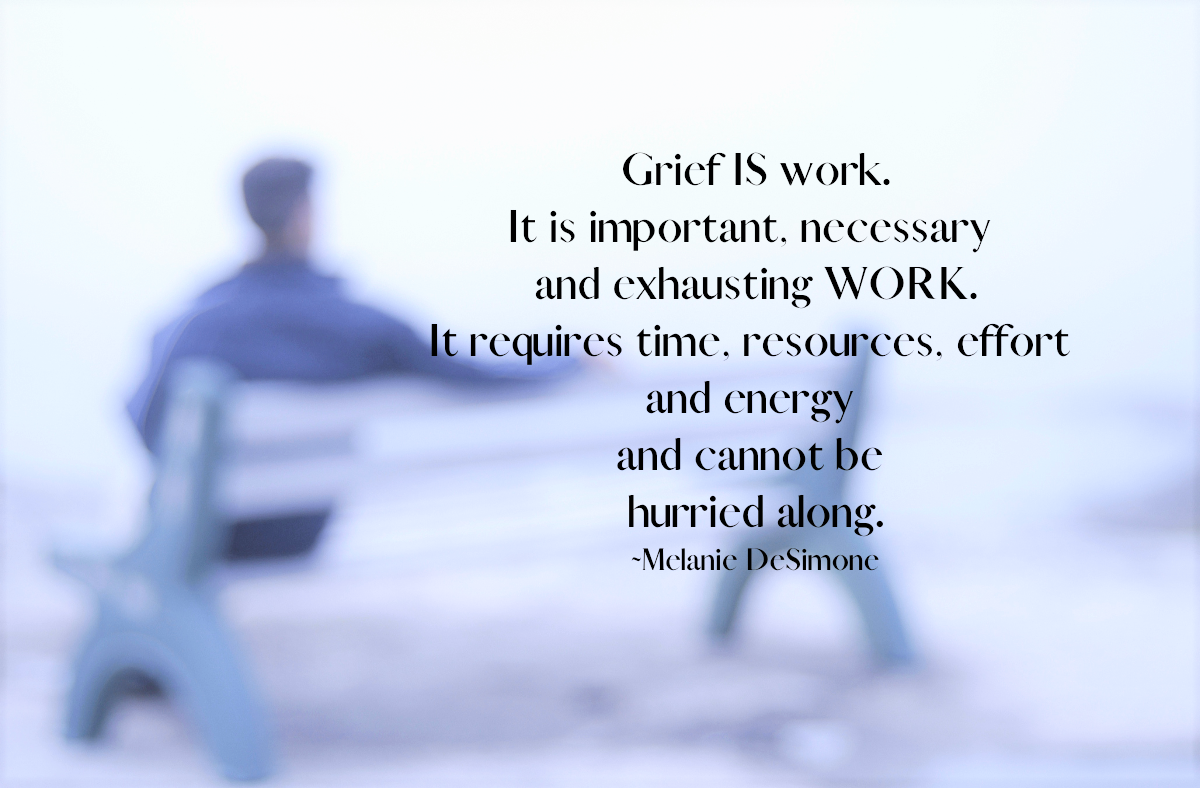
Grief IS work.

It is important, necessary and exhausting WORK.

It requires time, resources, effort and energy and cannot be hurried along.

But it is the only way a heart can begin to put the pieces back together.

❤

Is This Normal? Questioning How We Grieve.


Believe me, no one wonders more than I if the things I’m feeling, the things I’m doing and the rate at which I am healing is “normal”.

I belong to a couple of bereavement support groups and a recurring theme is, “Am I crazy?  Is this the way it is supposed to be?”

Sometimes grieving parents wonder these things because of their own misgivings.

But often, we question our feelings and experience because of external pressure.

And that is unfortunate and unfair.

When a mom brings her new baby home from the hospital, people are quick to remind her that life “will never be the same”.

She is encouraged to seek advice and help from friends and family and given space and time to figure out this new way of being.  As the years pass, she might express frustration and concern over the challenges of going back to work, sleepless nights, feeding issues, potty training, and dozens of other, everyday struggles that result from welcoming this little person into the family.  And that is just the beginning. 

No one thinks it strange that the ADDITION of a child is a life-long adjustment.

So, why, why, why is it strange that the SUBTRACTION of a child would also require accommodation for the rest of a mother’s life?

My heart grew larger when Dominic was born and the space that is his cannot and will not be filled by anyone or anything else.

I am learning each day to work around this empty spot.  I am becoming stronger and better able to carry the weight of grief that I must bear.

I can do many of the things I used to do before the only place I could visit Dominic was at the cemetary.

But I have to do them differently.  I need more help.  It takes more time. And sometimes I find after I plan to go somewhere that I am just not able to go after all.

I will never “get over” burying my son.

There will always be another mountain to climb, another loss to mourn, another hurdle to clear in this grief journey.

Dominic is part of me.  That didn’t change when he went home to be with Jesus.

The absence of his presence is EVERYWHERE.

And just for the record–missing the child I love for the rest of my life is perfectly normal.

Navigating Grief: What’s Normal?

Every time I come home from a retreat, a conference or a bereaved parent support group meeting I am reminded again that the range of “normal” in grief-especially child loss-is so very wide.

Still crying after a decade? Absolutely normal.

Trouble getting dinner on the table or remembering your child’s school schedule? Yep. That’s normal.

Struggling with crowds, back-peddling on commitments, feeling trapped by phone conversations, shopping when you are least likely to run into someone you know? Perfectly normal.

Our losses range from very recent to decades old and we all acknowledge that our behavior, our feelings, our ability to handle change, nearly every aspect of our lives is impacted by the death of our child.

So if you are wondering if your expression of grief is normal, it is.

Our lives were shattered.

Our hearts were broken.

Picking up the pieces, whatever that looks like, is absolutely, positively normal.

Empty Chair Endeavor Podcast: Insights from Melanie DeSimone, Dominic’s Mom

I recorded this conversation with Greg Buffkin from the Empty Chair Endeavor before my life was turned upside down by my dad’s stroke in September.

I had honestly forgotten exactly what we talked about so I was pleasantly surprised when I listened to it last week after it was published.

We covered a lot of ground-what helps, what hurts and what and Who has sustained us both on this journey no parent chooses. We talked about sibling loss and about parenting a child who has lost a sibling. We shared how trauma reshapes our emotions and our bodies.

If you’re looking for a word of encouragement as we plunge into the hectic holiday season, take a few minutes to listen.

I want to edit one thing I shared in the podcast: I’m not sure just when I’ll be able to schedule the 2026 retreats but I pray it is soon!

❤️ Melanie

You can find it here: https://podcasts.apple.com/us/podcast/navigating-grief-insights-from-melanie-desimone-dominics/id1654053256?i=1000738301553

Worldwide Candle Lighting Service 2025

 I love candles-always have.

I especially love them as the days get shorter and we creep toward the longest night of the year.

I love them more since Dominic ran ahead to Heaven.

Every time I light a candle, I remind my heart that even the smallest light can chase the darkness.

When hundreds, thousands and even millions of candles are lighted together, it does more than chases darkness, it undoes it.

Sunday, December 14, 2025 is the Worldwide Candle Lighting Memorial Service (WCL) sponsored by The Compassionate Friends (TCF)

Millions of parents and others will light a candle at 7:00 PM local time for one hour to honor sons, daughters, brothers, sisters and grandchildren gone too soon.

As the earth turns, a wave of light will sweep across the globe one time zone after another.

It’s natural for parents, grandparents, sisters and brothers to mark the light and life of one they miss.

It’s less natural for friends and extended family members to do so.

One of the greatest fears of every bereaved parent is that his or her child will cease to be remembered or that the light and life of a son or daughter will simply fade as time goes on.

Year-end holidays accentuate the place where our children should be but aren’t. Merry making and picture taking emphasize the gap between grieving hearts and those untouched by death of a close loved one.

That’s why TCF has chosen THIS week for the annual WCL.

If you want a simple way to bless someone you know who lost a child, grandchild or sibling, a single candle and a quick picture or post on social media will do it.

My heart is always encouraged and strengthened when others take time to remember Dominic.

Buy a candle.

Set an alarm on your phone.

Light up the night with us.

Together we will remember. Together we will chase the darkness. Together we will declare that our children are out of reach but not forgotten.

Never, ever forgotten. ❤

Stories of Loss and Hope: A Journey Through Grief

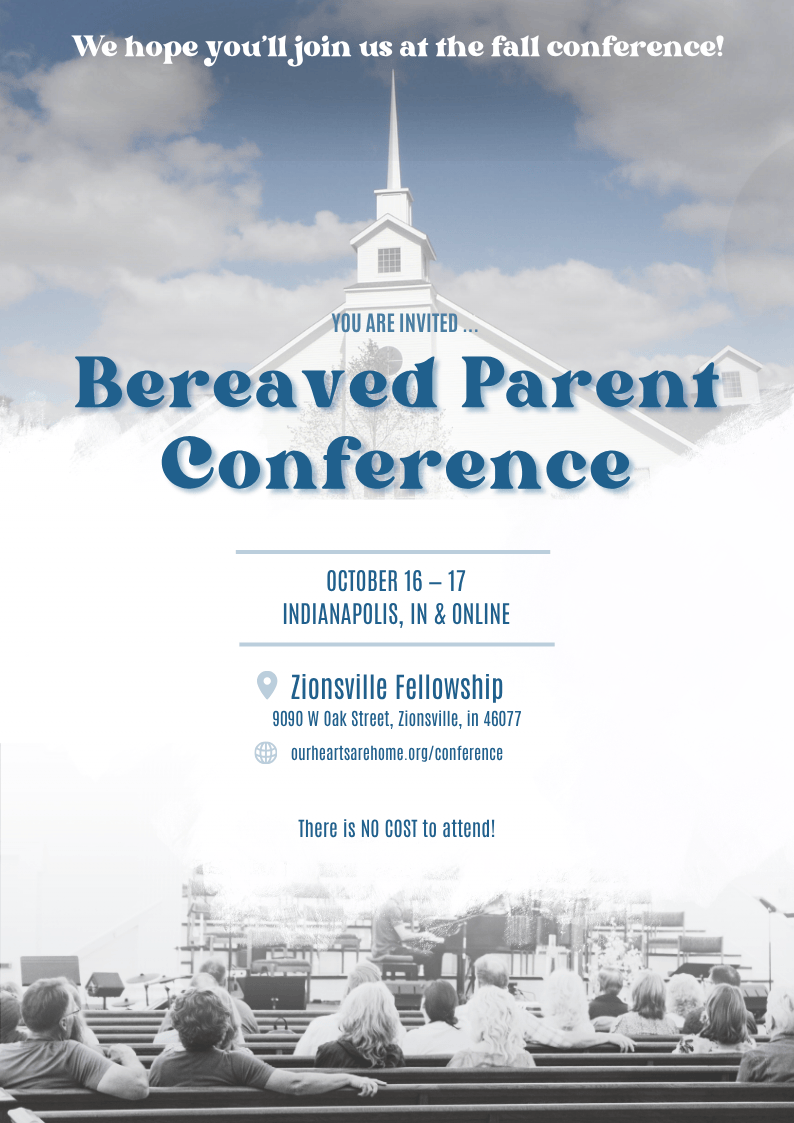
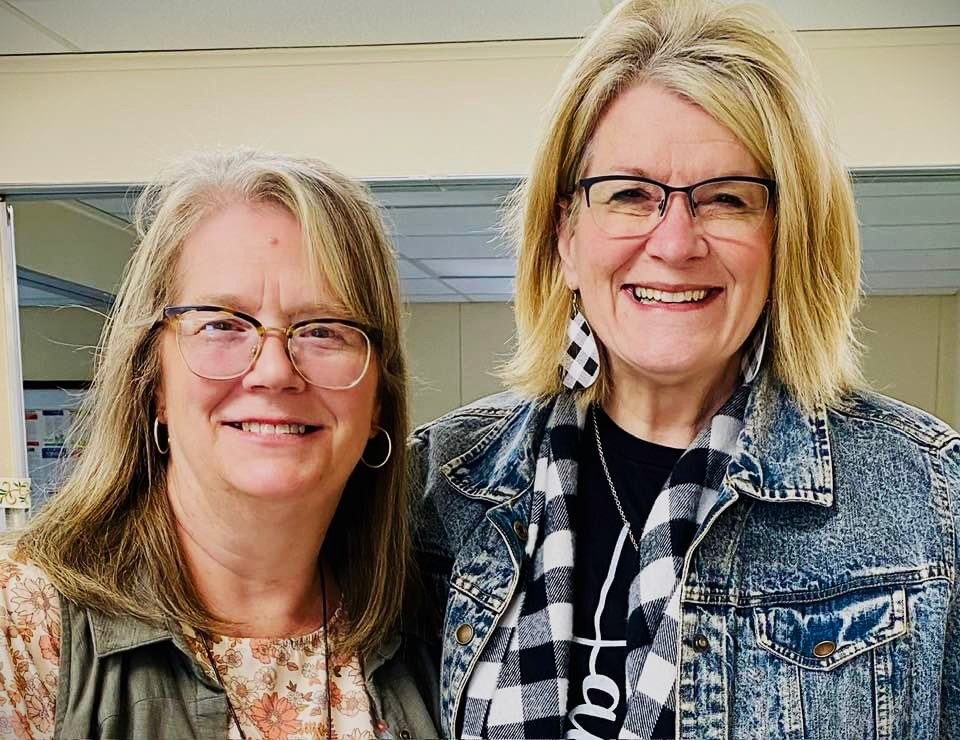
I was asked awhile back to be part of a project shepherded by fellow parents-in-loss, Laura and Gary House (https://ourheartsarehome.org/).

They wanted to gather and publish stories from other child loss survivors in hopes of encouraging hearts and strengthening the faith of parents facing the unimaginable.

I don’t mind saying that in spite of all I’ve written in this space for the past ten (!) years, it was challenging to distill my thoughts about that night, the days that followed and my own faith journey since into a single chapter.

But I, and a dozen other parents, did just that.

In our own words we tell our stories. We share our struggles and our triumphs.

Read the rest here: Until Then-Stories of Loss and Hope

Lessons from Geese: Finding Courage

Every autumn I hear the geese overhead and I think about how all that honking serves only a single purpose:  to remind the stragglers they are headed in the right direction.  

It speaks courage to my own heart as I remember that not only does the leader call out to those behind, but that each bird takes a turn at the head of the line so that the others can rest a bit.  

What  beautiful picture of how life SHOULD be.  

Read the rest here:  Of Flying Geese and Calling Courage!

Everyone’s Grief Journey is Unique

It’s a nearly universal human tendency to try to fit another’s experience into our own.

Even though I try hard not to, I still often find myself saying things like, “I know just how you feel” or, “This worked for me, it ought to work for you”.

Trouble is, grief is as individual as a fingerprint.

Read the rest here: Grief Is As Individual As A Fingerprint

A Beautiful Moment: The Light Finally Gets Through

A few years ago, I had a grace-filled, heartwarming visit with another bereaved mama who came all the way from Maine just to hang out with me. And that was so, so good.

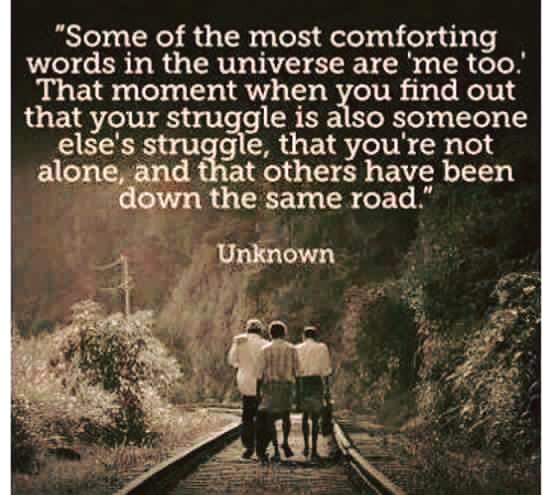
As she and I shared over coffee and tea, shopping and meals, lounging and walking we found so many ways in which our journeys have been similar even though the details are really very different.

One is this: There was a distinct moment along the way when each of us began to see light and color again in the midst of our darkness and pain and it was a turning point.

Read the rest here: There’s A Moment When The Light Makes It Through Again

Share this: