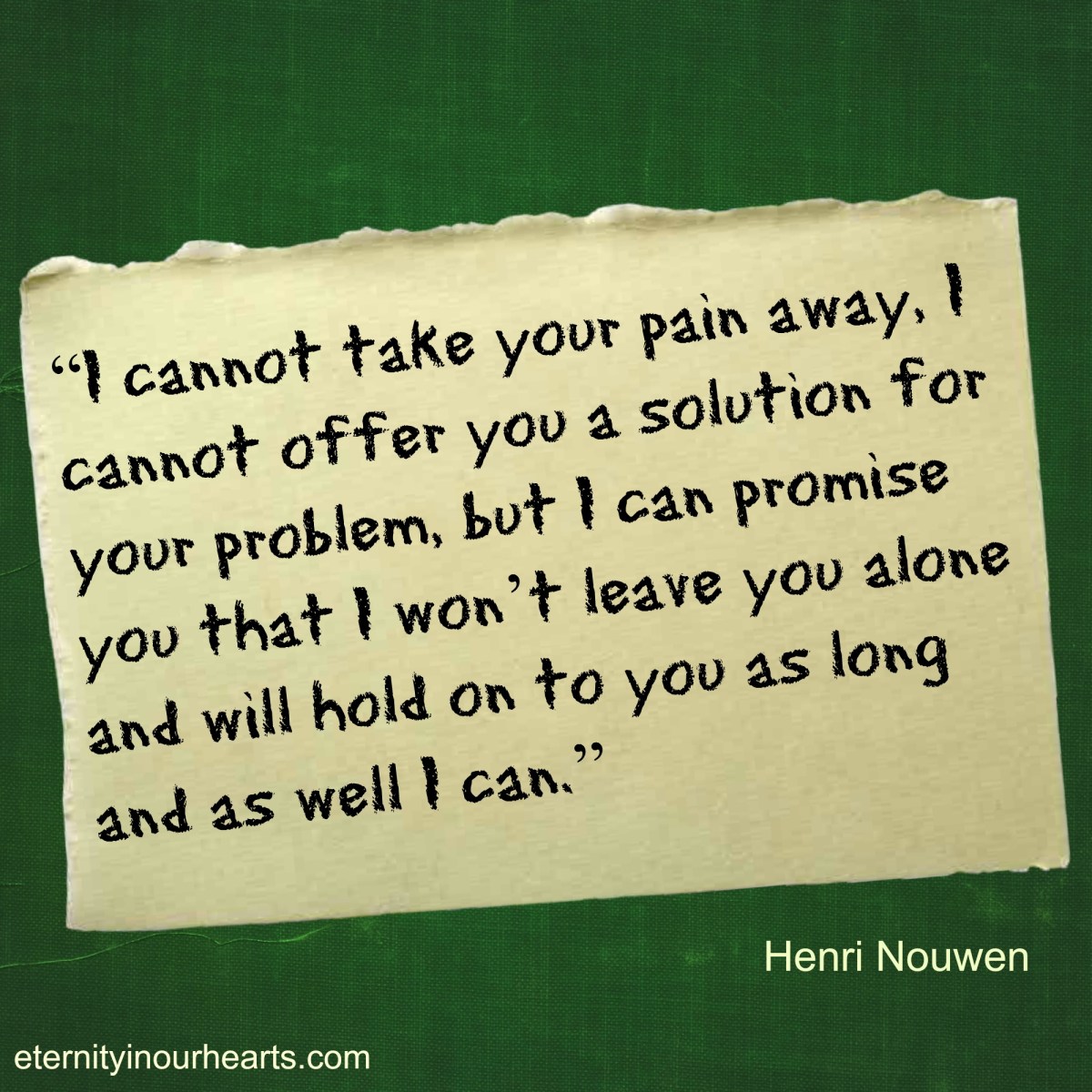
What Does it Mean to “Support” Someone?

Thank God for ADA requirements!

It wasn’t that many years ago when automatic doors were hard to find in places where they most certainly would have been helpful.

I remember approaching doors, arms full of bags and each hand grasping a child, hoping, hoping, hoping some nice person would be there to open it for me.

Many times there was.

Sometimes all I got was a glare and a sidestep from an empty-armed, able-bodied person.

I would manage to push the door open with my elbow but inside I was seething.

“Really?  Really!!  What makes you think getting out of the way is the same as opening the door?” 

(Thank goodness my thoughts are not displayed on an overhead sign! 🙂 )

In this Valley, I’ve discovered there is an emotional counterpart to the woman or fellow who refuses to actively help an overwhelmed mama.

There are those who see the burden I’m carrying and simply step aside.

I guess their rationale is that by not adding to the weight of my load, they somehow make it lighter. 

But it doesn’t work that way.  

As a matter of fact, knowing that my pain is seen but ignored is so much harder than thinking I’m just invisible.

Support means:

1. bear all or part of the weight of; hold up. 

2.  give assistance to; enable to function or act.

Support is going to cost you something.  It’s going to require action, time, energy, effort, commitment and resources. 

when the world whispers give up

I know it’s hard. 

Life is hard.  

But active, compassionate companionship is what knits hearts together no matter what struggle they are facing.  

And hearts that are bound by shared struggle and love are the strongest of all.  

friends uplift the soul little girl


Barefoot Over Broken Ground

I first shared this in 2014 not quite a month after Dominic ran ahead to heaven.

His leaving has made me much more aware that what we read as “stories” where we can turn to the last page and know the ending, others lived in real time, with no ability to fast forward to the ending.

It’s easy to be impatient with a heart barely holding onto hope and try to goad someone into “looking on the bright side” or hammer them with Scripture because “we know how this ends”.

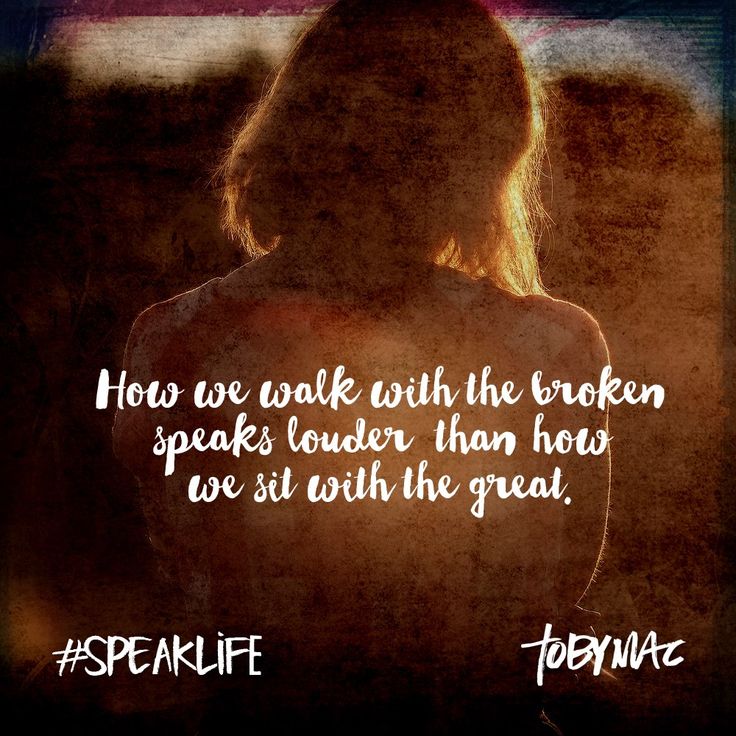
But when you are walking barefoot over a path of sharp stones, you really can’t focus too much on the fact that it might not be as long as you think.

All you know is it hurts like hell right now.

When I read the Gospels it is tempting to mock those who refused to see that Jesus was bringing in a kingdom that would be so much better than the earthly one they expected from Messiah.

But they were living a day-to-day reality of hopelessness under Roman rule that made them ache for relief.

When life this side of heaven is more than you can bear, there is great tension in your soul to beg God for relief in this earthly life and to be a bit impatient with the idea of “all things working for good” in some distant future.

It doesn’t mean you don’t believe it, but it does mean that you carry a weight of sorrow.

So be patient with broken hearts and with those walking a broken path.

You might think declaring “Victory in Jesus” is helpful.

But it’s not. 

Instead, hold a hand, call courage, choose to walk alongside.  

In the end it’s endurance that’s the real victory and that is only possible when a heart can hold on.

endurance is patience concentrated


If You Can’t Say Anything Nice….

There may be some mamas that don’t drill this into their children but if there are, they don’t live south of the Mason-Dixon line.

Every time there was back and forth in the back seat or on the front porch and Mama overheard, we were told, “If you can’t say anything nice, then don’t say anything at all.”

Parents weren’t interested in policing every errant word out of the under 18 crowd’s mouth back in the day.

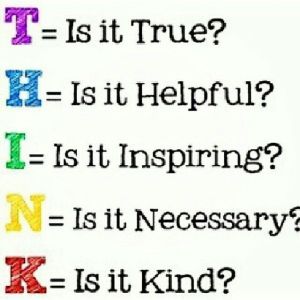
It was a simple (and effective!) rule:  If what you want to say does not meet the criteria of T.H.I.N. K. (true, helpful, inspiring, necessary, kind) then

just.

don’t.

say.

it.

THINK ACRONYM

I wish grown-ups would follow the same advice. 

Especially when it comes to offering up “helpful hints” to broken hearts.

In that instance it is rarely a case of another person aiming to be ugly or to hurt someone, but words are not neutral and they do hurt when tossed out carelessly by people who really just don’t understand another person’s pain.

So, for those who are tempted to fill empty spaces with empty words, may I help you apply the T.H.I.N.K acronym to the kinds of situations more likely to face us as adults?

T-Is it true?  You may think that giving out a Bible verse would automatically mean you were safe on this count.  Yes.  God’s Word is truth.  But how we use it and whether or not we understand the context can make a particular application of God’s Word UNTRUE.  And even if we get the context right, hammering a heart with a Bible verse may not be helpful.  You are not the Holy Spirit.  Let Him breathe truth gently into a wounded heart.

H-Is it helpful? This is tricky because sometimes what is helpful for one person is unhelpful for another.  I try to use this as my litmus test:  When have I ever been distraught and helped by someone pointing out the obvious? Or laying out a plan of action (when they don’t have access to the full picture)? Or reminding me that “all things work together for good” when right now all things really stink?  If there is any doubt about whether or not what I say will be helpful, I swallow my words.

I-Is it inspirational?  The word, “inspire” has roots in the the idea of breathing into someone or something.  Will my comment put wind in a person’s sails?  Will it breathe courage into his or her heart?  Will it lift them up and help them hold onto hope?  Is it the equivalent of mouth-to-mouth resuscitation or am I instead sucking what little breath they have left out of their body?

N-Is it necessary?  This single criteria helps me hold my tongue so many times.  I might think of lots of things but is is necessary for me to speak them?  Am I warning someone of impending danger or am I just trying to make myself sound wise or insisting on making a point?  To be honest, very few things I have to say are necessary. Most of the time a hand on the shoulder, a hug, a smile, a friendly nod are the only thing someone really needs.

K-Is it kind?  The word kind comes from the same root as “kin”-which means family.  Is what I’m going to say something I’d want someone to say to me or my close family?  Am I treating (with my words) this person they way I want to be treated?  The Golden Rule, rules.

I can’t claim to always follow my own good advice.

But when I do, I find that I am building people up, not tearing them down.

There’s enough tearing down in the world.

I want to speak light and life.

a candle loses nothing by lighting another candle

Repost: Help! I Need Somebody!

So, almost twenty years on a farm and I can NOT back a trailer.  Nope.  Can’t do it.

One day I spent hours trying to teach myself how to do it.  Never was able to do anything other than manage to jackknife the trailer, go unhook it and start over.

So when I go somewhere with a trailer I do one of two things:  (1) I find a space where I can drive in and be able to just make a loop or (2) I find the nearest person who CAN back a trailer, hand them my keys and ask them to do it.

I feel NO shame.

But that’s not the case with other things I can’t do.

Read the rest here:  Help! I Need Somebody!

Repost: The Authority of Compassion

I don’t like pain.

I don’t enjoy suffering.  

But deep pain and suffering have left a lasting impression on my soul.  Experiencing the loss of a child has enlarged my heart and sharpened my senses to the pain and suffering around me.

Choosing transparency in pain is hard and vulnerability is frightening.

But when I let others in, they see that I am just like them. I struggle, I cry out for mercy, I need God’s grace, mercy and strength to carry on.

And that lends authority to my invitation to meet Jesus.

The Authority of Compassion

We Are ALL Bruised Reeds from Henri Nouwen

I find great comfort in Henri Nouwen’s words. 

He was a Catholic priest who struggled with depression at times and ended his years living and serving at L’Arche-a community of able and disabled persons living together.

He wrote extensively and honestly and openly about his own struggles.  He was full of compassion for fellow travelers. 

He was honest about loose ends. 

I like that.

I’m sure I would have liked him too. 

Not Breaking the Bruised Reeds

Some of us tend to do away with things that are slightly damaged. Instead of repairing them we say: “Well, I don’t have time to fix it, I might as well throw it in the garbage can and buy a new one.” Often we also treat people this way. We say: “Well, he has a problem with drinking; well, she is quite depressed; well, they have mismanaged their business…we’d better not take the risk of working with them.” When we dismiss people out of hand because of their apparent woundedness, we stunt their lives by ignoring their gifts, which are often buried in their wounds.

We all are bruised reeds, whether our bruises are visible or not. The compassionate life is the life in which we believe that strength is hidden in weakness and that true community is a fellowship of the weak.

– Henri J. M. Nouwen

If you would like to receive daily devotionals from his writings you can click here and sign up:  henrinouwen.org

bruised reed

To The Ones Who Walk With Me: Thank You <3

I have never lived alone.

When I married at twenty I moved from my parents’ home to living with my new husband.

Within seven years of marriage, we had been joined by four precious children.

dominic and siblings little children at nannys

So even though I’m an introvert and crave quiet solitude, I’ve had precious little of it until the last couple of years.

Alone is good for many things.  It makes space to hear from God and to hear one’s own heart.

It can be a respite from the noise of our crazy, busy and LOUD world.

melanie and little bit

But alone is not the best way to walk the Valley of the Shadow of Death. 

If I isolate myself from others in this frightful place, darkness can overtake me.  My mind can embrace futility and hopelessness and convince my heart that there is no reason to push on.

There are songs that were never meant to be sung alone, valleys that were never meant to be walked alone. Grief is one of those valleys. And weeping is one of those songs.

~The North Face of God

Thankfully, I’ve not been alone on this journey. 

I’ve had beautiful family and friends who refused to leave me.  I’ve met amazing, brave bereaved parents who, even in their own grief, have lifted me up and spoken courage to my heart.

hhh retreat pics of kids (2)

And Godeven on the days when we haven’t been on speaking termshas not abandoned me. 

His faithful love endures forever.  His promises will not fail.  My name (just like Dominic’s!) is graven on His hands.

But He uses people to remind a heart of these promises and His love.

I will never be able to repay the people who have been “Jesus with skin on” to me! 

They are a gift,

a treasure,

a precious ointment to a wounded heart. 

friendship


Repost: They Don’t Know What They Don’t Know

I remember the first couple times I ventured out in public after Dominic left us and the flurry of activity surrounding his funeral was over.

I felt naked, afraid and oh, so vulnerable.  

The tiniest misplaced word or random glance could undo me and I burst into tears.  

They Don’t Know What They Don’t Know

Repost: Stuck or Unstuck in Grief? Who Gets to Decide?

If, as a culture, we don’t bear witness to grief, the burden of loss is placed entirely upon the bereaved, while the rest of us avert our eyes and wait for those in mourning to stop being sad, to let go, to move on, to cheer up. And if they don’t — if they have loved too deeply, if they do wake each morning thinking, I cannot continue to live — well, then we pathologize their pain; we call their suffering a disease.
We do not help them: we tell them that they need to get help.

~Cheryl Strayed, Brave Enough

Stuck in grief”-it’s a theme of blog posts, psychology papers and magazine articles.  The author usually lists either a variety of “symptoms” or relates anecdotes of people who do truly odd things after a loved one dies.  “Complicated grief” is a legitimate psychiatric diagnosis.

But who gets to decide?  

What objective criteria can be applied to every situation, every person, every death to determine whether someone is truly stuck in grief?

Read the rest here:  Stuck or Unstuck in Grief? Who Gets to Decide?

Repost: Grief and Grace-What I Need From Friends and Family

You cannot possibly know that scented soap takes me back to my son’s apartment in an instant.

You weren’t there when I cleaned it for the last time, boxed up the contents under the sink and wiped the beautiful, greasy hand prints off the shower wall.  He had worked on a friend’s car that night, jumped in to clean up and was off.

He never made it home.

So when I come out of the room red-eyed, teary and quiet, please don’t look at me like I’m a freak.

Grief and Grace:What I Need from Friends and Family