Grief Work 2026: What Exactly IS Grief Work?

A few years ago I was encouraged to assemble some of my posts into a series I titled “Grief Work”.

They definitely do NOT cover everything I would want to share with a bereaved parent but they are a place to start if you are early on this journey and you can explore any topic further by using the search bar any time you’d like.

I’m sharing again for those who may need them now or may want to pass these on to someone else who needs them.

❤ Melanie

I have used the term for years and only recently has someone asked me to define it.

I guess I never realized that in all the writing about it, I’d never really explained what it meant.

So here goes.

The term was coined by psychiatrist Erich Lindemann in the 1940s. He worked with survivors of the Cocoanut Grove tragedy and observed that grievers experienced common symptoms, feelings and faced similar challenges. Through his work, he developed a theory of grief incorporating his observations and his technique for walking grievers through these common issues.
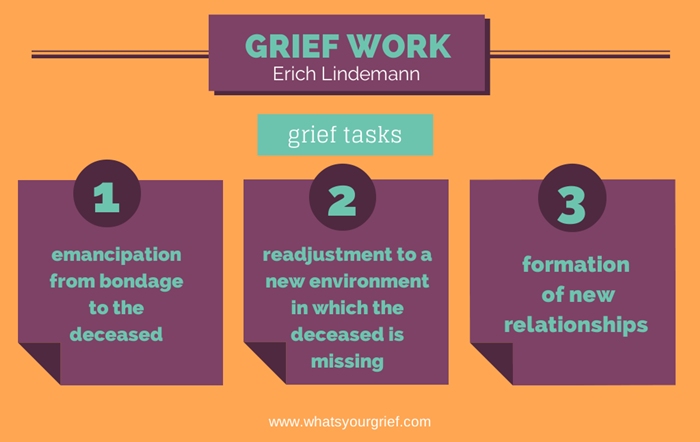
Image result for six stages of grief erich lindeman

Today the term has been expanded and is used widely to describe almost any approach to grief that includes specific techniques for helping someone walk the path of loss.

I use “grief work” to mean all the ways I (and others) must actively seek to identify, face, process, and ultimately incorporate the feelings, trauma and changes loss force upon us.

Grief work (in no particular order) can include but is not limited to:

  • Attending sessions with a professional, spiritual or lay counselor. Some people find it helpful to have a safe person outside the immediate grief circle to discuss feelings, concerns and relationship challenges that are generated by loss or exacerbated by loss. It’s best to find a counselor who specializes in grief, preferably child loss and/or traumatic loss (all child loss can be classed as traumatic loss). Other counselors may be too quick to label a bereaved parent’s grief as “abnormal” or “too lengthy” or “complicated” when it is, in fact, closely following observed timelines for dealing with child loss. If the first counselor you find isn’t a fit, try another. It’s OK to insist that you are heard, your feelings respected and your loss recognized for the life-shattering event that it is.
  • Finding, joining and participating in online or in person support groups. There are literally dozens of online support groups for bereaved parents. Some are designed to meet the needs surrounding specific types of loss such as sudden death, suicide, drug overdoses or loss to cancer or another disease or condition. Some are organized around certain faiths. Others may be rooted in geographic proximity and the online group might have a monthly or quarterly face-to-face meeting in the area. While it can sometimes be overwhelming to see the number of parents in such a group, it’s also extremely helpful to have a safe space to share things only another bereaved parent can understand.
  • Setting aside quiet time to think, process and possibly journal feelings. So much grief work must be done alone. Counselors can equip me with tools, support groups can give me real-life examples and encouragement but only I can do the nitty-gritty labor of teasing apart all the feelings and change grief brings with it. Journaling has been very helpful for me in putting words to what can sometimes be rather nebulous thoughts swirling around in my head. When I name what I’m feeling or experiencing, I can better construct a strategy for processing and living with it.
  • Walking back through memories, noting regrets, forgiving yourself and making peace with the past. We ALL have things we would have done differently. Death, being final, forces a heart to face that there is no chance to atone for past behavior. Words unsaid, things undone, opportunities missed are carved in the stone of yesterday. I spent many nights recounting my shortcomings as a mother, berating myself for what I didn’t do. Eventually I was able to rest on the simple fact that one thing I DID do was make sure Dominic knew he was loved.
  • Setting boundaries to give yourself and your family space and time to do grief work as well as to conserve emotional, relational and physical energy that’s in limited supply after child loss. So many of us live with few or no boundaries-responding to every request with a “yes”, adding things to the calendar without a thought to how exhausted we might be at the end of a day or week. Some of us are overtaxed at work or school. Some of us are hyper-involved in our churches, civic organizations or local politics. There are dozens of ways to be extended and just as many ways to live with that constant drain. Child loss forced me to recognize that I could no longer BE that person. I couldn’t afford the time, energy, mental space and emotional burden of saying “yes” anymore. I learned that “NO” is a complete sentence and began using it.
  • Practical considerations regarding your child’s belongings and other personal property. Many people might not consider this part of grief but it is. So many details to take care of, so many times I had to repeat the words, “My son was killed in an accident. I need to close this account.” So many copies of his death certificate mailed out to different agencies or companies, documenting the awful reality that he was never coming home again. Then there are questions of what to keep, what to store, what to give away. Should a room remain untouched if your child still lived at home? We had to clean out Dominic’s apartment only a few days after his funeral. It felt like I was boxing up everything beautiful about my boy.
  • Learning how to do holidays, birthdays, family gatherings, vacations and other gatherings. The empty chair looms larger when all the others are filled. If you have been the primary organizer of such events, it might surprise you to find the rest of the family still expecting you to be that person. Even if you aren’t the host for holidays, you will need to communicate to others if or how you feel comfortable participating.
  • Maintaining or regaining health after loss. Stress is one of the greatest contributors to so many health issues. Child loss is an unbelievably stressful experience. So it’s no wonder that many parents find themselves post loss with new or aggravated health problems. I had an appointment with my rheumatologist just one month after Dominic ran ahead to Heaven. It was critical that I tell her of my loss because in addition to whatever medical interventions she was prepared to prescribe, she needed to know I would be experiencing an extended period of intense stress that might necessitate closer observation and follow-up. As difficult as it may be to talk about, it’s important to inform your healthcare providers of your loss and to be absolutely honest about changes you’ve noticed in your body as a result.

There are probably a dozen or more subcategories of grief work I could list and some of you might think of ones I wouldn’t.

Grief IS work.

It is important, necessary and exhausting WORK.

It requires time, resources, effort and energy and cannot be hurried along.

But it is the only way a heart can begin to put the pieces back together.

❤

Lessons in Grief: What can I DO? Start by Showing Up.

This weekend another family joined the ranks of the bereaved. 

A beloved son left for heaven in a car accident.

The mama’s best friend messaged to ask what she could do to help this newly broken heart.

It made me dig deep in my memories for who did what in those first hours, first days and how it made a difference in our family’s ability to hold onto hope and to stumble forward in the heavy fog of grief, pain and sorrow that enveloped our hearts.

My friend was already committed to showing up and sitting silently and  lovingly with this child’s mother. I didn’t have to remind her of the power of compassionate companionship.

She was going. 

She was staying as long as it was helpful and necessary.

She was coming back as many times as needed.

And that is a gift!

love is courage

I remember the morning I got the news and as the sun was coming up, a truck pulled down our lane.  It was Robbie-our “adopted” son.  As soon as my oldest son (who was in WV at the time) got the call, he called Robbie.  Because he knew I would be able to bear Robbie’s presence and accept Robbie’s help.  I cannot describe the relief I felt when he came to the door-another shoulder to help carry this burden until we could gather all our family together to lift it in unison.

And after him came a couple we had known since the kids were little. 

Both rushed to our doorstep to offer companionship, practical aid, listening ears and simple reassurance that though this was NOT a dream-oh, how I wanted it to be a dream!I was not going to walk this Valley alone.  They stayed until my husband, son and parents had made it here.  I will never, ever, ever forget that gift of unconditional love and time offered just when I needed it most.

Others came.  Some did practical things, brought necessary items, helped me begin to think through next steps.  But many just sat with me and my children as we waited for my husband to fly in and my parents to drive up.

I cannot overstate how important SIMPLY BEING THERE was!

Thinking back on that time, I dug up some other very practical “first few days” things friends and family can do:

  • Bring disposable plates, cutlery and plenty of paper goods (toilet paper, kleenex, napkins) along with extra trash bags.
  • Place a notebook and pens near the spot folks might drop off meals or other things and ask that they write their names and what they brought inside.  My daughter did this for me and while I was often unable to acknowledge it at the time (or unaware of the blessing) I had a record that is dear to me still.
  • Set up an online meal planning/scheduling group. Make sure to note allergies or special food needs because while it’s wonderful to have food provided, it’s not helpful if the family can’t eat it because of dietary restrictions.
  • If there are unwashed clothes belonging to the childDO NOTwash them in an attempt to help out.  It may sound awful to anyone who has not buried a child, but nearly every mom I know wanted something with her child’s scent still on it.  I have a few things of Dom’s that are in a sealed plastic bag.  Every so often I open it and inhale what’s left of his fragrance.  Smell is such a powerful memory stimulant.
  • Begin to collect photographs from online sources, friends and family so that there will be many to choose from if the family wants to make a video for services.
  • Bring disposable Lysol wipes or something similar for quick clean ups in bathrooms and the kitchen.  Discreetly tidy up whenever possible or necessary.
  • Do NOT move papers, piles of mail, etc. without the family’s permission.  It may seem like a good idea at the time to make things neat for visitors, but it will be a nightmare later!  My brain is nearly empty of details for most of the first month after Dominic left us.  I depended on routine and familiar spots to remember where important items might be for the first year.  If something had been moved, I could not locate it, no matter how hard I tried.  If somethingHAS to be moved, place it in a box-clearly labeled-and attach a prominent note on the refrigerator or someplace like that indicating where it is.
  • Just sit and listen.  Or just sit in silence.  Whatever is most helpful to the bereaved parents and their family. Loving presence kept me anchored to this world when all I wanted to do was float away somewhere the pain couldn’t find me.

Compassionate companionship makes the difference between a heart holding onto hope or letting go and falling into the abyss.

Trust me.

I know.

Eleven Practical (mostly easy) Ways To Help a Grieving Friend

It’s possible to stand frozen at the corner of good intentions and helpful action.

I’ve done it dozens of times.

And every time I’ve allowed myself to swallow “but I don’t know what to do” and done nothing I’ve regretted it.

Every. Single. Time.

So I’m here to tell you that when you get that urge, feel that itch, hear that still, small voice that says, “DO something“, then do it.

You may already have a good idea of what it is you need to do, but in case you don’t know exactly how to make a difference in the life of a heart hanging on by a thread, here are some things to get you started:

Read the rest here: Should I DO Something? Yes. Absolutely.

Compassion 2024: 31 Practical Ways to Love a Grieving Parent

When Dominic died, I didn’t get a manual on what to do.  I didn’t get an orientation into how to be a grieving parent.  So when some people asked how they could help me and my family, I really didn’t know.

A comment repeated often by bereaved parents is, “Please don’t use the phrase, ‘let me know if there is anything I can do’, people mean well, but this is unhelpful.”

Another mom put it this way, ” There are too many meanings to this phrase.  It can mean anywhere from, ‘I really want to help’ to ‘I don’t know what to say so I’ll say this but I don’t really want you to ask’.  Also it’s so hard to make any decisions–trying to figure out what you might want or be able to do is overwhelming.  Instead, offer specific things you can do and make plans to do them.”

For those that want to help, here is a list of 31 ways you can provide practical and timely help to grieving parents.

Read the rest here 31 Practical Ways to Love Grieving Parents in the First Few Days

Compassion 2024: Bereaved Parents and the First Few Days

It will be ten (!) years on April 12th. A decade of living without one of my children here on earth. 

And yet those first hours and days are some of the most vivid in my memory. Who showed up, what they did, what they said (or graciously and wisely DIDN’T say), how fragile and lost I felt as precious friends guided me through so. many. decisions.

I will never, ever forget the kindnesses shown to our family during that time. I will never, ever stop thanking God for the brave souls that entered into our world of pain and simply refused to be shooed or frightened away.

❤ Melanie

The death of any loved one opens a door and forces you to pass through.

You cannot procrastinate, cannot refuse, cannot ignore or pretend it away.

Suddenly, you find yourself where you absolutely do not want to be.  

And there is no going back.

Many bereaved parents describe the first hours, the first days after losing a child as a fog–we feel both horrified (I can’t believe this is happening!) and numb (Is this real? Am I dreaming?).

Read the rest here: Loving Well in the First Days After Loss

Christmas 2023: 25 Ways to Bring Holiday Hope to the Grieving

This is the tenth Christmas without Dominic. There really are no words to describe the intersection of holiday cheer and another milestone in this journey of child loss.

I’m not sad all the time-far from it. Often I am very, very happy.

But I will never stop missing him, missing the family we used to be and missing our blissful ignorance of how quickly and utterly life can change in an instant.

And I will never outgrow the need to have others remember him as well, to encourage my heart and the hearts of my family members and to help us make it through another year, another Christmas. 

Here are some great ways to do it:  25 Ways to Give Holiday Hope to the Grieving

You Can Help Hurting Hearts

We are surrounded by hurting hearts. When one of them turns to you and bravely holds out her pain, accept it as an offering.

Because it is.

An offering of trust, friendship and vulnerability. 

❤ Melanie

We’ve all been there-we ask a routine question and someone refuses to play the social game.  

We say, “How are you?” and they answer honestly instead of with the obligatory, “I’m fine.  You?”

Suddenly the encounter has taken an unexpected turn.

“Oh, no!  I don’t know what to say,” you think.

It can end badly-both of you walking away uncomfortable and wary.

Read the rest here: How To Respond When Someone Shares Their Pain

Making Accommodations for Grief

The doctor I see every six months or so for my rheumatoid arthritis always fusses at me.

One of the routine questions is, “How’s your pain level?”

I usually say, “About a three.”

And then she looks at my hands and my feet-at the swollen joints and twisted toes-and shakes her head.

But here’s the deal:  sure they hurt, sure I can’t do all the things I used to do, sure I have to do many things differently than I did them when my hands and feet were unaffected by this disease-but I’m STILL moving and doing what needs to be done.

I don’t really know how to do anything else.

And that’s how it is with this grief I lug around-it’s heavier some days than others-but I’m STILL moving and doing what needs to be done.

I make daily concessions to my arthritic joints and I make concessions to my grief when I need to.

Read the rest here: Accommodating Grief

Why Is It SO Darn Hard to Ask for Help?

I would much rather be the one bringing the casserole than the one receiving it.  

Not because I’m ungrateful but because I’m uncomfortable.

It is humbling to have to depend on other people.  It’s hard to admit I can’t manage on my own.  It’s downright humiliating to need help with daily tasks that used to come easy.

But truth is, I cannot make it alone.

Read the rest here: Grace Like Rain: Why It’s So Darn Hard to Ask For Help

Help! I Need Somebody! (And You Do Too)

So many times I try to avoid admitting that I am unable to meet certain people’s expectations or do certain things that I either used to be able to do or feel I SHOULD be able to do.

I think the reason I don’t mind outing myself on trailers is because that confession usually gets a laugh or a knowing look from the person who helps me or an admission from someone standing near at the feed store that they also have trouble backing up a trailer.

But when I say, “I just don’t think I’m up to teaching VBS” or “I’d love to come to that event but I’ve reached my social quota this week” or “I’m still struggling with driving by that spot or eating at that restaurant” it’s often met with (at best) a quizzical look or (at worst) a comment about how I should be “better” by now.

Read the rest here: Help! I Need Somebody!