Sunday Prayer for a Grieving Heart

Father God,

I long to be enveloped in the sweet peace and safe cocoon of Your people.

But my heart feels oh, so isolated by this great grief it carries inside!

I take my place in the pew and am distracted by the intact, happy families surrounding me. Every bit of chatter about last week’s activities and this week’s plans reminds me I can no longer whisper a reminder to or share an inside joke with my missing child.

Help me come-broken as I am-and offer what’s left of me to You.

Open my heart and apply the Balm of Gilead to my wounded soul.

Speak courage and comfort to my spirit.

Lead the people You call and assemble to practice compassion and to actively reach out to the ones who struggle just to show up.

Thank You for seeing, hearing and loving me even when I feel unseen, unheard and unloved.

Amen

Tempted to Judge Someone Else’s Grief? Please, Don’t.

I’ve never been divorced or lost a spouse.

I’ve never fled for my life from a war torn country with only the clothes on my back or what few belongings I could fit in a small bag.

I’ve never watched my home go up in flames or heard it destroyed around me by wild winds.

But I’ve buried a child.

Grief walks through the door of a heart in all kinds of ways. Bad things happen-even to good people.

Bad things happen to believers in Jesus-even those who have dedicated their lives to living out the gospel message and loving others.

Sadly, when devastating or unbearable tragedy visits those who have devoted time, talent and treasure to building the Body of Christ, they can be most vulnerable to judgement from those who, up to now, would have described them as “pillars of faith”.

Because when their humanity squeezes (or even bursts!) out of the cracks in their hearts, others doubt their testimony.

I was just subjected to an uncomfortable conversation at Wednesday night Bible Study in which someone (who had not lost a child) declared that if a parent responds to this devastation with outsized emotion, they may not have an authentic relationship with Jesus.

They started with the (what I consider to be faulty) premise that “if you are a Christian, you ought to be stronger”.

And then they stepped into territory NO person outside of another’s grief should ever venture: They proceeded to assert that “all that wailing and screaming” some parents exhibited was, essentially, evidence of a weak faith.

I stopped them right there.

I was very upset but calmly defended the fact that this is untrue. Being human is something our Great High Priest understands full well.

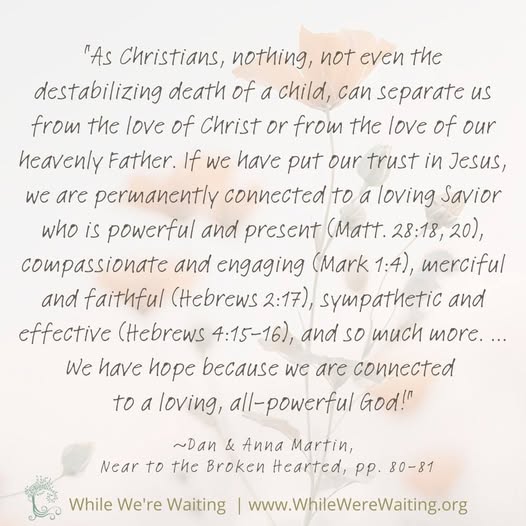
So it was more than a “God wink” when this morning I woke to the perfect graphic shared by my dear friend, Jill Sullivan, of While We’re Waiting Ministry:

Child loss is not a hammer in the hands of God. He is not “teaching me a lesson”. He is not waiting to see if I’ll fail some kind of test. He knows I am made of dust.

My Shepherd King is neither surprised nor offended by my weakness or my deep sorrow over my son’s untimely, sudden death. He does not chastise me nor turn His back on me.

Instead, He gathers me in His arms and sings mercy, grace and hope to my battered soul and broken heart.

His banner over me is love.

And nothing I do will change that because that is not only what He does, it is WHO HE IS.

Love Comes First


Usually I write about how child loss has impacted my life and the lives of my family.

Part of the reason I do that is to offer encouragement to other bereaved parents and guidance for people walking with and ministering to them.

Sometimes I address my writing to a broader audience that may include people who do not follow Jesus because some topics have more to do with general situations and less to do with faith-although my faith informs my life in every way.

But today I want to say something directly to the Body of Christ in the world whether or not you have personally suffered tragedy:

If we are gathering in the name of our Blessed Saviour and pushing the wounded to the fringe of our fellowships,

we have got it all wrong.

Jesus came for the broken,

the wounded,

the limping,

the very ones who were unwelcome in the “upstanding community”

of synagogues and the Temple.

He had no where to lay His head, carried no purse full of gold and walked everywhere He went.

He died between two thieves, mocked and naked, bleeding and helpless (in the human sense).

When He met people, He spoke directly to their HEART, regardless of their outward appearance.

He met REAL needs.

He LOVED in ways that made a difference.

We are calledI AM CALLEDto be like Jesus.

If I memorize the entire New Testament and miss this truthI have missed Him.

We read I Corinthians 13 at weddings and treat it like a marriage survival guide.

But that passage wasn’t written to two young people joining lives and “in love”, it was written to the CHURCH as a guideline for how Christ in us should be present in the world.

I don’t want to be a clanging gong!

I want to sing hope to those I meet by reflecting the love of Jesus everywhere I go.

I’m starting this morning at my own church door.

1Corinthians.13.2_lg have not love am nothing

How Pastors Can Help Bereaved Parents: Practical Advice

Being a pastor doesn’t mean you come out of seminary with answers to everything.

It doesn’t even mean you emerge equipped for very many of the situations and conversations thrust upon you once you enter ministry.

But I know a lot of folks expect you to be a pillar of strength, a fountain of wisdom, a well-spring of comfort. I’m sure you try to be all those things but it takes years to develop the experience needed to know what to say and do and what NOT to say and do in the most sensitive and painful moments humans face.

So when a thoughtful and inquisitive fellow bereaved parent asked the question below, I found myself REALLY considering the essential advice I’d pass along to a pastor about the unique and uniquely challenging ministry to those whose children have run ahead to Heaven.

It is most certainly NOT exhaustive, but hits the high points. It’s short, succinct and can go a long way toward promoting healing in shattered hearts.

I hope my pastor friends will read it and tuck it away in an easily accessible place. I promise you will need it one day.

I hope my fellow bereaved parents and others will pass it along to pastors they know.

❤ Melanie

This is the question: What advice would you give a pastor to serve, encourage, and walk with a grieving parent? What would you tell them not to do?

I would tell a pastor to:

*Listen, listen and listen some more– without correcting or judging. This is not a teachable moment. Take off the theologian’s coat and put on human flesh.

*Acknowledge the depth of their loss- not compare it or try to identify with it (unless you have also lost a child) and absolutely not minimize it.

*Don’t toss Bible verses– especially those intended to “bright side” their experience.

*Don’t stop checking in even if they stop going to church. If your ministry ends at the door of the building, you’ll lose lots of sheep.

*It will take longer- probably by years-than you think it should for them to return to some semblance of “normal”. Be patient.

*Ask, but don’t pressure, parents who once served (or are serving at the time of loss) if they want to continue serving. Some do, some find it impossible.

*Do not engage in gossip and speculation about “how they’re handling” their grief.

*Educate your congregation on the devastation of grief in general and child loss in particular. (See the story of Jacob-how deeply he grieved when he thought Joseph was dead, what a mess his family was…)

*When appropriate, make space in yearly celebrations or traditions for recognition of those who are mourning and who want to have their child (or other loved one) remembered.

*As time goes on, ask specific questions (How is your grief today? What do you find to be a struggle right now? Could you share something about _____, I love to hear about him/her?and then listen some more.

If you know them well, you will have many more opportunities to come alongside as a compassionate companion in their grief.

If you don’t know them well or you have a very large congregation, you can still use these general guidelines but also engage the help of someone who does know them and who may be better suited to companion them (with your help and support).


So many bereaved parents struggle with church and with their faith.

Each family and situation will be different.

Reaching out in a timely, encouraging, and understanding way helps them hold onto hope.

Lenten Reflections 2025: Proximity Does Not Equal Intimacy

Hey friend-I’ve been there.

Many of us who’ve spent decades in church can attest to filling a position because it answered a need deep inside of us rather than because of our love for Jesus.

It’s entirely possible to be near the things and people of God-even God Himself- and not be attentive to or aware of the Presence of Christ.

Read the rest here: Lenten Reflections: Proximity Does Not Equal Intimacy

Called to Be a Witness

What, exactly, is the value of believers in Jesus plastering an “Everything is fine” mask across our faces?

Are we afraid that if we allow someone to see our pain we are letting God down?

And how could that be?

Did not Christ Himself beg the Father in the Garden to take the cup from Him?

jesus in the garden

Yet we smile and wave and chat our way through encounters with people around us, pretending, pretending, pretending that life is easy when it most certainly is not.

all broken trees

Denying the dark and refusing to acknowledge the depth of our pain diminishes the value of the comfort of Christ.

When David wrote that, “yea, though I walk through the valley of the shadow of death, Thou art with me” he understood both the desperate need for and the great assurance of Christ’s Presence.

When we allow others to see our broken hearts, we bear testimony to the sustaining grace of Jesus.

heals the broken hearted

And we extend an invitation for them to meet this Savior that gives strength and comfort even in the darkest hours and hardest journeys.

walk with the broken toby mac

Ministering to Bereaved Parents: Advice for Pastors

Being a pastor doesn’t mean you come out of seminary with answers to everything.

It doesn’t even mean you emerge equipped for very many of the situations and conversations thrust upon you once you enter ministry.

But I know a lot of folks expect you to be a pillar of strength, a fountain of wisdom, a well-spring of comfort. I’m sure you try to be all those things but it takes years to develop the experience needed to know what to say and do and what NOT to say and do in the most sensitive and painful moments humans face.

So when a thoughtful and inquisitive fellow bereaved parent asked the question below, I found myself REALLY considering the essential advice I’d pass along to a pastor about the unique and uniquely challenging ministry to those whose children have run ahead to Heaven.

It is most certainly NOT exhaustive, but hits the high points. It’s short, succinct and can go a long way toward promoting healing in shattered hearts.

I hope my pastor friends will read it and tuck it away in an easily accessible place. I promise you will need it one day.

I hope my fellow bereaved parents and others will pass it along to pastors they know.

❤ Melanie

This is the question: What advice would you give a pastor to serve, encourage, and walk with a grieving parent? What would you tell them not to do?

I would tell a pastor to:

*Listen, listen and listen some more– without correcting or judging. This is not a teachable moment. Take off the theologian’s coat and put on human flesh.

*Acknowledge the depth of their loss- not compare it or try to identify with it (unless you have also lost a child) and absolutely not minimize it.

*Don’t toss Bible verses– especially those intended to “bright side” their experience.

*Don’t stop checking in even if they stop going to church. If your ministry ends at the door of the building, you’ll lose lots of sheep.

*It will take longer- probably by years-than you think it should for them to return to some semblance of “normal”. Be patient.

*Ask, but don’t pressure, parents who once served (or are serving at the time of loss) if they want to continue serving. Some do, some find it impossible.

*Do not engage in gossip and speculation about “how they’re handling” their grief.

*Educate your congregation on the devastation of grief in general and child loss in particular. (See the story of Jacob-how deeply he grieved when he thought Joseph was dead, what a mess his family was…)

*When appropriate, make space in yearly celebrations or traditions for recognition of those who are mourning and who want to have their child (or other loved one) remembered.

*As time goes on, ask specific questions (How is your grief today? What do you find to be a struggle right now? Could you share something about _____, I love to hear about him/her?) and then listen some more.

If you know them well, you will have many more opportunities to come alongside as a compassionate companion in their grief.

If you don’t know them well or you have a very large congregation, you can still use these general guidelines but also engage the help of someone who does know them and who may be better suited to companion them (with your help and support).


So many bereaved parents struggle with church and with their faith.

Each family and situation will be different.

Reaching out in a timely, encouraging, and understanding way helps them hold onto hope.

Lenten Reflections 2024: Proximity Does Not Equal Intimacy

Hey friend-I’ve been there.

Many of us who’ve spent decades in church can attest to filling a position because it answered a need deep inside of us rather than because of our love for Jesus.

It’s entirely possible to be near the things and people of God-even God Himself- and not be attentive to or aware of the Presence of Christ.

Read the rest here: Lenten Reflections: Proximity Does Not Equal Intimacy

Scoot Over, Make Room For the Broken

One of the things I learned quickly after Dominic ran ahead to Heaven was that other people were very uncomfortable around my brokenness.

For some, it was because they didn’t know what to say or do when tears leaked from my eyes.

Others found the presence of a bereaved mother simply too hard to take-if it happened to ME, it could happen to THEM.

A few were just too self-focused to allow anyone else’s pain to rain on their “perfect” parade.

But if I’ve learned anything from this life it is this: Christ loves the broken. It’s the broken and breathless who realize they need a Savior.

And when I make room for the brokenness of others in my life, I’m inviting His Holy Presence to dwell in our midst.

❤ Melanie

I used to position myself at the end of the pew, just in case someone I’m not too comfortable with might come along and try to sit down.

It saved us both that awkward conversation where they ask if they can join me and I say “yes” with my mouth but “no” with my body language.

Read the rest here:  Move Over, Make Room for the Broken

Faith and Doubt

So much of the “faith” handed down today through Sunday School lessons and sermons is one that simply doesn’t leave room for mystery or for doubt or, honestly, for many of the actual Bible stories if you read them straight from the Book and not get them second hand from a loose retelling .

Jesus Himself-the exact representation of the Father (Hebrews 1:3)-didn’t greet skeptics with absolute proof. He pointed to the work He was doing, the truth He was telling and the miracles He performed but He left it to the audience to decide if that qualified Him as the Christ.

Yet we treat those who bring questions to the table of grace at best as immature and at worst as apostates or faithless wannabes.

Read the rest here: The Opposite of Faith Isn’t Doubt