Child Loss and Self Care: Healthy Choices

My first instinct as a mother and a shepherd is always, “How can I help?”

I routinely set aside my own needs for the needs of others. Not because I’m so selfless but because that’s how I’m made-I’ve always had the heart of a caretaker.

That’s not a bad thing, most of the time.

But if taking care of others means NOT taking care of myself, then in the end, I’m of no use to anyone.  When I allow every bit of energy-emotional, physical, psychological and spiritual-to drain away until there’s nothing left, I am unable to meet my most basic needs, much less the needs of others.

I’ve written before that grief puts a hole in my bucket. It guarantees that no matter how much is poured in, I’m never truly full.

I’ve also written about setting boundaries and trying to preserve margin as I walk this Valley. I have to create space between me and the people around me if I’m going to make it through.

But there are some other steps I can take to help ensure my heart is strong enough for the journey. It’s not always about what I don’t do.

Sometimes it’s about what I choose TO do.

Here are some ideas for self-care in grief (or really ANY hard place in life):

  • Be patient with yourself. There is no time frame for grief.  Each heart is unique.  Extend grace to yourself, just as you would to a friend.  Try not to take on extra responsibilities.  It’s better to allow for some flexibility in obligations during this time (even around holidays!).
  • Listen to your body and your heart: If you need to cry, then cry. If you need to sleep, then do so. If you need to talk to someone, seek out someone who will listen. If you need to reminisce, then take the time. It is important for the grieving process that you go with the flow.
  • Lower expectations for yourself and communicate this new reality to others. You are not able to operate as you did before loss.  Your capacity for interacting with others, managing tasks and being available for the needs of others has been dramatically altered.  Own up to it, and let others know that it will be some time before you can shoulder the responsibilties you once did.
  • Let others know what you need from them. No one is a mind reader.  While we who are bereaved think our needs are obvious, it’s simply not the case.  Communicate to family and friends how they can support you.
  • Accept the help of others. Understand that grief is hard work. It requires a great deal of energy and can be exhausting. Even though we place a high value on self-sufficiency, it is important to ask for, and accept, help from those close to you. Others careand genuinely want to be of assistance, but usually do not know what to specifically offer. In particular, it is vital to know who will listen and be supportive. Sharing your story out loud is one key to healing. And, remember that professional guidance is also available
  • If you need counseling, get it! There is NO shame in asking for help. Get all the support you need. There are many bereavement support groups as well as counselors or spiritual advisors who specialize in bereavement counseling. Don’t hesitate to contact a medical and or mental health specialist if you have feelings of hopelessness or suicidal thoughts.
  • Accept your feelings. Feelings are neither right nor wrong, they just are. Sadness, loneliness, fear, confusion, anger—these are among the many feelings you may experience, and are completely normal. Emotions are often raw early in the grief process, but it is important to express them. Attempting to stifle feelings usually leads to an emotional outburst at an inconvenient time.
  • Face your feelings. The painful emotions associated with grief are a natural and normal response to loss. You can try and suppress them or hide from them all you want but in the end this will only prolong the grieving process. Acknowledging your pain and taking responsibility for your feelings will help you avoid the complications often associated with unresolved grief such as depression, anxiety, substance abuse, and health problems.
  • Express your feelings. The most effective way to do this is through some tangible or creative expression of your emotions such as journalling, writing a letter expressing your apologies, forgiveness and the significant emotional statements you wish you had said, or art projects celebrating the person’s life or what you lost.
  • Keep a journal. Writing down your thoughts and feelings can help you to validate and work through your grief.
  • Feel whatever you feel. It’s okay to be angry, to yell at God, to cry or not to cry. It’s also okay to laugh, to find moments of joy, or to let go when you’re ready. Your grief is your own and no one can tell you when you should be “over it” or when to “move on.”
  • Pay attention to physical needs. It’s easy to ignore your health when all you want to do is give up and give in.  However, it is even more important NOW to take care of yourself.  Eat balanced meals (set an alarm if you have to), try to get adequate rest (get medication if you need to) and make sure to get in some physical activity every day (set a timer if necessary).
    • Get physical exercise. If you exercised prior to your loss, try to maintain the same routine. If you did not exercise prior to your loss visit your doctor before embarking on a physical exercise routine. Physical exercise can improve the way you feel.
  • Eat right and get enough sleep. Maintaining a healthy diet and getting proper sleep is essential for functioning as well as you can. If you are having difficulty with either, visit your doctor.
  • Be aware of short-term relievers – these can be food, alcohol/drugs, anger, exercise, TV, movies, books, isolation, sex, shopping, workaholism, etc. Most of these things are not harmful in moderation but when used to cover-up, hide or suppress our grief they get in the way of the work grief requires.
  • Take the time to do the things you need to do for yourself. When you feel up to it, engage in activities to which you feel drawn. It could be visiting a place you haven’t been to in a while, walks in nature, reading, etc.
  • Pamper yourself. Treat yourself well. Do things for yourself that are helpful like walks, being with people who are nurturing to you, and inexpensive activities

Grief is a lifelong process-a marathon, not a sprint.

Maintaining space to do the work grief requires and engaging in activities and health habits that help me do that work is the only way to endure.

physical mental well being

Child Loss and Holidays 2026: Forgiveness and Healthy Boundaries


Holidays definitely challenge boundaries, don’t they?

Even in healthy relationships it’s easy to feel manipulated into going places and doing things we are ordinarily able to resist.

Often someone may accuse us of “unforgiveness” when we choose to set a healthy boundary.

We can absolutely forgive someone and still decide there are limits.

I do not believe that in offering genuine forgiveness I am required to again submit myself to another person’s hurtful or sinful behavior.

I do believe that forgiveness releases that person from past offenses against me but it does not release them to continue to wound my heart.

And I will stand up any time, anywhere and defend my. right to create healthy boundaries between my heart and someone who has proven, time and again, that they intend to do just that.

daring to set boundaries brene brown

What does this look like in real life?

It means that I can call, write or tell someone that I truly forgive them for whatever pain they have caused me in the past.  That frees MY heart.

But if that person refuses to change his or her behavior, I am not obligated to allow them close enough to hurt me again.

It is NOT proof of an unforgiving heart to set up healthy boundaries.

It is wisdom.

So I don’t have to invite them to every event. I don’t have to allow them to corner me at gatherings where we both may attend.  I don’t have to tell them all the news in my life or include them in my circle of closest comrades.

I can be polite. I will refuse to spread malicious gossip about them and not continue to talk about the old wounds for which I’ve forgiven them.

When my heart tries to resurrect the forgiven offenses, I will remind it that those are no longer relevant.  I will not let bitterness overtake me.

There’s a compelling and beautiful anecdote about Corrie Ten Boom and forgiveness:

After WW II, Corrie traveled Europe speaking on the grace of God found even in Ravensbruck, the concentration camp where she was imprisoned and in which her sister died.

After one such talk, a German man came up to her and mentioned that he had been a guard at that camp.  Corrie recognized him though he, of course, did not recognize her.

He thanked her for what she shared and put out his hand to shake hers.  At that moment, she knew what she SHOULD do, but she did not want to do it.  She did not want to touch this man’s hand and offer forgiveness for what many felt was utterly unforgivable.

But God convicted her heart and in obedience she extended her hand.  She speaks of how she felt the Lord’s love and forgiveness wash over her and flow through her when she acted in obedience.

She never saw him again.

But for many of us, we continue to see and rub shoulders with the ones who have wounded us.

And if Corrie had again been forced into a concentration camp, she would not have been wrong to go kicking and screaming.

Forgiving that German guard did not excuse what he had done nor did it mean that if he was intent on repeating it that she (or anyone else) had to simply go along.

You do not have to allow another person to use you as a punching bag.  You do not have to subject your heart to verbal or emotional abuse.  You do not have to prove the sincerity of your forgiveness by enabling continued bad behavior.

forgiveness is not forgetting

That’s neither wise nor helpful.

Boundaries are OK.

They are necessary.

And they do not mean you haven’t forgiven someone.

Child Loss and Holidays 2026: What IS Forgiveness?

Part of preparing for the holidays is getting ready to face folks who we might have successfully avoided the rest of the year.

Many times we choose not to include them in daily life because they have wounded us in the past or are continuing to wound us in the present.

It’s hard to forgive someone who doesn’t want to change or who isn’t even remotely interested in having a conversation about how they have hurt our heart.

But the truth is, forgiveness frees ME from the tyranny of waiting for THEM to be different.

So, in the hopes of helping others who, like myself, sometimes struggle with feelings of unforgiveness, I’m sharing a few posts I’ve written on the topic.

It’s an area I have to work on often and especially this time of the year when I am forced to rub shoulders with those I prefer to keep at arm’s length.


A few years ago someone asked me for my definition of forgiveness.

It caught me off guard.

She had been sharing details of a very painful situation with someone who is clearly intent on making her life difficult “just because”.

I had to think about it.

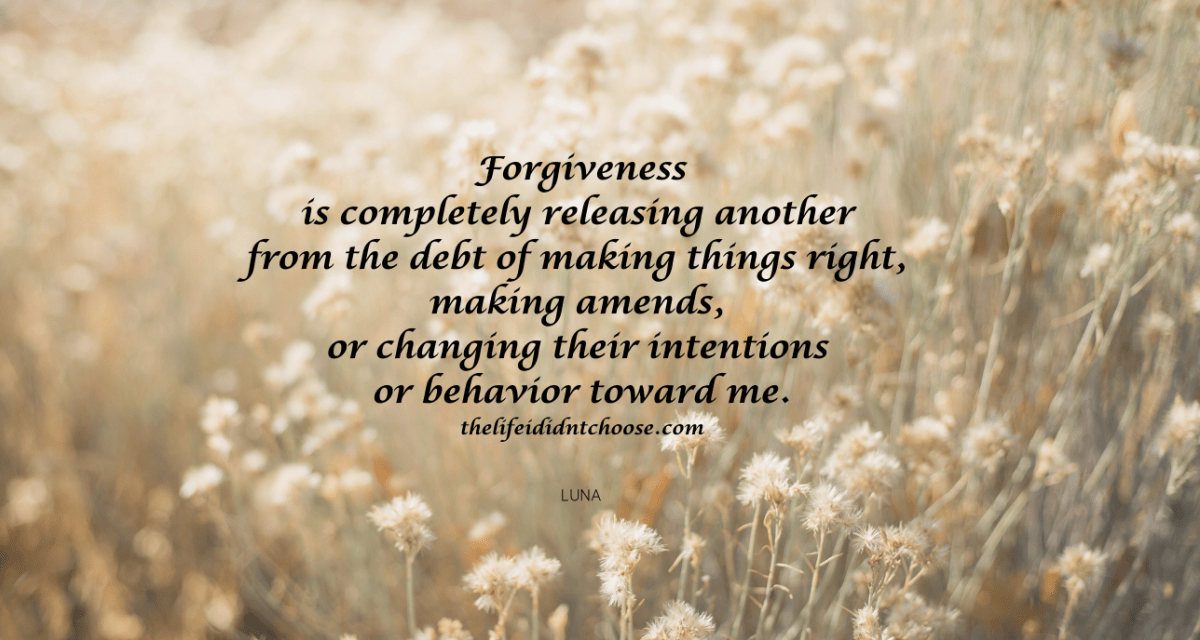
After a few seconds I told her that at its most basic level, I thought forgiveness was completely releasing another from the debt of making things right, making amends or changing in their intentions or behavior toward me.

And then I realized it was precisely what I thought even though I’d never framed it exactly like that before.

I’ve sat with my words for a several days now and I have a few more thoughts.

My definition may lack precision in terms of theology but it is absolutely congruent with lived experience.

It bridges the gap I (and many others) feel between what feels like real forgiveness (releasing the debt) and also still not trusting a particular individual enough to allow them in my life.

I can’t imagine a single soul walking in this world for very long without having at least someone wound them deeply. And it’s no good just trying to ignore the pain or paper it over or distract yourself from it. I eventually find it gnaws a hole in my heart.

When that happens, it’s necessary (for my own mental, emotional and spiritual health) to face it and deal with it.

That’s when the choice to forgive can release the energy that will otherwise be expressed in bitterness or anger or sarcasm or avoidance or unfulfilling and often harmful choices.

If I forgive-release another from the debt of making things right or making amends or changing in their intentions or behavior toward me-then I am no longer held hostage to what they do or don’t do, say or don’t say.

It is real and freeing.

Doing that, I can more accurately evaluate whether the individual is a safe one whom I can allow back into my life:

  • Is their behavior consistent?
  • Are their intentions good and loving or hurtful and mean?
  • Can I trust them?

You do not have to allow them back in if they are not worthy of that privilege.

So, so many bereaved parents have been wounded in so, so many ways.

Sometimes by those they love. Sometimes by strangers who contributed to the death of their child. Sometimes by others who have made it difficult or impossible to do the work grief requires.


Those that inflict the wounds may be repentant or they may not.


That’s outside our control.

But we all have the opportunity to make the choice to release the debt and free ourselves of the ongoing burden of caring whether they are sorry or not.

And that is work well done.

Child Loss and Holidays 2026: Seven Practical Ways to Help Grieving Parents During the Holidays

I have a favor to ask my nonbereaved friends and family: Would you read this and think about how you can extend grace and practical help to the bereaved parents (and other bereaved folks) in your circle?

I bet you’re already planning menus, hiding gifts and juggling schedules.

It won’t be nearly that complicated to create space and choose to bless the bereaved in the midst of holiday festivities.

Here are seven easy ways to do just that.

❤ Melanie

Most parents feel a little stressed during the holidays.

For bereaved parents, the rush toward the “Season of Joy” is doubly frightening.

Constant reminders that this is the “most wonderful time of the year” make our broken hearts just that much more out of place. Who cares what you get for Christmas when the one thing your heart desires–your child, alive and whole–is unavailable…

It is so hard to find a way to trudge through the tinsel when what you really want to do is climb into bed and wake up when it’s all over.

Here are some practical ways family and friends can help grieving parents during the holidays:

  1. Don’t resist or criticize arrangements a bereaved parent makes to help him or her get through this season.If they are brave enough to broach the subject, receive their suggestions with grace and encourage them with love.  Do your best to accommodate the request.
  2. If the bereaved parent doesn’t approach you–consider thoughtfully, gracefully approaching him or her about what might make the holidays more bearable.But don’t expect a well-laid plan-I didn’t get a “how-to” book when I buried my child…this is new to me and very, very painful.  I am doing the best I can to keep my head above the waves and I cannot be expected to captain the boat through these turbulant waters.
  3. Don’t be surprised if a bereaved parent doesn’t want to exchange gifts (or at least, not receive gifts). No one can rewind time or restore my family circle to wholeness and I just can’t think of anything else that I want or need.
  4. Don’t assume that the bereaved parent should be relieved of all meal duties around the holiday.For some of us, doing the routine things like baking and cooking are healing.  For others, there just isn’t energy for anything other than the most fundamental daily tasks. ASK if they want to contribute.
  5. Don’t corner surviving children for a private update on their parent’s state of mind. My children are grieving too.  When you expect them to give an update on me you diminish their pain and put them in a difficult position.  If you want to know, ask me.
  6. If there are young children in the family, it might be helpful to offer to take them to some of the parties/gatherings/church services that their parent may not be up to attending. Ask, but don’t be upset if they say “no”–it might still be too traumatic for either the child or the parent to be separated from one another.
  7. Ask them to share about the one they miss.  One of my greatest fears as a grieving parent is that my child will be forgotten.  But we might not speak up because we don’t want to make others feel uncomfortable.

I know that life goes on, the calendar pages keep turning and I can’t stop time in its tracks.  I greet each day with as much faith and courage as I can muster. This season requires a little more-and I will need help to make it through.

Child Loss and Holidays 2026: Making Space for Grief During the Season

We are just weeks away from plunging headfirst into the rough and tumble holiday season.  

Thanksgiving is drawing near and I don’t know about you, but it seems that once I eat the turkey and dressing, the clock moves faster and the days crowd one another in a race to Christmas and the end of the year.

So I want to take a minute to think about how important it is to make and maintain space for grief during this busy season.

You have to do it.  

I know, I know-where to fit it in between family gatherings, social engagements, mandatory office parties and children’s pageants?

If you don’t, though, the grief will out itself one way or another.  

So may I offer the following practical suggestions for this upcoming holiday season?

  • Start each day (whenever possible) with a few minutes of alone time.  Let those moments be the buffer between you and the day ahead.  Don’t allow your mind to wander to your “to do” list.  Sit.  Sip the hot beverage of your choice and let silence soothe your soul.
  • Don’t overschedule your days (or nights!).  Exercise the option of saying, “no” to things that are not really important or necessary.  Just because you have done it every other year doesn’t obligate you to do it this year.  Exhaustion always magnifies despair.  
  • Try to balance busy days with not so busy days.  The surest path to meltdown is traveling in the fast lane.
  • Let other people take on responsibilities-especially if they offer- and even if they don’t.  Asking for help when you need it is a sign of maturity, not a sign of weakness.
  • Keep a pad and pen on your nightstand and jot down any random thoughts that you don’t want to forget before bedtime.  There is no sense worrying about something you can’t address until morning and writing it down means you won’t forget it.
  • Make use of online everything.  Have gifts sent directly to recipients.  Order groceries for pick up.  There are many ways to make life less hectic and more enjoyable.  If you don’t know what’s available in your area, ask friends and family.
  • Plan for at least one recovery day for every large gathering/party/meal you have to attend.  Some of us need two.
  • Don’t sweat the small stuff.  If you are used to having matching everything, perfect centerpieces and gourmet meals it may be hard to lower your standards.  But if there is one thing I have learned since Dominic ran ahead to heaven, it’s that the companionship of those we love trumps anything else.  People rarely remember how you set your table but they will remember who sat around your table.
  • And if your heart is too tender to do anything but hold on and hope this month passes quickly, then do that.  You don’t have to live up to anyone else’s expectations.  Sometimes that’t the best we can do and that is OK.

Grief requires so. much. energy.

And you can’t spend the same energy twice.

So make space for grief in your holiday plans.  

bereaved parents have one job during the holidays to survive

International Infant and Pregnancy Loss Awareness Day 2026

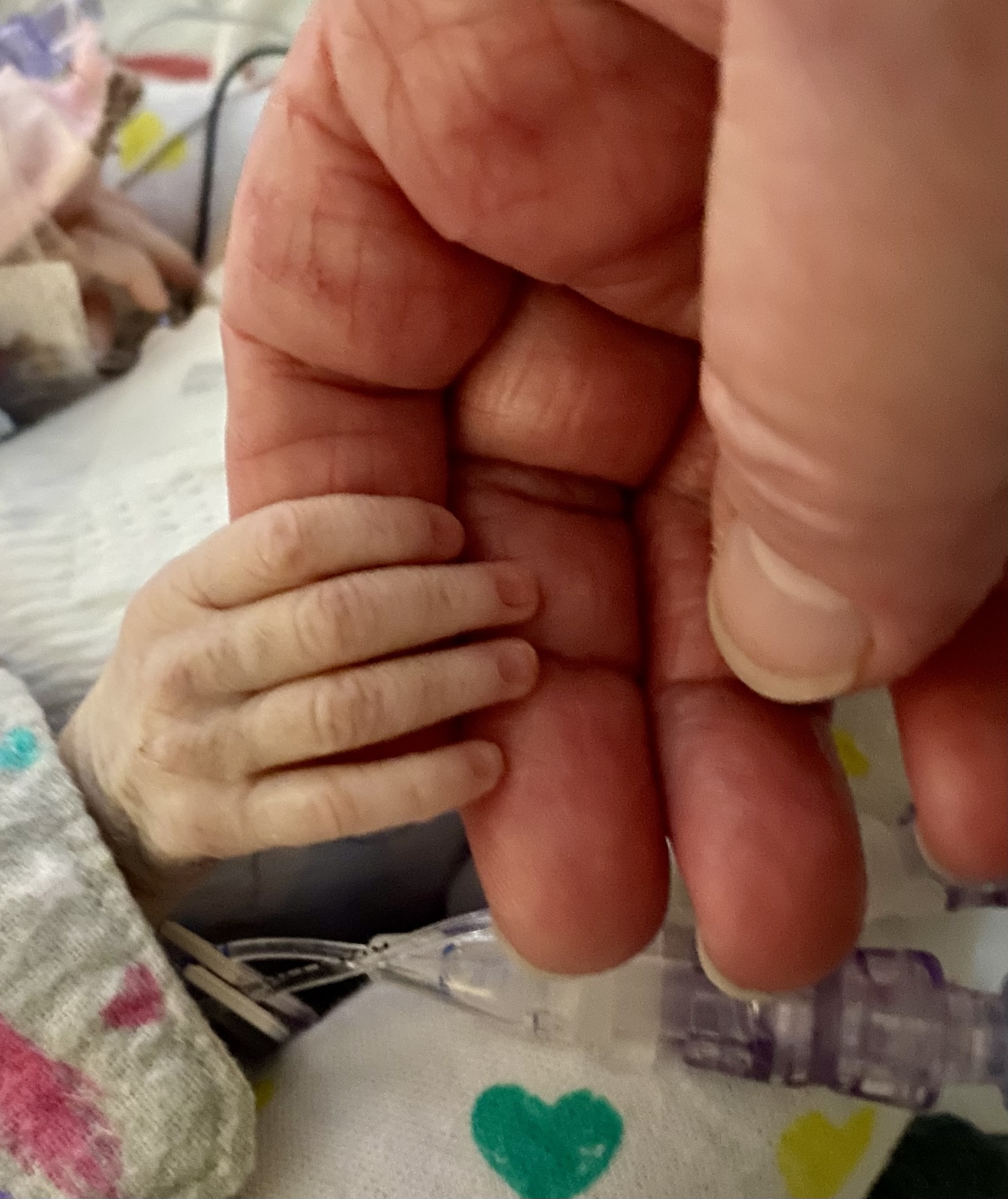
As a young wife I suffered pregnancy loss but it was not until my granddaughter, Holly, was born last December, that my life included infant loss.

Having to say “good-bye” to a child before you’ve even had a chance to make memories (or made very few memories) is a special kind of heartache.

All that hope held in the promise of a budding life simply disappears in a torrent of tears.

Today we honor both the brave parents who endure and the precious souls who went to Heaven so very early.

It happens in all kinds of ways.

For one reason or another, the tiny life budding in a belly never gets to see the light of day. Never takes a first breath. Never cries. Never opens his or her eyes to the mama waiting to meet her precious one.

So many mamas have experienced the excitement of watching the pregnancy test show positive only to endure days, weeks or months later, the sadness of saying good-bye to a little one they never got to meet.

Statistics tell us that one in four women will become part of this group during their lifetime.

But what statistics can never tell you about anything is why so, so many of the women who survive pregnancy and infant loss don’t talk about it.

Many think they can’t talk about it or shouldn’t talk about it because often the experience is so very personal.

It may be the pregnancy was never announced. It could be that the culture in which a mama lives doesn’t recognize life at conception so, really, what was lost? Perhaps many women in her family have had similar experiences and THEY didn’t “make a big deal” out of it, so why should she?

Then there’s guilt.

So, so much information is shoved into mothers’ faces about what they should and shouldn’t do to promote a healthy pregnancy and birth. Eat this, don’t eat that. Take this, don’t take that. Exercise-but not too strenuously. Drink water. Don’t drink alcohol or too much caffeine.

It’s easy to blame yourself when a baby stops growing.

Some brave mamas carry a baby for months and to the point of birth-see that precious bundle on an ultrasound, hear the heartbeat, watch and feel those legs kick-yet never hear a cry or hold a warm infant in their arms.

That’s a kind of awful no heart should have to bear.

And yet, that loss too is often unacknowledged.

How do you celebrate a life that was lived only inside the comfort and safety of the womb? How do you share a photo of your precious baby when the only one you have (if you have any) is of him wrapped in a blanket, eyes closed, your eyes crying?

If a second pregnancy follows any kind of pregnancy or infant loss, friends and family almost always pounce on the opportunity to push a mama’s heart forward fast and furious to the future of her “rainbow child” making it even less likely her missing baby is acknowledged or remembered.

But she never forgets.

A mama’s heart never lets go of the life that lived inside her.

That tiny baby-one week, one month, full term-is her son or daughter.

Counted among the others.

Just as precious.

Always.

I’m remembering with you, my sweet friends. Tonight I will light a candle along with millions who also remember, to honor the baby I never held. May the multiplied voices and hearts joined together help others hear the message that our child matters.

Every child matters.❤ Melanie

Child Loss and Holidays 2026: Life Adds Layers

This holiday season will be very different for my family.

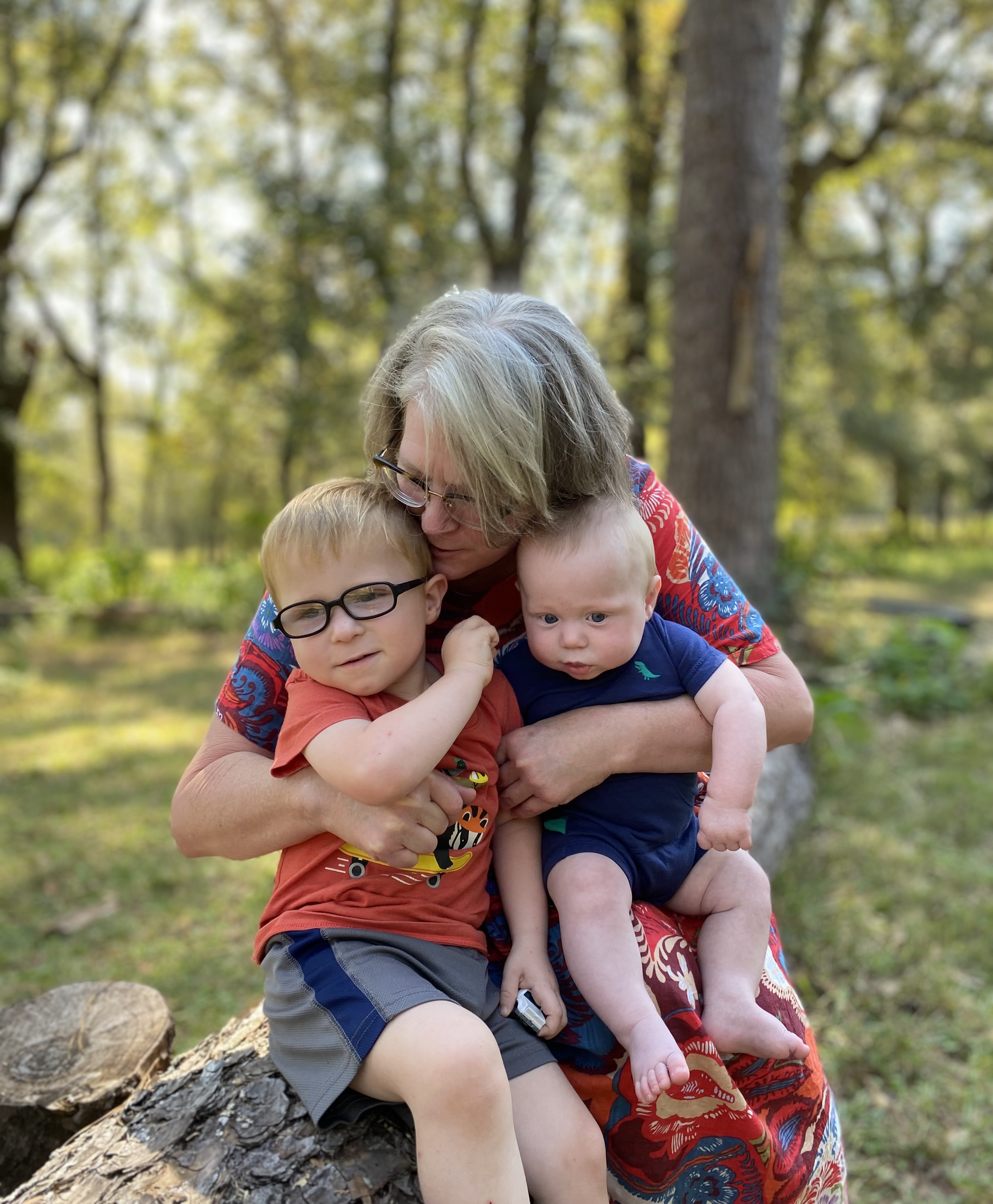
Last year at this time, we were looking forward with great gladness to adding a new little girl to the two grandboys who already brought laughter and joy to our lives.

Holly arrived early-December 21st-but was doing well when we gathered around the Christmas tree, bleary-eyed, coffee in hand, to watch the boys tear through wrapping paper and squeal with delight.

Less than twenty-four hours later, Holly was life flighted to Dallas Children’s Hospital and everything had changed. By January fourth, she had joined Dominic in the presence of Jesus.

Christmas was already a bit of a tricky season for us because my daughter’s birthday is on the eighteenth. When she was young, I tried hard to disentangle her special day from the tinsel and lights of yuletide celebrations.

After Dominic ran ahead to Heaven, it became a reminder of the once unbroken family circle and the increasing distance between old memories and making new ones. Like other child loss and sibling loss survivors, we had to find a way to navigate this hap-hap-happy time when our hearts weren’t always in it.

Now we have deep sorrow woven directly into our Christmas season.

And once again, I’m reminded that life adds layers to loss.

No matter how much we may want it to stop, the world keeps turning. Days turn to weeks turn to years and each moment has the potential to scribe joy or pain across our hearts.

This year is going to be very, very different from any of the sixty-two I’ve lived through before. I’ll be sitting next to a son who not only said a too-soon “good-bye” to his brother but also was granted a tragically brief few days with his own beloved daughter.

My daughter-in-law joins me as a bereaved mother.

Their children join mine as bereaved siblings.

I’m not entirely sure how or even if we will celebrate beyond providing gifts for the youngsters.

I’m back at ground zero.

But what I know now that I didn’t know THEN-the first year after Dom left us-it this: We will survive.

Life doesn’t only add layers of loss.

It also adds layers of joy and moments of gladness.

This year will be hard but not every year will be AS hard.

So if you, like me, are bearing up under a fresh load of sadness, don’t give up.

Hold on.

I’m praying for both of us.

Child Loss and Holidays: Practical Ideas for Dealing With the Holidays

It cannot be overstated:  holidays are extremely hard after loss.  Every family gathering highlights the hole where my son SHOULD be, but ISN’T.

There is no “right way” or “wrong way” to handle the holidays after losing a child.

For many, there is only survival-especially the very first year.

These days also stir great internal conflict:  I want to enjoy and celebrate my living children and my family still here while missing my son that isn’t. Emotions run high and are, oh so difficult to manage.

So I’m including some ideas from other bereaved parents on how they’ve handled the holidays.  Many of these suggestions could be adapted for any “special” day of the year.

Not all will appeal to everyone nor will they be appropriate for every family.  But they are a place to start.

If you have decided to make a Holiday Journal,  consider printing these ideas to put inside or copying out the ones that might be helpful for you.

Skip it.  

  • Sounds drastic and it is.  But for some families (especially if there are no small children involved) it is absolutely possible (and sometimes healing) to ignore all traditions and trappings associated with Thanksgiving and Christmas.
  • You might choose to serve others on these days by volunteering with a local organization offering meals to the homeless or disadvantaged in your community.
  • Take a holiday meal to hospital workers, police officers or firemen in your area.  You can do it anonymously or in the name of your child.

Consider traveling for the holidays.

  • On the first Thanksgiving after my son left us, we shared the weekend with our newly married son and his wife in another state.  It was the first time in my life I hadn’t spent the holiday with my parents.  It was still very hard, but helpful in a way.
  • Other families have chosen to rent a cabin or condo and have the same people involved but experience the season in another location.  Most try to choose a place with a natural focus for activity that isn’t all about the holiday-like skiing in the mountains or near a lake or beach.

Change how you do meals.

  • If your family traditions always include the same foods in the same house, you might want to eat the holiday meal in a restaurant instead.
  • You could swap up the timing of a meal-evening instead of noon or vice-versa.
  • Change up the guest list-include a few close friends along with family members (friends that understand your grief).  Sometimes it helps to have others not so affected by the loss in the mix.
  • If you have been the host but don’t feel like you can do it this year-definitely consider passing that to someone else.  And don’t feel guilty about it.
  • Include the missing family members at the table in some way. One bereaved mom wrote:  “My niece includes my  son and mom at events hosted in her home.  She sets a chair aside and places a photo in the seat and a commemorative bow on the chair back.”
  • Don’t make certain foods. I make giant plates of cookies but have not made shortbread cookies since my son left us.  It was his favorite and one of the few things that tempted him from his strict weight-lifting diet
  • Make your child’s favorites and enjoy eating them and sharing memories around the table.

Let others do the planning/cooking/communicating.

  • Explain to your family that you aren’t up to being the one to plan this year’s holidays.  Let someone else do it.  Participate if and when you can.  
  • Be kind, but stand your ground.

Make new traditions. 

  • If you go around the table at Thanksgiving saying, “I’m thankful for…“-it might not be something you can do this year.  That’s OK.
  • Light a candle for the missing child.  You might want to have those present share a favorite memory or you might simply want to have the candle create a silent presence.
  • Some families can’t bring themselves to use the same Christmas tree they used before loss so they get a new and/or different one.  Some don’t want a tree at all.
  • Some families have a separate tree full of ornaments or memorabilia for their missing child and use the main tree as usual for the rest of the family.
  •  “I have a separate tree for Z. . It’s filled with ornaments that remind us of him. They range from glass ornaments with his favorite candy inside to a Thomas the tank engine ornament. Collecting more ornaments for him as I’m out shopping for others helps me during this very painful time.”
  • Some families don’t hang any stockings while others hang them all, including the missing child’s.
  • Another family asks family members and friends to write a note to their son or share a favorite memory of him.  They place them in his stocking to be opened and read on Christmas Day.
  • “We asked everyone to do a random act of kindness in memory of our daughter and our friends’ son and to email it to us. We printed out all of the emails, put them in her stocking and read them as a family on Christmas morning. It was amazing to hear all of the lives touched as a result, and it took our focus off of our loss.”
  • My husband, children (all adults) and myself didn’t want to receive gifts from extended family the first year.  We still gave them, but asked that others refrain or give a donation in our son’s name.
  • Some families buy gifts that would be appropriate for another child the same age as their missing child (or the age they would be) and give them to  another child for Christmas.

Commemorate your child:  

  • Some bereaved parents put a Christmas tree with solar powered or battery powered lights on their child’s resting place.
  • Some parents take family photos and include a large photo of their missing child or a special family memento (like a stuffed animal or symbol on a shirt) to represent that child in the pictures.
  • Some families give donations in their child’s name to organizations that purchase Christmas gifts for needy families or food for families at Thanksgiving.
  • In some communities there is a “Blue Christmas” ceremony on December 21st each year in which families gather to remember lost loved ones with music, candles and sometimes a devotional message. Some are sponsored by local chapters of The Compassionate Friends.  If there is not one in your area, your church may be willing to host one.

Keep the same traditions:

  • For some families, keeping everything the same is the most comforting choice. Especially if there are young children involved, it may be the easiest way to go.
  • But feel free to ask for help.  If you are not up to shopping for children in the family, make a list, let someone else do it and wrap the presents for you. Or use an online shopping service (many offer gift wrap).
  • Same goes for holiday outings-maybe a good family friend or an extended family member could take the children this year and document it with photos.

Whatever you choose to do or not do, know that there’s no wrong way or right way.  

Be gentle with yourself-this is a hard road.  And a long one. 

Photo credit: State Farm via Visual hunt

Child Loss and Holidays 2026: What the Bereaved NEED From Family and Friends

I know it is hard.  I know you don’t truly understand how I feel.  You can’t.  It wasn’t your child.

I know I may look and act like I’m “better”.  I know that you would love for things to be like they were:  BEFORE.  But they aren’t.

I know my grief interferes with your plans.  I know it is uncomfortable to make changes in traditions we have observed for years.  But I can’t help it.  I didn’t ask for this to be my life.

I know that every year I seem to need something different.  I know that’s confusing and may be frustrating.  But I’m working this out as I go.  I didn’t get a “how to” manual when I buried my son.  It’s new for me every year too.

So I’m trying to make it easier on all of us.  

I’m trying to be brave and think ahead and offer up what I can to help you understand.

I’m not asking you to stuff your feelings.  But I am asking you to weigh your disappointment in things being different against my unfathomable sorrow in burying my child.

And this is what I need from YOU:

Acknowledge my loss.  It doesn’t matter if it has been a few months, a few years or even decades-every single time the whole family gets together, the hole where my child SHOULD be is highlighted.  Other people may have moved on, and I am stronger now than I was, but the missing is as hard today as it was the day he left.  I need you to acknowledge that even if you don’t understand it.

Be flexible.  Every day is different for me.  And even if we did a certain thing last year, it may not be something I want to repeat.  Life circumstances continue to evolve-living children grow and marry, grandchildren make their appearance, health issues may emerge and change physical capabilities-life keeps on regardless of loss.  So this year is DIFFERENT than last year.  For everyone.  If we all embrace flexibility, there’s less opportunity for breakage.  Rubber bounces.  Glass shatters.  I don’t want my loss to be the central focus, but it’s a huge part of my experience and I can’t ignore it.  Help me, please.

Give me space.  Grant space in the larger picture-don’t make showing up to every family event a “mandatory option”.  Understand that even with planning and the best intentions, I may wake up and realize that I. just. can’t. do. it.  Or I may come, but leave early.  And grant space in the details-if I walk out of a room, let me go.  It may be helpful for one person to check on me after a few minutes but don’t send the calvary to drag me back.  I don’t always want to detract from a gathering and I may need to cry, or gather myself, or just sit silently remembering my son.

Give me time.  Time by itself does not heal anything.  But time is a critical component of healing.  If this is the first holiday season after loss, don’t pressure me with artificial deadlines about what I want to do or whether or not I’m going to participate in this or that. And even if it’s not the first season, I still need time.  It will be the third set of holidays after my son’s departure and I’m still feeling my way in the dark.  Don’t force me to decide if I can’t.  Just go on with your plans.  If I can join in, I will.  If I can’t, then I won’t.  That’s the best I can do.  It’s how I have to live every single day right now.

Grant mercy.  I will mess up.  I will say things in the passion of loss that I regret.  Overlook it.  Don’t lash out or hit back.  My emotional tank is so empty sometimes that it’s a wonder I can still feel anything.  I am truly trying. Grant mercy.

Extend grace.  Grace is lavishing love on the unlovely. Forgiving when someone doesn’t ask for it.  Doing something for someone and not expecting anything in return.  Step up and step out in faith that loving me will help me heal.  Even when you can’t see that it makes a difference. Don’t stop.  Don’t withdraw.

Know that this is not what I would have chosen.

Child loss happened TO me.

It is out of my control.

And the calendar pages keep turning.  Every holiday season means another year gone without the companionship of the child I miss.

I want to continue to embrace life, to enjoy my loved ones, to make new memories.  But I need your help to make it happen.

Don’t abandon me now.

compassion is a choice

Child Loss and Holidays 2026: So Yeah…Here Come the Holidays

When I was forced into this life I didn’t choose, I had no model for how to navigate holidays post child loss. Not one Thanksgiving dinner nor Christmas morning of my life had been marred by the deep, dark MISSING that fills a bereaved parent’s heart.

So I muddled through, best I could, striving hard to embrace and accommodate my own and my family’s pain while managing expectations of those outside our immediate grief circle.

It was hard.

It was emotionally exhausting.

It still is, some days and seasons.

But if I’ve gained any wisdom from over a decade of holiday seasons spent without Dominic, it’s this: Better to face it and make a plan than to ignore it and let things unfold willy-nilly.

I’m praying for you. Now. In October.

❤ Melanie

I will confess: I’m no better at this than the first set of holidays after Dominic ran ahead to Heaven.

Every. Single. Year. has brought changes and challenges on top of the empty chairs round the family table.

Since Dominic left us we’ve had additions (two grandchildren and various significant others) and sadly, more subtractions (my mother joined Dom in 2019). We’ve dealt with distance, deployment, healthcare and retail work schedules, a pandemic and lots of other, less easily defined tensions and difficulties.

When I ran across this quote awhile back my heart screamed, “YES!!!”

Gathering an entire family (which may include teens and young adults) for any extended length of time is a feat of scheduling, negotiation, and preference management. International treaties have been worked out in fewer steps. The sheer number of details that have to line up is mind-boggling.

Elizabeth Spencer

There are the absolute parameters forced upon any family by distance and availability. Negotiating THOSE is truly a feat.

But when your family story includes profound loss, a mama often has additional hoops to jump through. Surviving siblings bring their own grief to the table and what that looks like can change over time. So something that worked one year might be rejected this season.

I wish I had some magical insight that could guide every wounded heart through these next, treacherous months.

I don’t.

What I can tell you is that it’s better to start earlier rather than later. Nothing falls into place without some planning. Old habits are hard to break and traditions are well-worn habits so don’t expect anyone to give them up easily.

No one can read your mind (are YOU telepathic?). Tell your friends and family what you need (even if it is that you have NO idea what you need!).

And then make space in your celebrations for times when you can grieve the absence of your child. It may be a shared moment or it may be you remember in solitude.

If you have surviving children, remember they are grieving too. They have lost a sibling, their innocence regarding death’s ability to steal even the young and the family they once knew.

Extend grace to others when you can.

Extend grace to yourself when you must.

Be honest and do the best you can.

Then remember that even these days are only twenty-four hours long. They will pass.

The sun will rise and you will, undoubtedly find out you survived.