It’s so easy to focus on the miles left to travel and forget how far I’ve come.
Life has a habit of reminding me that there are hills yet to climb, emotional hurdles still to come and (the ever looming threat) gray hair, wrinkles and an aging body with which to tackle them.
But every now and then I remember to take stock of just how many miles I’ve already traveled.
When days become months and months become years it’s hard to explain to others how grief is both always present but not always in focus.
I’ve struggled to help those outside the loss community understand that the absolute weight of the burden is precisely the same as when it fell on me without warning that dark morning.
Dominic’s absence, if anything, has seeped into more places, changed more relationships and influences more choices than it did [ten] years ago when I was only just beginning to comprehend what a world without him would look like.
But I, and my family, have continued to live.
We’ve added family members through marriage and birth. We’ve gone places, made memories and made career moves. We’ve gotten older. My husband retired. Children moved away.
All these things and more mean that life is simply bigger than it was when Dom left us.
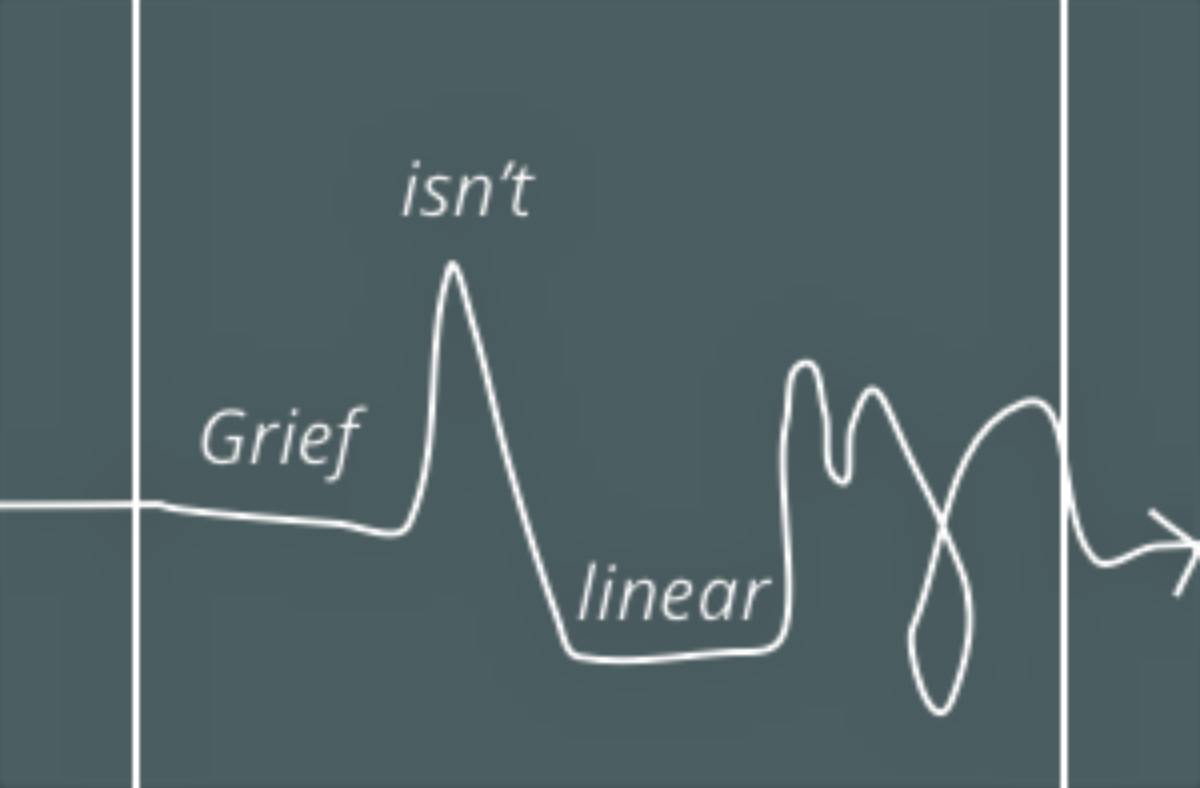
I really like this graphic that puts this in perspective.
It’s a slow, gradual process.And for some hearts who are forced to endure multiple losses in a short time the circle may never get very large because the grief is so great.
I remember when I realized that sorrow was not ALL I felt nor Dominic’s absenceALLI saw.It was a bit frightening to be honest.
Did that mean my love for him was waning or that his importance in our family was forgotten? Was I a bad mother because I no longer cried every day for the child not here? Had my heart grown cold?
But then I realized none of those things were true. What allowed me to feel joy again, to participate fully in family outings or gatherings, to plan holidays and birthdays once more was instead that my heart had found a way to hold both sorrow and gladness at the same time.
There are still days when grief looms large and my world seems too small to contain it. But those don’t come as often as they once did.
Life will march on, regardless of how hard we might wishit wouldn’t.
And, in large measure, life after loss is what we choose to make of it.
I remember very well the morning I woke on April 12, 2015-it was one year since I’d gotten the awful news; one year since the life I thought I was going to have turned into the life I didn’t choose.
I was horrified that my heart had continued to beat for 365 days when I was sure it wouldn’t make it through the first 24 hours.
I shared this last year around this time in response to many, many comments and questions from bereaved parents about what felt like random or unusual physical manifestations of their own grief.
I hope it helps another heart navigate this life none of us would choose.
❤ Melani e
It’s a well known fact that stress plays a role in many health conditions.
And I think most of us would agree that child loss is one of (if not THE) most stressful events a heart might endure.
So it’s unsurprising that bereaved parents find themselves battling a variety of physical problems in the wake of burying a child.
My goal this month is to share posts (some shared previously) that will encourage bereaved parents and also give them something to share on their own social media.
If we remain silent-shushed and shamed by those who find death uncomfortable or unmentionable-then things will never change.
The power is ours. Truly it is.
Tell your story. Tell your child’s story.
❤ Melanie
I’ve had awhile to think about this. Seven years is a long time to live with loss, to live without the child I carried, raised and sent off in the world.
So I’ve considered carefully what my “top ten” might be.
In all fairness, Elizabeth Kubler-Ross never intended her book, “On Death and Dying” to be adopted as a proscriptive model for walking hearts through grief.
It was a compilation of observations and interviews with those who were facing death or actively dying not a study of those left behind to mourn.
Sadly, however, it’s been used as a standard to measure grievers’ “progress” for decades.
It’s time to let it go.
❤
Ever since Elizabeth Kubler Ross published her best-selling book, “On Death and Dying” both professionals and laypersons have embraced her explanation of the “five stages of grief”.
The model has been used as a faulty standard to measure grievers’ “progress” for decades.
I belong to a number of closed online bereaved parent groups.
I’m not sure if it is a function of gender or not, but the moms seem to be a bit more willing to share their feelings and to respond to the feelings of others.
Every now and then, a dad speaks up. When he does, I usually pay close attention to this male perspective.
Wes Lake is a bereaved dad in our group who often has thoughtful posts that touch my heart. This one in particular was a beautiful, true and helpful reflection so I asked him for permission to share.
No one wakes up one day and just “is”. We become, over time, as our innate nature interacts with the world around us. First our parents and siblings influence us and then school, friends, life experience either gently molds us or pounds us into shape.
Often we get so used to our own way of doing and being we never give it much thought. It’s just “how we are”. We work around our faults and try to use our strengths to our advantage.
Most of us are pretty good at it.
Then something earth shattering comes along and suddenly the cracks are exposed and we haven’t the energy to cover them over.









 thelifeididntchoose