One More Time: What Broken Hearts Need From Others During Holidays

I know it is hard.  I know you don’t truly understand how I feel.  You can’t.  It wasn’t your child.

I know I may look and act like I’m “better”.  I know that you would love for things to be like they were:  BEFORE.  But they aren’t.

I know my grief interferes with your plans.  I know it is uncomfortable to make changes in traditions we have observed for years.  But I can’t help it.  I didn’t ask for this to be my life.

Read the rest here:  Grief and Holidays:What the Bereaved Need From Friends and Family

Exploding the Myth: God Doesn’t Give You More Than You Can Handle

blessings-come-through-rain-drops

You know, I don’t expect those outside the Body of Christ to have good theology-that’s like expecting me to be able to explain thermodynamics.  

Ain’t gonna happen-it’s outside my scope of understanding and practice.

I do expect those who have spent a lifetime reading Scripture, studying Sunday School lessons and listening to sermons to know better.

But many don’t.

“God doesn’t give you more than you can handle” is bandied about freely among those who, if they thought about it before they said it, know it isn’t true.

god-doesnt-give-you-more-than-you-can-handle

Usually it’s tossed at someone going through a tough time in an effort to encourage them.

Can I just let you in on a secret?  It is NOT encouraging.  At. all. Not one bit.

Because what’s implied is that I SHOULD be able to handle this.

But I can’t.

And it lets you off the hook.  

It’s like I’m drowning and instead of diving in to rescue me, you’re giving swimming lessons from the safety of the shore.

It’d be much more helpful if you threw me a lifeline.

life-preserver

God routinely gives me more than I can handle.

It’s one tool He uses to turn my heart to Him.  It’s one way He helps me understand (although He knows it already)  that I absolutely cannot handle it by myself.

So instead of sending the message that I should be able to handle this-join me in the dark place, hold my hand as we walk together and help me feel God’s love through you.


presence best gift


It Matters to That One

Talk is cheap.  

So many folks think posting a meme or retweeting a catchy phrase is the same as acting on what they believe

It’s not.

If the only action you take to advance the values you claim to hold dear is a few keystrokes behind the safety of a screen I question your commitment.

Don’t tell me you love your neighbor when you don’t know his name.

Get up off the couch and make a difference.

Can I change the world?  Probably not.

But I can change my corner of it.

Can I help everyone?  No.

But I can help someone.

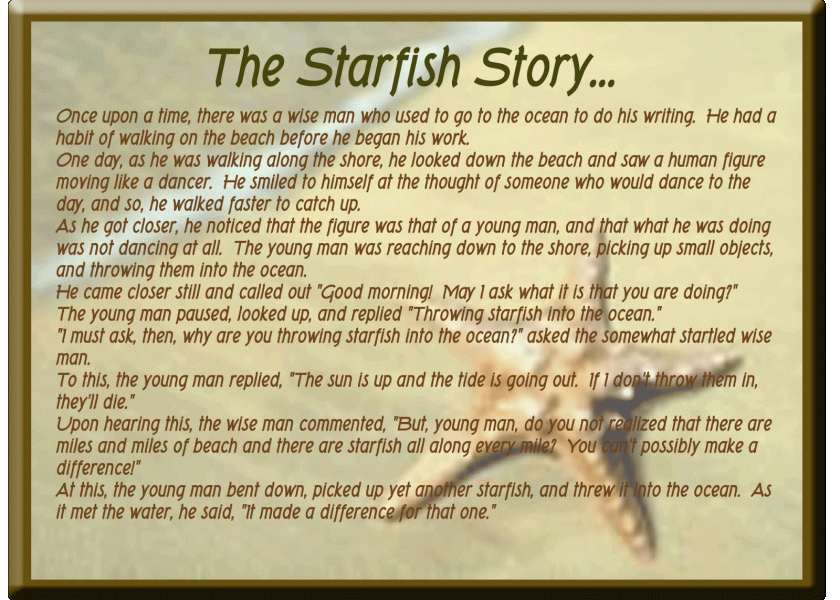
This is an old story, but it’s true:

starfish-story


How To Respond When Someone Shares Their Pain

empathy-dictionary

We’ve all been there-we ask a routine question and someone refuses to play the social game.  

We say, “How are you?” and they answer honestly instead of with the obligatory, “I’m fine.  You?”

Suddenly the encounter has taken an unexpected turn.

“Oh, no!  I don’t know what to say,” you think.

It can end badly-both of you walking away uncomfortable and wary.

But it doesnt have to. There are ways to express compassion and empathy, words that can comfort and encourage.

What should you say when I, or anyone, shares their heart-their pain?

  • Acknowledge my pain. Don’t be silent or gloss over my declaration by changing the subject.  Silence often feels like disapproval and changing the subject feels like dismissal.  I have just entrusted you with something important, something it was hard for me to share, something that is a great burden on my heart-let me know you heard me.  Good responses that are always appropriate:  “I’m sorry”; “That must be hard”and “My heart hurts for you”.  In person, a hand on the arm or a hug is good.  Give me space to cry if that’s what I need to do.


  • Ask questions.  Not the who-what-when-where-why questions that fuel gossip and make good news stories.  But questions that can help me share more:  “Do you want to talk about it?” or “How can I help you?”.  It may take a few moments for me to answer-I may have to think about if I really do want to share more.  You may help me by asking, “What’s especially hard right now?”  


  • Accept that this hurts ME-even if you think it wouldn’t hurt YOU. Everyone’s story  is unique.  You may be more emotionally, physically, psychologically and spiritually resilient than me.  Great!  But this is MY story, and this hurts ME.  Please, please, please do not try to talk me out of my pain.  Please don’t toss Bible verses or platitudes at me seeing if they will stick.  Please don’t tell me about how YOU would handle my situation (unless I ask). And, more than anything, please do not turn my heartfelt sharing into a discussion of how my pain causes you pain.  It may be true, but now I feel guilty instead of supported.


  • Affirm me for sharing, for enduring and leave the door open for next time.  It takes courage and energy for me to share my pain.  Many days I gloss over inquiries because I’m just too worn out to spend the limited emotional energy I have left on the drama of sharing honestly.  If I risk it, it’s because I’m either desperate or I trust you.  Either way, let me know you appreciate my bravery.  Tell me that you see how hard it is and that just carrying on is an accomplishment.  Leave my heart better than you found it so I’ll be encouraged to share again.   

Brene Brown has done some amazing work in the area of shame, hurt, compassion and empathy.  I’ve found it valuable in my own valley and also instructive in serving others in theirs.  

This short video based on her work is incredibly helpful. Please take a moment to watch it:  Brene Brown on Empathy

brene-brown-on-empathy-image


Bridle your Tongue

In this journey of loss I have been blessed and wounded by words.

I have been encouraged and disheartened by stray comments.  I’ve been thrown a lifeline and pushed under the raging waves of grief by friends, family and acquaintances who often had no clue they were doing either.

Our words matter. 

Our tongues have the power of life and death.

Whoever first wrote “Sticks and stones can break my bones, but words can never hurt me” was either in denial or lived a very sheltered life.

Please, for the love of love, think before you speak.

Choose to listen before you lob a response bomb across whatever divides your heart from another. Count to ten if you have to, take a deep breath, read and re-read your words before you press “post”.

And, if all else fails remember:  if you don’t have something nice to say, maybe it’s better not to say anything at all.

The one you think is invincible may be on the edge of crumbling.  The one you think is strong may be hanging by a thread.

We all make mistakes in all kinds of ways, but the man who can claim that he never says the wrong thing can consider himself perfect, for if he can control his tongue he can control every other part of his personality! Men control the movements of a large animal like the horse with a tiny bit placed in its mouth. Ships too, for all their size and the momentum they have with a strong wind behind them, are controlled by a very small rudder according to the course chosen by the helmsman. The human tongue is physically small, but what tremendous effects it can boast of! A whole forest can be set ablaze by a tiny spark of fire, and the tongue is as dangerous as any fire, with vast potentialities for evil. It can poison the whole body, it can make the whole of life a blazing hell.

James 2-6 PHILLIPS

Every person on this planet bears the image of the God who made him or her.  You can’t disrespect the person without also disrespecting the Lord.

tongue-has-no-bones

Repost: When Will You Be Over This?


family never gets over the death of a loved oneThink back on the most awful thing that has ever happened to you.

Does it still hurt?  Do you still carry scars from where it pierced your soul and broke your heart?

Can you forget it? Really, really forget it?

Read the rest here:   When Will You Be Over This?

HALTing a Grief Spiral

If you’ve ever been in any kind of counseling or recovery group , you have probably seen or heard this acronym and advice: HALT  before you speak.

It’s a great reminder that I should take a moment to consider my frame of mind before I blurt out something that might damage a relationship or wound someone else’s heart.

I had never thought about it until recently, but it is also a great reminder to us who grieve that what we interpret solely as grief (which we cannot control) might be compounded greatly by other things  (some of which we can control).

So I am learning to apply the HALT acronym to a grief spiral in my own life.

When I feel absolutely overwhelmed and the grief wave is dragging me under I ask myself, “Am I hungry, angry, lonely or tired?”

hungry

H-Am I hungry?

  • Have I eaten something within the past 4-6 hours?
  • Have I had enough water in the past 2 hours?
  • Have I eaten too much sugary food today (this can impact blood sugar even if I’m not “hungry”)?
  • Am I eating a balanced diet overall?
  • Am I grazing and eating too much?
  • Do I have an underlying physical condition such as hypoglycemia or diabetes which may impact my ability to think clearly?

Some of us eat our feelings and some of us avoid food when we are stressed.  Either can be terrible for health and for mental well-being.

If you have ever been diagnosed as borderline diabetic in the past, intense grief can send you over the edge-request that your primary health provider do an A1-c test, not just measure fasting glucose.

If you don’t feel like eating, make it a non-option.  Set an alarm on your phone if you have to and consider food as medicine.  If you aren’t fueling your body appropriately, you just simply don’t have the energy to do all the things grief requires.

If you find you are overeating, try to portion out healthy and lower calorie snacks that can help you feel full but are lower in sugar and empty calories. Or instead of eating, try taking a walk or doing a few minutes of impromptu exercise.

angry

A-Am I angry?

Somewhere in life I embraced the idea that anger is “bad”.   When I am angry, I feel the anger and also feel guilty for being angry.

  • Has someone said something that upset me?
  • Has someone done/not done something that frustrates me?
  • Am I angry at God?
  • Am I angry at my missing child for leaving/for choices they made/for not saying “good-bye”?
  • Am I angry at myself for not protecting my child (even if it was not in my power to do so)?
  • Am I angry with my spouse or other close family members because they are not grieving in the same way as me?
  • Am I angry that the world goes on without my child?
  • Am I angry at friends that haven’t “been there” for me?

Acknowledge your anger.

If it is toward a person, ask yourself if you can bring it to them and mend the relationship. If that’s not an option, think about how you can construct boundaries to limit that person’s impact on your life, at least while you are experiencing the most intense feelings of grief.

If it’s toward God, express it in a journal or aloud or to a safe friend.  The Psalms are full of “Why God?”;  “Where are You?”;  “Why have You abandoned me?”

If your anger is toward your missing child, consider writing your thoughts in a journal or a letter to him or her.  Often I find that really all I need is an opportunity to express myself. It doesn’t “fix” things, but it makes them bearable.

woman-looking-through-rainiy-window

L-Am I lonely?

Grief is an isolating experience.  

Once the funeral and first few days or weeks pass by, most people around us either don’t think about our loss or don’t recognize its ongoing impact on our daily lives.  There have been many days when I have felt very, very alone.

  • Do I feel isolated in grief?
  • How long has it been since I was with other people?
  • Have I called/texted/messaged anyone today?
  • Has anyone called/texted/messaged me today?
  • Do I feel like nobody understands me?
  • Do I feel like God has abandoned me?
  • Do I feel like I just can’t talk to anyone anymore because of the differences in our experiences?

I have been blessed with some amazing friends who continue to seek fellowship even though it’s been  2 1/2 years since my son left us.  And I also joined several online communities of bereaved parents where I can vent my feelings any time and be assured that I am received, affirmed and understood.

I think anyone who hopes to heal after the loss of a child must have a safe someone to talk to.  If you don’t have friends or family that can fill that need, consider counseling.  There are just some things you have to speak aloud to be able to work out.

exhaustion

T-Am I tired?

  • Did I sleep last night?
  • Am I going to bed too late or waking too early?
  • Am I staying overly busy and running myself down?
  • Am I getting adequate and appropriate exercise?
  • Am I taking medication that makes me sleepy/tired?

I know that for many bereaved parents, sleep is elusive.  And once asleep, staying asleep is a whole other issue.  But without proper rest, you cannot have the resources to do the work grief requires.

If you are consistently struggling with sleeplessness, consider asking your healthcare provider for help.  There are a number of natural sleep remedies (melatonin, valerian root, etc.) that may be appropriate.  And if necessary, prescription medicine can help break the cycle of insomnia.

None of these things-hunger, anger, loneliness or feeling tired-are the root cause of my grief.

I grieve because my son is gone.

BUTany of them, or a combination of them-can make me more vulnerable to feeling worse IN my grief.

I cannot control the fact that I am grieving.

I cannot remove the burden of sorrow and pain that losing a child has placed upon me.

But I can make adjustments in my lifestyle or life choices to make it easier to bear that burden.

How Many Children Do You Have?

A friend shared this poem recently.  I had never read it before but it spoke to my heart.
Whenever someone asks, “How many children do you have?”
I always give the true answer, ” I have four children.”
Because I do.
we-are-seven-1
We Are Seven

By William Wordsworth

———A simple Child,
That lightly draws its breath,
And feels its life in every limb,
What should it know of death?

I met a little cottage Girl:
She was eight years old, she said;
Her hair was thick with many a curl
That clustered round her head.

She had a rustic, woodland air,
And she was wildly clad:
Her eyes were fair, and very fair;
—Her beauty made me glad.

“Sisters and brothers, little Maid,
How many may you be?”
“How many? Seven in all,” she said,
And wondering looked at me.

“And where are they? I pray you tell.”
She answered, “Seven are we;
And two of us at Conway dwell,
And two are gone to sea.

“Two of us in the church-yard lie,
My sister and my brother;
And, in the church-yard cottage, I
Dwell near them with my mother.”

“You say that two at Conway dwell,
And two are gone to sea,
Yet ye are seven! I pray you tell,
Sweet Maid, how this may be.”

Then did the little Maid reply,
“Seven boys and girls are we;
Two of us in the church-yard lie,
Beneath the church-yard tree.”

“You run about, my little Maid,
Your limbs they are alive;
If two are in the church-yard laid,
Then ye are only five.”

“Their graves are green, they may be seen,”
The little Maid replied,
“Twelve steps or more from my mother’s door,
And they are side by side.

“My stockings there I often knit,
My kerchief there I hem;
And there upon the ground I sit,
And sing a song to them.

“And often after sun-set, Sir,
When it is light and fair,
I take my little porringer,
And eat my supper there.

“The first that died was sister Jane;
In bed she moaning lay,
Till God released her of her pain;
And then she went away.

“So in the church-yard she was laid;
And, when the grass was dry,
Together round her grave we played,
My brother John and I.

“And when the ground was white with snow,
And I could run and slide,
My brother John was forced to go,
And he lies by her side.”

“How many are you, then,” said I,
“If they two are in heaven?”
Quick was the little Maid’s reply,
“O Master! we are seven.”

“But they are dead; those two are dead!
Their spirits are in heaven!”
’Twas throwing words away; for still
The little Maid would have her will,
And said, “Nay, we are seven!”

Source: The Longman Anthology of Poetry (Pearson, 2006)


wisdom-is-often-nearer-when-we-stoop-than-when-we-soar

Bereaved Parent’s Wish List

This list is adapted from a friend’s Facebook post (with permission) and a list published by Children’s Hospital of Colorado.

BEREAVED PARENT’S WISH LIST:

1. I wish my child hadn’t died. I wish I had my child back.

2. I wish you wouldn’t be afraid to speak my child’s name. My child lived and was very important to me. I need to hear that my child was important to you also.

3. If I cry and get emotional when you talk about my child, I wish you knew that it isn’t because you have hurt me. My child’s death is the cause of my tears.

4. Being a bereaved parent is not contagious, so I wish you wouldn’t shy away from me. I need you now more than ever.

5. I might be sad and I might cry, but I wish you would let me talk about my child.

6. I wish you wouldn’t expect my grief to be over in a certain amount of time. I wish you could understand that my grief will never be over. I will suffer the death of my child until the day I die.

7. I am working very hard on my recovery, but I wish you could understand that I will never fully recover. I will always miss my child, and I will always grieve that my child is gone.

8. I wish you wouldn’t expect me to “not think about it” or to “move on.” Neither will happen, so don’t frustrate yourself.

9. When I say, “I’m doing okay,” I wish you could understand that I don’t “feel” okay and that I struggle daily.

10. I wish you knew that all of the grief reactions I’m having are very normal. Depression, anger, hopelessness, and overwhelming sadness are all to be expected. So, please excuse me when I’m quiet and withdrawn or irritable or cranky.

11. I wish you understood that grief changes people. When my child died, a big part of me died as well. I am not the same person I was before my child died and I will never be that person again.

12. I wish very much that you could understand …understand my loss and my grief, my silence and my tears, my void and my pain but I am so very thankful you don’t share my experience.  


Repost: How Do You Breathe?

“It was the question I asked the bereaved mother that came to my son’s funeral.

It was the question a mother asked me as we stood by her granddaughter’s casket, surrounded by family and flowers.

And it is the right question.

Because when the breath leaves the body of your child, and you look down at the shell that used to be the home of a vibrant, living soul, you simply can. not. breathe.”

Read the rest here:  How Do You Breathe?