Holidays 2026: Ten Ways to Love a Mourning Heart at Thanksgiving

Thanksgiving is less than a week away and I know many are making final plans and preparations to gather family and friends around the table.

In the rush toward celebration, please don’t forget those in your circle who have suffered loss.

Even the second or third Thanksgiving with an empty chair is unbelievably hard.

Here are some helpful ideas to get you started.

❤ Melanie

We are all on a journey through life and each carry some sort of load. Mine is child loss.  Yours may be something else.

We can help one another if we try.

Love and grace grease the wheels and make the load lighter.

Here are ten ways to love a mourning heart at Thanksgiving:

1. Let them grieve. Give space and grace for any outward display of grief or emotion.  It doesn’t require comment.  Maybe an outstretched hand or a tissue or maybe not.  Sometimes silence presence is best.

2. Begin conversation with statements that are true for you and then listen. I appreciate someone sharing their heart with me.  It’s really OK to say, “Hey, I’ve wanted to reach out but I just didn’t know how.” I would rather hear that than excuses.  ❤

3. Share a memory of their child or their pregnancy (if a child was born straight into heaven). Whenever I hear a story about Dominic I may not have heard before, it is a gift.

4. Speak their child’s name. It may make me cry.  But I cry anyway. And if no one says his name I cry because I think they’ve forgotten.

5. Give them room to step away. Sometimes I’m overwhelmed and I just need a breath of fresh air or a moment to gather my strength.  Don’t send the cavalry to “rescue” me and don’t make me feel bad by drawing attention to my absence when I return.

6. Find a way to commemorate their child in company with the living. Light a candle, place a photo, set an honorary place at the table, give a gift in his memory to a charity and display the card-there are many ways to make him part of the holidays.

7. Allow them to participate/ not participate as they are able. This will be our fourth set of holidays and I still don’t have a routine that feels “right”. I do enjoy and even crave cooking meals so I appreciate being asked to do that.  Some other things are still hard so I appreciate not being forced to do those.

8. Don’t use this once or twice a year gathering to require an extended debrief of how they are feeling/coping/doing. Invite me to share and then respect the boundaries I establish in my sharing.  It depends on the day whether I’m going to give you a brief response or a long one. Let me lead the dance.

9. Try not to make assumptions about what is best for their heart. Ask questions instead of making pronouncements. Like I said, I still don’t have any traditions that feel right after nearly four years.  I need space to think about and make choices about what may work for THIS Thanksgiving.

10. Remember that all holidays are hard. When the whole family gathers, it highlights even more that my son is missing.  Other times it’s easier to play a mental game with myself and pretend he’s just off somewhere. But when the chairs are drawn around the table and his is empty, there’s no denying that he is gone, gone, gone.  Lots and lots of grace makes it easier for my heart.

empty chair prayer

Holidays 2026: A Bereaved Parent’s Wish List


If you’ve followed this space for very long, you probably noticed that I don’t publish many lists.

I usually like to share my thoughts and observations generously padded by narrative. That’s because lists can sometimes sound harsh and unkind.

But when I came across this one several years ago, I found it honest, useful and to the point for folks who might not wade through folksy wisdom to find the meat of things.

So here it is one more time:

This list is adapted from a friend’s Facebook post (with permission) and a list published by Children’s Hospital of Colorado.

BEREAVED PARENT’S WISH LIST:

1. I wish my child hadn’t died. I wish I had my child back.

2. I wish you wouldn’t be afraid to speak my child’s name. My child lived and was very important to me. I need to hear that my child was important to you also.

3. If I cry and get emotional when you talk about my child, I wish you knew that it isn’t because you have hurt me. My child’s death is the cause of my tears.

4. Being a bereaved parent is not contagious, so I wish you wouldn’t shy away from me. I need you now more than ever.

5. I might be sad and I might cry, but I wish you would let me talk about my child.

6. I wish you wouldn’t expect my grief to be over in a certain amount of time. I wish you could understand that my grief will never be over. I will suffer the death of my child until the day I die.

7. I am working very hard on my recovery, but I wish you could understand that I will never fully recover. I will always miss my child, and I will always grieve that my child is gone.

8. I wish you wouldn’t expect me to “not think about it” or to “move on.” Neither will happen, so don’t frustrate yourself.

9. When I say, “I’m doing okay,” I wish you could understand that I don’t “feel” okay and that I struggle daily.

10. I wish you knew that all of the grief reactions I’m having are very normal. Depression, anger, hopelessness, and overwhelming sadness are all to be expected. So, please excuse me when I’m quiet and withdrawn or irritable or cranky.

11. I wish you understood that grief changes people. When my child died, a big part of me died as well. I am not the same person I was before my child died and I will never be that person again.

12. I wish very much that you could understand …understand my loss and my grief, my silence and my tears, my void and my pain but I am so very thankful you don’t share my experience.

Sometimes, Thanksgiving is Born of Sacrifice


Rocking babies I never dreamed that one day my life would look like this.

I never imagined that one of those tiny bodies I held close to my mama heart would not outlive me.

Now I sit in the same rocking chair in the dark, thinking about how so many things I wouldn’t have written into my story are now part of it.

And if I’m honest,  it can easily overwhelm my heart. It can carry me to a place of despair and desperation where there’s no room for thanksgiving-not the holiday OR the feeling.

Here we are-the thirteenth year of holidays without Dominic-and I’m only a little better at it than I was at first.

empty chair prayer

Oh, I’ve figured out how to make my way through the day.  I can lay out the plates, fill the pantry and put on a spread.  I am not nearly as prone to tears as I once was-at least not while folks are watching.

But that easy flow of laughter and near chaos that once marked our gatherings has been replaced by a kind of mechanical plodding that moves from one moment to the next until the day has passed and I’ve survived once again.

I always expected our family to grow larger. I looked forward to the day we would no longer fit around the dining room table and we’d have to figure it out.  Spouses and then grandchildren peopled my imagination with such clarity!  While I never saw faces, I could hear the laughter and watch the motion of so. many. new. lives filling my home.

This year is especially strange.

Circumstances and work schedules and distance dictate that Thanksgiving will be spent with most of my family far away from my table.

So there won’t be just one empty chair today, there will be several.

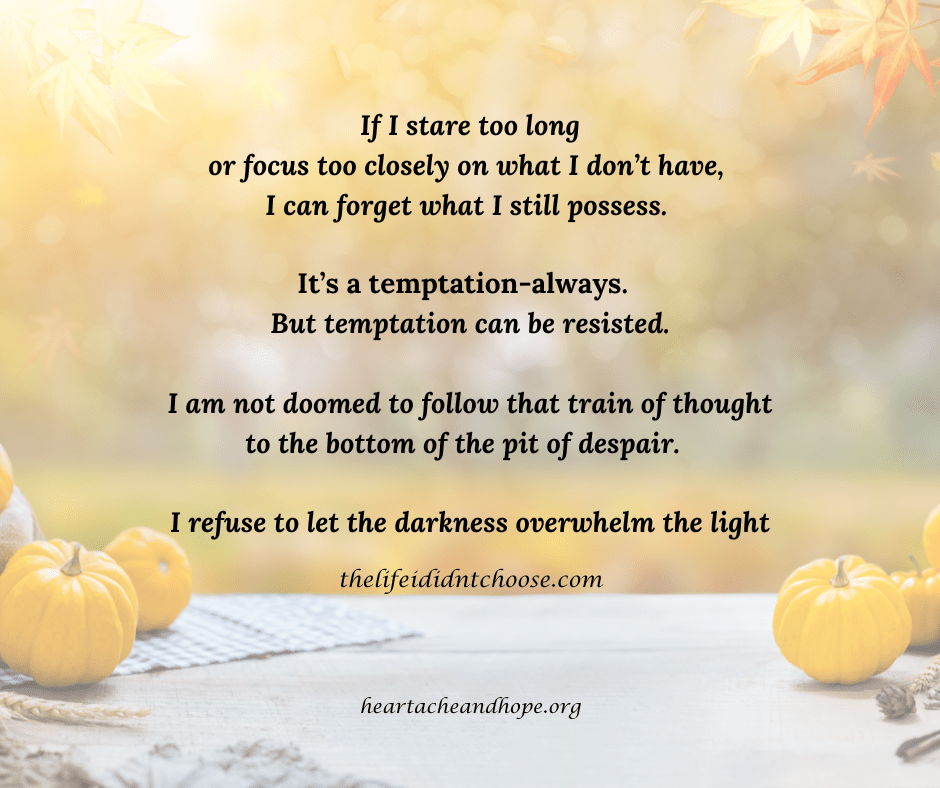
And if I stare too long or focus too closely on what I don’t have, I can forget what I still possess.

It’s a temptation-always.

But temptation can be resisted.  I am not doomed to follow that train of thought to the bottom of the pit of despair.

I refuse to let the darkness overwhelm the light.

I will be thankful for all the love this house has known, still knows and will know.  I will be grateful that even though we are physically distant, we talk to one another, sharing laughter across the miles.  I will cherish the moments I had with Dominic and rest in the knowledge that in eternity we will have so many more.

I can’t fill that chair-no one can fill that chair except my son-but I can fill my heart with good things.

I can choose thankfulness even when it’s hard.

Maybe that’s what Thanksgiving is really about-not an unending list of all the sweet things in life-but a short list of beauty extracted from the hard places.

Thanksgiving isn’t always bounty, sometimes it’s sacrifice.

❤

Child Loss and Holidays 2026: Seven Practical Ways to Help Grieving Parents During the Holidays

I have a favor to ask my nonbereaved friends and family: Would you read this and think about how you can extend grace and practical help to the bereaved parents (and other bereaved folks) in your circle?

I bet you’re already planning menus, hiding gifts and juggling schedules.

It won’t be nearly that complicated to create space and choose to bless the bereaved in the midst of holiday festivities.

Here are seven easy ways to do just that.

❤ Melanie

Most parents feel a little stressed during the holidays.

For bereaved parents, the rush toward the “Season of Joy” is doubly frightening.

Constant reminders that this is the “most wonderful time of the year” make our broken hearts just that much more out of place. Who cares what you get for Christmas when the one thing your heart desires–your child, alive and whole–is unavailable…

It is so hard to find a way to trudge through the tinsel when what you really want to do is climb into bed and wake up when it’s all over.

Here are some practical ways family and friends can help grieving parents during the holidays:

  1. Don’t resist or criticize arrangements a bereaved parent makes to help him or her get through this season.If they are brave enough to broach the subject, receive their suggestions with grace and encourage them with love.  Do your best to accommodate the request.
  2. If the bereaved parent doesn’t approach you–consider thoughtfully, gracefully approaching him or her about what might make the holidays more bearable.But don’t expect a well-laid plan-I didn’t get a “how-to” book when I buried my child…this is new to me and very, very painful.  I am doing the best I can to keep my head above the waves and I cannot be expected to captain the boat through these turbulant waters.
  3. Don’t be surprised if a bereaved parent doesn’t want to exchange gifts (or at least, not receive gifts). No one can rewind time or restore my family circle to wholeness and I just can’t think of anything else that I want or need.
  4. Don’t assume that the bereaved parent should be relieved of all meal duties around the holiday.For some of us, doing the routine things like baking and cooking are healing.  For others, there just isn’t energy for anything other than the most fundamental daily tasks. ASK if they want to contribute.
  5. Don’t corner surviving children for a private update on their parent’s state of mind. My children are grieving too.  When you expect them to give an update on me you diminish their pain and put them in a difficult position.  If you want to know, ask me.
  6. If there are young children in the family, it might be helpful to offer to take them to some of the parties/gatherings/church services that their parent may not be up to attending. Ask, but don’t be upset if they say “no”–it might still be too traumatic for either the child or the parent to be separated from one another.
  7. Ask them to share about the one they miss.  One of my greatest fears as a grieving parent is that my child will be forgotten.  But we might not speak up because we don’t want to make others feel uncomfortable.

I know that life goes on, the calendar pages keep turning and I can’t stop time in its tracks.  I greet each day with as much faith and courage as I can muster. This season requires a little more-and I will need help to make it through.

Child Loss and Holidays 2026: Practical Ways to Remember Our Children at Thanksgiving and Christmas

It’s not like we forget, is it?

And it may be that other folks remember too.

But it can feel oh, so lonely amidst the lights and the laughter when the one name you want most to be spoken aloud just isn’t.

So what are some practical ways to include our missing child in holiday celebrations?

I, and three other bereaved moms, together with Our Hearts are Home, shared thoughts and ideas on how to remember -in a tangible, physical way-our child during the holidays.

Two common themes tie them all together: (1)represent your child in a meaningful way that is authentic to who they are; and (2) help lead others into the knowledge that it is not only OK to talk about your child but downright joyful to hear it (even if it makes you cry).

Not every idea will suit every family but there is probably one (or more!) that you might find suit yours.

So here they are.

THANKSGIVING

  • Light a candle (real or battery powered) and put it in a prominent place or as part of a centerpiece. You can attach a lovely tag or put a picture next to it or somehow otherwise indicate that it is in honor of your child.
  • Memory candles of all sorts are available to order and ideas for making them are easily found online. They often have names and (if you want them) dates etched directly onto the candle or on a container designed to hold a candle.
  • Photographs are always wonderful. Some families set a place for their missing child or have a separate chair set aside to note their absence. Pictures can be placed on the table, on a side table next to a child’s favorite dish or in some other spot. It’s a Jewish tradition to include photos of all close family members gone before during Sukkot (a biblical holiday many feel is the precursor to our Thanksgiving) as a way to remember and honor ongoing ties and love
  • Cook your child’s favorite dish and put a note next to it that says so. Perhaps bring copies of the recipe or, if something that lends itself to this, prepare take home boxes with a serving or two for family members to relish and remember later. Mention to others sharing the meal that this is your child’s favorite and why. It’s a great way to encourage natural conversation.
  • Share why you are thankful for your missing child. This can be done in the context of offering thanks for other family members who have joined you and for those who are no longer present if you feel awkward or expect pushback from family members.
  • Provide a ceramic plate with your child’s name in the center and acrylic paint markers. Have family and friends write one word that they think of when they think of your child. Directions for curing the paint and making it permanent can be found online.
  • Donate a holiday meal in their honor through a local food bank or charity.
  • Watch a favorite movie or show and share memories of why it’s a favorite.
  • Create a memory table by asking guests to bring something that reminds them of your child. During your time together, ask the guest to share why they chose that item.
  • Create a Thanksgiving memory journal. Ask others to write a memory in it. You can add to it each year.
  • Do an act of kindness in their honor.
  • Share stories. One of the things I’ve learned is that if I don’t bring Dominic up and “give permission” to others, they often won’t either. Share about your child in Heaven just as you would one that is here on earth. Every family has a story about that “one Thanksgiving, so and so did…” .
  • Provide a family photo album of Thanksgivings past. These will naturally spark conversation about memories, about the lives and love of those no longer present and give bereaved parents a great opening to speak about their child.
  • Leave an empty chair or place setting.
  • Participate in a Thanksgiving walk or run in their honor. There are lots of 5Ks around this time of year and almost anyone can participate. Get a group, dress up honoring your child and (turkey) trot on!
  • You might just want to visit their grave or a special place that is meaningful to you.
  • Send thank you notes to those who were special to them or played a part in their lives. The first Thanksgiving after Dominic left for Heaven, I wrote notes to everyone I could think of who had shown up or helped our family in some way during those early days.

CHRISTMAS

  • Hang ornaments that represent your child. Some parents do a separate tree for their missing child (and some keep it up all year).
  • Hang your child’s stocking along with the others. You can write letters to your child and encourage other family members to add their own. You can ask family members to fill the stocking with gift cards that can be donated in your child’s name to a charity that represents his or her heart.
  • Volunteer to serve at one of the many organizations that need extra help this time of year.
  • Listen to favorite songs. It’s easy to make an entire dedicated playlist of songs that remind you of your child or are your child’s favorites.
  • Buy a gift they’d like and give it away. Many parents purchase gifts for a child who would be the same age as their child this year. You can get names from your local DHR or from churches or other organizations.
  • One family who draws names for Christmas asked family members to purchase a present that began with their daughter in Heaven’s first initial.
  • Adopt a family and provide Christmas for them in your child’s honor.
  • Make a memory chain for the tree. One mom said her daughter had family and friends write a memory on the strips and then put them together in a chain. It could be lengthened each year.
  • Purchase a poinsettia at church remembering your child.
  • Give an item that belonged to them to someone who would treasure it. This one can be hard because it’s difficult to release those physical objects our child last touched. But if/when you are ready, it can be a truly beautiful and special act of remembrance.
  • Make cookies for caregivers or others who helped during a prolonged illness or hospital stay. Make cookies for first responders in your own community.
  • Memory table runners are easy to purchase or make. Have guests write a favorite memory using permanent markers.
  • Make a story book of their life and display it where others can see it and enjoy it.
  • Make or purchase an ornament with their handwriting imprinted to give to family. Because Dominic left for Heaven when my other children were also leaving home, I have made or bought ornaments every year that represent our family and include names. Dominic’s is always included.
  • (Of course, you could do most of the things listed for Thanksgiving as well.)

I’ve written a lot about surviving the holidays after child loss and will be sharing many of those posts in the coming weeks.

But there are a few thoughts I want to leave you with that I pray provide some hope for any heart dreading the next seven weeks.

Soon after Dominic ran ahead to Heaven I realized all the trappings I associated with Thanksgiving and Christmas were not essential to the primary ideas embodied in both holidays.

Thanksgiving is about setting aside time to express gratitude to God for what He has done, is doing and will continue to do. 

I can still manage that. 

Christmas is a celebration of the Light coming into a dark world. 

This broken heart can definitely get behind that any day. 

So, in the end, if your heart cannot bear the thought of one more holly jolly song, one more hap-hap-happy get together, one more frenzied rush to the store for a forgotten present or pantry item—just choose to sit this one out. 

It’s OK.  I promise.

Here’s a link to the webinar: https://www.youtube.com/watch?v=70hNdxY9hWE

And here are links to a few downloadable resources:

Surviving the Holidays: Navigating Christmas With a Broken Heart (https://www.heartacheandhope.org/_files/ugd/fc3456_3f2dbf5095c847a5ac340996c3fbdac1.pdf)

Grief and Holidays: What the Bereaved Need From Family and Friends (https://www.heartacheandhope.org/_files/ugd/fc3456_0100d55e210d4ffa8cffa6f113eef48a.pdf)

Season of Joy: Blessing the Brokenhearted During the Holidays (https://www.heartacheandhope.org/_files/ugd/fc3456_f497651fd49c48c3ae86ba202e9f8ead.pdf)

Remembering Our Children During the Holidays: Practical Ideas (https://www.heartacheandhope.org/_files/ugd/fc3456_672b3487e6214ba7adb6ad6c895bd108.pdf)

Child Loss and Holidays 2026: Life Adds Layers

This holiday season will be very different for my family.

Last year at this time, we were looking forward with great gladness to adding a new little girl to the two grandboys who already brought laughter and joy to our lives.

Holly arrived early-December 21st-but was doing well when we gathered around the Christmas tree, bleary-eyed, coffee in hand, to watch the boys tear through wrapping paper and squeal with delight.

Less than twenty-four hours later, Holly was life flighted to Dallas Children’s Hospital and everything had changed. By January fourth, she had joined Dominic in the presence of Jesus.

Christmas was already a bit of a tricky season for us because my daughter’s birthday is on the eighteenth. When she was young, I tried hard to disentangle her special day from the tinsel and lights of yuletide celebrations.

After Dominic ran ahead to Heaven, it became a reminder of the once unbroken family circle and the increasing distance between old memories and making new ones. Like other child loss and sibling loss survivors, we had to find a way to navigate this hap-hap-happy time when our hearts weren’t always in it.

Now we have deep sorrow woven directly into our Christmas season.

And once again, I’m reminded that life adds layers to loss.

No matter how much we may want it to stop, the world keeps turning. Days turn to weeks turn to years and each moment has the potential to scribe joy or pain across our hearts.

This year is going to be very, very different from any of the sixty-two I’ve lived through before. I’ll be sitting next to a son who not only said a too-soon “good-bye” to his brother but also was granted a tragically brief few days with his own beloved daughter.

My daughter-in-law joins me as a bereaved mother.

Their children join mine as bereaved siblings.

I’m not entirely sure how or even if we will celebrate beyond providing gifts for the youngsters.

I’m back at ground zero.

But what I know now that I didn’t know THEN-the first year after Dom left us-it this: We will survive.

Life doesn’t only add layers of loss.

It also adds layers of joy and moments of gladness.

This year will be hard but not every year will be AS hard.

So if you, like me, are bearing up under a fresh load of sadness, don’t give up.

Hold on.

I’m praying for both of us.

Child Loss and Holidays: Practical Ideas for Dealing With the Holidays

It cannot be overstated:  holidays are extremely hard after loss.  Every family gathering highlights the hole where my son SHOULD be, but ISN’T.

There is no “right way” or “wrong way” to handle the holidays after losing a child.

For many, there is only survival-especially the very first year.

These days also stir great internal conflict:  I want to enjoy and celebrate my living children and my family still here while missing my son that isn’t. Emotions run high and are, oh so difficult to manage.

So I’m including some ideas from other bereaved parents on how they’ve handled the holidays.  Many of these suggestions could be adapted for any “special” day of the year.

Not all will appeal to everyone nor will they be appropriate for every family.  But they are a place to start.

If you have decided to make a Holiday Journal,  consider printing these ideas to put inside or copying out the ones that might be helpful for you.

Skip it.  

  • Sounds drastic and it is.  But for some families (especially if there are no small children involved) it is absolutely possible (and sometimes healing) to ignore all traditions and trappings associated with Thanksgiving and Christmas.
  • You might choose to serve others on these days by volunteering with a local organization offering meals to the homeless or disadvantaged in your community.
  • Take a holiday meal to hospital workers, police officers or firemen in your area.  You can do it anonymously or in the name of your child.

Consider traveling for the holidays.

  • On the first Thanksgiving after my son left us, we shared the weekend with our newly married son and his wife in another state.  It was the first time in my life I hadn’t spent the holiday with my parents.  It was still very hard, but helpful in a way.
  • Other families have chosen to rent a cabin or condo and have the same people involved but experience the season in another location.  Most try to choose a place with a natural focus for activity that isn’t all about the holiday-like skiing in the mountains or near a lake or beach.

Change how you do meals.

  • If your family traditions always include the same foods in the same house, you might want to eat the holiday meal in a restaurant instead.
  • You could swap up the timing of a meal-evening instead of noon or vice-versa.
  • Change up the guest list-include a few close friends along with family members (friends that understand your grief).  Sometimes it helps to have others not so affected by the loss in the mix.
  • If you have been the host but don’t feel like you can do it this year-definitely consider passing that to someone else.  And don’t feel guilty about it.
  • Include the missing family members at the table in some way. One bereaved mom wrote:  “My niece includes my  son and mom at events hosted in her home.  She sets a chair aside and places a photo in the seat and a commemorative bow on the chair back.”
  • Don’t make certain foods. I make giant plates of cookies but have not made shortbread cookies since my son left us.  It was his favorite and one of the few things that tempted him from his strict weight-lifting diet
  • Make your child’s favorites and enjoy eating them and sharing memories around the table.

Let others do the planning/cooking/communicating.

  • Explain to your family that you aren’t up to being the one to plan this year’s holidays.  Let someone else do it.  Participate if and when you can.  
  • Be kind, but stand your ground.

Make new traditions. 

  • If you go around the table at Thanksgiving saying, “I’m thankful for…“-it might not be something you can do this year.  That’s OK.
  • Light a candle for the missing child.  You might want to have those present share a favorite memory or you might simply want to have the candle create a silent presence.
  • Some families can’t bring themselves to use the same Christmas tree they used before loss so they get a new and/or different one.  Some don’t want a tree at all.
  • Some families have a separate tree full of ornaments or memorabilia for their missing child and use the main tree as usual for the rest of the family.
  •  “I have a separate tree for Z. . It’s filled with ornaments that remind us of him. They range from glass ornaments with his favorite candy inside to a Thomas the tank engine ornament. Collecting more ornaments for him as I’m out shopping for others helps me during this very painful time.”
  • Some families don’t hang any stockings while others hang them all, including the missing child’s.
  • Another family asks family members and friends to write a note to their son or share a favorite memory of him.  They place them in his stocking to be opened and read on Christmas Day.
  • “We asked everyone to do a random act of kindness in memory of our daughter and our friends’ son and to email it to us. We printed out all of the emails, put them in her stocking and read them as a family on Christmas morning. It was amazing to hear all of the lives touched as a result, and it took our focus off of our loss.”
  • My husband, children (all adults) and myself didn’t want to receive gifts from extended family the first year.  We still gave them, but asked that others refrain or give a donation in our son’s name.
  • Some families buy gifts that would be appropriate for another child the same age as their missing child (or the age they would be) and give them to  another child for Christmas.

Commemorate your child:  

  • Some bereaved parents put a Christmas tree with solar powered or battery powered lights on their child’s resting place.
  • Some parents take family photos and include a large photo of their missing child or a special family memento (like a stuffed animal or symbol on a shirt) to represent that child in the pictures.
  • Some families give donations in their child’s name to organizations that purchase Christmas gifts for needy families or food for families at Thanksgiving.
  • In some communities there is a “Blue Christmas” ceremony on December 21st each year in which families gather to remember lost loved ones with music, candles and sometimes a devotional message. Some are sponsored by local chapters of The Compassionate Friends.  If there is not one in your area, your church may be willing to host one.

Keep the same traditions:

  • For some families, keeping everything the same is the most comforting choice. Especially if there are young children involved, it may be the easiest way to go.
  • But feel free to ask for help.  If you are not up to shopping for children in the family, make a list, let someone else do it and wrap the presents for you. Or use an online shopping service (many offer gift wrap).
  • Same goes for holiday outings-maybe a good family friend or an extended family member could take the children this year and document it with photos.

Whatever you choose to do or not do, know that there’s no wrong way or right way.  

Be gentle with yourself-this is a hard road.  And a long one. 

Photo credit: State Farm via Visual hunt

Child Loss and Holidays 2026: What the Bereaved NEED From Family and Friends

I know it is hard.  I know you don’t truly understand how I feel.  You can’t.  It wasn’t your child.

I know I may look and act like I’m “better”.  I know that you would love for things to be like they were:  BEFORE.  But they aren’t.

I know my grief interferes with your plans.  I know it is uncomfortable to make changes in traditions we have observed for years.  But I can’t help it.  I didn’t ask for this to be my life.

I know that every year I seem to need something different.  I know that’s confusing and may be frustrating.  But I’m working this out as I go.  I didn’t get a “how to” manual when I buried my son.  It’s new for me every year too.

So I’m trying to make it easier on all of us.  

I’m trying to be brave and think ahead and offer up what I can to help you understand.

I’m not asking you to stuff your feelings.  But I am asking you to weigh your disappointment in things being different against my unfathomable sorrow in burying my child.

And this is what I need from YOU:

Acknowledge my loss.  It doesn’t matter if it has been a few months, a few years or even decades-every single time the whole family gets together, the hole where my child SHOULD be is highlighted.  Other people may have moved on, and I am stronger now than I was, but the missing is as hard today as it was the day he left.  I need you to acknowledge that even if you don’t understand it.

Be flexible.  Every day is different for me.  And even if we did a certain thing last year, it may not be something I want to repeat.  Life circumstances continue to evolve-living children grow and marry, grandchildren make their appearance, health issues may emerge and change physical capabilities-life keeps on regardless of loss.  So this year is DIFFERENT than last year.  For everyone.  If we all embrace flexibility, there’s less opportunity for breakage.  Rubber bounces.  Glass shatters.  I don’t want my loss to be the central focus, but it’s a huge part of my experience and I can’t ignore it.  Help me, please.

Give me space.  Grant space in the larger picture-don’t make showing up to every family event a “mandatory option”.  Understand that even with planning and the best intentions, I may wake up and realize that I. just. can’t. do. it.  Or I may come, but leave early.  And grant space in the details-if I walk out of a room, let me go.  It may be helpful for one person to check on me after a few minutes but don’t send the calvary to drag me back.  I don’t always want to detract from a gathering and I may need to cry, or gather myself, or just sit silently remembering my son.

Give me time.  Time by itself does not heal anything.  But time is a critical component of healing.  If this is the first holiday season after loss, don’t pressure me with artificial deadlines about what I want to do or whether or not I’m going to participate in this or that. And even if it’s not the first season, I still need time.  It will be the third set of holidays after my son’s departure and I’m still feeling my way in the dark.  Don’t force me to decide if I can’t.  Just go on with your plans.  If I can join in, I will.  If I can’t, then I won’t.  That’s the best I can do.  It’s how I have to live every single day right now.

Grant mercy.  I will mess up.  I will say things in the passion of loss that I regret.  Overlook it.  Don’t lash out or hit back.  My emotional tank is so empty sometimes that it’s a wonder I can still feel anything.  I am truly trying. Grant mercy.

Extend grace.  Grace is lavishing love on the unlovely. Forgiving when someone doesn’t ask for it.  Doing something for someone and not expecting anything in return.  Step up and step out in faith that loving me will help me heal.  Even when you can’t see that it makes a difference. Don’t stop.  Don’t withdraw.

Know that this is not what I would have chosen.

Child loss happened TO me.

It is out of my control.

And the calendar pages keep turning.  Every holiday season means another year gone without the companionship of the child I miss.

I want to continue to embrace life, to enjoy my loved ones, to make new memories.  But I need your help to make it happen.

Don’t abandon me now.

compassion is a choice

Child Loss and Holidays 2026: Hard Conversations

You don’t have to bury a child to know that changing long-standing family traditions around holidays is a hard, hard thing.

Just ask a parent trying to work out Thanksgiving and Christmas for the first time after an adult child marries.  Suddenly the way things have “always been” are no longer the way things are.

Holidays typically involve so many more people and family members than everyday get-togethers and each person brings expectations, emotions and personal history to the table.

So, that is why I decided to run this series of posts NOW.  Because one of the things I have learned over the years is that giving people time to adjust to change is a good thing.

If you have made a Holiday Journal like I suggested, then use a page to list all the people that are typically part of your family’s holiday plans-you might want to make subheadings by holiday (and there may be other special get-togethers your family observes, so include those).

That list is a starting point for the people you may need to communicate with about the upcoming holidays.

Don’t feel like you have to include each individual in a unique communication-you can focus on those who are “in charge” of the gatherings/traditions and request that they pass it along.

Here are some specific tips for reaching out:

Understand that they DO NOT understand.

  • I know that unless someone has experienced child loss themselves, they really do not understand what it feels like.  (You might choose to share this post to help them understand-just a bit:What Grieving Parents Want Others to Know)  
  • No matter how much they may want to, they cannot really feel what I feel.  I have to constantly remind myself of that.

Don’t wait.

  • The closer we get to those dates on the calendar the more likely that others will assume you are just going to continue the traditions.
  • Most people dislike change.  And they hate it even more when it is a last minute change.  So don’t delay in at least giving those affected by your plans a “heads up” that things won’t be the same this year.
  • On a practical note people may need time to change plans if they involve making travel arrangements.

Decide how you will communicate your message.

  • Do you want to speak to them (on the phone or in person)?  This choice allows for subtle communication through tone and inflection but also requires immediate response.  Very few people can say, “I need to think about this” before blurting an answer.  Sometimes verbal exchanges can escalate quickly.
  • Do you want to write your message (text, message, email)?  This choice allows for a delayed response, gives a record of what was communicated but leaves room for misinterpretation because tone and inflection are hard to indicate by written word.  Let your heart and past experience with the person(s) be your guide.  It may be that it’s best one way for some and another way for others.

Acknowledge their loss.

  • Regardless of the relationship of other family members to your missing child, they have lost something  and someone too. They may not feel my pain precisely, but they feel the pain of losing a grandson, nephew, cousin and they feel the pain of losing who I was before burying my child.
  • They need space and permission to express their loss.

Use “I” statements.

  • Don’t accuse.  Don’t bring up every bad memory from Thanksgiving and Christmas past. Start from today and say, “I feel like I cannot do all (or some or any) of these things for Thanksgiving and Christmas this year.”
  • Be as honest as you can be.  Feelings are not wrong.  What we do with them may be wrong or hurtful.  But it’s OK to say, “I just can’t do this right now” or “I don’t know how to do this without my child”.

Expect resistance.

  • People naturally hate change.  We develop relationship ruts and it takes a lot of energy to climb out of them.  They may very well find great comfort in keeping things as “normal” as possible after your loss.
  • What is helpful for you may feel threatening to them.
  • Stand your ground without being combative.  You can say something like, “I understand this is very hard on you, and I am sorry that this is painful, but it’s just how it needs to be for me and my family to continue to heal.”

If you can, offer an alternative.

  • In subsequent posts I’ll share some ways other bereaved parents have approached the holiday season.  Maybe one of those ideas will appeal to you and you can offer it as an alternative to the way things were before loss.
  • You might suggest that extended family continue traditions they cherish and you join in for the part you feel you can endure.

Extend grace.

  • Assume the best.  Assume that your extended family and friends are trying to understand and do not want to add to your burden or cause you pain.  Re-read messages with an ear to what hearts are saying even when the words may fail to communicate that message.
  • Ask for clarification before you react. There is so much room for misunderstanding around holiday plans anyway and when you add loss to the mix, it can be a recipe for relational disaster.
  • Allow time before responding to something that hurts your feelings.  It may very well have been unintentional.

I know that all these suggestions require additional emotional energy when we feel we are already tapped out.  We are already carrying a load that can crush a spirit-it seems unfair that we have to initiate the conversation, offer alternatives and give grace.

But they do not understand.

And they may not know where to start.

We have to remain focused on the goal:  Surviving the holidays.

If your family includes young children, how you approach this season is even more important.  You are building memories for them, shaping their childhood experiences and helping them learn to cope with what will be a life-long challenge-living with grief.

Child

Child Loss and Holidays 2026: So Yeah…Here Come the Holidays

When I was forced into this life I didn’t choose, I had no model for how to navigate holidays post child loss. Not one Thanksgiving dinner nor Christmas morning of my life had been marred by the deep, dark MISSING that fills a bereaved parent’s heart.

So I muddled through, best I could, striving hard to embrace and accommodate my own and my family’s pain while managing expectations of those outside our immediate grief circle.

It was hard.

It was emotionally exhausting.

It still is, some days and seasons.

But if I’ve gained any wisdom from over a decade of holiday seasons spent without Dominic, it’s this: Better to face it and make a plan than to ignore it and let things unfold willy-nilly.

I’m praying for you. Now. In October.

❤ Melanie

I will confess: I’m no better at this than the first set of holidays after Dominic ran ahead to Heaven.

Every. Single. Year. has brought changes and challenges on top of the empty chairs round the family table.

Since Dominic left us we’ve had additions (two grandchildren and various significant others) and sadly, more subtractions (my mother joined Dom in 2019). We’ve dealt with distance, deployment, healthcare and retail work schedules, a pandemic and lots of other, less easily defined tensions and difficulties.

When I ran across this quote awhile back my heart screamed, “YES!!!”

Gathering an entire family (which may include teens and young adults) for any extended length of time is a feat of scheduling, negotiation, and preference management. International treaties have been worked out in fewer steps. The sheer number of details that have to line up is mind-boggling.

Elizabeth Spencer

There are the absolute parameters forced upon any family by distance and availability. Negotiating THOSE is truly a feat.

But when your family story includes profound loss, a mama often has additional hoops to jump through. Surviving siblings bring their own grief to the table and what that looks like can change over time. So something that worked one year might be rejected this season.

I wish I had some magical insight that could guide every wounded heart through these next, treacherous months.

I don’t.

What I can tell you is that it’s better to start earlier rather than later. Nothing falls into place without some planning. Old habits are hard to break and traditions are well-worn habits so don’t expect anyone to give them up easily.

No one can read your mind (are YOU telepathic?). Tell your friends and family what you need (even if it is that you have NO idea what you need!).

And then make space in your celebrations for times when you can grieve the absence of your child. It may be a shared moment or it may be you remember in solitude.

If you have surviving children, remember they are grieving too. They have lost a sibling, their innocence regarding death’s ability to steal even the young and the family they once knew.

Extend grace to others when you can.

Extend grace to yourself when you must.

Be honest and do the best you can.

Then remember that even these days are only twenty-four hours long. They will pass.

The sun will rise and you will, undoubtedly find out you survived.