Responding Well To Hurting Hearts

We’ve all been there-we ask a routine question and someone refuses to play the social game.

We say, “How are you?” and they answer honestly instead of with the obligatory, “I’m fine.  You?”

Suddenly the encounter has taken an unexpected turn.

“Oh, no!  I don’t know what to say,” you think.

It can end badly-both of you walking away uncomfortable and wary.

But it doesn‘t have to. There are ways to express compassion and empathy, words that can comfort and encourage.

What should you say when I, or anyone, shares their heart-their pain?

  • Acknowledge my pain. Don’t be silent or gloss over my declaration by changing the subject. Silence often feels like disapproval and changing the subject feels like dismissal. I have just entrusted you with something important, something it was hard for me to share, something that is a great burden on my heart-let me know you heard me.  Good responses that are always appropriate: “I’m sorry”; “That must be hard”and “My heart hurts for you”.  In person, a hand on the arm or a hug is good. Give me space to cry if that’s what I need to do.
  • Ask questions.  Not the who-what-when-where-why questions that fuel gossip and make good news stories. But questions that can help me share more: “Do you want to talk about it?” or “How can I help you?”.  It may take a few moments for me to answer-I may have to think about if I really do want to share more.  You may help me by asking, “What’s especially hard right now?”
  • Accept that this hurts ME-even if you think it wouldn’t hurt YOU. Everyone’s story  is unique.  You may be more emotionally, physically, psychologically and spiritually resilient than me. Great!  But this is MY story, and this hurts ME. Please, please, please do not try to talk me out of my pain. Please don’t toss Bible verses or platitudes at me seeing if they will stick. Please don’t tell me about how YOU would handle my situation (unless I ask). And, more than anything, please do not turn my heartfelt sharing into a discussion of how my pain causes you pain. It may be true, but now I feel guilty instead of supported.
  • Affirm me for sharing, for enduring and leave the door open for next time. It takes courage and energy for me to share my pain.  Many days I gloss over inquiries because I’m just too worn out to spend the limited emotional energy I have left on the drama of sharing honestly.  If I risk it, it’s because I’m either desperate or I trust you. Either way, let me know you appreciate my bravery. Tell me that you see how hard it is and that just carrying on is an accomplishment. Leave my heart better than you found it so I’ll be encouraged to share again.

Brene Brown has done some amazing work in the area of shame, hurt, compassion and empathy. I’ve found it valuable in my own valley and also instructive in serving others in theirs.

This short video based on her work is incredibly helpful. Please take a moment to watch it: Brene Brown on Empathy
brene-brown-on-empathy-image

Grief Work 2026: Learning To See Beyond My Own Pain

I remember clearly walking around like a giant nerve for the first days, weeks and months after Dominic left us.

It didn’t take much for me to burst into tears.

Everywhere I went I was forced to endure words and actions that pierced my heart.

It was hard not to take it personally. It was impossible not to react. Surely people should know better, be better, do better!

But the truth is, they don’t know. And if I’m honest I have to admit that before it was ME, I didn’t know either.

So part of the work grief required was for me to develop thicker skin.

I had to learn to scroll past social media posts, overlook careless comments and not expect those outside my immediate grief circle to understand how Dominic’s death continues to impact me and my family.

❤ Melanie

If you’ve joined me here for more than a minute you know I am a fierce advocate for bereaved parents in particular and all grievers in general.

But you’ve probably also noticed that, at least in my own life, I recognize how traumatic and/or difficult circumstances can make it hard to see past the hurt and the shattered world a broken heart inhabits. I can judge others harshly without meaning to.

A couple of recent incidents have reminded me how easy it is to interpret every offhand comment or heartfelt opinion as targeted at ME when, in fact, they are simply a reflection of that person’s experience in the world.

I can’t insist that others see the world through MY eyes if I’m not equally prepared to try to see it through THEIRS.

Look, I know how painful it is to scroll through social media posts and feel the darts land square in the center of my heart. Parents bemoaning their children leaving home (all the while I’m thinking, “yeah-but you can call, visit and still hug your child”); folks complaining about how hard it is to manage schedules and meals or trying to figure out family vacations with teens or young adults (“gee, I wish I had the privilege of including ALL my kids for holidays“); and then there are the “miraculous deliverance from a wreck” posts (I’m wondering why Dom wasn’t delivered).

But NONE of those folks are posting or commenting with me in mind. They are simply sharing their thoughts and feelings just like I share my own.

I’ve learned to just scroll on past.

It’s neither healthy nor helpful for me to type some long (or short!) snarky comment trying to “correct” them. I’m not entirely sure they need correcting.

Before it was ME that sent a child to Heaven I had No. Idea.

They don’t either.

So save your energy for the work grief requires. Save it for the family you’ve got left. Save it for a rainy day when tears fall as fast as drops from the sky.

You’re gonna need it.

How Can I Respond When Someone Shares Their Pain?

We are surrounded by hurting hearts. When one of them turns to you and bravely holds out her pain, accept it as an offering.

Because it is.

An offering of trust, friendship and vulnerability. 

❤ Melanie

We’ve all been there-we ask a routine question and someone refuses to play the social game.  

We say, “How are you?” and they answer honestly instead of with the obligatory, “I’m fine.  You?”

Suddenly the encounter has taken an unexpected turn.

“Oh, no!  I don’t know what to say,” you think.

It can end badly-both of you walking away uncomfortable and wary.

Read the rest here: How To Respond When Someone Shares Their Pain

Grief Journey: Please Be Patient With Me

Thankfully for most parents graduation isn’t really an end.  It marks a transition and perhaps growing geographical distance, but the relationship will continue.

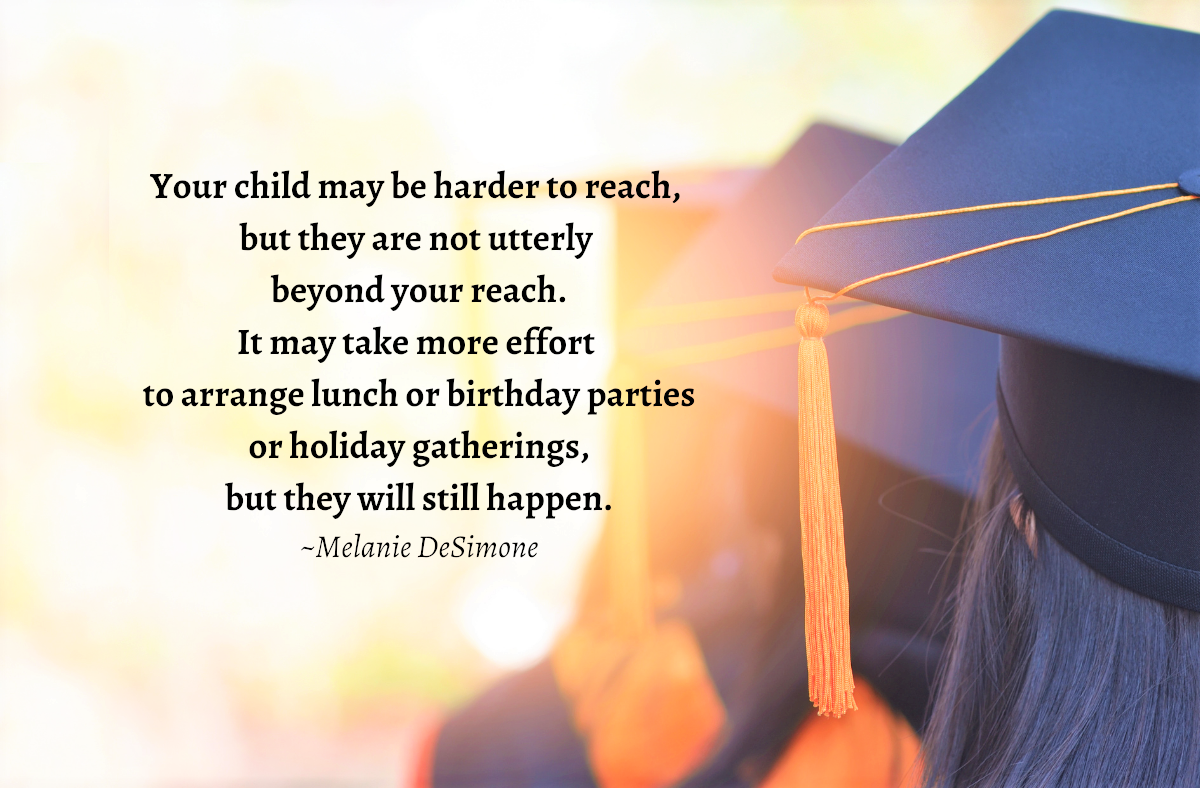
Your child may be harder to reach, but they are not utterly beyond your reach.

You might stand at the doorway of their empty room and wonder when they might come home for a visit and wake up under your roof again, but they WILL come home for a visit.

I’m not diminishing the very real sense of loss parents feel when the child they have nurtured begins a life apart.

But some of us face something harder.

My child is utterly unreachable.

Read the rest here: Please Be Patient With Me

You Can Help Hurting Hearts

We are surrounded by hurting hearts. When one of them turns to you and bravely holds out her pain, accept it as an offering.

Because it is.

An offering of trust, friendship and vulnerability. 

❤ Melanie

We’ve all been there-we ask a routine question and someone refuses to play the social game.  

We say, “How are you?” and they answer honestly instead of with the obligatory, “I’m fine.  You?”

Suddenly the encounter has taken an unexpected turn.

“Oh, no!  I don’t know what to say,” you think.

It can end badly-both of you walking away uncomfortable and wary.

Read the rest here: How To Respond When Someone Shares Their Pain

How Can I Help Wounded Hearts?

We are surrounded by hurting hearts. When one of them turns to you and bravely holds out her pain, accept it as an offering.

Because it is.

An offering of trust, friendship and vulnerability. 

❤ Melanie

We’ve all been there-we ask a routine question and someone refuses to play the social game.  

We say, “How are you?” and they answer honestly instead of with the obligatory, “I’m fine.  You?”

Suddenly the encounter has taken an unexpected turn.

“Oh, no!  I don’t know what to say,” you think.

It can end badly-both of you walking away uncomfortable and wary.

Read the rest here: How To Respond When Someone Shares Their Pain

Patience Appreciated!

I wrote this a few years ago in response to post after post across social media of (mostly!) moms lamenting the fact their son or daughter would soon be moving away or off to college. 

I get it!  

When you are used to having your kid around it’s tough when he or she leaves the nest.  

But there is a vast difference in having to work a little harder to stay in contact or arrange visits and never being able to speak to your child again. 

It’s an adjustment to compare calendars to find a day your family can celebrate together but it’s heartbreaking to know that one chair will always be empty at every family gathering.  

Read the rest here:  Please Be Patient With Me

Responding Well When Someone Shares Their Pain

We’ve all been there-we ask a routine question and someone refuses to play the social game.  

We say, “How are you?” and they answer honestly instead of with the obligatory, “I’m fine.  You?”

Suddenly the encounter has taken an unexpected turn.

“Oh, no!  I don’t know what to say,” you think.

It can end badly-both of you walking away uncomfortable and wary.

But it doesn‘t have to.

Read the rest here: How To Respond When Someone Shares Their Pain

Silence Really IS Golden-What NOT to Say to Grieving Hearts

I just got back home from attending the funeral of one of my parents’ very best, lifelong friends.

And even though he was full of years I’m never prepared for the way death steals from us.

As I looked around the crowd gathered near his wife I wondered how many might be offering up platitudes and quips that probably sound helpful in their heads but which fall hard on a broken heart.

So for those who feel compelled to say something, anything, in the silent space between a hug and giving way to the next person in line, here are a few things NOT to say.

❤

Humans are hard-wired to say something when silence lingers long between them.

So it’s not surprising that when death makes talking difficult, the person most susceptible to that pressure will often blurt out the first thing that pops into her head.

And it is often, oh, so wrong.  

Read the rest here: What NOT To Say

Holding The Door and Other Acts of Kindness

I’ve had a lot of people “hold the door” for me on this journey of child loss.

Most of them have not walked in my shoes but they could see my soul was worn and I needed encouragement.

For that I will be eternally grateful.

Read the rest here: Empathy: Let Me Hold The Door For You