Navigating Grief: Today is a Gift

“Today is a gift, that’s why they call it the present.” ~unknown

Do we treat each day as a gift from a loving God, a present wrapped up in His grace and goodness, to be opened with joy, used with care and set lovingly on the shelf of life when done?

Or do we bear it as a burden?

I’ll admit not all days are equal.

Some ARE burdens.

No one (I don’t think!) loves going to the dentist. Few of us are keen on doing taxes or taking tests or slogging through the rain to work or school.

Some of us have much heavier burdens as we wake to an empty bed, an empty heart or an empty bank account.

But even these awful days are a gift.

Why?

Because God’s mercies are new every morning. The rising sun brings fresh opportunity to rest in, rely on and relish God’s grace, goodness and promised strength.

And every new day means we have more time.

More time to love the people we love, more time to find new people to love, more time to do the good works which God in Christ has planned for us to do.

We wake each morning to the same 24 hours given every other soul on this planet.  It’s ours to choose. 

How will we spend it?  Will we fill it with foolish things? With important things?

Here’s how I do it:

  • Put the significant and essential things in first. Time with the Lord, time with family, time with my own thoughts. (Orienting my heart and mind to what truly matters first thing makes the rest of the day so much better.)
  • Then the necessary. Work, school, chores, appointments, cooking and meals. (No way around having to do these things, but I can still choose to fit them in AFTER the most important and valuable ones.)
  • Finally, the incidental things. Facebook, television, window (internet) shopping, binge watching Netflix. (So hard to discipline my heart to focus on what will truly make a difference instead of distracting myself with the trivial.)

And surprisingly I manage most days to get it done (even checking social media).

Life is not an emergency, although I often live as if it is.

I careen around the corner of hour after hour like I’m driving a car out of control, begging someone to make it stop.

I can make it stop.

I can take my foot off the accelerator, park it and decide where and how fast I’m going to drive tomorrow.

Every single day is an opportunity to choose.

I can start fresh and make time for the things that are truly important.

If I want to.

Navigating Grief: Hardly the Time for Being Taught


It seems to be the nature of humans to listen with an ear to respond rather than an ear to hear.

I’ve done it myself.

Jumped right in with all kinds of suggestions designed to “fix” someone else’s problem.

Or worse, heaped my own experience with something more or less (often less) similar onto an already overburdened heart.

I hate that tendency in myself and I’m working hard to try to change it.

Image result for listen to respond listen to understand

Those who feel compelled to just say SOMETHING often bombard grievers with platitudes, comparisons to their own grief or just empty, frivolous words that require we either stand there dumbfounded or find a gracious way to exit the conversation.

It’s especially painful for a broken heart when a well-meaning someone decides THIS is the moment for a theology lesson.

“God has something planned for you in this” or “God will use this for good”. (Romans 8:28-29)

“We don’t grieve as those without hope!” ( I Thessalonians 4:13)

“All our days are numbered.” (Psalm 139:16)

I get it-death is a heavy subject and the death of a child isn’t something anyone wants to talk about, contemplate or be forced to wrestle with. So it’s often easier to simply say something-anything-do your duty and walk away.

But it is hardly helpful.

Deep grief as a result of unbearable loss is not a teaching moment.

It’s an opportunity to listen well, think carefully about if or when you need to say anything and simply offer compassionate companionship to a broken heart.

Grieving felt hardly like the time for being taught, at least initially. Early grief was my time for pulling out of my past those truths that I had already learned — out of my ‘basement — so that I could begin to assemble them together into something even more meaningful to me than before. It was the time for understanding that even though I had always believed in heaven, it now looked to my perceptions to be more real than this world. It was the time when, even though I already believed in God’s control of the world, I now felt dependent upon him being sovereign over it for all my hopes. It was the time for realizing that even though I already believed that Christ conquered death, I now longed to see death die.

Lianna Davis, Made for a Different Land

Navigating Grief: Darkness and Fear

I was afraid of the dark until I was almost forty years old.

My fear was rooted in scary childhood moments and even years of adult experience could not rip it from the soil of my psyche. I never could convince my heart what my head knew to be true: there was nothing in the dark that wasn’t also there in the light.

It was fear, not darkness, that controlled me.

There is great darkness in grief.  So many unanswerable questions, so much anquish, so much pain.

And there is darkness in many other painful, unchangeable circumstances.

The darkness can hide things that I see clearly in the light.  And if I’m not careful, I  can allow the darkness to foster fear and keep me from venturing futher.

In my own strength, depending on my own resources, I am afraid.

But when I call out from my scary place to the God Who made me, I can face the fear in confidence He hears and cares.

When I am afraid, O Lord Almighty, I put my trust in you.

Psalm 56:3 GNT

Sometimes believers in Christ can convince themselves that admitting their world is dark with pain or suffering or questions diminishes the power of God–that it speaks ill of God or that it means God is insufficient to uphold us in our weakness.

If I pretend that I’m never afraid, or that I never experience darkness, I am denying others my aid.

Even worse, I may be shaming them to silence, sending the message that if they are experiencing pain, something is wrong with THEM.

How many people are sitting in our pews with broken hearts and broken lives, afraid to reach out for help because–in addition to the pain of their broken life–they live under condemnation?

Life is full of pain and darkness.  Even for those who follow Jesus.

When I deny that truth, I also refuse to testify to God’s power to help me carry on and give me the courage to face my fear.

God is the God of the day AND the God of the night.  

I do not diminish Him by admitting that I experience both.

He invites me to lean into Him and to hold hands with His children as I journey on, even when it’s dark.

“Christians with this unflinching faith in the sovereign God do not deny grief. But even in their darkest hours, they borrow God’s strength. In their tears and pain they cling to God who will never let them go. What the Savior has done for others He will do for you. When you are shaken, and you know that life will never be the same again, you can trust and not be afraid. You can live in HOPE with the sturdy confidence that God will dry your tears and put you on your feet again.”

“Grief, Comfort for Those Who Grieve and Those Who Want to Help” by Haddon W. Robinson

Navigating Grief: To Deny the Presence of Pain is to Diminish the Power of the Cross

To deny the presence of pain is to diminish the power of the cross.  

Dying, Jesus honored His mother’s courage by acknowledging her pain. She was losing the Son she loved and it hurt in a way that only mothers can comprehend.  He didn’t tell her that it would “be alright” or that “the ending is ultimately victorious”.

Instead, He looked upon her trembling figure and saw her broken heart.

He made what practical provision He could by telling John to care for her. He knew it would not undo her sorrow.

Some in the church preach that pain and suffering are anomalies–that they are aberrations in the “victorious Christian life”.

And we place great emphasis on the idea that even though we may have trouble in this life–“We know the REST of the story!”  Jesus WINS!

Yes. He. does.

But some of our earthly stories-the ones we are living right now- do not have tidy, happy endings:

Some are burned in the fire.

Some die of cancer.

Some fall headlong into mental illness.

And some bury their children.

What to do when you are confronted by undeniable pain in your own or someone else’s life?

Acknowledge it.

Look with mercy on the broken heart.

Allow suffering to flow from the cracks unchecked and unjudged.

Be still and be love.

Offer practical aid without strings attached.  Be mindful of what is actually helpful even if it doesn’t make sense to you.  Come alongside for the long haul.

There is no greater gift to the one who is suffering than a faithful friend who refuses to be frightened away.

Loving burden-bearers help those of us living with no-happy-ending earthly stories cling more securely to the hope of ultimate victory in Christ.  

And by doing so, declare the power of the cross.  

For the message of the cross is foolishness [absurd and illogical] to those who are perishing and spiritually dead [because they reject it], but to us who are being saved [by God’s grace] it is [the manifestation of] the power of God.

I Corinthians 1:18 AMP

A Prayer for the Broken-Blessing the Dust

There are many times in my life when I’ve felt small and unseen.

Many times when my spirit sank so low I couldn’t even remember “up” much less find it.

But there is no moment so humbling as the one when I came face-to-face with the undeniable FACT that my son had exhaled for the last time.

Walking into the sanctuary where his body lay still, unnatural and absolutely silent, my heart shattered into even smaller pieces.

So I understand Job’s cry.

I cry out to You for help, but You do not answer me; when I stand up, You merely look at me.

Job 30:20 HCSB

I know what it is to fall to the ground in utter dejection, complete hopelessness and pray, pray, pray that life leaves my body because the pain is unbearable.

That’s one reason Lent is a kind of relief every year.

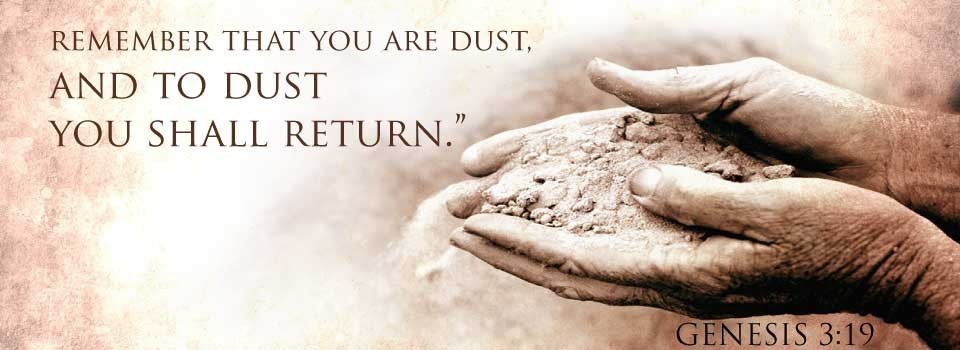
It’s a season when others join me in admitting that from dust we came and to dust we will return.

Image result for from dust to dust

But it’s also a season of hope.

Because while Lent forces my heart to focus on my frailty, it points me toward my Savior.

The One who made us is the One who rescues us.

The One who saves us is the One who sees us.

The One who sees us is the One who longs to comfort us.

I love this blessing by Jan Richardson:

“All those days
you felt like dust,
like dirt,
as if all you had to do
was turn your face
toward the wind
and be scattered
to the four corners

or swept away
by the smallest breath
as insubstantial—

did you not know
what the Holy One
can do with dust?

This is the day
we freely say
we are scorched.

This is the hour
we are marked
by what has made it
through the burning.

This is the moment
we ask for the blessing
that lives within
the ancient ashes,
that makes its home
inside the soil of
this sacred earth.

All those days
you felt like dust,
like dirt,
as if all you had to do
was turn your face
toward the wind
and be scattered
to the four corners

or swept away
by the smallest breath
as insubstantial—

did you not know
what the Holy One
can do with dust?

This is the day
we freely say
we are scorched.

This is the hour
we are marked
by what has made it
through the burning.

This is the moment
we ask for the blessing
that lives within
the ancient ashes,
that makes its home
inside the soil of
this sacred earth.

So let us be marked
not for sorrow.
And let us be marked
not for shame.
Let us be marked
not for false humility
or for thinking
we are less
than we are

but for claiming
what God can do
within the dust,
within the dirt,
within the stuff
of which the world
is made
and the stars that blaze
in our bones
and the galaxies that spiral
inside the smudge
we bear.”

—Jan Richardson, Blessing the Dust, For Ash Wednesday

It’s no secret I am frail, prone to break-even shatter-into the tiniest bits of dust.

But that doesn’t stop my God from gathering what’s left to make something beautiful.

When I find myself face down in the dirt, no strength to lift my head, I remind my heart, “[Do] you not know what the Holy One can do with dust?”

Navigating Grief: When Life Looks More Like Ash Wednesday than Fat Tuesday

Twenty-four hours separate one of the most outlandish global parties and one of the most somber religious observances on the Christian calendar.

Many of the same folks show up for both.

Mardi Gras, “Fat Tuesday”, is the last hurrah for those who observe Lent-a time of reflection, self-denial and preparation before Resurrection Sunday.

It’s a giant party-food, fellowship and fun-a wonderful way to celebrate the blessings of this life.

Ash Wednesday, by contrast,  is an invitation to remember that “from dust you came and to dust you will return”.  

None of us get out of here alive.

Even where the Gospel is preached every Sunday there are those who forget this life is hard and often full of pain and suffering.

If your experience so far has looked more like Mardi Gras and less like ashes, well, then-be thankful.

But don’t be deceived.

“From dust you came and to dust you will return.”

For some of us it was a similar twenty-four hour turnaround that upset our world, tossed us headfirst into the waves of sorrow and burned that truth into our hearts, not just dabbed it on our foreheads.

Sometimes I feel excluded from fellowship with the saints because I can’t join in the celebratory spirit of a worship service.

When the hymns only focus on our “victory in Jesus”  my heart cries, “Yes-but perhaps I won’t see the victory this side of heaven.”

When the congregation claps and dances to feel-good songs that celebrate the sunshine but ignore the rain, my eyes swim with tears because I know the reality of a downpour of sorrow.

Because sometimes praise is a sacrifice.

offerings

Church needs to be a place where we can share the pain as well as the promise that Christ will redeem it.

Jesus Himself said, “in this world you will have trouble”.

So I can’t claim allegiance to the Church of the Perpetually Cheerful.

I want to create space for the hurting and broken and limping and scared.

How about a new denomination that acknowledges the truth that life is hard.

Instead of the “Overcoming Apostolic Praise-filled Ministers of Eternal Optimism” I would name it the “Trudging But Not Fainting Faithful.“

By all means enjoy the “Fat Tuesdays” in life.

Drink them in, dance, celebrate! 

But remember that it can change in a heartbeat.

And that it HAS changed for many of us.

There is hope.

All is not lost.

But in the meantime, it’s hard.

An Invitation: Lenten Journaling Guide

I don’t know about you, but this year I feel especially beat up.  I’ve had personal circumstances and family circumstances that have once again plunged me beneath the heavy and impenetrable fog of grief. 

It will be an unbelievable twelve years since Dominic ran ahead to Heaven on April 12th. He died the Saturday before Palm Sunday and was buried the Monday after Easter. 

When the dates and days don’t correspond, I feel like most years I experience it all twice.   


Photo by Katie Jewell Photography

And even though I depend on the observance of Lent to walk my heart through this Season of Sorrow, I just don’t have it in me to look up verses, parse their meaning and try to derive some deeper spiritual lesson from any of it. 

But I want something structured to keep my focus from drifting away from the truth which keeps me anchored to hope. 

If that resonates with you, then this Lenten Journaling Guide might be something that helps your heart too.  I’d love to have company.

Before we start, I want to say this:  Lent is not about performance. It is an invitation to walk honestly with Jesus.

For those who carry grief, surrender can feel complicated.

Some days you may have many words. Other days you may have none.

Both are sacred.

This journal is a gentle companion — not a task list. Move slowly.

Skip a day if needed. Linger where the Spirit meets you. You are not behind. You are not failing.

You are walking a broken and sacred road.

Holding space for grief. Pointing toward hope.

~ Melanie

You can download the Lenten Journal Guide here:

https://www.heartacheandhope.org/_files/ugd/fc3456_75aa51759a284a54a56f1316980a3391.pdf

THIS Wednesday is Ash Wednesday and Lent begins on Thursday.

Navigating Grief: Seeing Scripture as an Eternal Love Story

When I began to view Scripture as an eternal love story, it opened my heart to the truth that even when this broken world results in pain, sorrow and unbearable (without Jesus) burdens, Love is writing a better ending.  

I don’t have to like what’s happening but I can lean in and grab hold of my Shepherd King who will always guide me through the awful.  

I may ache for a lifetime but will rejoice for eternity.

Does that negate the pain?  

NO!

Does it make it bearable?

YES!

Navigating Grief: Bringing My Emotions to Jesus

“Emotions are real, but they can lie.”  

I repeat that to myself often.   

In everyday life I can interpret another person’s silence as a snub when, in fact, they simply were so distracted they didn’t see or hear me. 

t

Now, I know God is never asleep or distracted (see Elijah vs. Jezebel’s “priests”).  

But I know sometimes He feels distant or silent.  

He’s not.  

Jesus promised to never leave nor forsake me.  

And He hasn’t.

When I can’t feel or hear Him, it’s usually because my emotions are running so high the noise drowns out His still, small voice.

So I bring them to Him as a sacrifice and trust Him to help me bear them and to align them with the TRUTH that what I am currently suffering is not the last word.  

My story will be redeemed.  

My unfathomable loss will be restored.

His promises never fail.

Navigating Grief: The Problem of [Un]Answered Prayer

Our family is going through another hard, hard season. Three weeks ago today, my granddaughter, Holly, was gathered into the arms of Jesus.

This little babe was prayed for before she was born early and every moment of every day until she went to Heaven a mere fourteen days later.

So once again I find myself in the position of asking, “Does prayer even matter?”.

When it’s not your kid you can think of all kinds of lofty, theologically correct arguments or reasons for why God answers one prayer and not another–for why one person is healed and not another–for why one person survives a devastating-should-have-killed-him accident but not another.

But when it is your child that doesn’t survive or isn’t healed or is stolen through the violent actions of someone else…well, that’s a different matter entirely.

Read the rest here: The Problem of [Un]Answered Prayer