Unbounded Love: A Generous Life

Every day I have a choice:  I can live with my hands closed tightly around what I think I can protect from others or I can live with my hands open both to give and to receive.

Losing a child makes it tempting to cling that much tighter to what and who I have in my life.

But losing a child also makes it plain that no matter how tightly I hold onto the people and possessions I think are mine, in the end, I’m just not strong enough to do it.

I don’t have power over sin and death.   I can’t anticipate or control the thousands of potential dangers that lurk around corners and spring from shadows.

Every thing and every person that I treasure is a gift from God.  They were given me to steward, not to own.

There is an interesting conundrum associated with success documented in many studies: those who have more tend to give less.  The actual dollar amount may be larger, but as a percentage of income or wealth, it is much smaller.

It seems that those who accumulate wealth and experience privilege begin to consider themselves more deserving than those who live in poverty.

I think there is a corollary in the church:  we who are members of the Body of Christ and walk in the joy of forgiveness can drift from remembering that we, too, were once far from God, walking in darkness and without hope.

It wasn’t so long ago that you were mired in that old stagnant life of sin. You let the world, which doesn’t know the first thing about living, tell you how to live. You filled your lungs with polluted unbelief, and then exhaled disobedience. We all did it, all of us doing what we felt like doing, when we felt like doing it, all of us in the same boat. It’s a wonder God didn’t lose his temper and do away with the whole lot of us. Instead, immense in mercy and with an incredible love, he embraced us. He took our sin-dead lives and made us alive in Christ. He did all this on his own, with no help from us! Then he picked us up and set us down in highest heaven in company with Jesus, our Messiah.

Ephesians 2:1-6 MSG

God is a generous and loving God.  He makes his rain to fall on the righteous and the unrighteous :

You have heard that it used to be said, ‘You shall love your neighbour’, and ‘hate your enemy’, but I tell you, Love your enemies, and pray for those who persecute you, so that you may be sons of your Heavenly Father. For he makes the sun rise upon evil men as well as good, and he sends his rain upon honest and dishonest men alike.

~Matthew 5:44-47 MSG

He longs for all to come to a saving knowledge of Christ:

The Lord does not delay His promise, as some understand delay, but is patient with you, not wanting any to perish but all to come to repentance. ~2 Peter 3:9 HCSB

And He has called us as His ambassadors of reconciliation to proclaim His goodness, love and generosity throughout the world:

All this is done by God, who through Christ changed us from enemies into his friends and gave us the task of making others his friends also.

2 Corinthians 5:18 GNT

When we walk with closed hands, when we act as if we are “us” and the rest of the world is “them” we build walls instead of bridges.

And we push people away instead of drawing them in.

Have we forgotten that but for the grace of a loving and generous God, we too would be lost?

What are you so puffed up about? What do you have that God hasn’t given you? And if all you have is from God, why act as though you are so great, and as though you have accomplished something on your own?

I Corinthians 4:7 TLB


the cost of compassion

I can’t help it.

I think too much.  I wonder too often.  I work too hard to make sense of things.

And the thing that is puzzling me right now is why people pull away from those experiencing deep and lasting pain.

Like the pain of burying a child.  Or the burden of chronic physical disability.  Or the unceasing struggle of overcoming addiction.

I think I’ve hit on a few possibilities:

  • There is no end in sight.  None of these scenarios offer a tidy final chapter that wraps loose ends into a comfortable narrative.
  • It challenges what we believe about God.  It’s one thing to consider the problem of pain and suffering in the world from a theoretical perspective and quite another to experience it in real time.
  • Our days are too full of “busy work” to leave room for real ministry. Overscheduled and frazzled,  we don’t have the emotional, physical or psychological energy required to stand with someone while they battle.

So we trade pity for compassion.

Pity says, “I’m sorry for you.  Let me do something for you that makes me feel better.”

We offer platitudes and prayers from afar as a substitute for presence and personal interaction.

And when our attention is turned elsewhere, we drift away–abandoning the broken to sit alone with their pain.

Most of us don’t mean to do it–we just move on, leaving the limping behind.

But the cold shoulder wounds as much as hurtful words. Acknowledgement is as great a blessing as an extended hand.

Compassion says, “I see your pain.  I hurt with you.  Let me stay with you until you feel better.  And if you never feel better, I’ll still be here.”

Compassion requires conscious commitment to push back against our tendency to forget those who live with things they cannot change and will never forget.

God Himself stepped into His creation to feel the pain of brokenness, to bear the price of sin and to open a Way for restoration and redemption.

Jesus came to make the Father known.

There is no substitute for walking with the wounded.  It is costly, it is painful, it is hard.

But I would argue that when we do, we are most like our Savior.


Repost: Loving a Grieving Heart

If you love someone who has lost a child, perhaps these thoughts might help you understand a bit of their pain and how completely it changes the way we who have encounter the world.

Please be patient.  Please don’t try to “fix” us.  Please be present and compassionate.  And if you don’t know what to say, feel free to say nothing–a hug, a smile, an understanding look–they mean so very much.

A bereaved parent’s grief doesn’t fit an easy-to-understand narrative. And it flies in the face of the American “pull yourself up by your bootstraps” mentality.

You can’t beat it–it’s not a football game-there is no winning team.

You can’t lose it–it’s not the extra 10 pounds you’ve been carrying since last Christmas.

You can’t get over it–it’s not a teenage love affair that will pale in comparison when the real thing comes along.

You can only survive it.  You can heal from it, but it will take a lifetime and require very special care.

I have a young friend whose first child was born with a life-threatening heart defect.  At just a few months of age, her little girl received a heart transplant.  Without it, she would have died.  With her new heart, this sweet baby will live-but her parents must observe careful protocols to protect that heart and she will never outgrow the scar from the surgery that saved her life.

Burying Dominic wounded my heart so deeply that while I know it will heal–it is beginning to, I think–it will bear the scars and require special handling as long as I walk this earth.

So when I thank you for an invitation, but choose not to go…I’m not rejecting you, I’m protecting my heart.  Please ask again–tomorrow might be a better day, and going somewhere or being with someone could be just what I need.

If you call and I don’t pick up…I might be crying, or about to, and I choose not to burden you with my grief.  Call in a day or two or next week–keep trying.

A text or email or card is so helpful.  I can read these when I’m ready and respond when it’s easier for me to think.

And please, please, please don’t look for the moment or day or year when I will be “back to my old self”.  My old self was buried with my son.  I am still “me”–but a different me than I would have chosen.

I know it makes you uncomfortable–it makes me uncomfortable too.

But because I trust in the finished work of Christ, I know that one day my heart will be completely healed.

I hurt but I have hope. This pain will be redeemed and my scars will be beautiful.

“For just as Christ’s sufferings are ours in abundance [as they overflow to His followers], so also our comfort [our reassurance, our encouragement, our consolation] is abundant through Christ [it is truly more than enough to endure what we must]”  2 Corinthians 1:5.


When it Doesn’t Feel Like Grace

It’s been said that everything this side of hell is the grace of God.

But burying my child doesn’t feel like grace, it feels like punishment.

Or abandonment.

Or forgetfulness.

I cannot add my voice to the modern Christian chorus of “Everything happens for a reason”.

Is this my tree, set in the midst of my garden?  The one about which God says, “Trust Me”?

I am tempted to argue, tempted to try to frame the meaning of my test in terms my human heart can understand.

“God must not love me.”

“He must be hiding something.”

I am faced with the same question that mocked my first mother, “Did God really say?”

And, like Eve, I am tempted to give in to the fear that draws my soul to doubt the wisdom and goodness of God.

Why would He bring me to this place where I am forced to walk obediently in trust and without light?

But these are whispers of the enemy of my soul, luring me away from the only Source of hope and comfort that there is.

And he is skilled at turning my feelings against the truth.

I am powerless to fight the serpent in my own strength, too weak to answer what seem like reasonable questions.

So I throw myself on the mercy of Him Who made me, of Him Who brought me to this point of testing.

In my weakness I rest in His strength.

and finally He said to me, “My grace is enough to cover and sustain you. My power is made perfect in weakness.” So ask me about my thorn, inquire about my weaknesses, and I will gladly go on and on—I would rather stake my claim in these and have the power of the Anointed One at home within me.

2 Corinthians 12:9 VOICE


Repost: What Grieving Parents Want Others to Know

I’m sharing this post again because based on response, it continues to speak to grieving parents and to their family and friends.

If you know someone who has lost a child, I hope these words give you insight into how very hard it is to keep going while carrying that burden.

If you are a bereaved parent, you might find sharing this post helps your circle of friends and family get a glimpse inside your own heart.


People say, “I can’t imagine.

But then they do.

They think that missing a dead child is like missing your kid at college or on the mission field but harder and longer.

That’s not it at all.

It isn’t nostalgia for a time when things were different or better or you talked more: it’s a gut-wrenching, breath-robbing, knee-buckling, aching groan that lives inside you begging to be released.

There is no smooth transition up the ladder of grief recovery so that you emerge at the top, better for the experience and able to put it behind you.

We’ve all heard the much touted theory that grief proceeds in the following stages:

  • denial
  • anger
  • bargaining
  • depression
  • acceptance

And people (who haven’t experienced grief) tend to think it’s a straight line from one stage to another, gradually going from bottom to top and then on with life.

But it just isn’t true.

Reality is, these “stages” coexist and fluctuate back and forth from day to day and even hour to hour.

Grief remakes you from the inside out.

Losing a child has made me rethink everything I believe and everything I am.  It has changed and is changing my relationship with myself and with others in ways I couldn’t imagine and often don’t anticipate.

And it is hard, hard work.

Life around us doesn’t stop.  Grieving parents return to work, continue to nurture their surviving children, keep getting up in the morning and taking care of daily details.

We are doing all the things others do, but we are doing them with an added weight of sorrow and pain that makes each step feel like wading through quicksand.

We want you to know we are doing the best we can.

Life without my child is like having a leg amputated–I am forced to learn to manage without it, but everything will always be harder and different. And it will be this way for the rest of my life.

The one thing a grieving parent DOESN’T want you to know is how it feels to bury your child.

I don’t want anyone else to know what it means to leave part of your heart and a chunk of your life beneath the ground.

“But please: Don’t say it’s not really so bad. Because it is. Death is awful, demonic. If you think your task as a comforter is to tell me that really, all things considered, it’s not so bad, you do not sit with me in my grief but place yourself off in the distance away from me. Over there, you are of no help. What I need to hear from you is that you recognize how painful it is. I need to hear from you that you are with me in my desperation. To comfort me, you have to come close. Come sit beside me on my mourning bench.”

Nicholas Wolterstorff   LAMENT FOR A SON

Blessed are Those Who Mourn?

I must remind my heart every day that Jesus Himself declared the blessing in mourning.  I must remember that there is comfort available at His feet.  Not in running from my pain, but in embracing it and trusting Him to redeem it.

What blessing is there in mourning?  What comfort in distress?  What good can come from pain and brokenness?

Good questions.

Honest questions.

Questions I have asked God. 

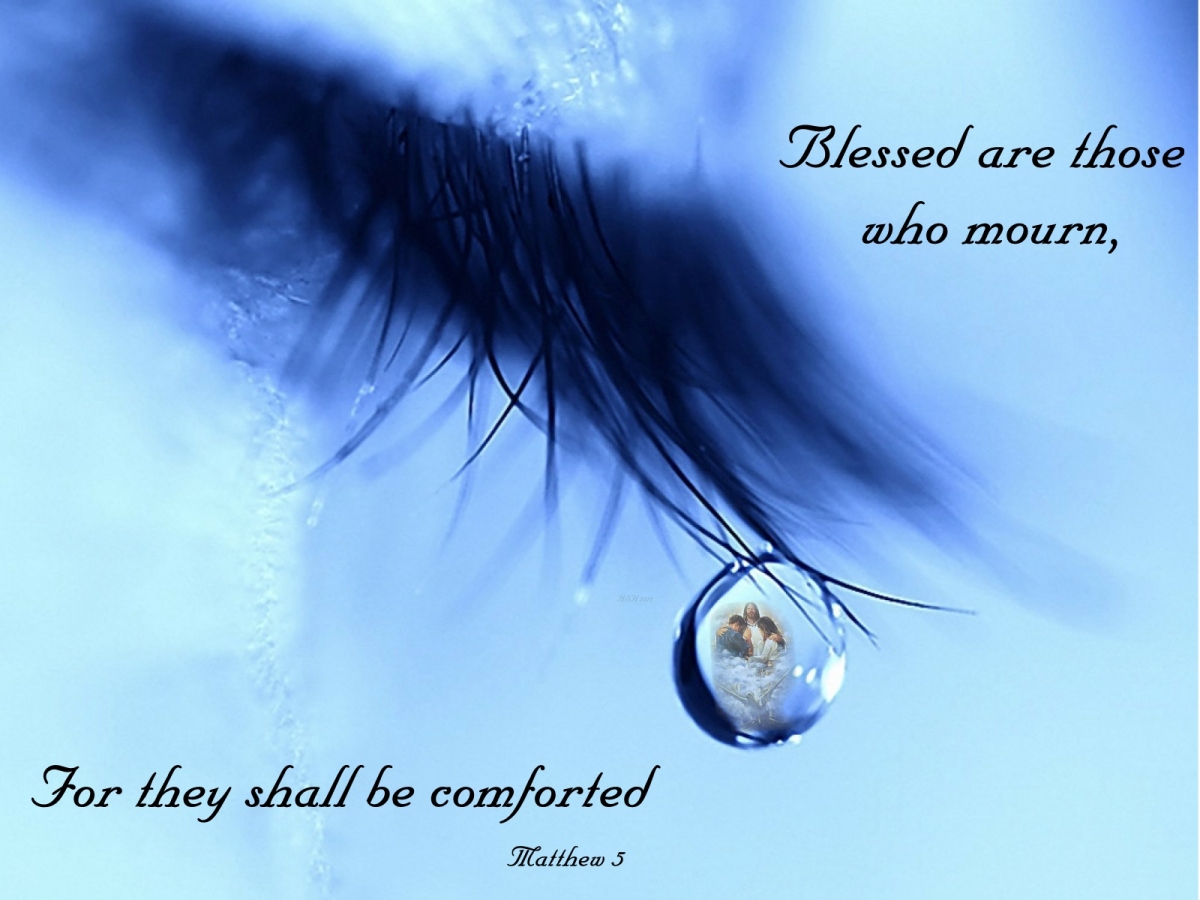
“Blessed are those who mourn, for they shall be comforted.”~Jesus

The folks that followed Him up the hill were part of a nation that had waited centuries for deliverance from sin and persecution.  Jesus was surrounded by people powerless to change their circumstances. They were grieving, mourning, in distress.

So when He said, “Blessed are those who mourn, for they shall be comforted” He was offering real hope to the brokenhearted. He was issuing an invitation…

When we  reach the end of our own strength in grief, God invites us into a fellowship of suffering that includes Jesus Christ.

Burying a child is a humbling experience.  It is teaching me that I am powerless and oh, so dependent on the grace and mercy of God.

My heart was broken open wide to receive the truth that fierce love makes me vulnerable to deep pain.

And the pain cleared the clutter and noise of the everyday to focus my mind’s attention and my heart’s affection on the eternal.

My life is swept clean of distraction and foolish things and filled with new understanding of what is important and lasting.

My pain has not disappeared.

But it is making room for the God of all comfort to fill it with hope:

That what I am feeling right now is not forever and forever is going to be glorious…

And God shall wipe away all tears from their eyes; and there shall be no more death, neither sorrow, nor crying, neither shall there be any more pain: for the former things are passed away. Revelation 21:4 KJV

Hallelujah is an Exhale

You can’t hold your breath forever.

But when you first learn your child is dead you want to–oh, how you want to.

I don’t know if it was defiance or hope that made me certain that if I could just stop breathing, I could freeze time.

I could undo the truth.

I could stop the creeping terror that seized my heart.

But it was impossible.  My body insisted that my lungs release the poison of carbon dioxide and refresh my oxygen supply.

There is a spiritual counterpart to the physical desire to stop breathing. 

Most bereaved parents will tell you that at some point in their grief journey, whether they would describe themselves as “believers” or not, they have had to examine their notion of God.

They have to ask, “How am I to relate to this Person that controls the Universe–this Being that could have saved my child–but chose not to?”

I am a Christ follower.  I believe in Jesus and I trust His Word.

But I will honestly confess that burying my child has made me reexamine just what that means and just Who He is.

Before my son was killed, I gave mental assent to the idea that “God is in control” but wasn’t forced to reconcile His control with my heart’s desire to guarantee my family’s safety.

But His existence, and His character does not depend on my understanding.  And to be frank, a God I can comprehend wouldn’t be much of a God at all.

I could not will my body not to stop breathing.

And what I am learning in this grief journey is that I can’t hold my spiritual breath forever either.

The poison of doubt and the insistence that I be able to comprehend the fullness of God will suffocate my soul as surely as lack of oxygen will stop my heart.

So, “Hallelujah” is my exhale.

It is my letting go-my drawing in again the life-giving truth that God is God and I am not.

And acknowledging that while I cannot understand His ways, I can choose to trust His Father love.


.


Beautiful Broken

We try so hard to hide our scars.

We work diligently to cover signs of aging.  We spend billions on face lifts, tummy tucks and hair implants in an effort to fool ourselves and others that time and trials can be erased like chalk on a blackboard.

We aim for smooth perfection, though few of us achieve it.

But there is no escaping or covering the deep wound of losing a child. All the make up in the world couldn’t return my “after” face to the carefree expression of “before”.

Photo filters and special effects will never recreate the light of eyes that did not know the sorrow of burying my son.

I am broken.  This life has made cracks in my body and pierced my soul.

My wounds can be offensive to others–a reminder that they, too, may receive a blow that can’t be concealed.

The truth is that none of us escape hardship in life.  All of us have hidden heartache.  We all have cracks in our polished persona.

Dominic could be brutally honest.

A promise I made to myself, in honor of him, was that I would not hide my heart behind a false front or a fake smile.  I would allow others to see both the brokenness and the usefulness of a life lived with pain.

Recently I was introduced to a Japanese art form called “kintsugi”. Artists repair broken pottery with lacquer dust mixed with precious metals, joining the cracked pieces and highlighting the imperfection.

According to one source, “As a philosophy it treats breakage and repair as part of the history of an object, rather than something to disguise.”

What a beautiful tribute to truth!

My brokenness is part of me, but so also is the healing.

Revealing my wounds, I invite others to reveal their own. Sharing my pain, I encourage others to share theirs.  Opening my heart, I welcome you to open yours.

Displaying my scars, I uncover the glory of the God Who is healing them.  

This priceless treasure we hold, so to speak, in a common earthenware jar—to show that the splendid power of it belongs to God and not to us.

2 Corinthians 4:7 Phillips