Loving Well: Transitioning From “Good-bye” to Grief

A funeral or memorial service seems like a final chapter.  We close the coffin, close the doors and everyone goes home.

But for bereaved parents and their surviving children, it’s not an end, it is a beginning.

Much like a wedding or birth serves as the threshold to a new way of life, a new commitment, a new understanding of who you are, burying a child does the same.

I walked away from the cemetary overwhelmed by the finality of death–not in a theological sense–I believe firmly that my son lives with Jesus–but with the undeniable fact that he is no longer available to me on this earth.

And in the days afterward, I was struck by the inadequacy of a funeral or memorial service to make space for the deep and ongoing sense of loss and pain and sorrow.

There is a difference between mourning and grief.  Although before losing Dominic I never bothered to notice.

I think we confuse the two on a regular basis.  I know I did.

Mourning is defined as “the outward signs and rituals associated with sorrow for a person’s death.  It is usually limited in time by social conventions or community expectations”.   

Mourning is the more or less public (depending on the family’s choices) “Good-bye” to their loved one.  It’s a circumscribed set of things we do and time we spend welcoming others into the space where we remember, make final arrangements for a body and celebrate the life that has left us.

In most North American communities, we have dispensed with the tradition of draping pictures, windows and ourselves for six months to a year to mark the home and heart of someone who has suffered loss.

What used to be a longer span of time allowing for special accommodations due to grief has now been squeezed into about two weeks.

Our hyper-drive world insists that even parents who bury a child show up to work, begin to participate and act like they have it “together” in public much sooner than our frail human bodies and broken hearts can manage.

Grief is more than a feeling.  It invades your heart, your mind, your body and your soul

Grief is the deep and poignant distress caused by bereavement..

It cannot be circumscribed by time and refuses to limit itself according to the expectations of others or even myself.  It will last (though perhaps not with the same intensity) as long as I live.

Because unlike a funeral, missing my son will not come to an end until I am reunited with him in heaven.

And we need to talk about this.

We need to help ourselves and others understand that grief changes who we are.  It changes how we perceive the world.  It alters our sense of self and impacts our relationships with others.

I am not as fragile as I was just weeks or months after Dominic’s death.  I have learned to put on a smile and pass by his favorite food in the grocery store without crying.  I can remember funny things he said or did without simultaneously experiencing gut-wrenching pain that he is no longer here to do them.

But I am still grieving.  

I am still working out how this missing is weaving itself into the fabric of who I am.

And it is WORK.

Much of the work I have to do on my own–I have to think about and feel and embrace the changes that have been thrust upon me.  But for some of the work, I need the help of others.  I need to be able to speak aloud my thoughts and feelings and receive feedback so that I’m not stuck in unfruitful inner dialogue.

It requires energy and resources.

While I am doing this grief work, my physical, mental, emotional and spiritual energy is largely consumed by it.  I am unavailable more often.  I have a smaller capacity to absorb sudden change and unexpected events. I’m uncomfortable in crowds.  I tire more easily.

And it takes TIME.  

I have discovered that no matter how much I want to speed up this process, it will not be hurried along.  And it proceeds in a “two-steps-forward-one-step-back” fashion so even when I feel I am making progress, I discover I’m not as far along as I think I am or would like to be.

So how to love well at this stage in my grief journey?  When I’m transitioning from “good-bye” to grief?  When I’m trying to understand this new life I never expected to live?

  • Acknowledge my ongoing pain and struggle.
  • Encourage me by allowing me to share honestly.
  • Be patient.  I want to heal but I don’t have control over how long it will take.
  • Don’t shut me out or shut me down.  Grief is uncomfortable for both of us.
  • Remember my son.  I need to know that others miss him too.

Rejoice with those who rejoice [sharing others’ joy], and weep with those who weep [sharing others’ grief].

Romans 12:15 AMP


Extravagant Love: Tales of Friendship and Encouragement After Losing a Child

When I asked other bereaved parents to share the things people did that blessed them in the wake of losing a child, I didn’t expect so many stories of extravagant love–of acts surpassing anything I could have thought of or imagined.

“After my daughter passed, which was minutes before Mother’s Day 2012, outside the hospital room, my son gave me a handmade Mother’s Day card that he somehow found time to make in all of the chaos. The card spoke of my daughter, me being her mother, and included a beautiful poem he had written that tugged so strongly at the heartstrings. Oh my heart!”

“A couple who had lost their son years earlier, drove two hours just to come and sit with us.  A dear friend took over my life for the next couple of weeks.”

“On my son’s first anniversary date of his passing, a friend of mine organized a candle light vigil outside our house that night. We didn’t know anything about it. When we walked outside our front door that night, there were people on our lawn with candles”.

“One phone call by the Abbott to our church and everyone who needed to know, knew. We didn’t have to make the calls. And the youth pastor, children’s pastor, and each child’s best friend made it to our house within moments of our kids getting the news. Held them while they screamed. Stayed for hours.”

“I was most grateful to the hospice worker who offered to pack up the hospital room for us and deliver our belongings back to us at home.”

“My pastors wife said ‘lean into your grief, and onto the Lord’–these words carry me to this day, almost 7 years later.  My sister came over, and never left my side until after the funeral.”

“My daughter was in a car accident. The owner of the house where the accident was came out held her hand and prayed with her. I am so grateful to him for giving her peace at that moment.”

“A coworker came and she did not come empty-handed, she brought two things: a box of tissues and a bottle of wine. I was grateful for both. She sat and cried with me and I didn’t feel like I had to be brave or consider other people’s feelings if I was breaking down. She didn’t try to hug me or shush me when I would cry– she’d just cried with me, handed me tissues, and she would pour glasses of wine and we would talk and laugh and cry. There was another young lady who came looking for my youngest son who has just lost his only brother and he had locked himself away in his room she pulled us all together and taught us how to play a card game none of us knew how to play.  But it was such a good distraction and it pulled my son out of his self-imposed isolation.”

“To give you some background: it was the summer before my son’s freshman year and we lived in a tourist town on the coast. We were coming back from the bigger hospital he had been transported to. When we crossed the bridge to our hometown, we came up on a group of teenagers. Hundreds of kids and some adults had begun a candlelight walk on the sidewalk that runs pretty much the whole town of Emerald Isle, NC. People just kept coming. It was amazing. Even the tourists were moved by this impromptu event. The kids sent out the message through social media.”

“I have a long distance friend who has written a psalm a day. It’s been 3 months and she’s still sending them.”

“We also had a lady at the church quietly give us random care packages over the months. No words, just thought. It is very sweet.”

“My son was an avid reader and a friend of mine had bookmarks made with his picture and the footsteps poem on the back to distribute at the viewing. I will cherish that gift forever.”

“One of our son’s best friends somehow managed to have HUNDREDS of rubber bracelets made up that had his name and life verse embossed on them, and he gave them to people at the reception following the memorial. At the time, I thought, ‘That’s nice, but what are we going to do with them?’  I still see people wearing them, and when anyone asks me about mine, I tell his story and give it away.”

“At the cemetery after the graveside service I was having a very difficult time leaving. I knew I could not stand to watch the casket being lowered into the ground yet I could not bring myself to leave. A dear friend and a fellow pediatric cancer mother offered to stay at the cemetery until our son was buried. Long after everyone left she offered to stay until the end. As crazy as this sounds I knew my son would not be alone and I was able to leave knowing that someone was with him.”

“Our family has had a “secret angel” who every month on the 20th which is the day of our son’s passing has brought a red bag and left it on our porch. Inside the red bag has been something small for our family or something for the foundation that we started in our son’s name. It’s never been about the gift received but about someone remembering our son…every month for 5 years and 5 months we have received one of these bags. It has meant a lot to our family and truly has helped us to heal.”

“A hairdresser friend cut a lock of my daughter’s hair (with our permission). She placed some in heart shaped lockets along with meaningful small charms (think Origami Owl). We treasure these pieces.”

I suppose I shouldn’t have been surprised. When we lost Dominic, there were many who blessed us in ways that I can only describe as offerings poured into our lives from the bountiful love of Christ:

It was important to me that we held the funeral in a church and not a funeral home. Even though it meant making accommodations in a busy Easter weekend service schedule, we were made to feel welcome–we had visitation for four hours on Easter Sunday evening.

Three churches participated in making food and hosting a meal after the burial.  The Body of Christ worked in unity to bless us.

Like many parents, I had never considered where I would bury my child. But local pastors graciously guided our family through procurring a burial plot just a mile from our house. Even though I firmly believe that Dominic is not there–just the empty shell that once housed his essence–it comforts me to know he’s not far from home.

Dominic’s friends from The University of Alabama School of Law quietly arranged for me to receive his diploma posthumously.  Dominic was honored during the ceremony and his name was called along with his classmates at graduation.  I will cherish their kindness as long as I live.

I believe that God honors these offerings.

I believe He smiles when His children love one another in sacrificial and extravagant ways.

I believe it is a fragrant aroma, wafting to heaven and drawing others near to the foot of the cross.

[Jesus said] “I am giving you a new commandment, that you love one another. Just as I have loved you, so you too are to love one another. By this everyone will know that you are My disciples, if you have love and unselfish concern for one another.”

John 13:34-35 AMP

Loving Well: Meaningful Ministry to Grieving Parents

Our journeys begin in different ways.

Just as every birth story is unique, so, too, is every parent’s story of loss.

It may be a phone call or an officer at the front door.  It may be a lingering illness or a sudden one. Our children may have lived days or decades.

Their death may be anticipated, but it is never expected.

And it is always devastating.

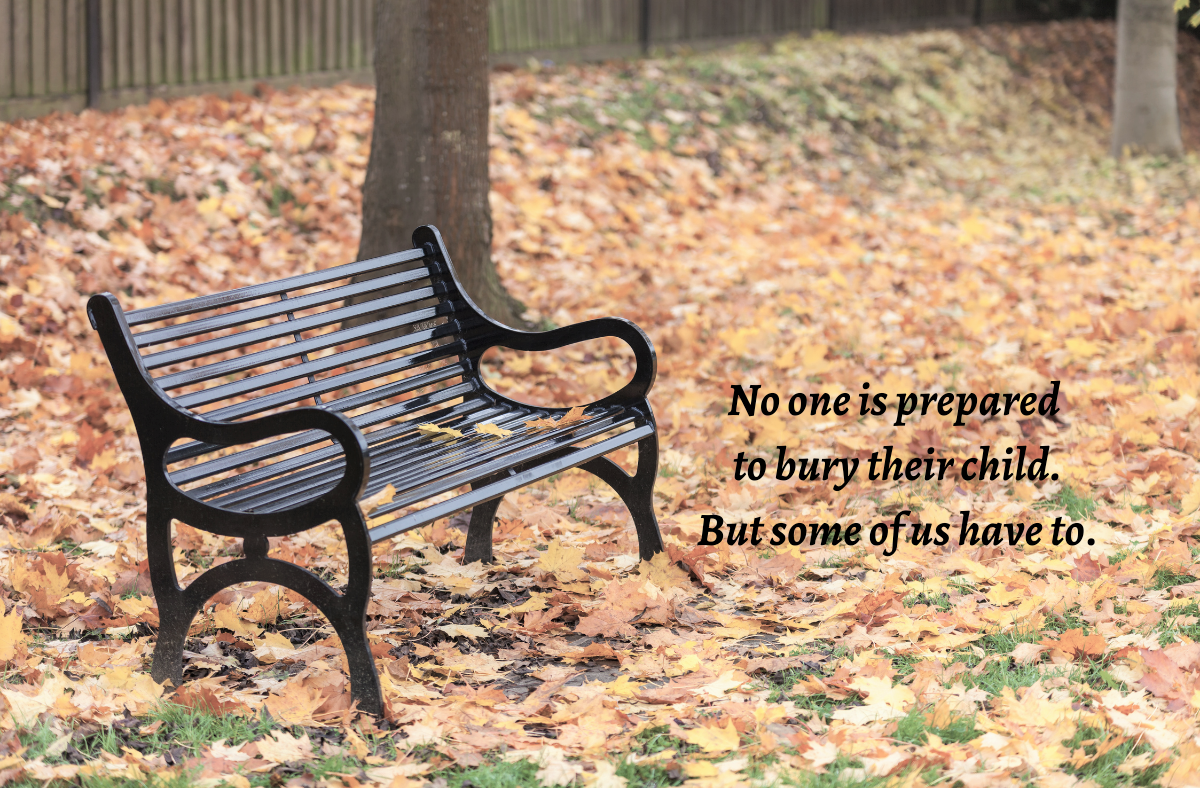
No one is prepared to bury their child.

But some of us have to.

In the best circumstances, loving well is a challenge.  It requires commitment and energy when many of us feel like we are already running on empty. The challenges are magnified in the face of child loss.

Yet as members of the Body of Christ, our calling is to minister to, encourage, care for and walk with those among us who are grieving.  And it is a daunting task.

If, as W.H. Auden said, “Death is the sound of distant thunder at a picnic”, then the death of a child is the sound of a tornado.

Compassion compels friends and family to reach out, but fear can constrain them.

“What do I say?”  “What can I do?”

Unsure of the answer, they may say and do nothing.

Yet some friends and family dive in bravely and do everything they can to help parents face this awful reality.  And I am certain so many more would come alongside, speaking courage and offering help if they knew more about what DOES help and what IS encouraging.

I have three goals for these next posts:

  • To share the way many bereaved parents have been loved well by those they know.
  • To encourage the members of the Body of Christ to reach out to anyone who has suffered loss and to give concrete ideas of how they can do that.
  • To exhort pastors and other ministry leaders NOT to set up a PROGRAM but to create a NETWORK of individuals, gifted in mercy and willing to serve, who can be responsible for shepherding the members of a local body who have experienced the loss of a child.

I hope you will join me as I share from my own experience and the experience of other bereaved parents how the Body of Christ can minister to members who bear the pain of grief and loss.

Please don’t think that these suggestions are appropriate only for those who have lost a child or even only for those who have experienced grief associated with death.

Grief enters our lives in many forms: the end of a marriage, chronic disease, job loss, and any number of unexpected and often undesired life transitions.

Ministry begins with awareness.  When we learn to see with the eyes of Jesus, we can become vessels through which His grace and compassion are poured out to others.

Then Jesus made a circuit of all the towns and villages. He taught in their meeting places, reported kingdom news, and healed their diseased bodies, healed their bruised and hurt lives. When he looked out over the crowds, his heart broke. So confused and aimless they were, like sheep with no shepherd. “What a huge harvest!” he said to his disciples. “How few workers! On your knees and pray for harvest hands!”

Matthew 9:35-38

Well With My Soul?

If you have been in a church that sings hymns, I’m pretty certain you’ve heard the backstory to the hymn, “It is Well With My Soul”.

Or at least the most popular version–Horatio Spafford lost four daughters in a tragic accident.  Only his wife survived the sinking ship on its way to England.   Once there, she sent a heart-rending telegram, “Saved alone” to Spafford who had not accompanied them on the voyage.

As the story goes, Spafford, upon crossing the Atlantic to meet his wife, passed over the spot of the sinking and the words to the famous hymn came to mind:

When peace, like a river, attendeth my way,
when sorrows like sea billows roll;
whatever my lot, thou hast taught me to say,
It is well, it is well with my soul.
Refrain:
It is well with my soul,
it is well, it is well with my soul.

But, as Paul Harvey was famous for saying, here’s “The rest of the story”.

Spafford belonged to a congregation that staunchly believed difficulty and tragedy were divine chastening for sin or lack of faith.

Apparently, in the minds of at least some of his friends, the awful things that happened to Horatio and his wife were their own fault. Eventually, Spafford and his family removed themselves from the church and created their own fellowship.

Tragically, it seems that Spafford died confused, dismayed and perhaps, disbelieving.

Why is this important?

Because the support (or lack of support) bereaved parents receive from their fellow Christians can make all the difference between losing sight of Jesus and finishing well, with our eyes fixed on the “Author and Perfector of our faith”

We love the shortened version of the Horatio Spafford story because it ends with a triumph of faith, a crescendo of hope and a tidy finish to a messy story.

But the same reason the broad sweep of Spafford’s life is rarely brought to our attention is the same reason many find it difficult to walk beside grieving parents in their journey–even sincere, committed Christians can have doubts.

Even those who have read and believe the Bible can take longer than anyone would like to settle firmly on trusting God again after tragedy.

And even when we who struggle because of deep grief reach the place where our hearts can again rest in the sovereignty and goodness of God, we may always have unanswered questions.

Believers in Christ are called to minister to the members of His Body.  We are commissioned to encourage, uplift, care for and help each other.

It often involves more energy, time and effort than we are willing to give.

But if we believe, as Paul said, that every single member is called by God to serve a specific purpose then can we afford to ignore even one of them?

The way God designed our bodies is a model for understanding our lives together as a church: every part dependent on every other part, the parts we mention and the parts we don’t, the parts we see and the parts we don’t. If one part hurts, every other part is involved in the hurt, and in the healing. If one part flourishes, every other part enters into the exuberance.

I Corinthians 12:25-26


Reminded to Rest

I was reminded in the past few days that I am oh, so vulnerable to attack when I am already wounded.  And that even when I see it coming, I am often unable to fend it off successfully.

The enemy taunts me and encourages me to compare my life with the lives of others.  He stands on the sidelines and calls out, “Your Father loves others better than you!”  He accuses in the shadows, “You are a failure.  Your faith is pitiful.  You will not persevere to the end.”

But he is a liar and the father of lies and deception and untruth are his native tongue.

I have to go back, again and again and again, to the Truth and recite it, write it, declare it and hold fast to it.

I must remember that every promise of God in Christ is “yes” and “amen”.

I must remind myself daily that victory has already been declared even when I can’t see it or feel it.

And when I am too tired to fight, I must allow myself to withdraw and catch my breath-extending the same grace to me that I would extend to another in my place.

It is o.k. to draw boundaries and to create safe places where I can recuperate and regain my strength.

I am not in competition with anyone else.  God has marked my course and He will lead me home.


But I stand silently before the Lord, waiting for him to rescue me. For salvation comes from him alone.

Psalm 62:TLB


It Never Rains in Sunny California

My husband works in Southern California so I spend part of each year on the West Coast.

While shopping one day, a brief rain storm blew in and caught me off guard.  As I was leaving the store, I noticed the reaction of my fellow shoppers–they stood, dumbfounded and paralyzed behind the plate glass windows unsure how to get from the shelter of the store to the shelter of their cars.

They had no idea how to walk in the rain because they didn’t expect it and they were unprepared.

For Christians, pain, loss and death can feel like a sudden storm.  Often these events catch us off-guard, unprepared and we stand frozen–immobilized because we have no idea what to do.

As long as our Sunday schools, sermons and supper table conversations don’t make room for the very real experience of pain and suffering in the Christian life, we are raising a generation to believe that pain and suffering and loss are rare events and that they may very well get through life without experiencing them.

And we are leaving them vulnerable to attacks of the enemy when painful events come along.

Hurting people make us uncomfortable.  It takes courage to sit with the suffering and allow them to share their pain and struggle.  It requires energy and effort to enter in and help bear their burden.  But when we do, we not only offer help for their wounded hearts, we are also learning things that will be useful in our own journey

That day in California I walked to my car, unfazed by the drops falling from the sky because, being an Alabama girl, I was used to the rain.

I share my story and pray that others may find comfort in their own grief and pain.  Not everyone will lose a child.  But everyone will face trials and testing and times of doubt.

And the only safe harbor in the storms of life is in the Person and Promise of Jesus Christ.

He alone can still the wind and waves that threaten to overwhelm us and drown our hope.

We who have run for our very lives to God have every reason to grab the promised hope with both hands and never let go. It’s an unbreakable spiritual lifeline, reaching past all appearances right to the very presence of God where Jesus, running on ahead of us, has taken up his permanent post as high priest for us, in the order of Melchizedek.

Hebrews 6:18-20 MSG


the cost of compassion

I can’t help it.

I think too much.  I wonder too often.  I work too hard to make sense of things.

And the thing that is puzzling me right now is why people pull away from those experiencing deep and lasting pain.

Like the pain of burying a child.  Or the burden of chronic physical disability.  Or the unceasing struggle of overcoming addiction.

I think I’ve hit on a few possibilities:

  • There is no end in sight.  None of these scenarios offer a tidy final chapter that wraps loose ends into a comfortable narrative.
  • It challenges what we believe about God.  It’s one thing to consider the problem of pain and suffering in the world from a theoretical perspective and quite another to experience it in real time.
  • Our days are too full of “busy work” to leave room for real ministry. Overscheduled and frazzled,  we don’t have the emotional, physical or psychological energy required to stand with someone while they battle.

So we trade pity for compassion.

Pity says, “I’m sorry for you.  Let me do something for you that makes me feel better.”

We offer platitudes and prayers from afar as a substitute for presence and personal interaction.

And when our attention is turned elsewhere, we drift away–abandoning the broken to sit alone with their pain.

Most of us don’t mean to do it–we just move on, leaving the limping behind.

But the cold shoulder wounds as much as hurtful words. Acknowledgement is as great a blessing as an extended hand.

Compassion says, “I see your pain.  I hurt with you.  Let me stay with you until you feel better.  And if you never feel better, I’ll still be here.”

Compassion requires conscious commitment to push back against our tendency to forget those who live with things they cannot change and will never forget.

God Himself stepped into His creation to feel the pain of brokenness, to bear the price of sin and to open a Way for restoration and redemption.

Jesus came to make the Father known.

There is no substitute for walking with the wounded.  It is costly, it is painful, it is hard.

But I would argue that when we do, we are most like our Savior.


Help Me, Please!

Burying my son and living life without one of my children walking with me continues to be the hardest thing I have ever done.  I wouldn’t wish the pain and struggle on my worst enemy.

But I am determined not to waste the things that God is teaching me through this experience.

I want to allow Him to redeem this brokenness.

That’s why I share my journey.

I am working on a series of posts that will highlight some of the most helpful things people did for me and our family in the early days of our grief journey.  I will also share the physical, emotional, spiritual and psychological challenges and experiences of bereavement.

I am asking other bereaved parents who are willing,  to share their experiences so people can have the benefit of many and varied voices:

(I will never reveal any names or identifying information)

  • What did people do for you and your family that was particularly helpful around the time of your child’s death?
  • What do you wish had been done differently?
  • What advice would you give to a parent in the first few weeks of grief?
  • What support did you receive from your church or faith community?
  • What support did you wish you had received from your church or faith community?
  • What were the greatest challenges with extended family?
  • What was helpful for your surviving children as they grieved?
  • What surprised you most about grieving your child?
  • What do you want others to know about your grief journey?

These are just a few questions that I would like to explore–you may think of others. Please feel free to respond in the “comments” section or send me an email to Godsgrdnr@aol.com.

You can also join the discussion on the public Facebook page:  Heartache and Hope: Life After Losing a Child.

There is nothing easy about grieving a child, but I pray that sharing our experiences can help ease the pain of other parents just beginning this journey.


An Invitation

When Dominic died,  I was unaware of any  resources available to bereaved parents other than books written on the subject.  Thankfully, through personal contacts and Google searches, I found out about groups, online communities, blogs and excellent articles that helped me understand I wasn’t alone, I wasn’t crazy and I could survive.

I am working on a series of posts that will highlight some of the most helpful things people did for me and our family in the early days of our grief journey.  I will also share the physical, emotional, spiritual and psychological challenges and experiences of bereavement.

If you are a bereaved parent or someone who loves a bereaved parent, please consider joining me on my public Facebook page:  Heartache and Hope:Life After Losing a Child and share your perspective.

Someone suggested not too long after Dominic died that I might start a group for bereaved parents in my area–there aren’t any close by in our rural Alabama county.

I was not even ready to talk openly about my own feelings, much less listen to and absorb the pain of other grieving parents.

A few months ago I was introduced to a wonderful ministry called While We Are Waiting (whilewearewaiting.org) and discovered the blessing of belonging to a community of people who (unfortunately) know how I feel and can relate to my experience as a bereaved parent.  I began to realize that Facebook can be a place to connect people that otherwise might feel isolated in their pain.

I’m still not ready to sit face-to-face with more than one or two people at a time for deep conversation about life and death and fear and hope.

But I have opened a FaceBook page–Heartache and Hope:Life After Losing a Child–and it is public-although I am moderating posts.  I want to facilitate a way for parents in my area or in their own area, to find one another and form communities of support.

For some of us, online will be best.  Others may choose to get together in physical spaces.  Whatever works and brings hope to grieving hearts is wonderful.

I am not going to “invite friends” to like this page-thankfully, I don’t have that many people on my friend list who have buried children.  But I am inviting those who read my blog, and who have themselves lost a child to “like” the Heartache and Hope page.  And please invite other bereaved parents too.

There is no agenda other than encouraging one another in Christ and reminding ourselves of the hope we have in Jesus:  death is defeated, the grave is not the end, and our children will one day be reunited with us in glory.


Listen very carefully, I tell you a mystery [a secret truth decreed by God and previously hidden, but now revealed]; we will not all sleep [in death], but we will all be [completely] changed [wondrously transformed],  in a moment, in the twinkling of an eye, at [the sound of] the last trumpet call. For a trumpet will sound, and the dead [who believed in Christ] will be raised imperishable, and we will be [completely] changed [wondrously transformed]. For this perishable [part of us] must put on the imperishable [nature], and this mortal [part of us that is capable of dying] must put on immortality [which is freedom from death]. And when this perishable puts on the imperishable, and this mortal puts on immortality, then the Scripture will be fulfilled that says, “Death is swallowed up in victory (vanquished forever). O death, where is your victory? O death, where is your sting?” 1 Corinthians 15:51-55 AMP

grief and sleep

Boy, do I envy my cats’ ability to fall asleep any place, any time.

I’ve lived with chronic physical pain for over a decade and there are nights when it is hard to go to sleep-when it is impossible to ignore the pain.  But I have never thought of myself as having trouble sleeping.

Until now.

When grieving a child, you are oh, so very tired.  Yet often sleep eludes you.

“He who learns must suffer.  And even in our sleep pain that cannot forget falls drop by drop upon the heart, and in our own despair, against our will, comes wisdom to us by the awful grace of God.”

Aeschylus

Lying in bed, in the dark, my mind kicks in to hyper-drive.  With no external stimulation to provide distraction, images come unbidden and unwelcome to taunt me.  I work hard to guide the train of thought to a less tortuous route.

So I thought I would share some ways that help me make it through the long nights:

  • Only lie down when you are tired enough to expect that you can fall asleep.  I am physically active each day so that at least my body is ready for rest.
  • Don’t drink caffeinated beverages after 12 noon and don’t eat heavy foods past mid-afternoon.
  • Be selective about what you listen to, watch or read in the hours leading up to bedtime.  I try to feed my mind images and information that will help me focus on more positive themes when I close my eyes.
  • Keep a pad and pencil next to the bed to jot down last minute reminders of things you might need to remember tomorrow.  I try to think ahead and have a rough plan of action for the next day so that my mind can rest.
  • Make sure you are physically comfortable–room temperature and bed clothes appropriate to the season, pajamas in soft fabrics, well-hydrated, take analgesics as needed for physical pain, etc.
  • Make whatever concessions are needed to hold anxiety at bay.  I have a nightlight in my bathroom that casts a soft glow into my bedroom.  I keep my cell phone and home phone next to me because once you get “that call” you feel like you must be instantly accessible to loved ones.  My cat sleeps with me–purring is a great comforter.
  • When I turn out the light and turn over, I purposely focus my mind’s attention and heart’s affection on trusting God to help me drift off to sleep.

“I can lie down and go to sleep, and I will wake up again, because the Lord ·gives me strength [sustains/upholds me].”

Psalm 3:5 EXB

  • If you wake up in the middle of the night, try reciting Scripture, poems, humming hymns or other music to lull yourself back to sleep. I will sometimes do mental work like planning a project or trying to recall a childhood memory–anything that might make me tired.
  • If  you can’t go back to sleep in 30 minutes or so, get up and get on with the new day–even if it is only hours old.  There’s no use lying in bed and tossing and turning. While I may be exhausted for that day, I’m almost certain to be able to sleep better the next night.

Sleep is important.

If you find that you are unable to get more than a few hours sleep for longer than two weeks–talk to your doctor.  There is NO SHAME in asking for help. And there are many products available that are non-habit forming and suitable for short-term use.

It is impossible to do the work grief requires if you are worn out from lack of sleep in addition to carrying the pain of losing your child.

“We sleep, but the loom of life never stops, and the pattern which was weaving when the sun went down is weaving when it comes up in the morning.”

Henry Ward Beecher

If we can help ourselves get the rest we need, we are better able to face the challenge of each new day.