Why is Anxiety Part of Child Loss?

It surprised me when I felt anxious after Dominic ran ahead to Heaven.

Not that the doorbell startled me, or that passing the place of the accident was hard nor that hearing motorcycles made my skin crawl.

But that every single day for many, many months anxiety crept up my backbone and made a knot in my neck.

It surprised me that I felt like I was literally going to explode.  I would walk and walk and walk just to push the negative energy out of my body.

I was also surprised by what seemed to be random triggers-smells, sights, foods, voices, places-that could send me into a tailspin of rapid heartbeat, hurried breathing, sweaty palms and a feeling of abject terror.

I didn’t know it then, but my experience is common.

It shouldn’t be surprising, really.

We all operate in the world as if it is predictable, as if it follows rules.  It’s how we stay sane.

If our minds perceived that most of what we experience has at least a small element of the random, we would sit frozen, terrified to move.

Who can live in a world where you never know what to expect?

When Dominic left this life suddenly, unexpectedly and without warning, my sense of safety and order was violated.

The illusion of control was stripped away.  The grid through which I viewed the world was ripped to shreds.  What I thought I knew about how things worked was proven unreliable.

Truth is, I never really had all that much control, but burying Dominic made that undeniably obvious.

This brutal disruption in worldview created a kind of internal panic.

I wasn’t conciously aware of it at the time because I was overwhelmed with sorrow and the pain of loss.  But my mind was trying to wrap itself around a new understanding of how the world works.

I needed to learn to live in a world where I couldn’t predict outcomes, I couldn’t guarantee safety (even if I did everything “right”) and I couldn’t REALLY plan for tomorrow because tomorrow might very well never come.

I had to figure out how to get out of bed instead of cower under the covers. To get in the car instead of stay at home.  To continue to love the people God gave me even though they may be taken any time.

Anxiety is an outward expression of the inward reality of this disruptive process. My body was screaming what my mind was silently sorting out.

As I have worked on incorporating my experience of losing a child into my worldview, the anxiety has decreased.

I don’t expect to ever live free of anxiety again-how can I when I know by experience what most people only imagine?

But I’m learning ways to deal with it when it rears its ugly head.
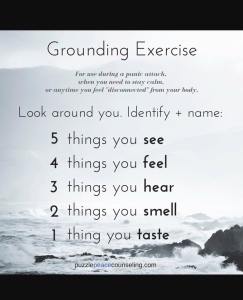
grounding-exercise

And I’m learning that every time I triumph over it, I’m stronger and better able to do it the next time.  

courage-dear-heart


Shadows and Sunlight

The sun streams just so

and turns my head

I’ve learned not to look too long at that wall

But today

Well today I am face to face with HIS face

I didn’t mean to linger

but I did

IMG_2637

No remedy but to let the grief wash over me

allow the tears to fall and the hurt to run its course

How can I push this down so well most days

How is it possible to NOT feel this all the time

Am I a monster that my heart can pretend it hasn’t been torn in two????


Not a monster just a mom

A mom with children left to love

Ones left to hold, to encourage, to champion as they keep on keeping on

photo-36

shadow and sunlight

hope and despair

not either/or

both/and

Repost: Choosing the Eternal Path

For most of us in America it seems that we rush from place to place, from event to event, from meal to meal, from crisis to crisis.

But when I read the Gospels I don’t feel a sense of rush at all. 

Jesus expressed urgency when proclaiming that the kingdom of God was near, but He was never in a hurry.

Read the rest here:  Choosing the Eternal Path

Treacherous Travel

My husband had to make a plane on Saturday and it took us over two hours to drive the 50 miles to the airport from our house.  We took a couple detours around accidents that stopped traffic but we were still reduced to an agonizing crawl for most of the way.

Down here in Dixie we don’t do winter precipitation well.  A half inch of snow calls for a complete city shutdown and ice means days trapped inside our homes.

Northerners laugh at us slip-sliding across the interstate but how are you supposed to travel on snow and ice when you don’t have the equipment necessary to make the journey?

Even snow tires don’t matter when you hit black ice.

As I watch the sun melt the remains of our latest winter “storm” I’m reminded of at least one reason this journey of child loss is so. very. difficult.

photo-37

There is nothing that can prepare you for it.  No way to suit up or grab gear or train for burying your child.

It’s treacherous travel and there’s no opting out.

You can’t wait a few hours or a day or a week and rearrange your schedule. You are dropped right down in the valley and forced to keep moving.

And the whole way is black ice-slick and scary.

You are in a spin before you know it, panicked and trying to straighten out without crashing.

I haven’t crashed.

It’s good to be reminded every once in awhile that all things considered,  I’m doing pretty well.

I am making progress-slow, slow progress-but I’m still on the road.  


Can’t Fake It Forever

There’s a common bit of advice in grief circles:  Fake it until you make it.

It’s not bad as far as it goes and can be pretty useful-especially just after the initial loss and activity surrounding it.

Like when I met the acquaintance in the grocery store a month after burying Dominic and she grabbed me with a giant smile on her face, “How ARE you?!!! It’s SO good to see you out!!!”

I just smiled and stood there as if I appreciated her interest, a deer caught in headlights, silently praying she’d live up to her talkative past and soon move on to another target.

Faked it.

Boom!

BUT there comes a time when faking it is not helpful.  In fact, it’s downright dangerous.

Because if I fake it long enough and get good enough at it, I can convince myself that I have done the work grief requires.

Grief will not be ignored forever.

It bubbles up in physical symptoms and sleepless nights. It boils over in anger and impatience and anxiety and nervous habits.

There is no way through but through.  It has to be faced head on.

Life circumstances kept me distracted and busy for the first four or five months after Dominic ran ahead to heaven.

IMG_1790

I cried, screamed and was heartbroken-I definitely had my moments. But for the most part I functioned at a pretty high level.

It wasn’t until things slowed down that I had my come apart. And it caught me by surprise.

I was forced to sit in silence and face the feelings.  I was compelled to hear my heart shatter-over and over again.

I’ve now had 33 months of this burden of sorrow.  Almost three years to think about, work on and pray through the pain.  

I’m learning to pay attention to my own heartbeat, to my body, to my triggers, to my joy-bringers, my joy-stealers and my limitations.  I’m beginning to accept the bellycrawl progress through this tunnel of darkness by focusing on the bright light at the end.  

I still fake it sometimes-it’s not worth it to me to get into a long conversation with that person I only see every year or so.  Too much time, too much energy and too little reward.

But I’m learning to be more genuine with the people that matter most.  I’m learning to be honest about how I feel, what I need and how much I can do.

And I refuse to allow busyness to creep up on me so that I don’t have the time and energy to continue doing the work grief requires.  

not-required-set-yourself-on-fire-life-daily-quotes-sayings-pictures


Repost: Subtitles

My husband is the child of immigrants.  And even thirty years after coming to America, my in-laws preferred their native Italian to English.

So when we would be in a crowded room, comments flying, I struggled to keep up with what was being said because I didn’t speak the same language.

Sometimes feelings got hurt because what one of us thought we were saying was not what the other person heard.

Read the rest here:  Subtitles

Healthy Boundaries in Grief

As a people-pleasing first born who hates conflict, giving in has always been  easy for me. It’s only later that I wish I hadn’t.  

So for most of my life, setting personal boundaries has been challenging.

But in the aftermath of child loss, healthy boundaries are no longer optional, they are necessary for survival.  

So what are healthy boundaries?

  • Saying “no” without guilt
  • Asking for what you want or need
  • Taking care of yourself
  • Saying “yes” because you want to, not out of obligation or to please others
  • Behaving according to your own values and beliefs
  • Feeling safe to express difficult emotions and to have disagreements
  • Feeling supported to pursue your  own goals
  • Being treated as an equal
  • Taking responsibilty for your own emotions
  • Not feeling responsible for someone else’s emotions
  • Being in tune with your own feelings
  • Knowing who you are, what you believe, what you like

~sharonmartincounseling.com

What does this look like in real life?

  • Not being “guilted” into engaging in social/family/church activities before I am ready
  • Letting family and friends know when I need encouragement, companionship, solitude, help or space
  • Keeping or making doctor’s appointments and staying on top of my physical well-being by sleeping/eating/taking medication/exercising as best I can
  • Participating in what is helpful and life-giving to me when I want to and not because I feel like I have to.  
  • Giving myself space and time to figure out how losing a child impacts my beliefs, my sense of self, my understanding of the world-being honest about questions and about struggles.  If I have to take a break from church for awhile, that’s OK.
  • Expecting support from friends and family to do the work grief requires.  If some in my circle can’t do this, then I’ll put those relationships on hold until I feel stronger. I am not required to live up to other people’s standards.
  • Embracing and acknowledging my own emotions.  Not expecting someone else to “make me better”.  No one can take away the sorrow and pain of child loss.  It is excruciating.  There is no way through but THROUGH.  Face the feelings.  Get help from a counselor if necessary.  Join a support group.  Find safe friends.  But I will not be able to distract myself or ignore the heartache forever.
  • Understand that though I share the loss with others-a spouse, my surviving children, my child’s grandparents, etc-I am not responsible for how they are dealing with loss. I may offer help, may arrange counseling (especially for children), should strive toward an environment where feelings can be expressed-but I can’t work through their loss experience for them.  
  • Pay attention to my own feelings and what triggers grief attacks.  When I can, plan around the triggers.  When I can’t, accept the feelings and go with them.  If I need to leave a venue, leave.

What it doesn’t look like:  

Healthy personal boundaries are not an excuse for bad behavior.  They are not to be used as blunt instruments to bully others into submission or to advance my own agenda against theirs.

My boundaries don’t give me the right to be hateful, hurtful or unkind.  They are not permission to pitch fits, make public displays or belittle others.  

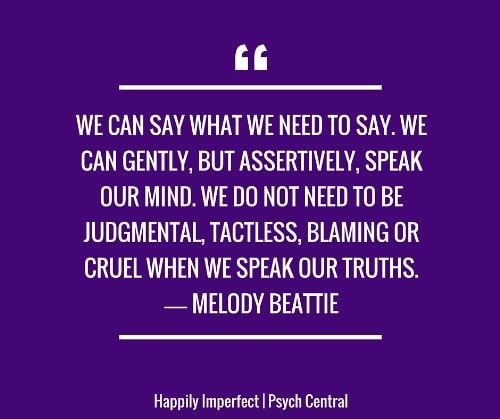
say-what-we-need-to-say-gently

And they are absolutely NOT a reason to plaster hate speech across social media.  If I have a personal relationship issue then it needs to be handled personally and privately not publicly. Vague Facebook statuses that suggest I’ve been offended by half my friend list are off limits.

Establishing healthy personal boundaries is work.  

Already exhausted from grief, the last thing I want is more work.

But if I don’t defend the space and time I need to do the work grief requires I cannot make progress toward healing.

If I don’t limit my interaction with those who are unhelpful or downright hurtful, I will be dragged down further in the mire of sorrow and sadness.

If I don’t purposely pursue physical, emotional and psychological health, grief will kill me.

New Year, New You?

January is the month of resolutions and new beginnings!

So I boldly declare that THIS year I will (take your pick):

  • Lose weight
  • Eat only healthy food
  • Exercise more
  • Read more books
  • Declutter my house
  • Spend more time with family
  • Spend less time with electronics
  • Blah,blah,blah

Wouldn’t it be grand if all it took was the turn of a calendar page to make all things new?

How wonderful if I could wipe the slate clean and start afresh just because the earth had made another round of the sun!

But the average length of time these commitments last is just 7-10 days. (Which by now, most of us have already found out.)

Why?

Because we can rarely make sweeping changes that go against habits and character traits just because we say it aloud or write it on a special piece of paper.

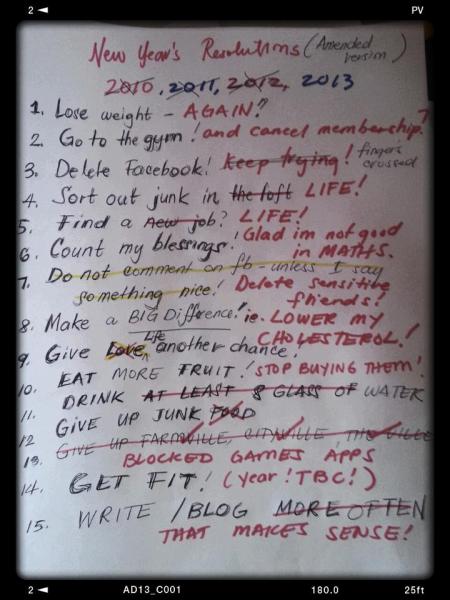
new-years-resolutions-list

Life’s not like that.

Life is an amalgamation of thousands of small and a few not-so-small choices that combine to make me who I am.

Choices become habits and habits become character.

And then there are the other thingsthe things I didn’t choose-that slam into me and violently reshape who I am-ready or not.

How I respond to what I can’t control continues to remake who I am.

There is ONE resolution that can remake me from the inside out.

There is one habit that that will not only make THIS year new, but will make ME new.

There is a single choice that I can make every day that will affect me and everyone around me.

It’s not hard, but there will be resistance.  It doesn’t require special equipment, but it requires commitment.  I don’t have to be in shape-as a matter of fact, the more out-of-shape I am, the more remarkable the transformation.

If I place my heart in the hands of Jesus by sitting in silence with Him each day, reading His Word and asking Him to open my eyes to the beauty He places in my path-even this rocky road of child loss-He will renew my mind and transform my character so that I am conformed to His image.

He is the Potter.

The work is His.

I am the clay.

he who began a good work in you


Repost: Not What I Had Planned

Every time the headlines scream death and destruction, my heart stops.  

When it’s YOUR child, husband, mother, cousin you can’t change the channel or route the conversation to lighter topics.

You just have to bear it.  

Read the rest here:  Not What I Had Planned

Grief is Not Sin

Grief is not sin.  

It wasn’t until another grieving mom asked the question that I realized there are some (many?) in the community of believers that think grief is sin.

Not at first, mind you-everyone is “allowed” a certain amount of time to get over the loss of a dream, the loss of a job, the loss of health or the loss of a loved one.

But carry that sadness and wounded heart too publicly for too long and you better be ready for someone to question your faith.

And (heaven forbid!) you drag your limping soul to church on Sunday and sit silent during worship, tears streaming, as the rest of the congregation heartily affirms all the things you now wrestle with every day.

Is God good?  ALL the time?  Does God protect the ones He loves?  ALL the time?

“We bring the sacrifice of praise….” What sacrifice have you made lately?  Have you buried a child?

I think anything has the potential to be sin.  If I allow my heart, mind and soul to focus exclusively on what I’ve lost instead of what I’m promised through Jesus Christ, that is sin.  

But grief itself is not sin.

Paul said, “We do not grieve as those who have no hope”  NOT  “we do not grieve”. (I Thessalonians 4:13)

Sadness is not sin.  Sorrow and missing my son is not sin.

For a time, especially at the beginning, grief occupied most of my field of vision.  It’s that huge.  

We are made of dust and it cannot be otherwise.

Death is awful and the redemption of what was lost in the Fall cost God His only son. “The whole creation groans” (mourns, grieves) “to be set free from bondage to decay”. (Romans 8:21-22)

death matters lewis

Jesus cried out, “My God, My God, Why have You forsaken Me?” as He bore the full weight of sin and sorrow of the world.

I believe that grief becomes sin when I choose to turn my face away from God and only toward my sorrow.

If I am holding it and dragging it with me toward the foot of the cross, that’s not sin.

If I turn my heart and face toward the One Who made me and trust that even in this painful place He is carrying me and will care for me, that’s not sin.

The writer of Hebrews speaks of bringing the “sacrifice of praise” (Hebrews 13:15).  It is no sacrifice to praise God for the beautiful blessings.

It is quite the sacrifice to praise God for what Joni Eareckson Tada calls a “bruising of a blessing”.

If I continue to wrestle, like Jacob-clinging and begging for the blessing-I am not sinning when I walk away with the limp the wound leaves behind.

Jesus has opened the way to the throne of grace by His own blood.

I don’t have to hide and I don’t have to be afraid. 

He knows my pain.  He knows my name.

I keep bringing my broken heart to the altar and lift it up in broken praise.

That’s not sin.

It’s the widow’s mite-it’s everything I’ve got.  


worship-that-means-something-costs-something