Navigating Grief: Bringing My Emotions to Jesus

“Emotions are real, but they can lie.”  

I repeat that to myself often.   

In everyday life I can interpret another person’s silence as a snub when, in fact, they simply were so distracted they didn’t see or hear me. 

t

Now, I know God is never asleep or distracted (see Elijah vs. Jezebel’s “priests”).  

But I know sometimes He feels distant or silent.  

He’s not.  

Jesus promised to never leave nor forsake me.  

And He hasn’t.

When I can’t feel or hear Him, it’s usually because my emotions are running so high the noise drowns out His still, small voice.

So I bring them to Him as a sacrifice and trust Him to help me bear them and to align them with the TRUTH that what I am currently suffering is not the last word.  

My story will be redeemed.  

My unfathomable loss will be restored.

His promises never fail.

Navigating Grief: Understanding “Acceptance”

In all fairness, Elisabeth Kubler-Ross had no idea her research would be taken out of context and plastered across professional literature and media outlets as a definitive explanation for the grief experience.

But ever since, counselors, pastors, laypersons and the general public have come to expect folks to politely follow the five (sometimes described as six) stages of grief up and out of brokenness like a ladder to success.

It doesn’t work that way.

 ❤ Melanie

Sometimes those that walk alongside the bereaved are biding time, waiting for that “final” stage of griefAcceptance.

And some therapists, counselors and armchair psychiatrists are certain that if the grieving mother can simply accept the death of her child, she can move on–that she can get back to a more “normal” life.

But this notion is as ridiculous as imagining that welcoming a new baby into a household doesn’t change everything.

And new parents have months to prepare.

I had the brief millisecond between the words leaving the deputy’s mouth and my ears hearing them for my mind to comprehend.   

And I admit, there were moments in the day, even a few months afterwards, that I found myself saying out loud, “How can Dominic be dead?”

But those have mostly passed.

I accept that my son is dead.  He will not return to me in the land of the living.  He will not walk through my front door and he will not grow older, marry and have children of his own.

Every now and then, I do see a shape in a crowd, the shoulders set just so and for a moment my heart leaps.  But my mind quickly remembers that Dominic is not here.

So, acceptance means that I understand that things are the way they are.

Acceptance does not mean that I have to like it or that I don’t wish some things were different.

Acceptance means that I comprehend the future will not include new memories with Dominic as part of our family circle here on earth.

Acceptance does not mean that I never look back fondly and with yearning for the years we spent together.  It does not mean that I don’t grieve the years we won’t have.

I accept that I have a life to live even though part of my heart is no longer with me.

But acceptance does not mean that the life I live going forward is not impacted by my loss or that it isn’t framed at the edges by grief.

I am now what losing a child has made me.  

Acceptance means that I will offer up this new me, just as I have offered up every new me in the past, to the God Who made me, to use me according to His plan and for His glory.

The people of Israel were shaped as much by what they lost as by what they gained.

A group of Israelites, led by Ezra the scribe, returned to Jerusalem from Babylon, and were charged with rebuilding the Temple that had been destroyed many years earlier.

A few among them had seen with their own eyes the glory and majesty of Solomon’s Temple, but most of those returning had been born in captivity.  To the older men, this new temple paled in comparison to what they had lost.  But to the younger, it represented a new beginning and a brighter future.

Many of the older priests and Levites and the heads of families cried aloud because they remembered seeing the first temple years before. But others were so happy that they celebrated with joyful shouts.Their shouting and crying were so noisy that it all sounded alike and could be heard a long way off.

Ezra 3:12-13 CEV

The grieving were sad, but they worked anyway.

Acceptance acknowledges loss, but is not immobilized by it.

So how to love me and others well in this phase of our grief journey?

Understand that acceptance involves both of us:  while I must accept the fact that my child is dead and that my life is different than the one I would have chosen for myself–others must accept that I am who I am and I will never be the other me–the one before losing a child, again.

My life as a bereaved mother is always going to be a mixture of sorrow and joy.

It will always include looking back and looking forward.

It can’t be anything else.

Navigating Grief: Transitioning From “Good-Bye” to Grief

A funeral or memorial service seems like a final chapter.  We close the coffin, close the doors and everyone goes home.

But for bereaved parents and their surviving children, it’s not an end, it is a beginning.

Much like a wedding or birth serves as the threshold to a new way of life, a new commitment, a new understanding of who you are, burying a child does the same.

I walked away from the cemetary overwhelmed by the finality of death–not in a theological sense–I believe firmly that my son lives with Jesus–but with the undeniable fact that he is no longer available to me on this earth.

And in the days afterward, I was struck by the inadequacy of a funeral or memorial service to make space for the deep and ongoing sense of loss and pain and sorrow.

There is a difference between mourning and grief.  Although before losing Dominic I never bothered to notice.

I think we confuse the two on a regular basis.  I know I did.

Mourning isdefined as “the outward signs and rituals associated with sorrow for a person’s death.  It is usually limited in time by social conventions or community expectations”.   

Mourning is the more or less public (depending on the family’s choices) “Good-bye” to their loved one.  It’s a circumscribed set of things we do and time we spend welcoming others into the space where we remember, make final arrangements for a body and celebrate the life that has left us.

In most North American communities, we have dispensed with the tradition of draping pictures, windows and ourselves for six months to a year to mark the home and heart of someone who has suffered loss.

What used to be a longer span of time allowing for special accommodations due to grief has now been squeezed into about two weeks.

Our hyper-drive world insists that even parents who bury a child show up to work, begin to participate and act like they have it “together” in public much sooner than our frail human bodies and broken hearts can manage.

Grief is more than a feeling.  It invades your heart, your mind, your body and your soul

Grief is the deep and poignant distress caused by bereavement..

It cannot be circumscribed by time and refuses to limit itself according to the expectations of others or even myself.  It will last (though perhaps not with the same intensity) as long as I live.

Because unlike a funeral, missing my son will not come to an end until I am reunited with him in heaven.

And we need to talk about this.

We need to help ourselves and others understand that grief changes who we are.  It changes how we perceive the world.  It alters our sense of self and impacts our relationships with others.

I am not as fragile as I was just weeks or months after Dominic’s death.  I have learned to put on a smile and pass by his favorite food in the grocery store without crying.  I can remember funny things he said or did without simultaneously experiencing gut-wrenching pain that he is no longer here to do them.

But I am still grieving.  

I am still working out how this missing is weaving itself into the fabric of who I am.

And it is WORK.

Much of the work I have to do on my own–I have to think about and feel and embrace the changes that have been thrust upon me.  But for some of the work, I need the help of others.  I need to be able to speak aloud my thoughts and feelings and receive feedback so that I’m not stuck in unfruitful inner dialogue.

It requires energy and resources.

While I am doing this grief work, my physical, mental, emotional and spiritual energy is largely consumed by it.  I am unavailable more often.  I have a smaller capacity to absorb sudden change and unexpected events. I’m uncomfortable in crowds.  I tire more easily.

And it takes TIME.  

I have discovered that no matter how much I want to speed up this process, it will not be hurried along.  And it proceeds in a “two-steps-forward-one-step-back” fashion so even when I feel I am making progress, I discover I’m not as far along as I think I am or would like to be.

So how to love well at this stage in my grief journey?  When I’m transitioning from “good-bye” to grief?  When I’m trying to understand this new life I never expected to live?

  • Acknowledge my ongoing pain and struggle.
  • Encourage me by allowing me to share honestly.
  • Be patient.  I want to heal but I don’t have control over how long it will take.
  • Don’t shut me out or shut me down.  Grief is uncomfortable for both of us.
  • Remember my son.  I need to know that others miss him too.

Rejoice with those who rejoice [sharing others’ joy], and weep with those who weep [sharing others’ grief].

Romans 12:15 AMP

Navigating Grief: Love is the Reason I Grieve

If the people we love are stolen from us, the way to have them live on is to never stop loving them.
—James O’Barr

I grieve because I love.

My tears are a gift to the son I miss.  My sorrow honors his memory.  My broken heart gives evidence to the ones walking with me that my love is fierce and timeless.

This love isn’t the romantic, gushy, flowers-and-chocolate love celebrated on Valentine’s Day–but the deep, abiding, sacrificial love that brands a mother’s soul.

The love that began in the first moments of knowing I would welcome a new child into our home.  The love that stayed away from certain foods and suffered through colds without medicine because there was LIFE inside of me–my body was no longer mine alone.

The love that poured forth nourishment from breasts and lived the first months at the mercy of his appetite.

The love that did without sleep–because what is a little rest compared to being solace for my crying child?

I would give anything for my children.  Even my own life.

But in the end, I didn’t have that choice.

Watching the young mother with her infant, the older mama and her child at play in a park, the joy and pride of the even older woman as her son or daughter graduates high school, college or gets married–how could anyone think a mother’s grief could be small?

How can all the love and all the hopes and all the dreams of a mama’s heart be squeezed into days or weeks or months of tears and sorrow?

If my son had lived, the rest of my life would not have been long enough to pour out the love I have for him.

It is not nearly long enough for me to show my surviving children how very much I cherish them.

So my grief will be large and lifelong–as big and unbounded as my love.  

It cannot be anything less.

Grief is not a disorder, a disease or a sign of weakness. It is an emotional, physical and spiritual necessity, the price you pay for love. The only cure for grief is to grieve.

—Earl Grollman

Navigating Grief: Just Say His Name

It’s nearly impossible for anyone who has not lost the earthly companionship of a child to know how desperately I long to hear Dominic’s name spoken aloud.

There are days I walk around my home and think silently and even whisper quietly, “You existed! You exist!” just to remind my heart he is real.

You may hesitate to bring him up because you fear my tears. But any tears his name might evoke will be tears of gratitude as well as those of longing.

Please say his name

❤ Melanie

I know you are afraid.

You think that speaking his name or sharing a memory or sending me a photo will add to my sorrow.

I understand.

But even when it costs me a split second of sharp pain, it is truly a gift to know that Dominic lives on in the hearts and minds of others.

It helps keep him alive.

“I mean, they say you die twice. One time when you stop breathing and a second time, a bit later on, when somebody says your name for the last time.” ~Banksy

I know you’re busy.  I know your life is full and bustling with so many people and activities demanding attention that you don’t have any to spare.

It is easy to forget.

He wasn’t your child. The date of his homegoing isn’t etched into the marrow of your bones, it isn’t scribed on the inside of your eyelids.

Every time the calendar screams “12” I make one more chalkmark on my heart counting the days since I saw him last.

But please remember.  Please don’t let the day slip by and not acknowledge that it is as important a milestone to me and my family as his birthday.

I know you’re scared.

Death is scary.  Even for us who trust Jesus.  And the death of a child just trashes the notion that we are in control, that we can fully protect the ones we love from all harm.

But you are frightened of what you cannot comprehend.

I am living the reality of your greatest fear.

Be brave.  Step out and welcome me in.

Give space for the longing to hear my son’s name, to know my son matters, to relive some of the happy moments and funny times and even some of the hard days.

I can sit by myself and remember him.

But sharing him with you breathes life into the recollection and speaks hope to my heart.

It fuels the fire that helps me see that even when I’m not here to carry him into the land of those still living, someone else will do it for me.

Love is stronger than death even though it can’t stop death from happening, but no matter how hard death tries it can’t separate people from love. It can’t take away our memories either. In the end, life is stronger than death.

—Anonymous

Navigating Grief: When It’s Been YEARS-How to Bless a Grieving Parent

I do NOT blame you that my son and my sorrow have drifted down your list of “things that need attention”.  Your life is as busy as mine once was and your calendar full of commitments and celebrations that require your attendance.

But each year it feels lonelier and lonelier.  

Because each year fewer and fewer people remember or if they do, they don’t know how to offer that up as a blessing because it feels awkward or stiff.

So may I suggest a few things that most bereaved parents would absolutely LOVE for friends and family to say or do-especially as the months roll into years or even decades?

Read the rest here: When It’s Been YEARS-How to Bless a Grieving Parent

Navigating Grief: How to Help in the First Days After Loss

I’ve shared these posts in various forms over the years. I repeat them because there are always (sadly!) newly bereaved parents who need to see them and need their friends and family to see them too.

As I’ve had more experience on this path I’ve learned society (in general) is not well-versed in grief and the ongoing toll it takes on a heart, body, mind and spirit.

So I’m going to re-share in hopes it opens eyes and starts important conversations.

❤ Melanie

The death of any loved one opens a door and forces you to pass through.

You cannot procrastinate, cannot refuse, cannot ignore or pretend it away.

Suddenly, you find yourself where you absolutely do not want to be.  

And there is no going back.

Many bereaved parents describe the first hours, the first days after losing a child as a fog–we feel both horrified (I can’t believe this is happening!) and numb (Is this real? Am I dreaming?).

There are so many details, so many decisions that must be made immediately following a child’s death.  

And it is so hard to make them when consumed by overwhelming pain and loss.

This is when loving bereaved parents well is so very important.

Read the rest here: Loving Well in the First Days After Loss

Navigating Grief: How Pastors Can Minister to Bereaved Parents

Being a pastor doesn’t mean you come out of seminary with answers to everything.

It doesn’t even mean you emerge equipped for very many of the situations and conversations thrust upon you once you enter ministry.

But I know a lot of folks expect you to be a pillar of strength, a fountain of wisdom, a well-spring of comfort. I’m sure you try to be all those things but it takes years to develop the experience needed to know what to say and do and what NOT to say and do in the most sensitive and painful moments humans face.

So when a thoughtful and inquisitive fellow bereaved parent asked the question below, I found myself REALLY considering the essential advice I’d pass along to a pastor about the unique and uniquely challenging ministry to those whose children have run ahead to Heaven.

It is most certainly NOT exhaustive, but hits the high points. It’s short, succinct and can go a long way toward promoting healing in shattered hearts.

I hope my pastor friends will read it and tuck it away in an easily accessible place. I promise you will need it one day.

I hope my fellow bereaved parents and others will pass it along to pastors they know.

❤ Melanie

This is the question: What advice would you give a pastor to serve, encourage, and walk with a grieving parent? What would you tell them not to do?

I would tell a pastor to:

*Listen, listen and listen some more– without correcting or judging. This is not a teachable moment. Take off the theologian’s coat and put on human flesh.

*Acknowledge the depth of their loss- not compare it or try to identify with it (unless you have also lost a child) and absolutely not minimize it.

*Don’t toss Bible verses– especially those intended to “bright side” their experience.

*Don’t stop checking in even if they stop going to church. If your ministry ends at the door of the building, you’ll lose lots of sheep.

*It will take longer- probably by years-than you think it should for them to return to some semblance of “normal”. Be patient.

*Ask, but don’t pressure, parents who once served (or are serving at the time of loss) if they want to continue serving. Some do, some find it impossible.

*Do not engage in gossip and speculation about “how they’re handling” their grief.

*Educate your congregation on the devastation of grief in general and child loss in particular. (See the story of Jacob-how deeply he grieved when he thought Joseph was dead, what a mess his family was…)

*When appropriate, make space in yearly celebrations or traditions for recognition of those who are mourning and who want to have their child (or other loved one) remembered.

*As time goes on, ask specific questions (How is your grief today? What do you find to be a struggle right now? Could you share something about _____, I love to hear about him/her?and then listen some more.

Is Grief a Hammer in the Hand of God? No.

I may risk offending some of my fellow believers in Jesus but I will take that risk.

While scripture is plain that God uses the events in our lives to help fashion our hearts, it is also equally plain that God does not act cruelly or spitefully or wantonly.

What Joseph’s brothers did to him was evil.  God redeemed it.

What the crowd did to Stephen, the first Christian martyr, was evil.  God redeemed it.

What Nero did to the early Christians was evil.  God redeemed it.

Death is the ultimate evil, the last enemy. But Jesus overcame it and God will redeem it.

Yes, “all things work together for good for those that love the Lord” but not all things are good.

My son’s death is not a test, a lesson, a trial nor a hammer in the hand of God sent to pound me into the shape He desires for me.

It is an evil that He can and is using for good.

It will one day be absolutely, totally and irrevocably redeemed.

I can’t wait.

grief is not a tool

Navigating Grief: Sometimes There ARE No Answers

Several recent conversations, comments and our family’s experience of losing little Holly, have reminded me again how much energy and effort it takes to work through the cosmic questions that rock every bereaved parent’s world.

When Dominic ran ahead to Heaven I no longer had the luxury of turning a blind eye to things like, “How do you reconcile God’s sovereignty with free will?” and, “What difference does prayer make?” or, “Why do bad things happen to ‘good’ people?”.

These are the questions that filled my mind and kept me awake at night after burying my son.  Questions I was free to ignore before they took up residence in my soul and echoed in my head with every thump, thump, thump of my beating heart.

So I’m digging out some old posts where I share how I came to understand those questions, live with many (most?) unanswered yet hold fast to the truth that God’s faithful love and grace are sufficient and unending.

I hope it helps another heart.

❤ Melanie

We are a people who love a good mystery as long as it leads to a good ending-bad guys vanquished, questions answered, motives revealed and a tidy resolution.

But real life is rarely so neat and squared away.

Just consider your average doctor’s visit.  Diagnosis is often a result of trial and error when a simple blood test or throat culture is unavailable to confirm or rule out a particular malady.  Yet we blunder forward, trying this and that until something either works or the illness runs its course.

Relationships are even trickier.  We stand toe-to-toe with others hoping we understand what they are saying or not saying, feeling or not feeling-all the while forced to act and react in the space between.  It’s a wonder we aren’t all at war with one another.

And then there are the big “What ifs?” and “Whys?”

The cosmic questions that rock our world and threaten to undo us.

These are the questions that filled my mind and kept me awake at night after burying my son.  Questions I was free to ignore before they took up residence in my soul and echoed in my head with every thump, thump, thump of my beating heart.

It took a very long time for me to learn to live with them unanswered. And there are still moments when I scream aloud and raise my fist to the sky, demanding an accounting.

But most days, I can rest in that space between the asking and the answer-if not exactly at peace-then at least in a state of suspended animation.

And that may really be all God expects of me this side of heaven.

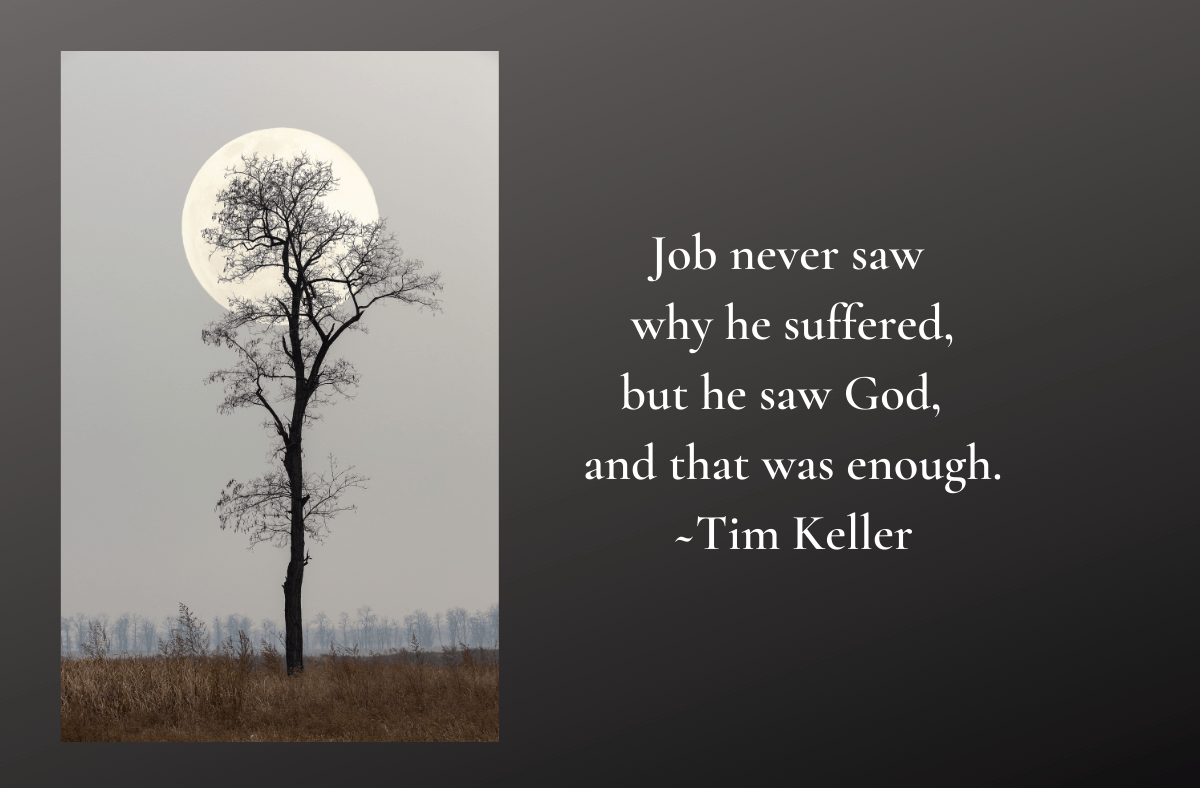
Job never did get any answers.

He stood before God speechless and in awe.

That’s pretty much where I am right now.

I don’t have to like it.

I don’t have to understand it.

I only have to be willing to admit that He is God and I am not.  

Job answered God:

“I’m convinced: You can do anything and everything.
    Nothing and no one can upset your plans.
You asked, ‘Who is this muddying the water,
    ignorantly confusing the issue, second-guessing my purposes?’
I admit it. I was the one. I babbled on about things far beyond me,
    made small talk about wonders way over my head.
You told me, ‘Listen, and let me do the talking.
    Let me ask the questions. You give the answers.’
I admit I once lived by rumors of you;
    now I have it all firsthand—from my own eyes and ears!
I’m sorry—forgive me. I’ll never do that again, I promise!
    I’ll never again live on crusts of hearsay, crumbs of rumor.”

Job 42:4-6 MSG