Navigating Grief: What is a Grief Circle?

Our family is navigating deep grief a second time.

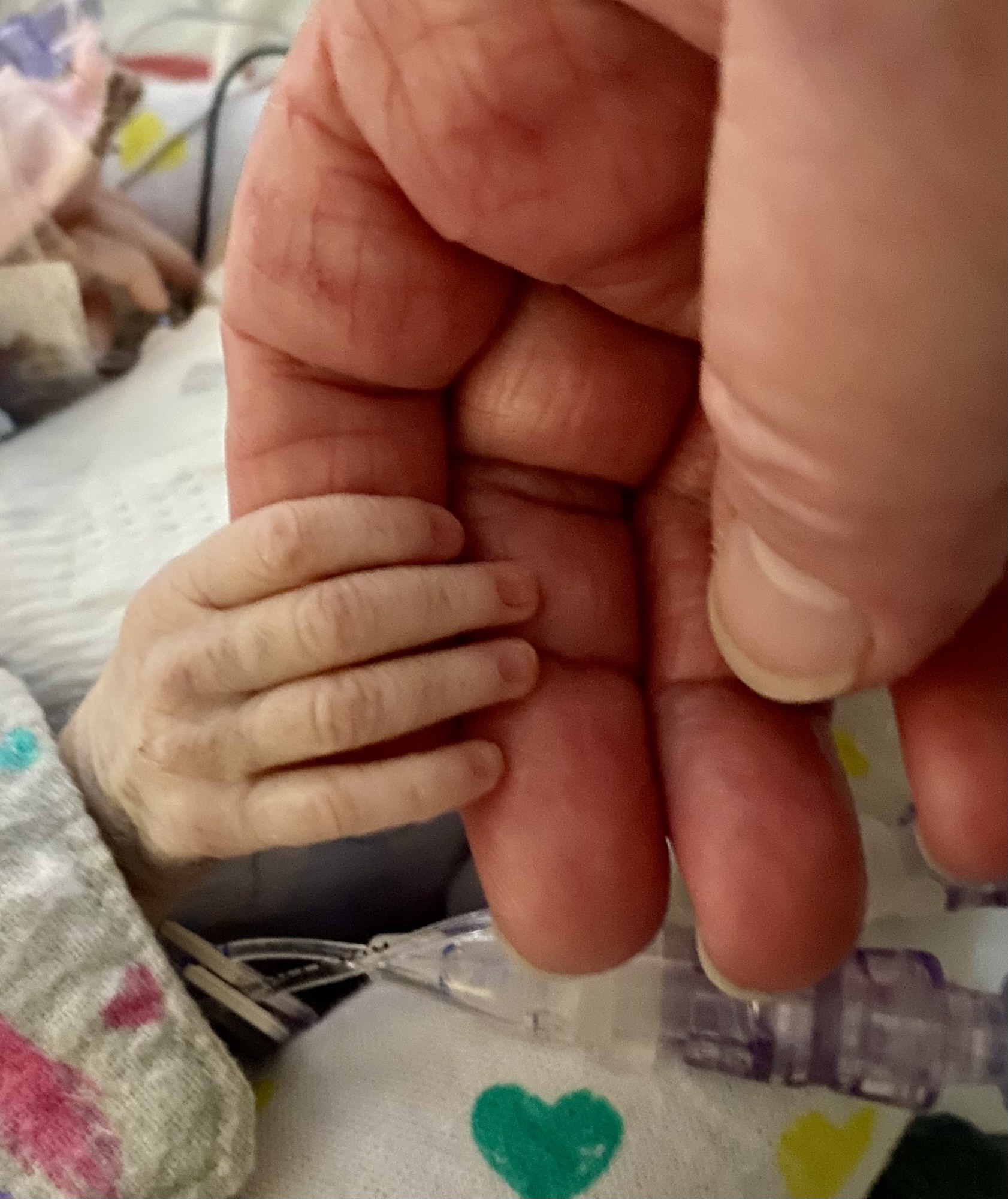
In January, my granddaughter, Holly, was gathered into the arms of Jesus after only two weeks on earth-almost to the minute.

Once again my children are plunged beneath the flood of hurt, pain, questions and sadness of child loss.

This time my oldest son and his wife are the center of the circle. Their sons are the immediate next ring. My two other earthbound children, my husband and I are slightly more removed.

But distance from the center does not necessarily indicate the degree to which the same loss might reignite old feelings, trauma, anxiety and unwanted physical, mental and spiritual responses to grief.

A grief circle is comprised of those most closely impacted by a loss.

The world likes to draw it tight because even if it doesn’t represent the reality of those involved. Expanding the circle expands the need for compassion and compassion might well demand action.

Drawing it smaller also gives the curious permission to ask personal questions from those close to the loss (and who may have information they desire) without feeling guilty about asking the question.

May I give a piece of (unsolicited) advice?

Please. Don’t.

Please don’t ask my children how I’m doing.

Please don’t ask my son and daughter, the uncle and aunt of Holly, how their brother is doing or how I am doing.

Please don’t ask my son how his wife is doing. He is also a parent of a child he can no longer hold.

Please don’t assume that being slightly removed from the center of loss means being removed from the pain and damage such a loss entails.

You are welcome to ask me anything. Both my experience and age mean I’m better equipped to answer or not answer as I am able.

I have found that Holly’s brief life and death have impacted me in ways I don’t understand and am still trying to process. She is my grandchild. I don’t love her less because her life on earth was brief.

Since I’ve walked this broken road, I am oh, so aware of what lies ahead for both my son and daughter-in-law as parents, their sons as surviving siblings and my own children as doubly grieved siblings.

I remember thinking when we gathered in the AirBnB the night after the long, long day Holly took her last breath how heavy, powerless and hopeless I felt.

No words could undo what had happened.

No hug could press the pieces of broken hearts back together.

No amount of wishing, wishing, wishing would turn back a clock that had relentlessly brought us forward to this very moment.

My family is knit together in ways and with bonds no one would choose.

We keep our phones with us “just in case”. We share travel itineraries, traveling companions’ contact information, and we answer phone calls from one another no matter where we are or with whom.

The grief circle is larger than most folks would like to admit and it remains intact over time and across distance.

There is no “fix” for grief.

No “getting over” or “past” loss.

There is moving forward and I am so, so proud of my family for choosing that hard path.

But here we are again.

And it is going to take more time than anyone outside our circle would like to admit.

Navigating Grief: No Such Thing as “Safe”

I remember as a  young mother of four working hard to keep my kids safe. 

dominic and siblings little children at nannys

Next to fed and dry (two still in diapers!) that was each day’s goal:  No one got hurt.  

It never occurred to me THEN to add:  No one got killed.  

Because the most outlandish thing I could imagine was one of them falling or touching a hot stove and us having to rush to the emergency room.

Then I became a mother of teens and one by one they acquired a driver’s license and motored away from our home.  

That’s when I began to beg God to spare their lives.

One particularly frightening test was when all four went to Louisiana-my eldest driving and the rest in the van with her.  I made them call me every hour and tell me they were OK.  It was the first time I realized that I could lose every one of them in a single instant should they crash-all my eggs in one basket.

I was glad when that day was over.  Although the irony is they were no “safer” at the end of those 24 hours than they were at the beginning.

Because what I know now, but didn’t know then is this:  There is no such thing as “safe”

Not the way we like to think of it-not the way we add labels to devices, seat belts to cars, helmets to everything from bicycles to skateboards.  Of course we should absolutely take precautions!  Many lives are saved by them every single day.  

But.  BUT…

Life is more random than we want to admit.  And there is no defense against random. 

There is no way to screen for every underlying physical abnormality, no way to drive so well you can stop the drunk or inattentive driver from plowing through a stop sign, no way to anticipate every foolish choice a young person might make that ends in disaster instead of a funny story.

IMG_1795

My first response when Dominic died driving his motorcycle was that I wanted my surviving sons to sell theirs.  They did so out of respect for me.  Neither of them wanted their mama to have to endure a second knock on the door and the same message delivered twice.

I receive it as a sacrifice offered in love from them. 

Because it was.  

Since Dominic left us almost [twelve] years ago, I have had to deal with my desperate need to keep my living children safe. 

And it is a real struggle.

Each child is involved in a career that includes inherent risk.  None of them are foolhardy, but they are exposed-perhaps more than many-to potential bad actors and dangerous circumstances.

julian and branch in snow
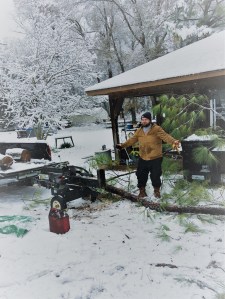
This branch fell just minutes after my son was standing in that spot splitting logs.

How I long for those days when I could tuck everyone in, turn out the lights and sleep soundly because all my chicks were safe inside my own little coop!  How I wish the only danger I thought about or knew about was a bump on the head from hitting a coffee table!

How my heart aches for one more moment of blissful ignorance!

But I can’t live in some imagined water color past.  I have to live in the world as it is.  

So I remind my heart that safe is an illusion-no matter where we are.  Life is not living if it’s only about preserving breath and not about making a difference.

And I let go.  

Over and over and over.

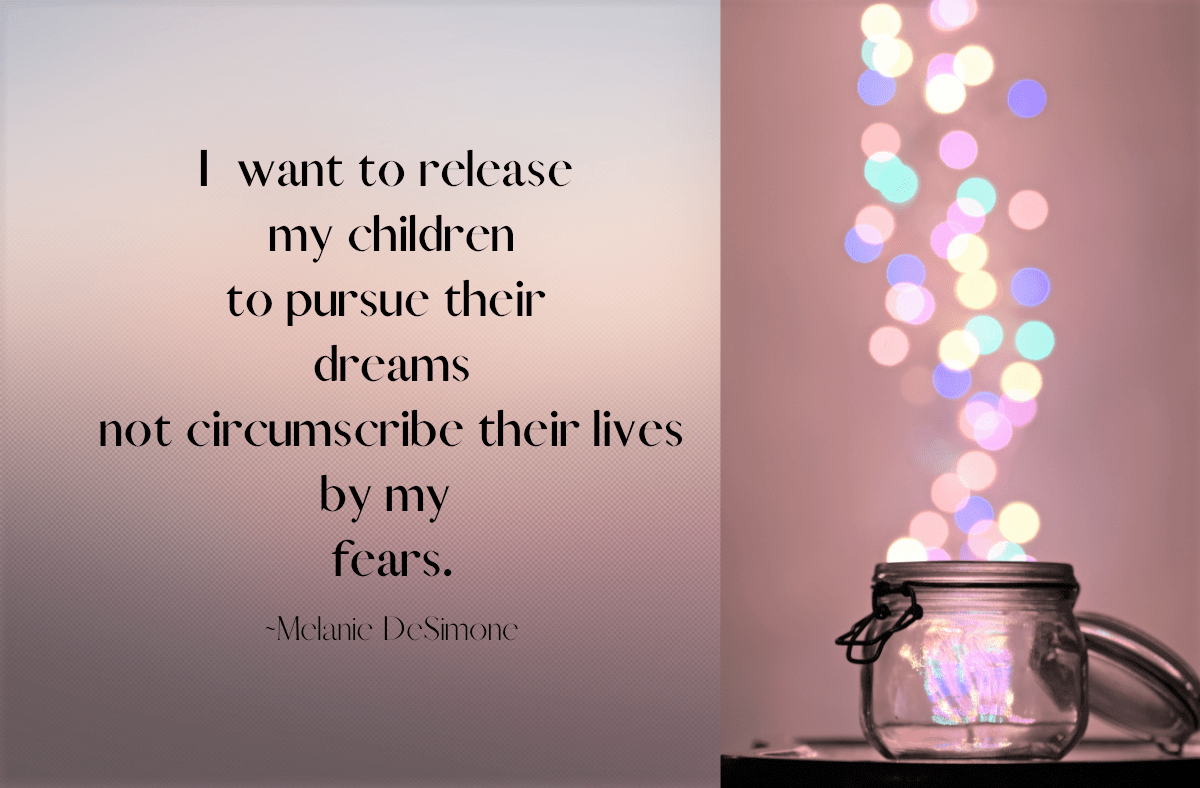
I release them  to be who they were meant to be. 

Even if it costs more than I am willing to give.  

fiona james and julian at james wedding by water

Navigating Grief: Helpful Tips for Interacting With Bereaved Families

I firmly believe that our friends and extended family want to reach out, want to help, want to walk alongside as we grieve the death of our child.

 I am also convinced that many of them don’t because they don’t know how.  

It may seem unfair that in addition to experiencing our loss, we also have to educate others on how to help us as we experience it, but that’s just how it is.

The alternative is to feel frustrated and abandoned or worse.  

So here’s a list of helpful tips (and a great infographic!) for interacting with bereaved families:  

Express condolences and show you care. Don’t avoid me, please!  You cannot make me any sadder.  I need to hear from you.

friends hugging

Refer to my child by name.  Dominic is STILL my son.  He is still part of my story.  But because he’s no longer visible, his name often goes unspoken.  Please talk to me about him, use his name, tell me a story of how he impacted your life or a memory that makes you smile.  It makes me smile too.

Actively listen and be supportive.  It’s hard to listen to someone tell you how much they are hurting and not offer advice or think of ways to “fix” them.  I can tell you from experience that what I need most on my darkest days is for someone to say, “It IS dark.  I’m so sorry.”  Silence is OK too.  Not every quiet moment needs to be filled with chatter.

listening is a postive act

Understand that each family and family member will grieve in different ways.  You may have observed child loss before but what you saw in one family may not translate to the next.  There are no hard and fast rules for this awful journey.  The age of the child, family background and structure, manner of death-all these impact grief.  In addition, mothers and fathers, sisters and brothers all bring their personalities, stage of life, beliefs and experiences to the journey.  There were five of us left behind when Dominic ran ahead.  We were each devastated but expressed it in very different ways.  Nearly five years later, those gaps have widened, not narrowed.

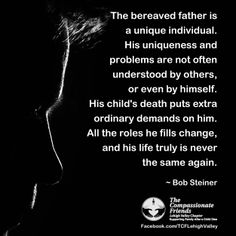
Fathers grieve too.  Sometimes support focuses almost exclusively on the mother.  In part because of a common notion that mothers are somehow emotionally closer to their children than dads.  In part because many men are less demonstrative and may do a good job hiding grief.  Whatever the reason, don’t assume one parent is dealing “better” with the loss than another (mother or father) just because he (or she) is not crying openly.  No one escapes this awful blow unscathed.

bereaved fathers

Don’t overlook siblings.  Surviving siblings are sometimes referred to as “forgotten grievers”.  If they are very young, people may think they are relatively unaffected by the death of a brother or sister. If they are grown and out of the home, people may figure that the siblings’ own, very full and very busy, lives keep them preoccupied.  While some of that may be true-to an extent-most surviving siblings are deeply impacted by the death of a brother or sister, regardless of age.  Not only have they lost a member of the family and changed birth order, they have also lost the family they knew, the parents they knew and a co-keeper of memories and secrets.  Bereaved parents are often overwhelmed with grief for their living children as well as the child that is missing. One of the best gifts anyone gave me was reaching out to my surviving children.  It helped my heart to know that they had friends who were supporting and loving them well.

kids cartoon

Be yourself.  People often feel awkward and stiff when approaching a bereaved parent or family member.  That’s perfectly understandable.  The bereaved seem so fragile (are so fragile!) that folks are afraid the wrong word or touch might shatter them into a thousand pieces.  But what your friend or family needs right now is the you they’ve always known and loved.  If you are a hugger, hug!  If you are a storyteller, tell stories (appropriate ones, ones of the missing child).  If you are a cook and cleaner, then cook and clean.  Our family was blessed by our friends doing exactly what they had always done-come alongside in their own special way.  So much had changed in our world that familiar touchstones, familiar routines and familiar faces were a real comfort.

Keep in mind words matter.  Now is not the time to try to satisfy your curiosity about exactly “what happened”.  Loud joking is rarely welcome.  Many bereaved families find it hard to laugh in the first days, weeks, months because it feels like betrayal.  Don’t offer platitudes intended to help them “look on the bright side” or consider that “it could be worse”.  There is nothing worse than burying your child.  Nothing.  Listen and take direction from the person you are comforting.  Follow his or her lead.  And if something less than helpful slips out, own it and apologize.

pencil-drawing-bereaved-mother

It’s never too late to reach out.  NEVER.  Sometimes people stay away at first for lots of reasons.  Or they show up for the memorial service and then fade into the background.  After a bit, even if they want to reach out, they may feel embarrassed by the long absence.  Don’t be.  So many people stop calling, visiting and texting within the first weeks that your outstretched hand of friendship will be a welcome beacon of hope.  If you need to, apologize for your absence.  Be honest.  Admit you were scared or whatever.

Then show up. 

Stick around.

You don’t have to be perfect.  

Just be present.  

bereaved families infographic

Navigating Grief: 31 Practical Ways to Love Grieving Parents

When Dominic died, I didn’t get a manual on what to do.  I didn’t get an orientation into how to be a grieving parent.  So when some people asked how they could help me and my family, I really didn’t know.

A comment repeated often by bereaved parents is, “Please don’t use the phrase, ‘let me know if there is anything I can do’, people mean well, but this is unhelpful.”

Another mom put it this way, ” There are too many meanings to this phrase.  It can mean anywhere from, ‘I really want to help’ to ‘I don’t know what to say so I’ll say this but I don’t really want you to ask’.  Also it’s so hard to make any decisions–trying to figure out what you might want or be able to do is overwhelming.  Instead, offer specific things you can do and make plans to do them.”

For those that want to help, here ia a list of 31 ways you can provide practical and timely help to grieving parents:

Show up and answer phones, open the door to visitors, find room for food they bring.  Act as a buffer zone for the parents.

Consider donating PTO, sick leave or vacation days to a bereaved parent if your employer allows it. Many employers allow three (3) days leave for a death in the family with no special consideration for the death of a child.  Three days is not long enough and many parents can’t afford to stay home without pay.

Donate sky miles, rental car points, hotel points or other loyalty points to the parents or family members that need to travel.  There are many expenses associated with burial and the family may not have extra money for travel.

Pick up family members from the airport that are coming for services.

Offer to accompany the parents to the funeral home as they make arrangements.

Donate a burial plot.  Few people have one picked out for their child.

With the family’s permission, set up an account to take donations to help with burial expenses or the medical bills that will be arriving soon.

Offer an extra bedroom to out-of-town family members or friends.  Not every home can accomodate extra guests and the parents need some space of their own.

Bring folding tables and chairs to the home–they are easy to set up and take down as needed to accomodate extra people in the house.

Respect a grieving parent’s need for some private time and space.  If we retreat to a back room, let us.  Check on us quietly and gently, but don’t follow us around asking, “Are you OK?”  No, we are not.  And being asked over and over is stressful.

It is always helpful to bring food.  Set up a meal schedule on Takethemameal.com. There is a way to note any special dietary restrictions.  When people sign up, they can see what others are bringing/have brought.  Driving directions are available on the site and the family can ask that meals be brought at a standard time so there is someone home to receive them.

Bring ice in an ice chest for drinks.

If a parent has a chronic health condition like diabetes or heart problems, check in with them regularly to see if they are taking their medication and if they are experiencing new symptoms.

Offer to drive grieving parents where they need to go.  Deep grief can impair driving as much as or more than alcohol or drugs.  Be willing to sit in the lobby or parking lot–we may not want company finalizing arrangements or speaking with our pastor.

Clean the house. And don’t allow your intimate glimpse to become a source of gossip.

Don’t turn on the television or radio unless the family asks you to or does it themselves. If you want to know the score, check your phone or go to your car.

Mow the yard, tidy flower beds, sweep, rake leaves.

Bring toilet paper, paper towels, paper plates and napkins.

If one or both of the bereaved parents are caregivers to an elderly relative, offer to take over that responsibility for awhile.  (Only if you are willing and competent to do so.)

Take surviving younger children for a walk in the park, to get ice cream or a hamburger. Not all children will be comfortable leaving their parents.  Even if they don’t understand what is going on, they may feel insecure and upset.

Sit with and minister to surviving older children.  We are concerned about our surviving children as well as the child we lost.  Knowing someone is loving on our kids is a great comfort.

Clean the family’s car before the funeral.

Make sure there are bottles of water and maybe a snack in the car for afterwards–often family members can’t eat and forget to drink before the day of the funeral.

Begin assembling electronic photos from friends for a slideshow at the funeral, if the family requests one.  Make sure you run choices by the parents before you flash them on a screen.

Make a list of appropriate songs that might help the family choose.  Don’t be hurt or offended if we use other songs instead–your list may very well have nudged our memory and been helpful.

Offer to drive the family to the funeral and burial.

Attend the funeral.  We want to know our child mattered.  We need to know you care.

If your church provides a meal for the family after burial, and you are asked to bring a dish, bring one.

Offer to help pack up a child’s dorm room or apartment.  We may welcome the help or we may want to do it alone–it has nothing to do with you.

Many grieving mamas want something that smells like their child.  If you are helping to clean in the first hours or days, don’t wash all the child’s clothing.  Put a few worn items in a ziploc bag for her to have later.

Don’t abandon the family after service.  There is such a sense of finality when the coffin is lowered or the memorial over.  Usually lots of people are around and then we go back to the house and quiet overwhelms us.  If you are close to the family, consider joining them for a little while when they first get home.

Dear friends, do you think you’ll get anywhere in this if you learn all the right words but never do anything? Does merely talking about faith indicate that a person really has it? For instance, you come upon an old friend dressed in rags and half-starved and say, “Good morning, friend! Be clothed in Christ! Be filled with the Holy Spirit!” and walk off without providing so much as a coat or a cup of soup—where does that get you? Isn’t it obvious that God-talk without God-acts is outrageous nonsense?

James 2:16-17 MSG

Are you a bereaved parent?  Have you walked this path with a friend or family member? Please add your suggestions to these in the comments section.

An Uncomfortable Exchange

The other day I had an uncomfortable exchange with someone that started with a phone call and ended with a series of texts.

I’ve learned a lot about the unhelpful things folks say to grievers and at this point I can let most remarks roll off like raindrops.

When someone says, “God needed another angel” or “I know just how you feel” (and they do not share my experience) or “at least you have other children/grandchildren” I usually smile, cut the conversation short and hang up or walk away.

So when this old family friend called and asked in a chipper voice, “How are you??!!”, I told them not well since my granddaughter just went to Heaven two days ago.

That invited several platitudes.

I endured them, hoping for a quick end to a painful conversation.

Then the spouse chimed in because they could not contain themselves and felt compelled to share a bit of friend circle news with me.

When I said, firmly but politely, I could not listen to that right now, they got upset.

I genuinely try to educate people outside the grief community when I can so I sent a text explaining that (especially!) when a loss is fresh, such conversations are incredibly painful.

The person responded by telling me I was rude and they were highly offended.

In the early days after Dominic ran ahead to Heaven, I would have curled up on my bed and slept away the pain such an exchange inflicted on my wounded heart.

I’m stronger now.

And I’m not just fighting for myself, I’m fighting for my newly bereaved son and his wife.

So after giving it some time and some thought, I wrote a text.

People might consider it harsh but I will not make death easy for others. It’s not easy on the families directly impacted and it’s not my responsibility to manage the feelings of folks who are not even in the grief circle.

I gave graphic details (which I will not recount here to spare my precious readers who actually lived through things like them) regarding the brief life and difficult death of my precious Holly.

I wanted to shock them into realizing the giant gap between the imagined experience of child loss and the LIVED experience of child loss.

I concluded by saying that if “rude” was the epitome of awful in their world, I was thankful they didn’t have anything to compare it to.

I am quicker to extend grace after all these years because I know many, if not most, folks are genuinely doing the best they can.

But I have boundaries.

I am not required to set myself on fire to keep others warm.

And I’m doing no one a favor by allowing someone who wields words like swords to go unchallenged.

There are still lots of times I remain quiet.

This wasn’t one of them.

An Old Familiar Ache

Sunday morning my sweet granddaughter, Holly, was gathered into the arms of Jesus.

Her little heart just couldn’t bear the weight of this earthly life.

I know her Uncle Dominic will love her well until we join them.

In the meantime I’m left with that old familiar ache-the heaviness sitting on my chest, threatening to squeeze the air from my lungs.

I recognized it immediately even though it’s been a long time since it felt so heavy.

We grieve because we love.

Tears, wails, laments are all reasonable responses to loss.

Death is the enemy. Don’t ever let anyone try to spiritualize that truth away.

God hates death.

Jesus wept at Lazarus’ tomb. His tears weren’t mere sentiment. They were proof that He longed for death to die.

I hate that my son and daughter-in-law now walk the path of child loss. I hate my grandsons will grow up wondering what their baby sister might “look like now”.

It’s another invitation into the deeper grace and greater love of a God who gave His only Son because He is unwilling for sin to win.

I’m thankful that because Jesus came, lived and gave HIS life, death does not have the last word.

“Living He loved me, Dying He saved me, Buried He carried my sins far away, Rising He justified, freely, forever, One day He’s coming-O Glorious Day!“

Glorious Day by Casting Crowns

Christmas 2025: Best Christmas Present EVER

I’ve had plenty of beautiful Christmases.

I’ve had more than a decade of more somber ones.

But when our pastor recently asked, “What was the best Christmas gift you ever received?” I didn’t have to think hard at all.

It was my daughter, Fiona.

Read the rest here:Best Christmas Gift EVER

It’s Not *Just* Christmas

Several times this week I’ve had messages or seen posts from bereaved parents feeling like failures because Christmas is STILL hard, even many years after their child went to Heaven.

Some of them heaped the guilt on themselves but many were responding to a family member or friend who felt compelled to tell them they should “be better by now” or “remember their other children” or “not ruin the holiday for everyone else”.

Other broken hearted parents have shared that they actually felt stronger and better able to face Christmas in years past but this year is hitting differently.

For them, it might be because Christmas is never JUST Christmas.

We come to this season with memories and emotional baggage of a lifetime. And for bereaved parents, the heaviest load we carry is our child(ren)’s absence. We also bear the additional burden of this particular year’s challenges, losses, physical and emotional stress and whatever lesser, but also energy intensive, cares and responsibilities we may have.

So I’d like to encourage my fellow road weary travelers.

Be gentle with yourself.

Take care of yourself first (when possible-I know littles make that much harder). You cannot pour from an empty cup.

Have honest conversations with those that matter most to you and limit conversation with those that only make you sadder and more stressed.

If you are concerned about your earthbound children, now is a perfect time to take them aside-one on one- and let them know that if it had been THEM, they would be equally grieved and missed.

Remember that saying “no” is a complete sentence. You don’t have to make excuses or satisfy someone else’s curiosity.

If you are at your limit for making merry, don’t.

There is no moral imperative that Christ’s birth be celebrated at all (although I think it’s a beautiful tradition). You have not failed Him or anyone else if you can’t participate in all the church activities this time of year.

This is the twelfth Christmas for us after Dominic ran ahead to Heaven and it’s a tough one.

For the first time since the first one, I’ve been unable to do even one thing to get ready or incline my heart toward anything like a “regular” Christmas.

My father suffered a major stroke in September and I have been at his home with him since then. My oldest son is expecting his third child and his wife is having complications that guarantee this little one will make an early appearance. Every member of my family is in different places and we are reduced to short phone calls and text messages for connection.
I would usually at least have a lovely pine scented candle to light each dark morning and evening but my father can’t tolerate the smell. So even this one ritual has been denied.

I’m trying desperately to get care lined up for my dad while worrying about the ever changing status of my DIL and granddaughter. The internet is slow, cell service is worse and I spend way too much time just attempting to contact people.

My father refuses to go anywhere for Christmas and I will, undoubtedly, be with my son’s family by then if the baby comes.

I’m sharing all that to say this: Every other challenge and burden is heaped on top of the already unbearable weight of missing Dominic. I’ve been barely dragging myself through each day.

So I’m taking my own advice.

I talked to my family and together we’ve agreed that we are streamlining and eliminating everything except what’s necessary for the grandchildren to have Christmas. The adults are fine.

I love my father but he is in his right mind (despite the stroke) and if he wants to be alone at Christmas, that’s his choice.

I’m putting on my stretchy pants and enjoying whatever holiday cheer my husband, my children and I can muster as we (hopefully) bask in the glow of a tiny new life.

So if you are struggling, dear heart, find the way forward that lifts as many burdens as you can.

Refuse to take on another person’s baggage.

Jesus came so that we don’t have to carry this alone.

He is here-Immanuel-God With Us.

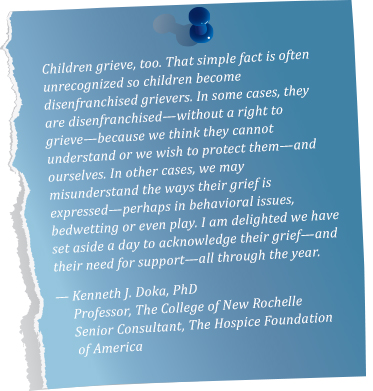
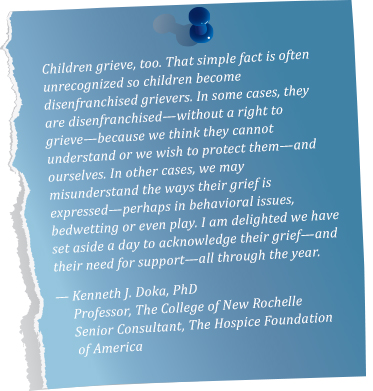
Children Grieve Too: Children’s Grief Awareness Day

Today is Children’s Grief Awareness Day.

I’m thankful a day is set aside to focus on children’s grief because it’s so easy for their grief to be overlooked, underrated and even dismissed.

Grown ups often tout the line, “Kids are resilient. They will adapt.

And while it’s true that from the OUTSIDE it might look like a child is OK or even thriving, on the INSIDE she may be curled up into a ball or he may be angry and resentful.

Sometimes these feelings find unhealthy expression through addiction or risky behavior. Sometimes they simply grow into a giant overwhelming shadow that darkens the child’s whole world.

Image result for images child grief day

My own mother’s mama died suddenly from a stroke when she was only ten years old. Within days, Mama was whisked away from everyone and everything she knew to live with her oldest married sister.

No one understood then that children needed to grieve so Mama never really did.

At least not out loud where anyone could hear.

But that grief informed her entire life-it made her kinder to many people and made it harder for her to develop deep attachments to others. She was only able to talk about it in the last couple of years of her life when failing health, my own loss and many hours spent in hospital rooms together created safe spaces for her to share.

Children grieve whether we observe it or not.

Children need safe spaces to express that grief even when it hurts our hearts to hear the words or see the tears.

No child should have to wait until they are grown to acknowledge his pain or her brokenness.

Image result for images child grief day

Just like we parents, surviving siblings grieve what they’ve lost AND what will never be. Graduations, weddings, new babies, holidays, birthdays and other occasions mark their hearts too.

Children bear other burdens as well.

They are often targeted by those outside the grief circle for updates on the family while their own grief goes unnoticed. After five years, my kids have developed a standard answer to the question, “How’s your mom doing?”

“About as well as you’d expect.”

Next.

Sometimes children feel they must be extra good and extra quiet in an effort to make up for the sadness in a home after the death of a child. Sometimes they take on adult roles, shouldering responsibilities a depressed or grieving parent can’t manage right now. Sometimes they struggle with misplaced guilt when their hearts are jealous of all the attention focused on the missing child.

Often they just wish things were back to how they were before tragedy struck.

Your children may never tell you these things unless you ask.

And they may not confirm them even if you do.

But rest assured, they are grieving too.

Give them permission to do it out loud.

Remembering Our Children Beyond Anniversaries

My son’s death is a point in time for people outside my immediate grief circle. It’s a date on a calendar. There is a period after his name.

But it is an ongoing experience for me and my family.

We don’t only remember on birthdays, holidays and anniversary days, we can never forget.

Yet often others do.

Read the rest here: I’m Sorry