Supporting Grieving Parents During the Holidays

Most parents feel a little stressed during the holidays.

For bereaved parents, the rush toward the “Season of Joy” is doubly frightening.

Constant reminders that this is the “most wonderful time of the year” make our broken hearts just that much more out of place. Who cares what you get for Christmas when the one thing your heart desires–your child, alive and whole–is unavailable…

It is so hard to find a way to trudge through the tinsel when what you really want to do is climb into bed and wake up when it’s all over.

Here are some practical ways family and friends can help grieving parents during the holidays:

  1. Don’t resist or criticize arrangements a bereaved parent makes to help him or her get through this season.If they are brave enough to broach the subject, receive their suggestions with grace and encourage them with love.  Do your best to accommodate the request.
  2. If the bereaved parent doesn’t approach you–consider thoughtfully, gracefully approaching him or her about what might make the holidays more bearable.But don’t expect a well-laid plan-I didn’t get a “how-to” book when I buried my child…this is new to me and very, very painful.  I am doing the best I can to keep my head above the waves and I cannot be expected to captain the boat through these turbulant waters.
  3. Don’t be surprised if a bereaved parent doesn’t want to exchange gifts (or at least, not receive gifts). No one can rewind time or restore my family circle to wholeness and I just can’t think of anything else that I want or need.
  4. Don’t assume that the bereaved parent should be relieved of all meal duties around the holiday.For some of us, doing the routine things like baking and cooking are healing.  For others, there just isn’t energy for anything other than the most fundamental daily tasks. ASK if they want to contribute.
  5. Don’t corner surviving children for a private update on their parent’s state of mind.My children are grieving too.  When you expect them to give an update on me you diminish their pain and put them in a difficult position.  If you want to know, ask me.
  6. If there are young children in the family, it might be helpful to offer to take them to some of the parties/gatherings/church services that their parent may not be up to attending. Ask, but don’t be upset if they say “no”–it might still be too traumatic for either the child or the parent to be separated from one another.
  7. Ask them to share about the one they miss.  One of my greatest fears as a grieving parent is that my child will be forgotten.  But we might not speak up because we don’t want to make others feel uncomfortable.

I know that life goes on, the calendar pages keep turning and I can’t stop time in its tracks.  I greet each day with as much faith and courage as I can muster. This season requires a little more-and I will need help to make it through.

Finding Joy Amidst Grief: Holiday Strategies

Fellow brave and bereaved, I don’t know how you feel coming off this late-in-the-month Thanksgiving headed straight for Christmas but I’m kind of tired.

Yesterday I shared about post-holiday blues but this is something different.

I love, love, love any time I get with my family and I want to be clear that THEY do not place demands on me I find burdensome.

But…I am no better prepared to trudge through all the holly-jolly THIS year than I was the second year after Dominic ran ahead to Heaven. (I don’t even count the first year when shock overwhelmed my heart.)

This far along in my grief journey many folks I rub shoulders with are either unaware that child loss is part of my story or they’ve tucked that “incident” away in some rarely accessed section of their memory. And while I do not tote my loss around like a token demanding special attention, it absolutely continues to inform how I experience every day and especially how I experience holidays.

So I wanted to share a few thoughts about THIS year-the eleventh Christmas I will celebrate since Dom left us.

  • It’s still hard. It still takes 110% effort to show up, engage, maintain enthusiasm, DO all the things (or even my abbreviated list of things), not let my emotions overrun my desire to be polite and find time to sit silent in the circle of sacred sorrow that helps my heart hold on to hope.
  • I have to constantly revisit my own advice (which I will repost in the coming days) about giving myself permission to bow out of whatever I simply can not face.
  • Communication is key. It sometimes surprises me (but shouldn’t!) that other people can’t read my mind and most forget what I told them last year or the year before. Add to that things change from year-to-year and there’s no way around the need for at least a casual conversation about what THIS year is going to look like.
  • Grace greases the wheels of relationships. Grace for myself. Grace for family and friends. Grace for strangers-including the clerk at the grocery store-who are probably doing the best they can too.
  • Increased social interaction-whether a function of more planned activities or just the crowds of shoppers-means it’s harder for me to escape the pressure of social anxiety that has developed post loss. I try to choose carefully what I add to my calendar, graciously send regrets for the rest and then refuse to feel guilty about it.
  • I am more careful about hydrating and not over indulging in any foods that tend to send my body into overdrive. It’s less about the calories (although I need to be mindful of those!) than it is about the wild swings poor nutrition produces in my sense of physical well-being.
  • I must plan rest stops along the way. I can’t overschedule, overstimulate and overwork myself and still maintain a semblance of control over my emotional response to the grief waves and grief ambushes this season is sure to provide. I try to set aside at least a few minutes EVERY DAY and (if possible) one day PER WEEK that promises quiet solitude and the opportunity to unwind and unspool built up tension and anxiety.
  • I purpose to find joyful moments and beautiful memories when gathered with others and when doing all the things holidays require. I hold them close and cherish them.

Most importantly, I remind my heart that this season is only a season.

It doesn’t last forever.

I will survive this like I’ve survived every day since Dominic left us-one moment, one breath at a time.

Coping with Child Loss: Why Silence Hurts

At first everyone talked about him.

It’s what people do just after a person leaves this world and leaves behind only memories.

It comes natural before the unnatural fact of child loss settles in and begins to make everyone uncomfortable.

But at some point after the funeral and way before the tears dried up, people stopped feeling easy mentioning his name.

Read the rest here: Help! My Family Won’t Talk About My Missing Child.

Some Days are Hard Stops. When I Can’t Ignore the Missing…

Most of the time I’m just kind of rolling along.

There are things to do, places to go, people to see, animals to feed.

I get up, get going and get on with it.

But there are some days that are what I call “Hard Stops” on this journey.  They are the days that force my heart to take special notice of the fact that Dominic isn’t here.

Sometimes they are milestone days like birthdays or holidays or the anniversary of that awful knock on the door.

Sometimes they are events where he should be there-like seeing his brother one more time before he deploys half-way around the world.

These days make my heart measure the time since I last hugged his neck, heard his voice, saw his strong, square hands reach across the table for the salt shaker-and I am overcome with how long it has been!

Then my heart shifts to the months and likely years I will have to live with this aching empty place where he should be but isn’t and I fear I just can’t do it!

Many days I’m able to distract myself from the sorrow and to live with the missing.

But these “hard stop” days force me to face it head on. and it is overwhelming. 

Every. Time.

So what do I do? 

When my heart is overwhelmed, I take it to the Rock that is higher than I.  

rock that is higher than i

I run to the Refuge of my Faithful Father.  

sing of strength you are my refuge

I turn my eyes to my Savior Who will redeem and restore.

restore after season of suffering

I put my hand firmly in the hand of my Shepherd Who will not leave me in this Valley of the Shadow of Death.  

jesus the shepherd the i am

And I pray for myself-and every heart having a hard time holding onto hope today-that we will feel the Father’s loving arms around us and that He will give us strength to stand.  

Grief Work 2025: Self-Care Is Necessary

My first instinct as a mother and a shepherd is always, “How can I help?”

I routinely set aside my own needs for the needs of others.  Not because I’m so selfless but because that’s how I’m made-I’ve always had the heart of a caretaker.

That’s not a bad thing, most of the time.

But if taking care of others means NOT taking care of myself, then in the end, I’m of no use to anyone.  When I allow every bit of energy-emotional, physical, psychological and spiritual-to drain away until there’s nothing left, I am unable to meet my most basic needs, much less the needs of others.

I’ve written before that grief puts a hole in my bucket It guarantees that no matter how much is poured in, I’m never truly full.

I’ve also written about setting boundaries and trying to preserve margin as I walk this Valley.  I have to create space between me and the people around me if I’m going to make it through.

But there are some other steps I can take to help ensure my heart is strong enough for the journey.  It’s not always about what I don’t do.

Sometimes it’s about what I choose TO do.

Here are some ideas for self-care in grief (or really ANY hard place in life):

  • Be patient with yourself.  There is no time frame for grief.  Each heart is unique.  Extend grace to yourself, just as you would to a friend.  Try not to take on extra responsibilities.  It’s better to allow for some flexibility in obligations during this time (even around holidays!).
  • Listen to your body and your heart: If you need to cry, then cry. If you need to sleep, then do so. If you need to talk to someone, seek out someone who will listen. If you need to reminisce, then take the time. It is important for the grieving process that you go with the flow.
  • Lower expectations for yourself and communicate this new reality to others. You are not able to operate as you did before loss.  Your capacity for interacting with others, managing tasks and being available for the needs of others has been dramatically altered.  Own up to it, and let others know that it will be some time before you can shoulder the responsibilties you once did.
  • Let others know what you need from them.  No one is a mind reader.  While we who are bereaved think our needs are obvious, it’s simply not the case.  Communicate to family and friends how they can support you.
  • Accept the help of others. Understand that grief is hard work. It requires a great deal of energy and can be exhausting. Even though we place a high value on self-sufficiency, it is important to ask for, and accept, help from those close to you. Others careand genuinely want to be of assistance, but usually do not know what to specifically offer. In particular, it is vital to know who will listen and be supportive. Sharing your story out loud is one key to healing. And, remember that professional guidance is also available
  • If you need counseling, get it!  There is NO shame in asking for help. Get all the support you need. There are many bereavement support groups as well as counselors or spiritual advisors who specialize in bereavement counseling. Don’t hesitate to contact a medical and or mental health specialist if you have feelings of hopelessness or suicidal thoughts.
  • Accept your feelings. Feelings are neither right nor wrong, they just are. Sadness, loneliness, fear, confusion, anger—these are among the many feelings you may experience, and are completely normal. Emotions are often raw early in the grief process, but it is important to express them. Attempting to stifle feelings usually leads to an emotional outburst at an inconvenient time.
  • Face your feelings. The painful emotions associated with grief are a natural and normal response to loss. You can try and suppress them or hide from them all you want but in the end this will only prolong the grieving process. Acknowledging your pain and taking responsibility for your feelings will help you avoid the complications often associated with unresolved grief such as depression, anxiety, substance abuse, and health problems.
  • Express your feelings. The most effective way to do this is through some tangible or creative expression of your emotions such as journalling, writing a letter expressing your apologies, forgiveness and the significant emotional statements you wish you had said, or art projects celebrating the person’s life or what you lost.
  • Keep a journal.  Writing down your thoughts and feelings can help you to validate and work through your grief.
  • Feel whatever you feel. It’s okay to be angry, to yell at God, to cry or not to cry. It’s also okay to laugh, to find moments of joy, or to let go when you’re ready. Your grief is your own and no one can tell you when you should be “over it” or when to “move on.”
  • Pay attention to physical needs. It’s easy to ignore your health when all you want to do is give up and give in.  However, it is even more important NOW to take care of yourself.  Eat balanced meals (set an alarm if you have to), try to get adequate rest (get medication if you need to) and make sure to get in some physical activity every day (set a timer if necessary).
  • Get physical exercise.  If you exercised prior to your loss, try to maintain the same routine. If you did not exercise prior to your loss visit your doctor before embarking on a physical exercise routine. Physical exercise can improve the way you feel.
  • Eat right and get enough sleep.  Maintaining a healthy diet and getting proper sleep is essential for functioning as well as you can. If you are having difficulty with either, visit your doctor.
  • Be aware of short-term relievers – these can be food, alcohol/drugs, anger, exercise, TV, movies, books, isolation, sex, shopping, workaholism, etc. Most of these things are not harmful in moderation but when used to cover-up, hide or suppress our grief they get in the way of the work grief requires.
  • Take the time to do the things you need to do for yourself.  When you feel up to it, engage in activities to which you feel drawn. It could be visiting a place you haven’t been to in a while, walks in nature, reading, etc.
  • Pamper yourself. Treat yourself well. Do things for yourself that are helpful like walks, being with people who are nurturing to you, and inexpensive activities

Grief is a lifelong process-a marathon, not a sprint.  

Maintaining space to do the work grief requires and engaging in activities and health habits that help me do that work is the only way to endure.  

physical mental well being

Grief Work 2025: How Stress Impacts Grief

It would be so helpful if there was an app to track stress like there is to track spending.

Wouldn’t it be marvelous to get an alert that said, “Low Balance”, for mental, physical and psychological reserves like the one you can get for your bank account right before you are heading to overdraft territory?

But there isn’t.

And few of us are very good at gauging just how much is left in our mental wellness accounts which means we often keep giving when the well is more than dry.

I’d be lying if I said I spend the same amount of time crying, lamenting and bent over in agonizing pain that I did in the early days of mourning Dominic. I’ve found a way to keep him close, to trust his soul to Jesus and to (largely) live in the present instead of always longing for the past.

There are days, though…

Some days are easy to anticipate-birthdays, holidays, the awful anniversary of his leaving-and some sneak up on me. I can often trace my overwhelming sadness to a specific trigger or memory dug up in a drawer or found in a pile of photos.

Occasionally, I have a horrible weepy day for no discernable reason.

That’s when I walk my heart back through recent events and always come to the same conclusion-I’ve let myself run dry:

  • I’ve overcommitted.
  • I’ve not planned rest.
  • I’ve had hard pain days.
  • There’s been family drama.
  • Someone I love is sick.
  • I’m sick.
  • A deadline looms large.
  • There’s some major unpredictability going on.
  • I’ve counseled too many people without enough time to regain my own emotional stores.
  • I’m not sleeping well.
  • I’m doing too much and not listening to my body.

What I’ve come to understand is that stress is a HUGE impact on my grief and how I experience it.

I won’t patronize folks reading this with a simplistic (but wholly unhelpful!) suggestion to “reduce or avoid stress”.

For heaven’s sake! If we could do that with a snap of our fingers we would hardly need someone to tell us to take advantage of that solution.

Truth is, stress is often largely outside our control.

But there ARE some things I can make choices about. So I do. I look ahead at the calendar and note upcoming milestone days. I plug in doctor’s appointments, birthdays and holidays. I review every invitation to celebrations or lunch in light of what is already inked in.

I’ve learned to be honest with folks about my limitations and send a card or gift through the mail if I can’t be there in person. I sometimes suggest an alternative date and time if the one a friend offers just doesn’t work for me. I stand firm in my opinion that “no” is a complete sentence and as long as I’m kind and gracious it is not incumbent upon me to offer an explanation for why I’m turning down an invitation.

And if I have an unexpectedly hard day-from grief or activity or because of my RA-I drop back the next day to allow time to recuperate and rest (if at all possible).

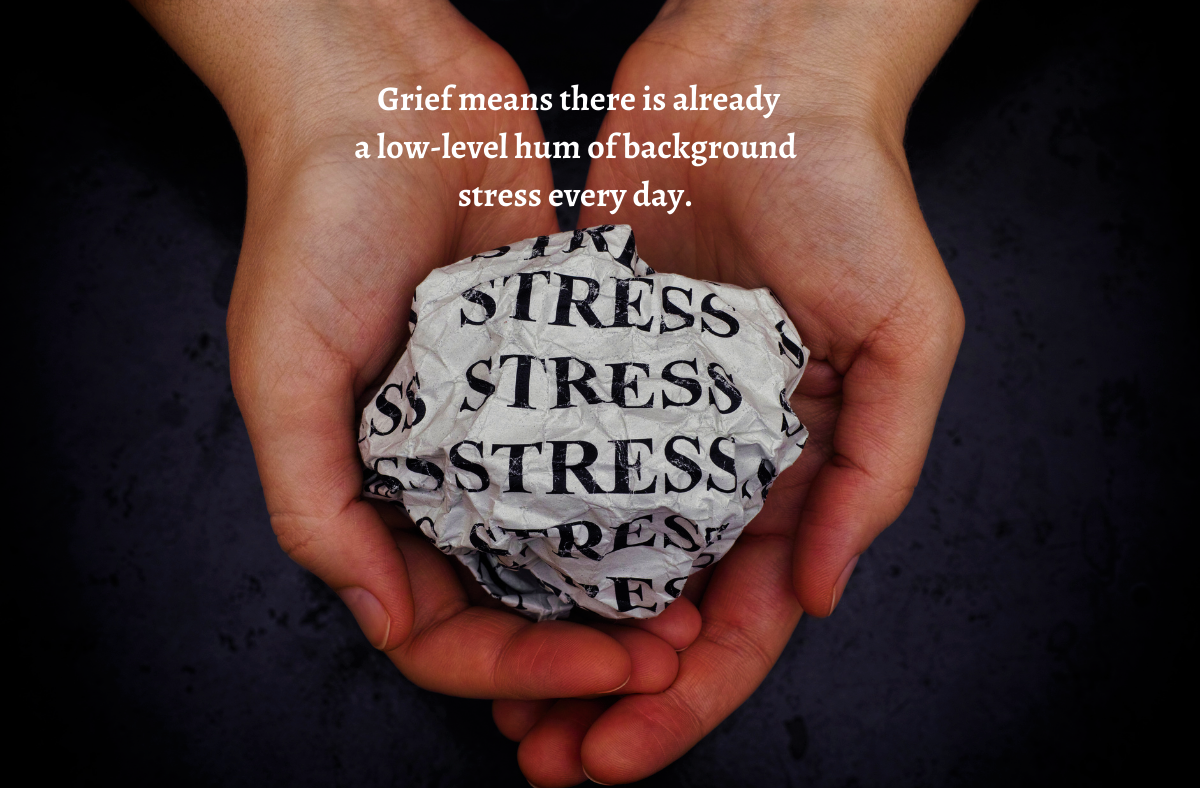
The reality is that child loss means there is ALWAYS a certain low-level hum of stress in my life.

Adding to that already higher-than-average stress means it’s easy for me to be tipped into unhealthy territory.

Crying is only the tip of the iceberg.

Health problems, heart problems, relationship issues and other long-term consequences often result.

It’s not only OK for me to set boundaries to protect my health and my heart,

It’s absolutely, positively the right thing to do.

Bereaved Parent Month 2025: Ten Ways to Survive Hard Grief Days

My hardest grief season begins in November and runs to the end of May.  Thanksgiving through Dominic’s birthday on (or near) Memorial Day are days full of triggers, memories and stark reminders that one of us is missing.

If I could fall asleep November first and wake up in June I’d do it.

But I can’t so I have to employ all the tricks I’ve learned in the over eight years since Dominic ran ahead to heaven to survive those particularly challenging months.

Here are ten ways I survive hard grief days:

1.  I make lists of things to do.  I’ve found that if I don’t make a plan for each day it’s far too easy to just lie around and feel sorry for myself.  I use index cards but whatever works for you is fine.  I list household chores, phone calls to make or notes to write, exercise, errands or whatever.  And then I consider them non-negotiable.  These are my marching orders and after my morning coffee I start down the list.

2.  I do something creative.  I crochet or arrange flowers or sew a little.  Taking just five or ten minutes to make something beautiful changes my perspective.  I have a can opener that takes the lids off without sharp edges and I make magnets for friends and family members or just to have on hand for a little gift.

3.  I take a walk.  I am thankful I can go outside on my own property and enjoy fresh air and country sunshine.  I know not everyone has that option.  But even a walk inside your office building or up and down a couple flights of stairs gets the blood pumping and releases endorphins.  If I can’t walk, then I at least change my physical position-from sitting to standing, from standing to moving.  Body position impacts my emotions.

melanie feet crocs and driveway step

4.  I find something to make me smile.  There is scientific evidence to back our common sense experience that smiling lightens our mood and helps our hearts.  I read jokes or check out some of my Facebook friends that tend to post funny memes or stories.  Sometimes I just “practice” a smile and even that can send feel-good hormones surging through my system.

paco face (2)
“Don’t try to win over the haters, you are not a jackass whisperer.” ~ Brene Brow
friends pick us up

5.  I call or text a friend.  Sometimes I just need to know that someone else is aware of my hard day. No one can undo my grief but when I feel there is a witness, it lightens the load somehow.

6.  I stay off Facebook and other social media platforms.  I love that I’m able to keep in touch with friends and family via social media.  But it can be full of drama and negativity as well.  So if I’m having a tough day, I remove the potential for it to be made harder due to random comments, posts or photographs.

Styled Stock Photography

7.   I pet my cats.  I have always been an animal lover.  But I truly do not know how I could have survived these past four years without the companionship of my cats and other furry friends.  Study after study confirms that being in the presence of pets lowers blood pressure and calms nerves. 

hand-coffee-roosevelt

8.  I go with my feelings.  There is no rule book that says I have to be tough and hide my tears.  If I’m having a hard grief day it is perfectly acceptable to let the sorrow wash over me and let the tears fall.  Sometimes fighting the feelings only prolongs my pain.  Often a good cry is cleansing and I am much better afterwards.

sometimes you can hurt yourself more by keeping feelings hidden

9.  I journal.  There are things I need to “say” that are better kept between me, God and my notebook.  I have kept a journal for nearly three decades.  Many times just writing out my feelings, my fears, my thoughts and my frustrations is enough to take the sting out.  There’s something about not keeping it all bottled up inside-even if no other soul reads it-that acts as a catharsis.

10.  I copy encouraging quotes or Scripture and hang them prominent places throughout the house.  I have notes tacked to my bed post, on my bathroom mirror, taped to the cabinet next to my stove, stuck on the fridge, slid into my wallet in my purse-absolutely everywhere.  Because when my heart is hanging on by a thread, the smallest bit of encouragement is often enough to help me hold onto hope.

None of these things undo my grief in the most basic sense.

Dominic is gone, gone, gone and I will not see him or hear his voice until we are reunited in the Presence of our Savior.

But they DO help.

One of the most devastating aspects of child loss is the overwhelming sense that NOTHING makes sense anymore and that I have absolutely NO control.

Choosing helpful habits and actions gives me a way to regain dominion over a tiny corner of my world.

And that little bit of action strengthens my spirit and helps my heart hold on.

remember to take care of yourself you cant pour from an empty cup

Surprising Things Can Make Grieving Harder

I’m the kind of person who thinks a lot about what makes people tick.

I always assume the person in front of me is the sum of his or her experiences.

We all are, really.

No one wakes up one day and just “is”. We become, over time, as our innate nature interacts with the world around us. First our parents and siblings influence us and then school, friends, life experience either gently molds us or pounds us into shape.

Often we get so used to our own way of doing and being we never give it much thought. It’s just “how we are”. We work around our faults and try to use our strengths to our advantage.

Most of us are pretty good at it.

Then something earth shattering comes along and suddenly the cracks are exposed and we haven’t the energy to cover them over.

Grieving hearts can be overwhelmed by all the seemingly unrelated issues that crop up after child loss. They lament that the pain and sorrow they bear missing their child is more than enough of a burden. Why, oh why are all these other things demanding attention at the same time?

How we grieve is informed by so many things!

Not only by our relationship with the one we miss but also our relationship with previous losses, ourselves and others.

Here are some often overlooked things that affect our grief:

  • Relationship with the one we miss. I think most of us realize this intuitively but we might be afraid to look deeper than the most recent memories and feelings. Dominic was almost 24 when he was killed in a single-vehicle motorcycle accident. At first my reaction to his death was mostly about losing him as a young adult. Over time I mourned losing him as a younger middle child who came along when I wasn’t taking as many photos of babies and toddlers (I have far fewer of him than his older siblings!). I mourned not making as much of his high school graduation and being not long out of major surgery for his college graduation. I mourned not making videos of his amazing drum playing because, you know, there’s always next time. My relationship with Dominic was complicated as all relationships are. I’m still discovering sore spots, having to think about, feel them and forgive myself or him for that specific pain. It takes time and willingness to explore my heart even when it hurts.
  • Relationship to previous losses. We’ve all suffered loss in our lifetimes. It might not have been due to death, but something or someone was taken from us, left us or is missing. And we’ve observed how others in our family have dealt (or not dealt) with loss. How we processed previous loss-what we learned or didn’t learn-in the course of living through it impacts how we approach child loss. I suffered numerous smaller losses before Dominic ran ahead to Heaven. One of the most profound was the decade prior to his leaving when my health declined in ways I could neither control nor anticipate. Over and over I was forced to accept that no matter how hard I tried, I couldn’t MAKE something happen (or not happen). I had already surrendered, for the most part, to the worldview that I was not in control. It didn’t stop my heart from crying out nor stop my mind from trying to find a reason for this awful tragedy, but it helped me get past the initial disbelief that it could happen at all.
  • Relationship to ourselves. Some of us are masters of ignoring inner voices and prodding. Some folks never have a conversation with themselves, question their own motives or examine their own behavior. They walk through life and experience it moment by moment, day by day without looking too far ahead or looking over their shoulder at what they might leave in their wake. I’d love to have a day like that. Because I’m precisely the opposite. I will replay a conversation a dozen times trying to figure out where it went wrong or what I could have said differently. I am never free of a long list of self-imposed “Do’s and Don’t’s”. Even while grieving, I had expectations regarding what was allowed and what was out of bounds. It took time for me to give my heart permission to do whatever was necessary as long as it didn’t harm me or others. The less introspective may need help setting boundaries around their words and behavior so they don’t damage other hearts and relationships in unbridled grief.
  • Relationship to others. One of the most shocking realizations in child loss is that although others are in your immediate grief circle (spouse, other children, grandparents) no one has precisely the same relationship with the missing child. And every relationship within a family is impacted by the space left behind. Families are reshaped as much by the subtraction of a member as by the addition of a new baby or spouse. It changes everything. So even in this intimate setting, misunderstandings happen. Each person is working through their own grief. As they do, they will change. And the cycle begins anew. The husband I knew and the children I knew BEFORE Dom left have been reshaped as much by this experience as I have. I tend to want to relate to the people they were before and not to the people they are NOW. The gap between the two can be difficult to navigate. We continue to learn to live together in our new reality-changing and (hopefully) growing together. We talk more about important things, hide less behind false fronts and work harder at keeping short accounts.

Child loss shook me to the core.

It rattled every loose thought and feeling so hard they fell out and I was forced to deal with them. It ripped away any facade I’d managed to construct around poor coping techniques and suddenly I had to find new ones. Excuses that served to kick relationship problems down the road weren’t enough anymore.

There was a lot of work to do.

Still is.

Surviving the Unthinkable: Grief and Self-Care

My first instinct as a mother and a shepherd is always, “How can I help?”

I routinely set aside my own needs for the needs of others.  Not because I’m so selfless but because that’s how I’m made-I’ve always had the heart of a caretaker.

That’s not a bad thing, most of the time.

But if taking care of others means NOT taking care of myself, then in the end, I’m of no use to anyone.  When I allow every bit of energy-emotional, physical, psychological and spiritual-to drain away until there’s nothing left, I am unable to meet my most basic needs, much less the needs of others.

Read the rest here: Grief and Self-Care: Surviving the Unthinkable

I Can Choose to Step Back and Not React

It is possible not to react to every single thing someone says or does.  It is possible to scroll past social media posts that get under your skin and not look back.  It is possible to ignore a snarky comment or an unhelpful piece of advice from someone who ACTS like they know what you’re going through but really has. no. idea.  

Now if you are new on this journey, you will read these first few lines and think, “Is this woman crazy????” 

I felt EXACTLY the same way in the first months and even through the first couple years in this Valley.

But, I will tell you this:  the sooner you can embrace the habit of practicing the pause, the sooner you will begin to feel like you have some control in your world again.

And isn’t that one of the things we crave after the tsunami of child loss sweeps over our lives-order, control, a sense of purpose and direction?

It’s hard. 

Really, really hard not to react against every arrow shot into my wounded heart.  Even when I know it was an accident and the offense is collateral damage, it still hurts.

But I’ve found that if I just take a single, deep breath I can put a bit of distance between the oomph of the impact and my reaction.  And there is actually power in choosing to ignore offense.

Because then I am in control, not the person lobbing the arrows. 

just-breathe

So what do I do in the split-second it takes to draw in that preparatory breath?  I consider the source.  I think (quickly) about my ongoing relationship with this person, what’s happening in THEIR life and why they might have said or done what they said or did.

Is it ignorance?  Is it sloppy choice of words?  Is it due to stress in his life?  Is she just worn out and not thinking?

And I decide:  is reacting to THIS particular exchange worth damaging the relationship?

Is it worth the negative emotional energy that I will have to expend?

Is it something I can overlook and move past?

Most of the time the answer is, “yes”.  I CAN let it go.  It’s not that big of a deal.  It is not a fair representation of our relationship and it is certainly not worth ruining a friendship.

I’m not just doing THEM  a favor.  I’m doing ME a favor.

choose to respond

I’m not “letting them off the hook”.  I may actually revisit the issue later on, when emotions aren’t running high. 

But I have learned that I only have so much emotional energy to expend in this Valley.  So much of it is already absorbed in carrying the missing and sorrow and reining in my own outrageous feelings that I just don’t need to waste the rest on trivial things.

So I don’t (most of the time). 

Practicing the pause helps me do that. 

It gives me control. 

There is far too little of that this side of child loss.

So I will take what I can get. 

boundaries control react