Bereaved Parents Month: Self-Care For Families

Child loss is also often sibling loss.  

In addition to their own heartache, bereaved parents carry the heartache of their surviving children.  

The family everyone once knew is now a family no one recognizes.  Hurting hearts huddle together-or run and hide-and it is so, so hard to find a way to talk about that pain. 

Read the rest here:  Grief is a Family Affair

Bereaved Parents Month Post: Grace and Space

It didn’t take long after Dominic’s leaving for life to ramp up and obligations to pour in. We had two graduations and a wedding within two months of his funeral.

Then there were thank-you notes to write, dishes to return and every day chores necessary to manage a home and family.

No escaping what must be done.

It took me a little while to realize that if I was going to survive this lifelong journey I had to make some changes in how and when I responded to requests to do something, be somewhere or participate in outside events.   Because no matter how worthy the request, there was only so much of me to go around and I was forced to spend nearly all my energy and time and effort on figuring out how this great wound was impacting me and my family.

I cannot overemphasize how much strength and energy is needed to do the work grief requires.

At first, turning down a request or asking someone to reschedule was relatively easy-the loss was fresh in their minds and they were gracious and understanding.  As the weeks and months and now YEARS have passed, it is harder…

Read the rest here:  Grace and Space

Confession: I Talk To Myself. A LOT.

I used to be the one family and friends hit up for a phone number or address before we all had that information in our pockets via smartphones.  

Now, there are days when I have a hard time remembering my OWN phone number, much less anyone else’s. 

Grief brain and RA fog have wiped my mind clean of not only important facts but also the ability to keep track of what I’m doing and where I’m going.

So I talk to myself.

A LOT.  

see me talking getting expert advice

It’s one way of keeping me on track and on task.  

I use lists and sticky notes and phone alarms as well, but something about talking myself through the day helps more than all those things.

I also talk myself down from anxious moments.  I repeat, “This is not an emergency, this is not an emergency” over and over when a truly non-threatening trigger ramps up the adrenaline and sends my heart into overdrive.  It is so easy to be driven by urgency if I don’t remind myself of this truth.

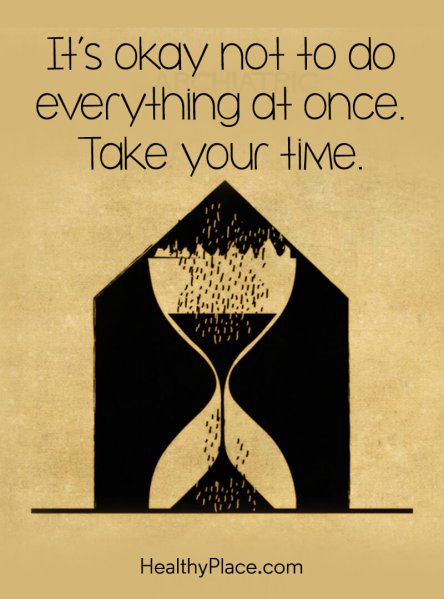
anxiety take your time

I remind myself out loud to be careful when walking on slippery mud or working with horses.  Even when I’m not conscious of grief, it can make me careless and inattentive.  I sometimes find that I’ve wandered into a situation where extra attention is absolutely crucial if it’s to end well.  So I say, “Pay attention!” or “Watch out!” just as I would to a roaming toddler or feeble senior.

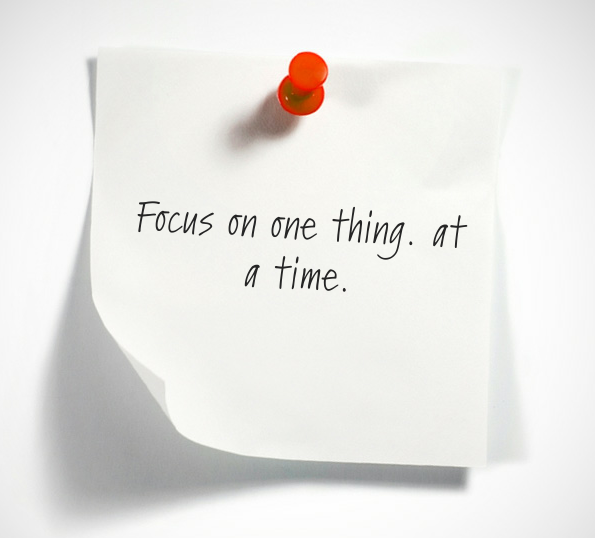
Complicated tasks have to be broken down now.  I can’t do two things at once.  If I forget and wind up juggling things when I shouldn’t be, I declare, “One thing at a time, Melanie.  One thing at a time!”

focus on one thing at a time

Driving, I’ll calm my nerves in traffic by focusing on my own lane, humming a tune and sometimes saying, “It’s not a race.  Slow down.  Take the easy way and don’t try to get around them.”  My house is 13 miles from the nearest traffic light, so when I have to go to the city, I almost always feel nervous.

And when I get out of the car at each stop I repeat the mantra:  “Keys, phone, list, purse.”

make a list sometimes remember to bring it

I have a running conversation about what I need to do next as I walk from room to room, tidying up.  I chant, “Lock the door.  Turn off the fan.  Feed the cats.” before bedtime.

The good thing about cell phones being everywhere is most times folks probably think I’m talking to someone else. 

What I like best about cell phones is that I can talk to myself in the car now and nobody thinks it’s weird.
― Ron Brackin

Either way, I don’t really care.  

no earpiece no cell phone talking to myself

It’s how I manage to get through a day without locking the keys in the car, falling on my backside or melting into an anxious puddle on the floor.  ❤

Bereaved Parents Month Post: Physical Manifestations of Grief

It’s a well known fact that stress plays a role in many health conditions.  

And I think most of us would agree that child loss is one of (if not THE) most stressful events a heart might endure.  

So it’s unsurprising that bereaved parents find themselves battling a variety of physical problems in the wake of burying a child.  

grief head in hands and stress words

What may be surprising is how uninformed medical and even psychological professionals are with respect to the very real ways child loss intersects with chronic conditions and often creates new symptoms.  

Here is a list of only SOME of the physical manifestations of grief (via What’s Your Grief?) with my own comments :  

Fatigue.  If you’ve always been an energetic sort, you might find this aspect of grief particularly disconcerting.  This kind of fatigue doesn’t get better with rest.  I’ve written about that here. 

Some days I can barely make myself get out of bed and when I do, I struggle to do any but the most necessary tasks.  Don’t automatically dismiss this symptom as ONLY grief (although it most certainly could be!) get a thorough check-up to rule out other causes such as low thyroid, diabetes, heart disease, major depressive disorder or a number of conditions that can be treated effectively with medicine.  Don’t beat yourself up if the doctor decides “nothing is wrong” with you.  You are grieving and grief is work!  I know this symptom has improved for me over time as I’ve established boundaries, admitted limitations and learned to rest when necessary.

charlie brown too tired to cry

Aches and Pains.  Our bodies and minds are connected in ways not well understood.  Mental and emotional distress can make any underlying pain condition that much worse.  When I’m feeling especially lonely, desperate or sad my autoimmune disease flares AND my perception of the very real pain that causes is heightened.  Pain and heartache can lead to a downward spiral that is hard to undo.  Get help and treatment for the physical and give yourself grace and space to endure the emotional causes of body aches.  Don’t self-medicate with drugs, alcohol or other self-destructive coping strategies.  Reach out to a safe person and let them help you find a better way.

painlevels

Headaches.  Needless to say, stress makes tension headaches more likely.  Sometimes, though, a headache can be a symptom of something more serious.  Don’t dismiss an especially sudden, intense or long-lasting headache as “just grief”.  It could be previously undiagnosed high blood pressure, stroke or migraine.  Those being ruled out, various relaxation techniques, cold or warm compresses, over-the-counter analgesics and gentle stretches might help.

Sometimes grief headaches can be alleviated by the simple act of telling our stories.  Bottling up emotions and thoughts adds to the ongoing stress and tension of my child loss burden.  When I spill them-either on paper in a journal, in a closed online bereaved parents’ group or in person to a safe friend or family member-often I feel the band around my head relax and the pain fade away.

Tightness in Chest, Shortness of Breath.  The day I got the awful news, I remember asking friends who came to sit with me over and over, ” Am I still breathing?”  My world was spinning out of control and my body responded.  Anxiety after child loss is real. Broken Heart Syndrome is real.  Heart attacks are not uncommon.  Don’t ignore these symptoms.  But don’t be surprised if they persist despite all tests to the contrary.  When I feel trapped and overwhelmed, a walk outside or even to another room can help.  Deep breathing exercises and grounding exercises can often interrupt an episode.

Broken_Heart_syndrome_EN-01

Forgetfulness.  I wrote this post on Grief Brain: It’s a Real Thing! a couple years ago and am always surprised to see it shared repeatedly.  But I think it strikes a chord with any heart walking through grief.  You are not crazy!  You are not experiencing early onset dementia (most likely).  Like other symptoms, get checked out if they persist or worsen.  But odds are, your experience falls within the range of normal for anyone whose life has been shattered by child loss.  Losing things, forgetting things, getting lost in familiar places, missing appointments or bill payments, inability to remember names of people you know well-all of these are common after loss.  In time, the symptoms usually diminish.  They have for me.  I still have to rely on lists and reminders much more often, though.  And that’s OK.
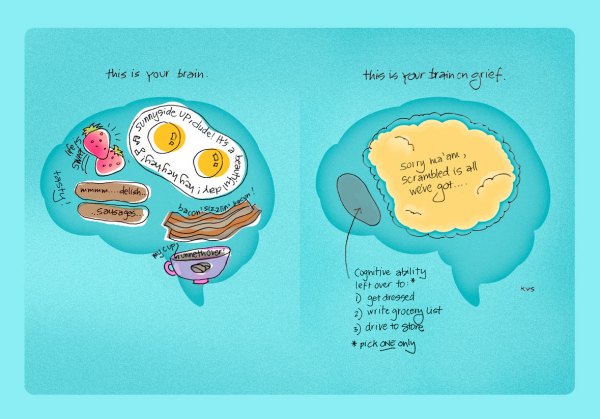
griefbrain1

Inability to Focus.  Like grief brain, this is another cognitive manifestation that’s not only annoying, it can impact life in significant ways.  Before Dominic ran ahead to Heaven, I was an avid reader.  I often had three or four books going at the same time.  I could spend hours focused on a single project.  Not anymore.  I sometimes find it difficult to read a recipe.

I have to take frequent breaks when working on something because my mind gets fuzzy and I just can’t pay attention for more than a few minutes at a time.  Some bereaved parents have to change jobs or careers because they are not able to perform necessary tasks anymore.  This particular symptom has not improved very much for me although I’ve found ways around it.  I use lists to keep an external record of what I should be doing and when.  I mix up mindless chores with ones that require more attention to give my brain a break.  I try to dissect larger jobs into smaller, manageable chunks.  And sometimes I just have to admit that today a particular thing just isn’t happening. 

Appetite or Digestive Issues.  Stress has long been linked to gut problems.  I suspect we’ve all had that “rumbling in our tummy” from time to time even before child loss.  For many of us it’s exponentially worse after.  Some bereaved parents try to stuff emotions by stuffing themselves with food.  Others can’t eat at all.  Still others experience stomach ulcers or bowel disease ranging from acute to chronic.  I was hospitalized twice in the first year after my son’s death for serious colon issues.

Again, don’t ignore sudden or persistent symptoms.  Try to eat well and avoid self-medicating with food.  Added pounds rarely add up to better emotional or mental health.  I let pounds I’d lost ten years ago find me again.  Get help if you need to from someone willing to act as an accountability partner.  I’ve recently joined a friend in setting goals for ourselves and sharing recipes and meal prep.  Try to treat food as another aspect of grief work and manage it the best you can.

the struggle bus

Getting Sick More Often.  Stress lowers the immune system.  That’s a fact.  So when bereaved parents encounter germs (as we all do from time to time) it may well be our bodies don’t have the energy or resources to combat them.  Colds, flu, strep throat, skin infections may all be more likely this side of child loss.  Don’t be discouraged to seek treatment.  There is so much we can’t control in life, but getting antibiotics for an infection is pretty easy.

It’s not in your head, mom or dad! 

Grief has real physical manifestations.   

Don’t be dismissed or denied the care you need. 

Educate your healthcare providers and insist on being heard. 

the weight of grief without words

*photo credit:  The Weight of Grief  Scupture ~ Celeste Roberge*


Repost: How Do I DO This? The Question Every Bereaved Parent Longs To Ask

After the flurry of activity surrounding the funeral, our house was so, so quiet. 

Even with the five of us still here, it felt empty.  

Because Dominic was gone, gone, gone and he was not coming back.

And the silence pounded into my head and heart until it became a scream: 

How do I DO this? 

Read the rest here:  How Do I DO This? The Question Every Bereaved Parent Longs to Ask

Do This, Not That: How To Help A Grieving Friend

“Above all, show your love.  Be willing to stand beside the gaping hole that has opened up in your friend’s life, without flinching or turning away.  Your steadiness of presence is the absolute best thing you can give.”  ~ Refuge in Grief

I truly believe that our friends and family WANT to be helpful as they companion us in grief.  

But if they’ve never known great loss, they may well be clueless.  

I love to share ideas, graphics and stories that can help them learn how.  

Here’s a good list, just right for sharing: 

  • Don’t compare griefs, ask questions.
  • Don’t minimize, respect their experience.
  • Don’t give compliments, trust your friend.
  • Don’t be a cheerleader, mirror their reality.
  • Don’t talk about “later”, stay in the present moment.
  • Don’t evangelize, trust their self-care.
  • Don’t start with solutions, get consent.

I’m not computer savvy enough to make graphics like this so I love it when I find them. 

I especially like this one which puts so many good ideas in a simple to use, easy to remember format. 

These are absolutely perfect for anyone walking with a grieving friend. 

do this not that for grief

Grief is a Family Affair

Child loss is also often sibling loss.  

In addition to their own heartache, bereaved parents carry the heartache of their surviving children.  

The family everyone once knew is now a family no one recognizes.  Hurting hearts huddle together-or run and hide-and it is so, so hard to find a way to talk about that pain. 

There is definitely a time and place for professional counseling.  Many, many families benefit from having a trained individual, outside the immediate grief circle, guide them in exploring feelings, developing coping strategies and learning to live life this side of loss.

But there is also something to be said for arranging casual open-ended activities with surviving siblings, parents and even grandparents where space and a more relaxed atmosphere often leads to honest sharing.

This graphic has lots of excellent suggestions for how to craft such a space.

Not all will be suitable for every family, but every family should be able to find a few that fit.

I’ll add these guidelines that may help your family make the best choice for YOU:

  • Don’t force it.  If you make an offer of an activity and it drops with a thud to the ground, let it go.  You might be able to do it another time.
  • Don’t make it (what my kids like to say!) a “mandatory option”.  There must be no guilt or coercion invading this space.  If one or more of your family members consistently refuse to join in, consider asking a close family friend to take that individual out alone and see what might be going on.
  • If you choose a movie or other story-themed activity, LOOK UP THE PLOT!  I can’t tell you how many times we were sideswiped by a death scene or some other heavy emotional plot twist.  There may be a time when your family is prepared to experience those things together (we can now) but it may not be yet.
  • Mix and match more structured activities with open-ended ones like walks outside, watching the sunset, sitting on the beach, hanging at the pool, playing a game (not too competitive-that will sometimes bring out hidden anger).
  • If you have a family with a broad range of ages you might have to do some things with the littles and some with the older kids.  You can always add one or two activities a month or quarter where everyone (or as many as are available) gets together.
  • If your children, spouse, parent or other close griever begins to talk-let them.  If tears flow-that’s progress!  If ugly feelings are expressed, listen.  Try not to be defensive.  Try to hear the hurt behind the words.  It’s OK to set ground rules like using “I” statements and not blaming.  But don’t shut them out or shut them down.  

These are just ideas.  

Google is your friend and your phone is probably already in your hand or pocket-use it.

Find things that fit YOUR family. 

The only way through is through.  

You have to feel and deal to heal. 

selfcare for families

My Sixth Mother’s Day as a Bereaved Mother

When it first happened all I could think about was getting through a minute, then a day and then all the decisions and days leading up to a funeral or memorial service.  

There’s no road map.  

Even when others come alongside (and many, many did!) there’s just no easy way to navigate that part of the journey.

And then I realized that in addition to all the “regular” days that absolutely, positively  break your heart, I had to forge a path through “special” days.

It was overwhelming!

Mother’s Day was especially challenging that first year.  Our loss was fresh and we’d had to acknowledge and celebrate two graduations and a wedding was about a month away.  How in the world could I honor my living children and also safeguard my broken heart?

We muddled through by having Mother’s Day at my daughter’s apartment co-hosted by some of her sweetest and most compassionate friends.  Not a lot of fanfare, but good food, good company and a quiet acknowledgment of Dom’s absence but also my living children’s presence.

It was a gift. 

This is my sixth Mother’s Day.  Every year is different.  Every year presents new challenges and every year things change.  

Since discovering there is an International Bereaved Mother’s Day my heart has taken advantage of having a day to think about and honor Dominic and then another day to think about and honor my living children.

That helps.  

I wrote this post three years ago but can’t really improve on it so I’ll share it again.  I pray that each heart who finds Mother’s Day hard will lean in and take hold of the hem of His garment. 

It’s really the only way.  

Read the rest here:  Mother’s Day as a Bereaved Mother


Grief: Why Hiding Isn’t a Long Term Solution

We’ve all done it-chosen to swallow words instead of share them.  

Or we’ve chosen to fake a smile instead of giving another person an honest peek into our hearts.  

Or we’ve pretended, pretended, pretended in the hopes folks sniffing around will go away.  

But it’s not a long term solution to the pain we carry, the scars we bear or the stories that need telling.

Hiding often seems a good idea at the time.  Conflict avoided.  Inconvenient conversations postponed.  Hard issues ignored.  Respite from harsh words, hard feelings and hopeless discussions obtained.

I’ve hidden for a fair share of my life.  

As a child it seemed that the best way to hover just under the parental radar was to go along to get along.  Don’t hold too many preferences too tightly.  Say “yes” even when your heart says “no”.  Let the loud ones prevail.  Stay quiet, stay small and stay out of trouble.

As a young married to a significantly older husband, it served me well.  Don’t rock the boat.  Silent assent keeps things smoother.  Say “yes” even when your heart says “no”.  It’s really not worth the hassle to do otherwise.  Stay quiet, stay small and stay out of trouble.

In a multitude of leadership positions within the church community, it served me well.  Don’t overstep-remember you aren’t a salaried employee.  Check your spirit and make sure your own heart is right.  Let it go and get over it.  Say “yes” even when your heart says “no”.  Stay quiet, stay small and stay out of trouble.

The problem with hiding from feelings and hiding from hard things and hiding from messy relationships is that I can’t hide forever.  Eventually someone or something will force those things to the top.  And if I haven’t been dealing with them all along, they gain strength and intensity in the waiting.

I don’t hide anymore.  

Dominic’s death unleashed a thousand unspoken words, a thousand unexpressed feelings. 

Suddenly I had a lot to say.  

And it didn’t all have a direct connection to Dominic’s leaving but it was his leaving that made them impossible to hide anymore.  Once the dam broke in my heart it ALL flooded out.

Or trickled. 

Or dripped.  

Decades of uncomfortable conversations I had avoided became unavoidable.  Years of relationship patterns that served no one were examined and remade.  I’m still finding bits that need attention, things I really need to speak aloud.  I will sometimes try to hide.  It doesn’t last long though.

What I’m learning from refusing to hide is that it’s so much healthier!  It’s so much better to speak my truth (always, hopefully!) in love.

When I silence my heart, I only postpone and prolong and pile up hurt.  

It doesn’t go away.  

It burrows in and makes a home, pushing out everything else.  

It’s no solution.  

Our hearts and minds are resistant to change and if you, like me, are one who hid to avoid conflict, who swallowed words and wounds and worry, it will be hard.

But try. 

Try to find ways (even if it’s writing letters to some folks) to express your true feelings.  Make sure you are speaking lovingly as well as truthfully.  Get a friend to read your note or hear you out and give you feedback.  

Then offer the important people in your life your heart-your true heart-instead of hiding. 

wounded_heart-960x600


It Takes As Long As It Takes.

I’m really not good at sitting still.  

When I see something that must be done I tend to get up and do it.  

But right now (as I wrote yesterday) I’m in a season where I need to be patient with myself.  I need to learn to rest.  I need to give my own heart the space and grace I’d quickly extend to another.  

So I’m hanging this little sign up around every corner in my house.  

I hope my heart heeds the message.  

takes as long as it takes