Be Quick to Listen, Slow to Speak

I’m pretty sure that every single grieving parent I know has gotten at least one private message, text or phone call that starts like this, “I know that I haven’t lost a child, but…” and ends with some sort of advice that seeks to correct a perceived flaw in how the parent is grieving (in public) his or her missing child.

I know I did.  It was the genesis of this post.

But before you hit “send” on that well-meaning missive, you need to know this:  

You have NO CLUE.

None.

Truly.

No matter if you lost a spouse, parent, close friend or favorite pet-it’s not the same thing.

It isn’t even the same thing if you have faced a season when your own child was near death due to accident or disease.

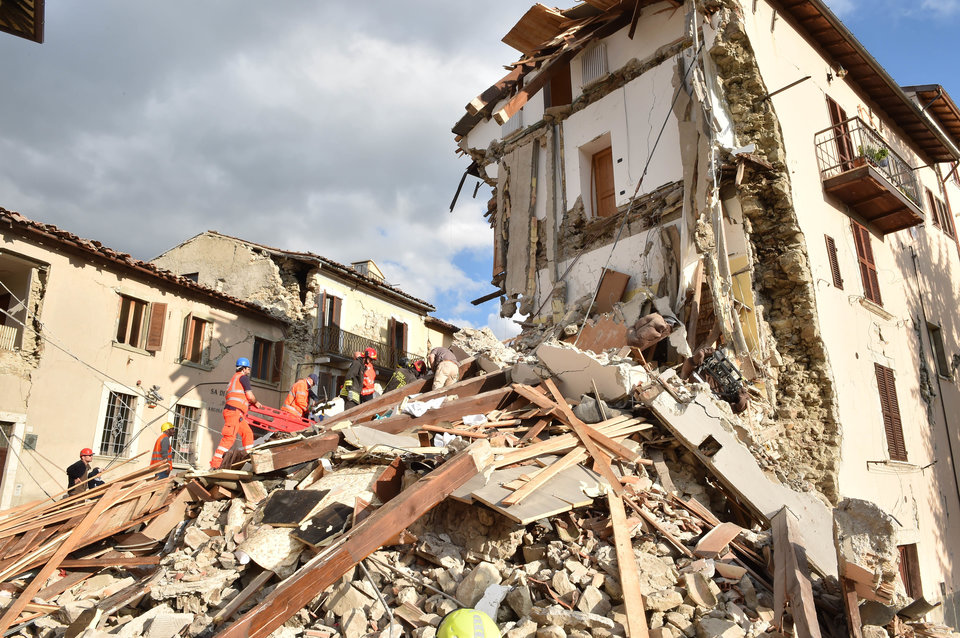
If your home has been demolished due to wind, fire or flood and all its contents lost forever-that is awful and tragic-but not comparable to watching the body of your child lowered beneath the ground.

Just like everyone else who uses social media, what you see in public does not reflect but a tiny corner of the whole picture.

I write every day about loss.  But loss is not all I experience 24/7.  I laugh, I love, I live. 

And while I may post my yearning for Dominic, I speak my heart to my living children every. single. day. 

kids at sea world 2017

My faith has been tried and tested.  I will not be false and pretend that just because I trust the finished work of Christ my heart has had it easy.  

But I’m still holding onto hope with both hands.  

My body has borne the brunt of anxiety and stress and grief.  You can see it in my eyes and in my hips.  

But I’m still standing.

My marriage has been stretched and strained.  

But we are still clinging to one another.  

beach hector and me and boys in sand

So before you suggest ways I might need to trim my sails,

just remember you aren’t sailing the same sea nor facing the same storms.  

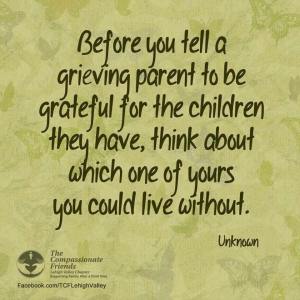
before you tell a grieving parent to be grateful which of yours could you live without

Repost: Fault Lines: Bereaved Parents and Social Anxiety

Even at four years into this journey, I can surprise myself when, for no apparent reason, grief explodes from someplace deep within me.  

I’m keyed into triggers-sights, smells, places and people that remind me of Dominic.

But sometimes I can’t figure out what causes the tears to fall or my stomach to be tied in knots.  

It seems to happen most often when I’m in social situations.  I feel surrounded, trapped and anxiety mounts. 

I’m no geologist, but from what I understand, earthquakes are nearly always “about to happen”.  Fault lines guarantee it.  Pressure is building underneath the surface of the earth and when it reaches a level that can no longer be contained, it spews.

Can I just let you in on a secret?

Bereaved parents are full of fault lines.

Many of us are nearly ready to blow almost every single minute, yet hold it in and hold it together.  If you could put a meter to our temple and measure how close we are to a come apart, you would be amazed that it happens so rarely!

Read the rest here:  Fault Lines: Bereaved Parents and Social Anxiety

Bereaved Parents Month Post: Why Do Friends Abandon Grievers?

I wrote this a few months ago because it is an issue every grieving parent faces:  Why do friends abandon us?

Truth be told, many of us abandoned others prior to our own bereavement for some of the same reasons.

It is really hard to hang in and hang on when a friend is going through such a hard time.  Understanding why my friends might pull away helps me extend grace.  ❤

It happens in all kinds of ways.  One friend just slowly backs off from liking posts on Facebook, waves at a distance from across the sanctuary, stops texting to check up on me.

Another observes complete radio silence as soon as she walks away from the graveside. 

Still another hangs in for a few weeks-calls, texts, even invites me to lunch until I can see in her eyes that my lack of “progress” is making her uneasy.  Then she, too, falls off the grid.

Why do people do that? 

Read the rest here:  Why Friends Abandon Grievers

Bereaved Parents Month Post: Have I Lost My Mind?

Here I am four years into this journey and I still have days when I think I have utterly lost my mind.  

Not because of internal cues but because of external pressure by family and friends to conform to some idea THEY have of what grief after child loss should look like.

I have to remind myself that they have NO IDEA what this is like and that if I am managing to move along-even at a snail’s pace-I’m just fine.

I wrote this a couple years ago in response to a private message sent to me by a friend:

“It was just over a year after Dominic’s accident and a friend forwarded an article about odd behaviors of those who were “stuck’ in grief.  Along with the forward was a little tag, “Reminds me of you.”

It hurt my feelings.

And it was inappropriate.”

Read the rest here:  I am NOT Crazy!

Ask Me, Please.

I have been guilty of this more times than I ‘d like to admit. 

I assume someone else’s feelings mirror my own and act on that assumption by withdrawing or not showing up or “giving them space”.

But the problem is, most times, on reflection, I realize my action (or inaction) was really all about sparing my own feelings  or staying within my own comfort zone.

The heart is deceitful above all things
    and beyond cure.
    Who can understand it?

~Jeremiah 17:9 NIV

So I’m learning to ask hard questions.

And I wish others would do the same.

Image result for dont assume ask me please

Before I assume someone doesn’t want companionship, or a phone call or another text or message, I’m trying to give them the opportunity to say no.  

I’ve been surprised more than once when I wanted to keep my distance in the name of “giving someone space” or “not bothering someone” that if I DID reach out, she responded by saying it was just what she needed.

I admit that asking risks rejection or worse-I might end up bearing the brunt of someone’s very bad day (or week!).  But not asking means I may not be doing precisely the thing God wants me to do.  I may be choosing the easy way out and rationalizing it so I feel better but the poor heart that needs my companionship or encouragement is left without the very help I was meant to provide.

I think Dominic’s death has made me brave in this one tiny place:  I say things I might not have said before.  I risk pain in relationships where I might not have been willing to risk before.  I assume that if I don’t speak important truths RIGHT NOW I might not get another chance.

I long to be a burden bearer for my friends and family because I know what it is to bear a burden.

So I ask and don’t assume.  

If someone wants to be left alone, then they are free to tell me.

But I will not stay silent or keep away simply for my own comfort.  

Who knows?  Maybe this is exactly the good work God has prepared in advance for me to do.

Image result for the good works that god has prepared for us


Repost: Be Free to Celebrate [Or Not!]

Often bereaved parents dread the major holiday season that starts in November and lasts through January.  We brace ourselves for THOSE days because they loom large on the calendar and give fair warning.

But the year is chock full of minor holidays and other celebrations that require just as much emotional energy as the “big” ones.

If I’m not careful, they will slip up on me and drain me dry.

So here’s how I try to approach them.

It helps my heart.

Maybe it will help yours too.  ❤

One of the most challenging things that faced me immediately after Dominic’s funeral was that we had two college graduations, Mother’s Day, Father’s Day, his birthday, a wedding and my own thirtieth wedding anniversary within two months.

Thankfully we had some amazing friends and family that stepped up and filled in the gaps.

Read the rest here:  Be Free to Celebrate [or Not!]

Just. Say. It.

I’m not sure when I began practicing this but I make a habit of telling people I love them even if it makes them uncomfortable.promise me something tell them you love themI remember saying it to my granddaddy who never told anyone-as far as I know-that he loved them.

I spoke it over each child as soon as she or he was laid in my arms.

Growing up, I closed every telephone conversation with, “I love you” and taught my husband to do the same.

tell the people you love that hou love them

I also try hard to tell people other important things right when I think of them, instead of “later”-whenever THAT may be.

when you see something beautiful speak it

I’m so, so glad I do and I did.

I have many regrets about Dominic’s too-soon departure from this life.

But I don’t have this one:  Unspoken words of love and affirmation.

The last time he was home, it was nearing final exams and I felt like I needed him to know how very proud I was of him and how very much I admired the man he had become.  So I stopped him as he was leaving, turned his strong shoulders to face me square, and looked him in the eye to give him words of blessing.

I didn’t get to hold his hand as he left this life. 

But I’m confident as he breathed his last, he knew he was loved.


heart hands and sunset

Don’t wait to tell the people that are important to you that they ARE important to you.

Don’t save words for “next time”, “later” or “when we get together again”.

Just say it.

Now.

Right now.

greatest weakness of humans optimus prime

What Does it Mean to “Support” Someone?

Thank God for ADA requirements!

It wasn’t that many years ago when automatic doors were hard to find in places where they most certainly would have been helpful.

I remember approaching doors, arms full of bags and each hand grasping a child, hoping, hoping, hoping some nice person would be there to open it for me.

Many times there was.

Sometimes all I got was a glare and a sidestep from an empty-armed, able-bodied person.

I would manage to push the door open with my elbow but inside I was seething.

“Really?  Really!!  What makes you think getting out of the way is the same as opening the door?” 

(Thank goodness my thoughts are not displayed on an overhead sign! 🙂 )

In this Valley, I’ve discovered there is an emotional counterpart to the woman or fellow who refuses to actively help an overwhelmed mama.

There are those who see the burden I’m carrying and simply step aside.

I guess their rationale is that by not adding to the weight of my load, they somehow make it lighter. 

But it doesn’t work that way.  

As a matter of fact, knowing that my pain is seen but ignored is so much harder than thinking I’m just invisible.

Support means:

1. bear all or part of the weight of; hold up. 

2.  give assistance to; enable to function or act.

Support is going to cost you something.  It’s going to require action, time, energy, effort, commitment and resources. 

when the world whispers give up

I know it’s hard. 

Life is hard.  

But active, compassionate companionship is what knits hearts together no matter what struggle they are facing.  

And hearts that are bound by shared struggle and love are the strongest of all.  

friends uplift the soul little girl


One Reason Why Grief Requires So Much Energy…

I’ve been doing this for a bit over four years now.

I’m pretty good at it in many ways-I’ve developed standard answers to common questions, figured out ways to keep my mouth shut when no answer I can think of is appropriate (literally biting my tongue), learned how to squelch tears and swallow sobs in public spaces, and (usually) how to avoid major triggers.

But navigating this territory is still exhausting.  

Because every. single. day. I have to make choices and make changes so I’m not overwhelmed and incapacitated by grief.  

And that takes a lot of energy.  Energy that’s not available for other things.  

Yet the world marches on and my responsibilities remain.  

It’s no wonder I flop in bed exhausted every night.  

I wrote this a couple years ago and it explains it well:  

One of the things I’ve been forced to embrace in the wake of child loss is that there are very few questions, experiences or feelings that are simple anymore.

“How many children do you have?”

A common, get-to-know-you question lobbed across tables, down pews and in the check-out line at the grocery store.  But for many bereaved parents, it can be a complex question that gets a different answer depending on who is asking and where we are.

Read the rest here:  It’s Complicated

If You Can’t Say Anything Nice….

There may be some mamas that don’t drill this into their children but if there are, they don’t live south of the Mason-Dixon line.

Every time there was back and forth in the back seat or on the front porch and Mama overheard, we were told, “If you can’t say anything nice, then don’t say anything at all.”

Parents weren’t interested in policing every errant word out of the under 18 crowd’s mouth back in the day.

It was a simple (and effective!) rule:  If what you want to say does not meet the criteria of T.H.I.N. K. (true, helpful, inspiring, necessary, kind) then

just.

don’t.

say.

it.

THINK ACRONYM

I wish grown-ups would follow the same advice. 

Especially when it comes to offering up “helpful hints” to broken hearts.

In that instance it is rarely a case of another person aiming to be ugly or to hurt someone, but words are not neutral and they do hurt when tossed out carelessly by people who really just don’t understand another person’s pain.

So, for those who are tempted to fill empty spaces with empty words, may I help you apply the T.H.I.N.K acronym to the kinds of situations more likely to face us as adults?

T-Is it true?  You may think that giving out a Bible verse would automatically mean you were safe on this count.  Yes.  God’s Word is truth.  But how we use it and whether or not we understand the context can make a particular application of God’s Word UNTRUE.  And even if we get the context right, hammering a heart with a Bible verse may not be helpful.  You are not the Holy Spirit.  Let Him breathe truth gently into a wounded heart.

H-Is it helpful? This is tricky because sometimes what is helpful for one person is unhelpful for another.  I try to use this as my litmus test:  When have I ever been distraught and helped by someone pointing out the obvious? Or laying out a plan of action (when they don’t have access to the full picture)? Or reminding me that “all things work together for good” when right now all things really stink?  If there is any doubt about whether or not what I say will be helpful, I swallow my words.

I-Is it inspirational?  The word, “inspire” has roots in the the idea of breathing into someone or something.  Will my comment put wind in a person’s sails?  Will it breathe courage into his or her heart?  Will it lift them up and help them hold onto hope?  Is it the equivalent of mouth-to-mouth resuscitation or am I instead sucking what little breath they have left out of their body?

N-Is it necessary?  This single criteria helps me hold my tongue so many times.  I might think of lots of things but is is necessary for me to speak them?  Am I warning someone of impending danger or am I just trying to make myself sound wise or insisting on making a point?  To be honest, very few things I have to say are necessary. Most of the time a hand on the shoulder, a hug, a smile, a friendly nod are the only thing someone really needs.

K-Is it kind?  The word kind comes from the same root as “kin”-which means family.  Is what I’m going to say something I’d want someone to say to me or my close family?  Am I treating (with my words) this person they way I want to be treated?  The Golden Rule, rules.

I can’t claim to always follow my own good advice.

But when I do, I find that I am building people up, not tearing them down.

There’s enough tearing down in the world.

I want to speak light and life.

a candle loses nothing by lighting another candle