

I ran across this infographic awhile ago and LOVE how it puts things in an easy to see and easy to follow format.
It’s a great tool-not only for those grieving the loss of a loved one–but for anyone going through a rough patch.

I ran across this infographic awhile ago and LOVE how it puts things in an easy to see and easy to follow format.
It’s a great tool-not only for those grieving the loss of a loved one–but for anyone going through a rough patch.
Joan Rivers was famous for opening her comedic routine with the question, “Can we talk?”
She would launch into a hilarious rendering of topics that were usually off-limits in polite conversation but which everyone secretly wanted to share. It actually helped bring some things into the light that had been hiding in shadows for far too long.
So, I’m going to take a cue from her and ask, “Can we talk?”
Can we talk about my missing son and quit pretending that just because he’s no longer present in the body, he’s not still part of my life?
Can we say his name without also looking down or away like his death is a shameful secret?
Can we share stories and memories and laughter and tears just as naturally about HIM as we do about anyone else?
Can we make a way to represent him at holidays, birthdays and special occasions? It doesn’t have to be a grand gesture-even a photo or place setting or ornament will do.
Can we stop acting surprised that I still get upset when other people’s kids reach milestones my son will never attain?
Can we talk about your feelings as well as mine without devolving into a shouting match or a flurry of accusations about who should be feeling what by now?
Can we make space for tears?
Can we make space for solitude?
Can we make space in our conversations and celebrations that allows joy and sadness to dwell together?
Can we continue to honor the light and life that was (and is!) my son?
Because if we can do this, it will make all the difference.
We’ve all been there-something traumatic or earth-shattering happens to someone we know and we mean to get in touch.
I put “write a note” or “call” on my list and then don’t do it.
Days, weeks months pass by. Now I feel awkward.
And the need to let her know I care is overshadowed by my sense of shame at not doing it sooner.
But it is NEVER too late to be a friend!

I won’t let pride stand between me and someone I love. I won’t allow fear to keep me away from a heart that needs help.

Who knows?
Maybe my outstretched hand will be exactly the hope someone needs to hold on to?
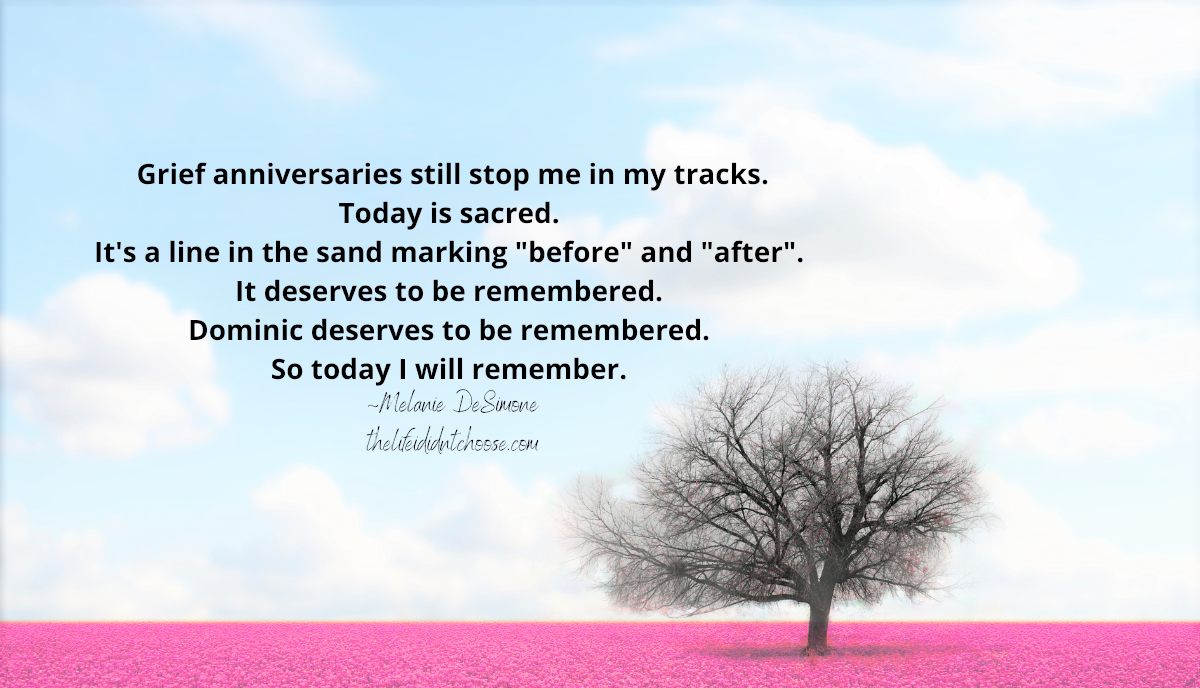
I know I’m not the only one who carries a calendar in my head that threatens to explode like a ticking timebomb. Days that mean nothing to anyone else loom large as they approach.

The date of his death.
The date of his funeral.
His birthday.
My birthday.
The day he should have graduated from law school
On and on and on.
How can I survive these oppressive reminders of what I thought my life would look like? How can I grab hold of something, anything that will keep my heart and mind from falling down the rabbit hole of grief into a topsy-turvy land where nothing makes sense and it’s full of unfriendly creatures that threaten to gobble me whole?
Every family,
every child that has run ahead and
every situation is unique.
What works for one person (even in the same family) won’t necessarily work for another. But there are some ways to make these days a little easier.
Here’s a list of what has helped my heart and the hearts of others walking this journey. Take what may help and toss the rest:
Most importantly, no matter what you do or don’t do, be prepared to give yourself grace whatever the day holds.
Don’t do what you don’t feel like you can do-even if you made plans ahead of time.
Do whatever helps your heart.
Hug anyone who chooses to come alongside and bear witness to this awful anniversary.
And hold tight to the fact that even the worst day only lasts 24 hours.

This list is adapted from a friend’s Facebook post (with permission) and a list published by Children’s Hospital of Colorado.
BEREAVED PARENT’S WISH LIST:
1. I wish my child hadn’t died. I wish I had my child back.
2. I wish you wouldn’t be afraid to speak my child’s name. My child lived and was very important to me. I need to hear that my child was important to you also.
Read the rest here: Bereaved Parent’s Wish List
Often this journey through the Valley of the Shadow of Death is dark and lonely.

I am frightened of what may lay in wait-tragedy has visited once, it could come again.
I know Jesus is my Shepherd and I never doubt His companionship. But if I’m honest, as much as I lean into that truth, it’s oh, so helpful to have a living, breathing human being walk with me.
So when a friend reaches out and takes my trembling hand it calls courage to my heart.
When we huddle together in the dark places, waiting out the storm of grief or doubt, it gives me strength to carry on.
Never, never underestimate the power of presence.
For now we see in a glass darkly, but then face to face, and now we know in part, but then we shall know fully just as we have been fully known
I Corinthians 13:12
So until then, what?
We feel our way in the dark.
Until we find each other.
We huddle together in the storm.
Wet and shivering, but together.
And maybe in the end it will be our huddling in the storm that gives us more comfort than our understanding of the storm.”~Ken Gire, The Weathering Grace of God

I wrote this post December, 2015. It hadn’t been long since I joined an online community of bereaved parents and began to see that I wasn’t the only one who had friends and family that misunderstood child loss.
I was spending a lot of time in my life trying to help others comprehend, just a little, what it felt like to bury a child.
Trying to give them a tiny taste of how this pain is so, so different than any other I had experienced. Begging them to toss the popular ideas bandied around that grief followed “stages” and was “predictable”.
I re-share every so often because it seems to help, a little. I’m re-sharing today in honor of Bereaved Parents Month. ❤
People say, “I can’t imagine.“
But then they do.
They think that missing a dead child is like missing your kid at college or on the mission field but harder and longer.
That’s not it at all.
The best way to help a struggling heart is to simply be available.
Anyone can choose to be a safe space for others to share their hearts.
Anyone can make room for honest conversation, welcoming another soul to unburden itself of whatever heaviness is weighing it down.
All it takes is a listening ear and time.

You’d think that being on the other side of untimely or even painful comments would shape my conversation so that I am not the one blurting out hurtful or thoughtless words.
Sadly, that’s not the case.
While I am much more careful about what I say and how and when I say it, I still put my foot in it on a regular basis.
I talk instead of listen-rushing ahead to share MY pain instead of sitting silently while someone else shares theirs.
I make comparisons instead of extending boundless compassion.
I focus too much on the words and not enough on the wordless communication of facial expression and body language.
I try to “fix” the problem or person instead of simply being present.
I overwhelm a hurting heart with too much information. Even good information delivered from a firehose instead of a water fountain is unhelpful.
I interrupt, cut people off, turn away and shorten uncomfortable conversations.
I want to do better.
I want to be the safe space hurting hearts need.
I want to be full of grace and mercy and kindness.
I know I fall short, but I’m still learning.

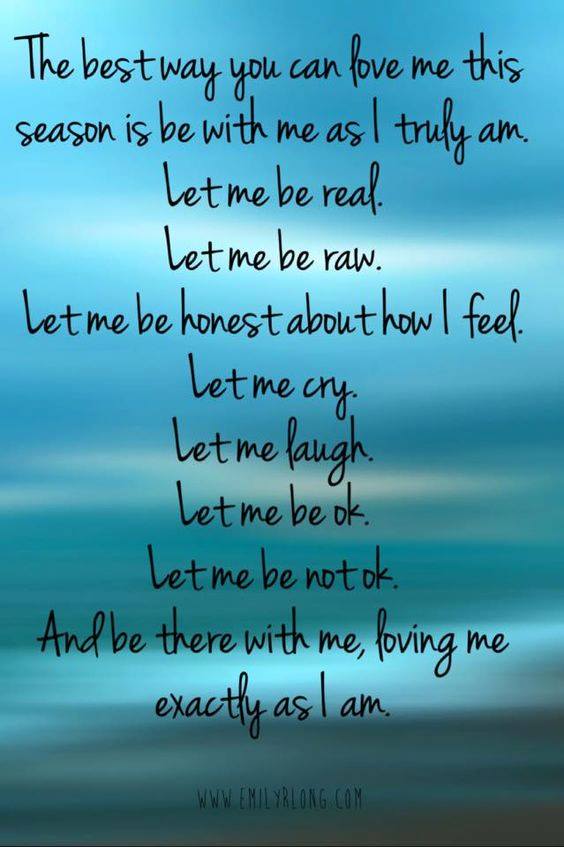
We say we want real.
But we really don’t.
We tune in by the millions to watch “reality TV” even though we know the drama is manufactured and the outcome decided months before.
We participate daily in quiet subterfuge when our coworker pretends her marriage isn’t falling apart even though we overhear her desperate phone calls trying to mend it.
We like to hear “Fine, thank you.” when we offer the polite greeting, “How are you?”.
What happens to the person who refuses to play along? What about the one whose heart is so broken that she can’t begin to put on the false front that would make everyone else more comfortable around her?

What do you do when someone stops pretending everything is OK?
Often, people walk away.
Because we have absolutely no idea what to do with real. We have no words when “How are you?” is answered with “Awful. My world is falling apart.”
We reward those who choose to go along with the script that makes us comfortable and isolate the ones that don’t.
But is that the world we really want to live in? Do we want to walk with unsaid words between us, unreleased feelings bottled up and threatening to overflow?
It is really more admirable to pretend?

MASKS by Shel Silverstein
She had blue skin
And so did he.
He kept it hid
And so did she.
They searched for blue
Their whole life through.
Then passed right by —
And never knew.





 thelifeididntchoose