Grief Work 2025: Self-Care Is Necessary

My first instinct as a mother and a shepherd is always, “How can I help?”

I routinely set aside my own needs for the needs of others.  Not because I’m so selfless but because that’s how I’m made-I’ve always had the heart of a caretaker.

That’s not a bad thing, most of the time.

But if taking care of others means NOT taking care of myself, then in the end, I’m of no use to anyone.  When I allow every bit of energy-emotional, physical, psychological and spiritual-to drain away until there’s nothing left, I am unable to meet my most basic needs, much less the needs of others.

I’ve written before that grief puts a hole in my bucket It guarantees that no matter how much is poured in, I’m never truly full.

I’ve also written about setting boundaries and trying to preserve margin as I walk this Valley.  I have to create space between me and the people around me if I’m going to make it through.

But there are some other steps I can take to help ensure my heart is strong enough for the journey.  It’s not always about what I don’t do.

Sometimes it’s about what I choose TO do.

Here are some ideas for self-care in grief (or really ANY hard place in life):

  • Be patient with yourself.  There is no time frame for grief.  Each heart is unique.  Extend grace to yourself, just as you would to a friend.  Try not to take on extra responsibilities.  It’s better to allow for some flexibility in obligations during this time (even around holidays!).
  • Listen to your body and your heart: If you need to cry, then cry. If you need to sleep, then do so. If you need to talk to someone, seek out someone who will listen. If you need to reminisce, then take the time. It is important for the grieving process that you go with the flow.
  • Lower expectations for yourself and communicate this new reality to others. You are not able to operate as you did before loss.  Your capacity for interacting with others, managing tasks and being available for the needs of others has been dramatically altered.  Own up to it, and let others know that it will be some time before you can shoulder the responsibilties you once did.
  • Let others know what you need from them.  No one is a mind reader.  While we who are bereaved think our needs are obvious, it’s simply not the case.  Communicate to family and friends how they can support you.
  • Accept the help of others. Understand that grief is hard work. It requires a great deal of energy and can be exhausting. Even though we place a high value on self-sufficiency, it is important to ask for, and accept, help from those close to you. Others careand genuinely want to be of assistance, but usually do not know what to specifically offer. In particular, it is vital to know who will listen and be supportive. Sharing your story out loud is one key to healing. And, remember that professional guidance is also available
  • If you need counseling, get it!  There is NO shame in asking for help. Get all the support you need. There are many bereavement support groups as well as counselors or spiritual advisors who specialize in bereavement counseling. Don’t hesitate to contact a medical and or mental health specialist if you have feelings of hopelessness or suicidal thoughts.
  • Accept your feelings. Feelings are neither right nor wrong, they just are. Sadness, loneliness, fear, confusion, anger—these are among the many feelings you may experience, and are completely normal. Emotions are often raw early in the grief process, but it is important to express them. Attempting to stifle feelings usually leads to an emotional outburst at an inconvenient time.
  • Face your feelings. The painful emotions associated with grief are a natural and normal response to loss. You can try and suppress them or hide from them all you want but in the end this will only prolong the grieving process. Acknowledging your pain and taking responsibility for your feelings will help you avoid the complications often associated with unresolved grief such as depression, anxiety, substance abuse, and health problems.
  • Express your feelings. The most effective way to do this is through some tangible or creative expression of your emotions such as journalling, writing a letter expressing your apologies, forgiveness and the significant emotional statements you wish you had said, or art projects celebrating the person’s life or what you lost.
  • Keep a journal.  Writing down your thoughts and feelings can help you to validate and work through your grief.
  • Feel whatever you feel. It’s okay to be angry, to yell at God, to cry or not to cry. It’s also okay to laugh, to find moments of joy, or to let go when you’re ready. Your grief is your own and no one can tell you when you should be “over it” or when to “move on.”
  • Pay attention to physical needs. It’s easy to ignore your health when all you want to do is give up and give in.  However, it is even more important NOW to take care of yourself.  Eat balanced meals (set an alarm if you have to), try to get adequate rest (get medication if you need to) and make sure to get in some physical activity every day (set a timer if necessary).
  • Get physical exercise.  If you exercised prior to your loss, try to maintain the same routine. If you did not exercise prior to your loss visit your doctor before embarking on a physical exercise routine. Physical exercise can improve the way you feel.
  • Eat right and get enough sleep.  Maintaining a healthy diet and getting proper sleep is essential for functioning as well as you can. If you are having difficulty with either, visit your doctor.
  • Be aware of short-term relievers – these can be food, alcohol/drugs, anger, exercise, TV, movies, books, isolation, sex, shopping, workaholism, etc. Most of these things are not harmful in moderation but when used to cover-up, hide or suppress our grief they get in the way of the work grief requires.
  • Take the time to do the things you need to do for yourself.  When you feel up to it, engage in activities to which you feel drawn. It could be visiting a place you haven’t been to in a while, walks in nature, reading, etc.
  • Pamper yourself. Treat yourself well. Do things for yourself that are helpful like walks, being with people who are nurturing to you, and inexpensive activities

Grief is a lifelong process-a marathon, not a sprint.  

Maintaining space to do the work grief requires and engaging in activities and health habits that help me do that work is the only way to endure.  

physical mental well being

Grief Work 2025: Physical Manifestations of Grief

Grief is not *just* feelings. It is so much more.

Often there are random or unusual physical symptoms that show up days, weeks or even years after a child has gone to Heaven.

An important and necessary part of grief work is learning to recognize the physical manifestations of grief and advocating for care from professionals who may not be able to make the connection unless the bereaved speak up and speak out.

❤ Melanie

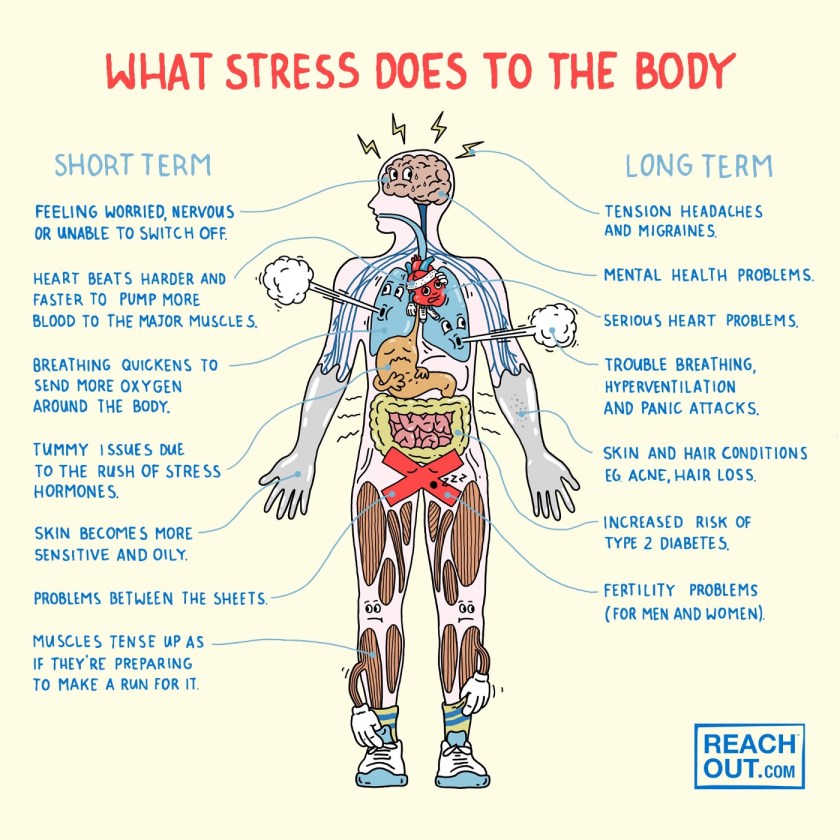
It’s a well known fact that stress plays a role in many health conditions.  

And I think most of us would agree that child loss is one of (if not THE) most stressful events a heart might endure.  

So it’s unsurprising that bereaved parents find themselves battling a variety of physical problems in the wake of burying a child.  

grief head in hands and stress words

What may be surprising is how uninformed medical and even psychological professionals are with respect to the very real ways child loss intersects with chronic conditions and often creates new symptoms.  

Here is a list of only SOME of the physical manifestations of grief (via What’s Your Grief?) with my own comments :  

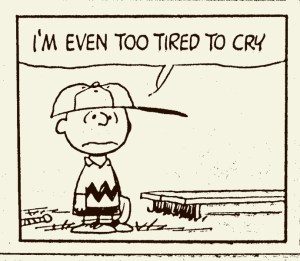
Fatigue.  If you’ve always been an energetic sort, you might find this aspect of grief particularly disconcerting.  This kind of fatigue doesn’t get better with rest.  I’ve written about that here. 

Some days I can barely make myself get out of bed and when I do, I struggle to do any but the most necessary tasks.  Don’t automatically dismiss this symptom as ONLY grief (although it most certainly could be!) get a thorough check-up to rule out other causes such as low thyroid, diabetes, heart disease, major depressive disorder or a number of conditions that can be treated effectively with medicine.  Don’t beat yourself up if the doctor decides “nothing is wrong” with you.  You are grieving and grief is work!  I know this symptom has improved for me over time as I’ve established boundaries, admitted limitations and learned to rest when necessary.

charlie brown too tired to cry

Aches and Pains.  Our bodies and minds are connected in ways not well understood.  Mental and emotional distress can make any underlying pain condition that much worse.  When I’m feeling especially lonely, desperate or sad my autoimmune disease flares AND my perception of the very real pain that causes is heightened.  Pain and heartache can lead to a downward spiral that is hard to undo.  Get help and treatment for the physical and give yourself grace and space to endure the emotional causes of body aches.  Don’t self-medicate with drugs, alcohol or other self-destructive coping strategies.  Reach out to a safe person and let them help you find a better way.

painlevels

Headaches.  Needless to say, stress makes tension headaches more likely.  Sometimes, though, a headache can be a symptom of something more serious.  Don’t dismiss an especially sudden, intense or long-lasting headache as “just grief”.  It could be previously undiagnosed high blood pressure, stroke or migraine.  Those being ruled out, various relaxation techniques, cold or warm compresses, over-the-counter analgesics and gentle stretches might help.

Sometimes grief headaches can be alleviated by the simple act of telling our stories.  Bottling up emotions and thoughts adds to the ongoing stress and tension of my child loss burden.  When I spill them-either on paper in a journal, in a closed online bereaved parents’ group or in person to a safe friend or family member-often I feel the band around my head relax and the pain fade away.

Tightness in Chest, Shortness of Breath.  The day I got the awful news, I remember asking friends who came to sit with me over and over, ” Am I still breathing?”  My world was spinning out of control and my body responded.  Anxiety after child loss is real. Broken Heart Syndrome is real.  Heart attacks are not uncommon.  Don’t ignore these symptoms.  But don’t be surprised if they persist despite all tests to the contrary.  When I feel trapped and overwhelmed, a walk outside or even to another room can help.  Deep breathing exercises and grounding exercises can often interrupt an episode.

Broken_Heart_syndrome_EN-01

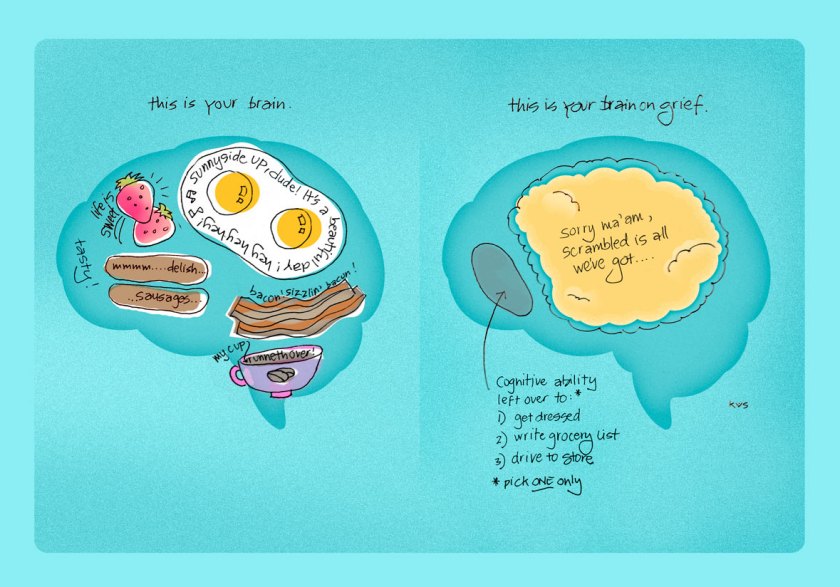
Forgetfulness.  I wrote this post on Grief Brain: It’s a Real Thing! a couple years ago and am always surprised to see it shared repeatedly.  But I think it strikes a chord with any heart walking through grief.  You are not crazy!  You are not experiencing early onset dementia (most likely).  Like other symptoms, get checked out if they persist or worsen.  But odds are, your experience falls within the range of normal for anyone whose life has been shattered by child loss.  Losing things, forgetting things, getting lost in familiar places, missing appointments or bill payments, inability to remember names of people you know well-all of these are common after loss.  In time, the symptoms usually diminish.  They have for me.  I still have to rely on lists and reminders much more often, though.  And that’s OK.

griefbrain1

Inability to Focus.  Like grief brain, this is another cognitive manifestation that’s not only annoying, it can impact life in significant ways.  Before Dominic ran ahead to Heaven, I was an avid reader.  I often had three or four books going at the same time.  I could spend hours focused on a single project.  Not anymore.  I sometimes find it difficult to read a recipe.

I have to take frequent breaks when working on something because my mind gets fuzzy and I just can’t pay attention for more than a few minutes at a time.  Some bereaved parents have to change jobs or careers because they are not able to perform necessary tasks anymore.  This particular symptom has not improved very much for me although I’ve found ways around it.  I use lists to keep an external record of what I should be doing and when.  I mix up mindless chores with ones that require more attention to give my brain a break.  I try to dissect larger jobs into smaller, manageable chunks.  And sometimes I just have to admit that today a particular thing just isn’t happening. 

Appetite or Digestive Issues.  Stress has long been linked to gut problems.  I suspect we’ve all had that “rumbling in our tummy” from time to time even before child loss.  For many of us it’s exponentially worse after.  Some bereaved parents try to stuff emotions by stuffing themselves with food.  Others can’t eat at all.  Still others experience stomach ulcers or bowel disease ranging from acute to chronic.  I was hospitalized twice in the first year after my son’s death for serious colon issues.

Again, don’t ignore sudden or persistent symptoms.  Try to eat well and avoid self-medicating with food.  Added pounds rarely add up to better emotional or mental health.  I let pounds I’d lost ten years ago find me again.  Get help if you need to from someone willing to act as an accountability partner.  I’ve recently joined a friend in setting goals for ourselves and sharing recipes and meal prep.  Try to treat food as another aspect of grief work and manage it the best you can.

the struggle bus

Getting Sick More Often.  Stress lowers the immune system.  That’s a fact.  So when bereaved parents encounter germs (as we all do from time to time) it may well be our bodies don’t have the energy or resources to combat them.  Colds, flu, strep throat, skin infections may all be more likely this side of child loss.  Don’t be discouraged to seek treatment.  There is so much we can’t control in life, but getting antibiotics for an infection is pretty easy.

It’s not in your head, mom or dad! 

Grief has real physical manifestations.   

Don’t be dismissed or denied the care you need. 

Educate your healthcare providers and insist on being heard. 

the weight of grief without words

*photo credit:  The Weight of Grief  Scupture ~ Celeste Roberge*

Bereaved Parent Month 2025: Physical Manifestations of Grief

Grief is not *just* feelings. It is so much more.

I shared this last year around this time in response to many, many comments and questions from bereaved parents about what felt like random or unusual physical manifestations of their own grief.

I hope it helps another heart navigate this life none of us would choose.

It’s a well known fact that stress plays a role in many health conditions.  

And I think most of us would agree that child loss is one of (if not THE) most stressful events a heart might endure.  

So it’s unsurprising that bereaved parents find themselves battling a variety of physical problems in the wake of burying a child.  

Read the rest here: Physical Manifestations of Grief

Bereaved Parent Month 2025: How Grief Continues to Shape My Life

It would be lovely if life were neatly divided into seasons or sections.

But like so many things, there are no clean lines between now and what used to be.

Who I am today is shaped by who I was the day before.

I think that’s one of the things I enjoy most about fiction-authors are free to wander back and forth among character’s thoughts, past experiences and present reality.

It makes for a more complete story.

Each year about this time (in the waning days of my Season of Sorrow) I usually stop and take stock of how far I’ve come and how grief continues to shape my life.

There are many, many ways I’ve healed and am healing:

  • I no longer cry every day.
  • I feel true joy!
  • The pain of losing Dominic doesn’t dominate me although it plays like Background Music-not always demanding my attention.
  • I celebrate my family and my family’s milestones with genuine excitement and once again enjoy planning get togethers, birthdays and (most!) holidays.
  • I function at a higher level and am able to rejoin some groups and participate in some activities I just couldn’t manage in the early years.
  • I’ve made peace with the questions that won’t be answered this side of eternity.
  • I’ve incorporated traumatic loss into my understanding of Who God is and how He may work in world while accepting I don’t always like it.
  • I attend baby showers, weddings and even funerals without bringing all my lost dreams or personal sadness to the event.
  • I laugh-a lot. It feels good again to belly laugh at family memories or new jokes.
  • I can extend hospitality once more. That was a core component of my pre-loss life and personality and I missed it.

But there are many ways in which grief and loss continues to inform how I walk in the world:

I absolutely, positively cannot multitask! I have to break daily chores into single actions so I can focus and accomplish one thing at a time. I used to be able to cook, talk on the phone, bend over and motion to a child needing help with school all at once. Not anymore! Just recently I lost an important piece of mail most likely because I was looking at it while chatting to a family member. I put it down and cannot for the life of me remember where it is.

I become anxious when around too many people-especially if they are people I don’t know or the venue is one with which I’m unfamiliar. This even happens in the car driving in new places. I was never an anxious person before. In fact, I was typically the voice of calm in a group of friends panicking over some small detail that went awry. I try not to share my anxiety, but it’s there and it takes a huge amount of energy to corral it and keep it from escaping into wild demonstrations like running from a room. (I do a lot of counting/visualizing/breathing and self-soothing.)

I don’t like noise. To be fair, I never really did but now it’s exacerbated. Shopping can be a real trial when stores insist on blasting music in hopes it makes patrons feel like spending more money. I, for one, just want to get what’s on my list and get the heck out of Dodge! I love children but I can’t tolerate the incessant chatter little ones bring to a Sunday School classroom or a Vacation Bible School craft table. I used to be the first one to volunteer for those posts but I just. can’t. do. it. anymore.

I crave predictability. I know, I know, of all people I should understand control is an illusion. I do. But the tiny details of life-like planning meals, choosing clothes, cleaning routines and evening quiet times- are things I want to be able to count on. Routine is my friend. It helps my mind (such as it is) operate on reliable pathways. I’ve never been a big fan of random, but now it’s something I try to avoid at all costs.

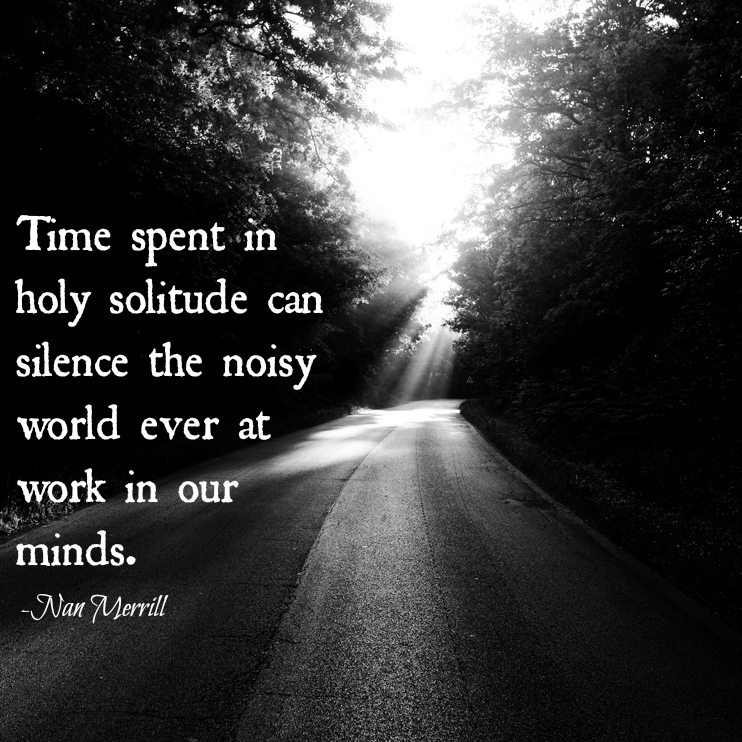
I need solitude. I’m still processing some things. I imagine I’ll be doing that the rest of my life as different experiences from NOW interact with my loss. I cannot do that in the presence of others. I need to think, reflect, write, read and walk it out. That means I have to devote time and space to being alone. If circumstances prevent me from quiet solitude for too long my blood pressure climbs, my patience disappears and little things grow large.

I don’t sweat the small stuff (usually-see above!). If time, effort or money can remedy it then it’s just. not. a. problem. I’ve learned the hard way that life and love are the most important things in life. Everything else might be nice but it’s not essential. I’m not minimizing the stress and strain of broken pipes, wrecked cars or lost jobs. It’s just that eventually those are situations that can be fixed. And lest you think I’ve not experienced any of those, I have. My first thought whenever anything happens I once perceived as “the worst thing that could happen” is, “It’s absolutely, positively NOT the worst thing that can happen”.

I need to observe a careful rhythm of commitment and freedom on a daily, weekly and monthly basis. I always kept my big calendars each year and tossed them into a box of “if I ever need to know these things”. When I look back on how busy we were as a young family I’m astounded at the pace we kept, the places we went, the hours I was frantically working to fulfill all our obligations along with the things we just wanted to do. I’m sure some of this is a function of age-I’m no spring chicken any more-but I know in my bones it’s also a function of the ongoing toll grief takes on my body, mind and soul. I can only manage a few days of busyness in a row until I need a complete shut-down for at least twenty-four hours or more. I refuse to schedule any but the most difficult to get appointments in a week where I’ve already inked in other commitments.

Sleep, regular exercise and good food are necessary for me to face life with a good attitude. This is probably true of most folks but just a day or two of fast food, no outdoor walks or interrupted nights and I’m toast. I’m not a whole foods, organic everything kind of gal but I try to eat a variety of fresh and less-processed meals. When I’m home I have an almost two mile path through woods and up gentle inclines that builds muscle, exercises my lungs and body and gives me ample time to drink in the beauty of birds, wildflowers and leafy trees. If you’ve ever been to my home you know that the rest of the crowd can stay up as long as they want to but I’m headed upstairs between eight and nine. Of course I get up before the sun, so my total hours are roughly the same but there’s something about that pre-midnight sleep that restores me like no other.

I could probably list dozens more, less obvious, ways grief still shapes the me of today. But it no longer binds me like it did in the early days. I’m better able to work around the difficult bits and still make a meaningful life with the people I love.

But it’s Ok to not be OK some days.

Those days are fewer and farther between.

I’m very thankful for that. 

Bereaved Parents Month 2025: Why Can’t I Keep My House Clean???

Eleven years later and I’m still on the struggle bus with this one.

I used to be able to keep clutter manageable, clothes put away and counters and carpets clean.

Now I sometimes come downstairs and wonder what tornado has blown through the family room only to realize it’s an accumulation of several days’ chores left undone.

Sigh.❤

I freely admit I was never a housecleaning fanatic.

With a busy family, a small farm and mountains of paper, pencils and books scattered around I was content if the most obvious dirt was swept up and the sink free of dishes.

But, I DID have a routine.  I DID clean my bathrooms and wash clothes and make beds and vacuum the rugs on a regular basis.

Not anymore.

Even all this time after Dominic ran ahead to heaven, I have not reestablished any kind of rhythm.

Read the rest here: Why Can’t I Keep My House Clean? Grief and Everyday Responsiblities

Grief in Real Life: Give Sorrow Words

A few summers ago, I participated in an online discussion group with others who read ATLAS OF THE HEART* by Brene Brown.

It was a helpful exercise to map, name and explore emotions so that I can create more meaningful connections to myself and others.

I think I’ve been doing some version of this my whole life. Language matters. Being able to give any emotion-especially the deep pain and sorrow of child loss-matters.

Language is our portal to meaning-making, connection, healing, learning, and self-awareness….

Language shows us that naming an experience doesn’t give the experience more power, it gives us the power of understanding and meaning.

Brene Brown, ATLAS OF THE HEART, xxi

The morning Dominic ran ahead to Heaven, after I made the awful phone calls I reached for my journal.  

I knew if I didn’t start spilling the grief onto paper my heart would explode with sorrow.  

Since I learned to hold a pencil I’ve been writing. 

It’s how I sort my thoughts, figure out my feelings and express my heart. 

i-write-because-i-dont-know

A few months after and I found several online support groups. 

There I learned a whole other  Language of Grief and Loss.  The more I read what others shared, the better I understood my own experience and understood how to communicate that truth to others.

You might not keep a journal or write poetry or craft lengthy essays about your pain and that’s just fine.  There’s no magic in written words.

Find a safe space or person and speak it aloud.  

Sorrow unspoken swells. 

It can’t be contained.  

It will absolutely consume you.  

Give-sorrow-words shakespeare

*Warning: ATLAS OF THE HEART contains language that may offend some folks. I just don’t want anyone to be surprised. ❤

It would be so helpful if there was an app to track stress like there is to track spending.

Wouldn’t it be marvelous to get an alert that said, “Low Balance”, for mental, physical and psychological reserves like the one you can get for your bank account right before you are heading to overdraft territory?

But there isn’t.

And few of us are very good at gauging just how much is left in our mental wellness accounts which means we often keep giving when the well is more than dry.

I’d be lying if I said I spend the same amount of time crying, lamenting and bent over in agonizing pain that I did in the early days of mourning Dominic. I’ve found a way to keep him close, to trust his soul to Jesus and to (largely) live in the present instead of always longing for the past.

There are days, though…

Some days are easy to anticipate-birthdays, holidays, the awful anniversary of his leaving-and some sneak up on me. I can often trace my overwhelming sadness to a specific trigger or memory dug up in a drawer or found in a pile of photos.

Occasionally, I have a horrible weepy day for no discernable reason.

That’s when I walk my heart back through recent events and always come to the same conclusion-I’ve let myself run dry:

  • I’ve overcommitted.
  • I’ve not planned rest.
  • I’ve had hard pain days.
  • There’s been family drama.
  • Someone I love is sick.
  • I’m sick.
  • A deadline looms large.
  • There’s some major unpredictability going on.
  • I’ve counseled too many people without enough time to regain my own emotional stores.
  • I’m not sleeping well.
  • I’m doing too much and not listening to my body.

What I’ve come to understand is that stress is a HUGE impact on my grief and how I experience it.

I won’t patronize folks reading this with a simplistic (but wholly unhelpful!) suggestion to “reduce or avoid stress”.

For heaven’s sake! If we could do that with a snap of our fingers we would hardly need someone to tell us to take advantage of that solution.

Truth is, stress is often largely outside our control.

But there ARE some things I can make choices about. So I do. I look ahead at the calendar and note upcoming milestone days. I plug in doctor’s appointments, birthdays and holidays. I review every invitation to celebrations or lunch in light of what is already inked in.

I’ve learned to be honest with folks about my limitations and send a card or gift through the mail if I can’t be there in person. I sometimes suggest an alternative date and time if the one a friend offers just doesn’t work for me. I stand firm in my opinion that “no” is a complete sentence and as long as I’m kind and gracious it is not incumbent upon me to offer an explanation for why I’m turning down an invitation.

And if I have an unexpectedly hard day-from grief or activity or because of my RA-I drop back the next day to allow time to recuperate and rest (if at all possible).

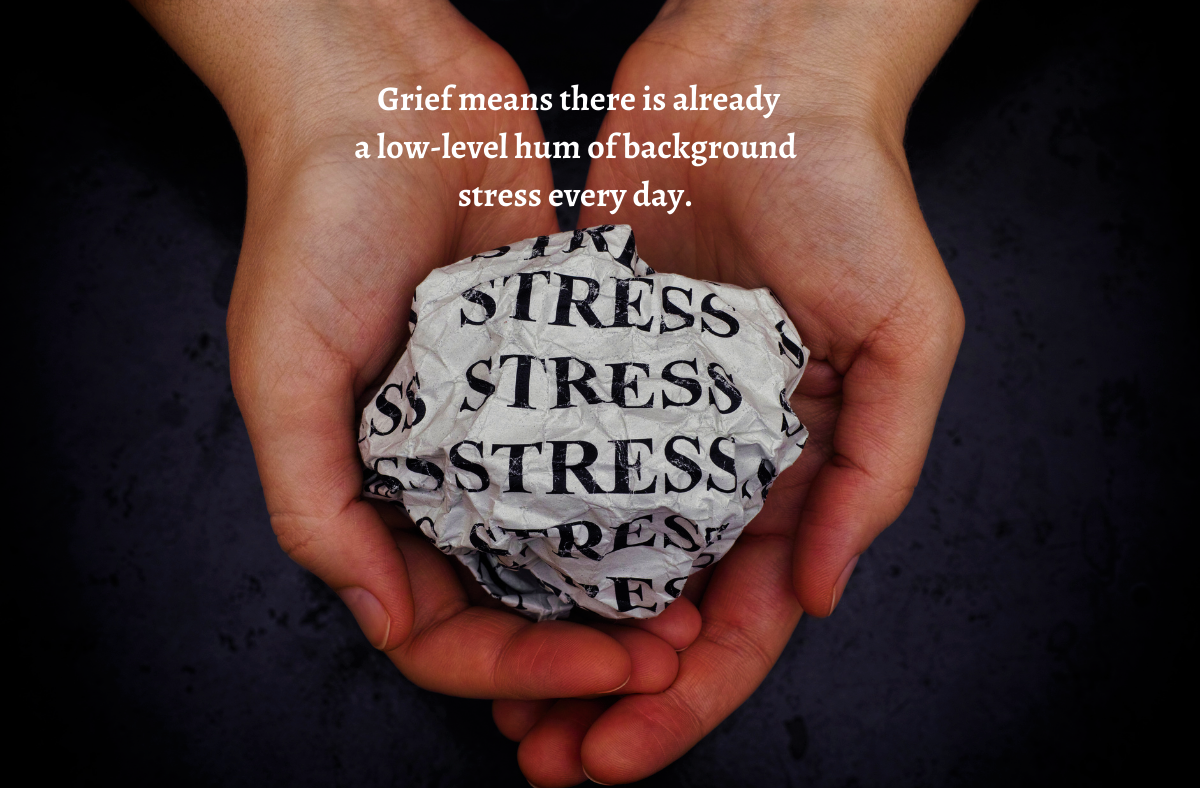
The reality is that child loss means there is ALWAYS a certain low-level hum of stress in my life.

Adding to that already higher-than-average stress means it’s easy for me to be tipped into unhealthy territory.

Crying is only the tip of the iceberg.

Health problems, heart problems, relationship issues and other long-term consequences often result.

It’s not only OK for me to set boundaries to protect my health and my heart,

It’s absolutely, positively the right thing to do.

Anxiety is Really Awful!

I’ve written before about anxiety and child loss here.  No matter the cause of death, the FACT of a child’s death seems to create the perfect conditions for a parent’s body and mind to experience anxiety, dis-ease, fear and often a sense of impending doom.

My world was rocked to its foundation the moment I heard the words, “He was killed in a motorcycle accident”.  

The worst thing I could imagine had come true.  

There was no protection from it happening again, no guarantee that THIS unbearable pain would be the ONLY unbearable pain I would have to carry.

I think my body chemistry was instantly transformed that morning to include rapid heartbeats, shallow breathing and a horrible creepy tension that climbs my spine and clenches its claws tightly at the base of my skull.

Before Dominic left us for Heaven I was not an anxious person.

Read the rest here: Anxiety is Awful!

Bereaved Parents Month 2024: Physical Manifestations of Grief

Grief is not *just* feelings. It is so much more.

I shared this last year around this time in response to many, many comments and questions from bereaved parents about what felt like random or unusual physical manifestations of their own grief.

I hope it helps another heart navigate this life none of us would choose. 

❤ Melanie

It’s a well known fact that stress plays a role in many health conditions.  

And I think most of us would agree that child loss is one of (if not THE) most stressful events a heart might endure.  

So it’s unsurprising that bereaved parents find themselves battling a variety of physical problems in the wake of burying a child.  

Read the rest here: Physical Manifestations of Grief

Grief Work 2024: Physical Manifestations of Grief

Grief is not *just* feelings. It is so much more.

Often there are random or unusual physical symptoms that show up days, weeks or even years after a child has gone to Heaven.

An important and necessary part of grief work is learning to recognize the physical manifestations of grief and advocating for care from professionals who may not be able to make the connection unless the bereaved speak up and speak out.

❤ Melanie

It’s a well known fact that stress plays a role in many health conditions.  

And I think most of us would agree that child loss is one of (if not THE) most stressful events a heart might endure.  

So it’s unsurprising that bereaved parents find themselves battling a variety of physical problems in the wake of burying a child.  

Read the rest here: Physical Manifestations of Grief