Last year during the month of August I joined with others and participated in a Scripture Writing Challenge.
We committed together to read and writeout short passages on grief every day.
I wrote companion posts and shared them.
Circumstances have prevented me from doing another in-depth study againthis year but I thought it would be nice to collect the entries from last August in a weekly bundle and put them out there for anyone who might want to revisit them or try it for the first time.
So here’s the fourth week’s links (including how to set upa journal):
Long time readers may have noticed that the past month there have been fewer original posts and more recycled ones.
I’m not sure precisely why, but it’s been a lot harder to put my thoughts and feelings into words than at any other time in this journey.
I’ve started and abandoned post after post. They languish in my “drafts” file and will, hopefully, eventually, be completed.
There’s just something about the rest of the world being forced to live in the no-man’s-land between what we used to take for granted and what we now have to face that makes it harder to talk about my personal experience.
Grief takes many forms and I believe the whole world is grieving now.
I can hear it. I can feel it.
All of us are facing (many for the first time!) the fact that control is largely an illusion.We climb into our vehicles and assume the person coming at us in the other lane will maintain their position but don’t know that he or she is distracted or medically impaired or drunk.
And then-BAM!-all bets are off. What we take for granted can change in an instant.
So I guess my challenge is in translating my particular grief into language others can understand and relate to.
For the first time I feel there’s a wider audience longing for the secret recipe to life after loss.
I know not every heart is suffering from physical loss of a loved one but I think there are some general principles I’ve learned that can help anyone who’s struggling to find a path through this difficult season:
Acknowledge what you’ve lost. It often helps to name what’s changed, what you miss, what you’ve had to give up. It may seem obvious but you might be surprised. When Dominic ran ahead to Heaven I knew I’d no longer have HIM. But what I didn’t realize at first was that I also lost the family I once knew (we were all changed), the me I used to be and the life I thought I’d have. There are Secondary Losses hidden inside every grieving heart.
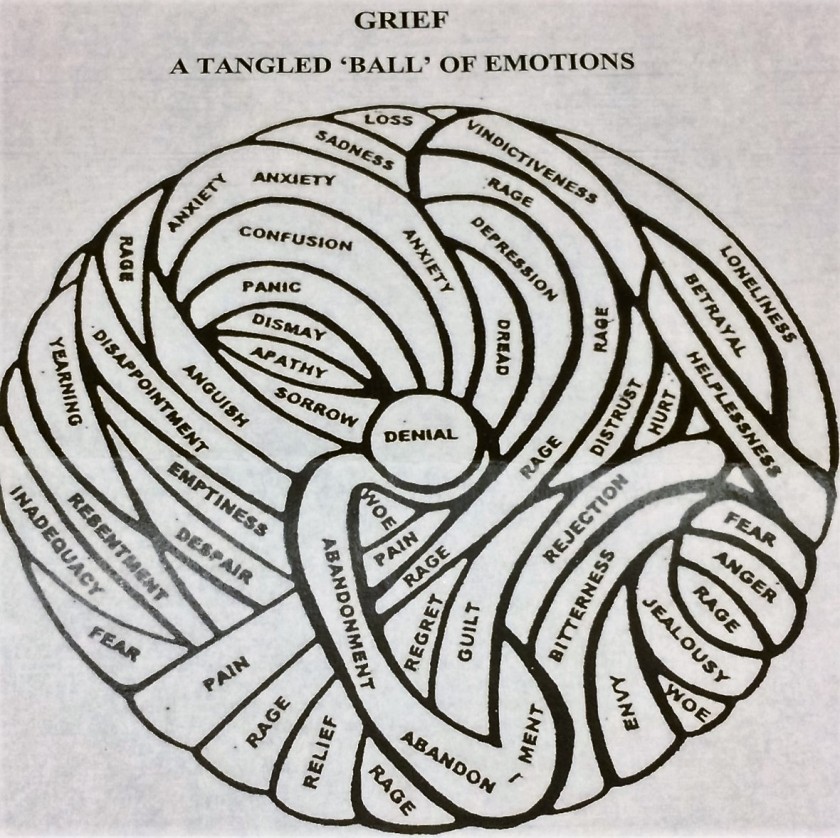
Face your feelings. Consider journaling your thoughts. Often speaking or writing out a feeling is the first step to dealing with it. Grief isn’t just one feeling-although we tend to think of it that way. It’s A Tangled Ball of Emotions. I had no clue until it was me trying to unravel the strands and understand what to do with them. Emotions will leak out somewhere. Are you short-tempered and cranky? There’s probably something underneath those outward signs.
Think about your strengths and coping skills. What has helped you get through tough times in the past? How can you use the same set of skills or tools to tackle this challenge? Child loss is the greatest and most difficult thing I’ve ever faced. If you had asked me in the first five minutes if I’d survive I would have told you, “no way”. But I have. Largely by leaning into my faith in Christ (which I know not everyone shares) and depending on coping skills I learned over the years dealing with chronic illness and other hard things. What have you survived in the past? Use that to get through this.
Stay connected to the people who matter most to you. Social distancing is an unfortunate label for what is actually physical distancing. Social media, smartphones, Skype, Zoom meetings and other electronic means of connection are widely available and can help a heart stay in touch with friends and loved ones. When someone feels isolated he or she is much more apt to give up and give in. Humans were made for community. If you can’t be physically next to people, find another way to get close and stay in touch. It might well require more effort but it’s worth it.
Make a new routine. It’s not just babies that thrive on schedules. We all need a semblance of control and normalcy. Eat at regular times. Set up a work station/school station if the virus is keeping you at home. If possible, make sure each day includes some physical activity and outdoor air. Exercise, hobbies, family story time or shared movies are all things that could be included. Try to go to bed and get up at about the same time each day. For several months after Dominic left us, I wrote each day’s plan on an index card. When I found myself at loose ends, sitting staring into space and sinking into despair, I consulted my card. I moved on to the next thing and eventually found I’d made it through yet another day.
Limit your media diet. Let’s face it-most of us are easily drawn into an “us vs. them” mentality. And once we begin to think in those terms it’s harder and harder to see beauty in the world. It’s one thing to remain informed and it’s another to be absorbed by all the things over which we have no control. Focus on smaller things-friends, family and community. That’s where a heart can make a difference.
Practice discernment and draw a line between what is inconvenient and what is truly tragic. Lots of things can FEEL like the end of the world but very few things actually ARE. Life has changed dramatically but it’s still life. Work and school look different. Masks are uncomfortable. Celebrations might be virtual. Shopping without trying on clothes is a hassle. But none of those things equate to death or loss of income or being unable to visit an elder in a nursing home. There are absolutely, positively tragic aspects to this experience and (sadly) one or more of them may visit your family. But unless and until they do, save your energy in fretting over (relatively) minor inconveniences.
Remember that there are more chapters to your story.All of us have dark pages in the books of our lives. Some of us have several chapters’ worth. But as long as there is life, there is hope. My family HAS survived child loss/sibling loss. We are different, we are wounded, but we have survived. Some of the things we have learned are truly beautiful (although we wouldn’t have chosen to learn them this way). If you listen and pay attention, you will learn things too.
Truth is, grief can drag you down so low you don’t remember which way is up, much less how to get there. No one knows that better than a bereaved parent.
Still, there are things you can do even there that will help your heart hold onto hope.
Where there is hope there is light.
And light will always, always chase away the shadows.
I wrote a few months ago about how the pandemic changed the routine around here.
My long quiet mornings spent reading and writing were suddenly transformed by our living room serving as office space for my work-at-home husband.
It took awhile to figure out how to adapt but eventually we found a rhythm to our days.
Now life has taken another turn. He’s retiring! Which is a very, very good thing but means I’ve got another boatload of adjusting to do.
Since he’s had an apartment in California for several years, he returned to clean it out and move things here. I need to declutter and rearrange at home to make space for some furniture and other items he’ll be bringing back.
I wish I had been one of those people who spent the past few months of stay-at-home to dig into closets, deep clean corners and dejunk junk drawers but I wasn’t. So that means I’m trying to do it now. Which is not only time consuming but sometimes overwhelmingas decades of daily memories fall out of folders, show up in odd places and hit my heart.
I’m soldiering on though.
I doubt I’ll tackle the toughest space-Dominic’s room-before my hubby makes it home. But I’ll have most of the rest of the place shipshape.
Until he brings that truckload to the door.
I better take pictures.
It may be the last time the house looks this good.
My world was rocked to its foundation the moment I heard the words,“He was killed in a motorcycle accident”.
The worst thing I could imagine had come true.
There was no protection from it happening again, no guarantee that THISunbearable pain would be the ONLYunbearable pain I would have to carry.
I think my body chemistry was instantly transformed that morning to include rapid heartbeats, shallow breathing and a horrible creepy tension that climbs my spine and clenches its claws tightly at the base of my skull.
Last year during the month of August I joined with others and participated in a Scripture Writing Challenge.
We committed together to read and writeout short passages on grief every day.
I wrote companion posts and shared them.
Circumstances have prevented me from doing another in-depth study againthis year but I thought it would be nice to collect the entries from last August in a weekly bundle and put them out there for anyone who might want to revisit them or try it for the first time.
So here’s the third week’s links (including how to set upa journal):
You’d think that the depths of despair, the breath pressed out of your lungs would stop a brain from wondering if even here, I’m “normal”.
I’m not sure it’s the same need for affirmation junior high girls crave-am I doing/saying/being the things that will guarantee I fit in-but it’s a close cousin.
The human heart longs to know that what it feels is something other hearts feel.
I was desperate for assurance that what I was going through fell well within the range of “normal”.
So let me assure you.
If you wonder if all these crazy emotions are normal in grief, the answer is a resounding, “Yes!”.
Grief is a ball of emotions any one of which may demand more or less of your attention on a given day. It’s not just sadness or missing or sorrow or even pain.






























 thelifeididntchoose