

It’s OK to not be OK.
If you are grieving, you are not responsible for making others feel better about YOUR pain.
Read the rest here: You Don’t Have to Pretend
It’s OK to not be OK.
If you are grieving, you are not responsible for making others feel better about YOUR pain.
Read the rest here: You Don’t Have to Pretend
I have friends who have not only buried a child (some have buried more than one) but have also buried parents, siblings, in-laws and other people close to their hearts in a very short span of time.
And I am appalled when they recite the trite comments doled out by others meant to patch broken hearts and sweep the leftover pieces under the rug of social propriety.
Let me just say this: Death. Is. Awful.
Full stop. No easy change of subject or laughter allowed to make the hearing of it softer.
It should be hard.
It should make us pause.
We should stop in our tracks to acknowledge the passing of the breath of God from a person’s body.
Death is an unavoidable reminder that the world is not as God intended it to be. It’s a reminder of the cost of sin. It’s a reminder that our time is short. And it’s a reminder that we are NOT in control.
Those are very uncomfortable truths.
My hope in Christ makes those truths bearable but it does not make facing the death of those I love hurt less.
A broken heart is a perfectly natural and reasonable response to the awfulness of death and to the absence of the presence of one I love. Great grief is the price of great love.
There’s a scene in The Magician’s Nephew where a little boy named Digory meets Aslan. His mother is sick, and he wants to ask for Aslan’s help, but he’s afraid. Lewis writes:
Up till then he had been looking at the Lion’s great front feet and the huge claws on them; now, in his despair, he looked up at its face. What he saw surprised him as much as anything in his whole life. For the tawny face was bent down near his own and (wonder of wonders) great shining tears stood in the Lion’s eyes. They were such big, bright tears compared with Digory’s own that for a moment he felt as if the Lion must really be sorrier about his Mother than he was himself. “My son, my son,” said Aslan. “I know. Grief is great. Only you and I in this land know that yet. Let us be good to one another.”
For those outside this great grief, it seems helpful to toss words like bandaids but it’s not.
I’m sure you mean well when you try to circumscribe my grief-to give limits to its expression and duration.
But unrealistic expectations make it more difficult to bear the burden I’m already carrying. Your words add to this weight of sorrow and pain that I cannot untie from my bent back.

Presence-often SILENT presence-is the balm for my wounded soul.
But please: Don’t say it’s not really so bad. Because it is. Death is awful, demonic. If you think your task as comforter is to tell me that really, all things considered, it’s not so bad, you do not sit with me in my grief but place yourself off in the distance away from me. Over there, you are of no help. What I need to hear from you is that you recognize how painful it is. I need to hear from you that you are with me in my desperation. To comfort me, you have to come close. Come sit beside me on my mourning bench.
~Nicholas Wolterstorff, Lament for a Son
(A psalm by David.)
Listen, Lord, as I pray! You are faithful and honest and will answer my prayer.
~Psalm 143:1 CEV
There are days when I am not interested in a deep dive into Scripture or a lengthy conversation with myself or anyone else about faith.
Days when I’m too tired to try to tease out the meat from the fat or the subtle from the obvious.
On those days I hang on to HOPE by remembering some basic truths:

In my own power I am lost, but God promises not to abandon me to my own resources.
He made me, He called me and He keeps me.

He hears my cry for mercy. He collects my tears. He turns His face toward my suffering and doesn’t look away.


When my heart is overwhelmed, He is my Rock, my Refuge and my Very Present Help in time of trouble.

He will not abandon me.

Many years ago my grandparents had a lovely Fiftieth Anniversary Celebration with family and friends.
My dad videotaped it and the tape was full of fun moments where my grandmother was smiling, laughing and having a wonderful day.
It was a short time afterward that she began to show signs of dementia and not very long after that she left us.
We watched the videotape a year or two after her leaving and I thought, “What a mercy she didn’t know what was coming!”
Those moments were full of unadulterated joy because a sorrowful future was hidden from her heart.
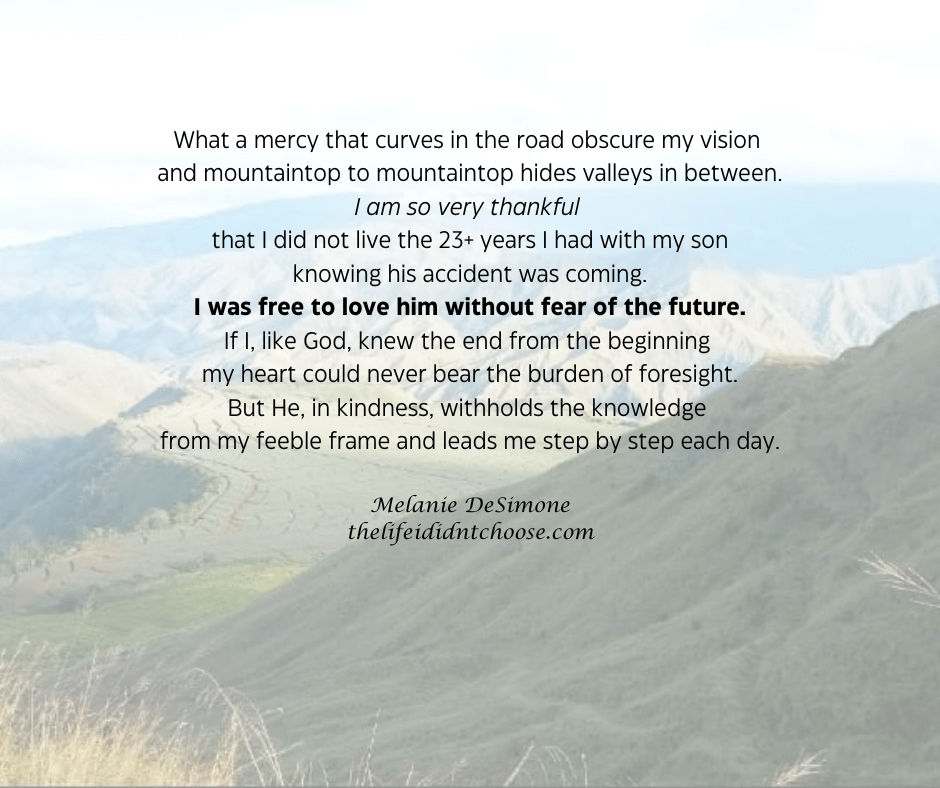
What a mercy that curves in the road obscure my vision and mountaintop to mountaintop hides valleys in between.
I am so very thankful that I did not live the 23+ years I had with Dominic knowing his accident was coming. I was free to love him without fear.
If I, like God, knew the end from the beginning my heart could never bear the burden of foresight.
But He, in kindness, withholds the knowledge from my feeble frame and leads me step by step each day.
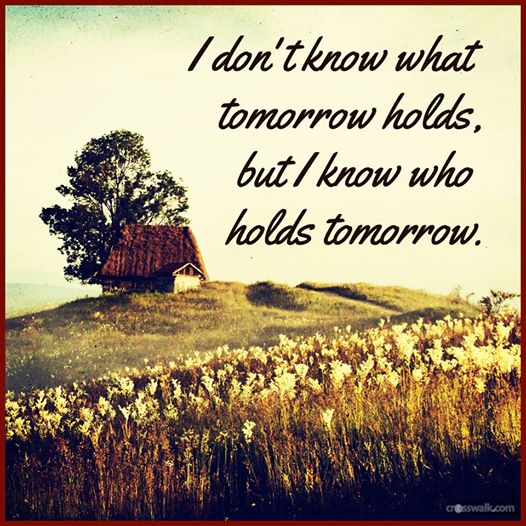

We’ve all been there-we ask a routine question and someone refuses to play the social game.
We say, “How are you?” and they answer honestly instead of with the obligatory, “I’m fine. You?”
Suddenly the encounter has taken an unexpected turn.
“Oh, no! I don’t know what to say,” you think.
It can end badly-both of you walking away uncomfortable and wary.
But it doesn‘t have to. There are ways to express compassion and empathy, words that can comfort and encourage.
What should you say when I, or anyone, shares their heart-their pain?
Brene Brown has done some amazing work in the area of shame, hurt, compassion and empathy. I’ve found it valuable in my own valley and also instructive in serving others in theirs.
This short video based on her work is incredibly helpful. Please take a moment to watch it: Brene Brown on Empathy
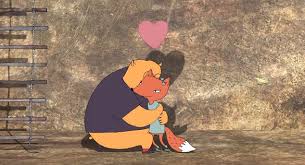
I know many who wonder about the eternal destiny of loved ones.
God in His mercy extends grace to everyone who believes.

NOTHING can separate us from the love of God:

God promises that HE holds on to US–HE finishes the work He began in us.
“And I am certain that God, who began the good work within you, will continue his work until it is finally finished on the day when Christ Jesus returns.”
Philippians 1:6 NLT
Even if the last choice someone made was a foolish one, or a desperate one, The Good Shepherd brings all His sheep home.
“My sheep recognize my voice. I know them, and they follow me. I give them real and eternal life. They are protected from the Destroyer for good. No one can steal them from out of my hand. The Father who put them under my care is so much greater than the Destroyer and Thief. No one could ever get them away from him. I and the Father are one heart and mind.” ~Jesus
John 10:27-30 MSG

The doctor I see every six months or so for my rheumatoid arthritis always fusses at me.
One of the routine questions is, “How’s your pain level?”
I usually say, “About a three.”
And then she looks at my hands and my feet-at the swollen joints and twisted toes-and shakes her head.
But here’s the deal: sure they hurt, sure I can’t do all the things I used to do, sure I have to do many things differently than I did them when my hands and feet were unaffected by this disease-but I’m STILL moving and doing what needs to be done.
I don’t really know how to do anything else.
And that’s how it is with this grief I lug around-it’s heavier some days than others-but I’m STILL moving and doing what needs to be done.

This is not the life I thought I would be living, but it’s the life I have.
So I make accommodations for my sorrow just like I make accommodations for my hurting hands and crooked toes.
I am not in control of everything, but I can control some things.
I would not have chosen this life for myself, but I can make choices that help make it bearable.

I was reminded once again this week how the events surrounding death and burial are inadequate indicators of the profound change that has taken place in the lives of those left behind.
Standing at the graveside of a precious friend’s father, I remembered watching Dominic’s earthly shell lowered beneath the ground.
I was wholly unprepared for the days and weeks and months that followed.
No one had told me it was only a beginning…Loving Well: Transitioning From “Good-bye” to Grief
I used to position myself at the end of the pew, just in case someone I’m not too comfortable with might come along and try to sit down.
It saved us both that awkward conversation where they ask if they can join me and I say “yes” with my mouth but “no” with my body language.
Frankly, I was at church to be lifted up so I could face the coming week with power and strength. I didn’t want to be dragged down by their reality of brokenness and sometimes bitter tears.
I don’t do that anymore.
I realize that most of what made me uncomfortable was other people’s pain.
Now I’m the one who’s broken. I’m the one who can’t get through “Amazing Grace” without blubbering.
And I’m the one that others hope won’t ask to join THEM.
But here’s the deal: God loves the broken. Christ came for the broken. It’s the broken and breathless who long for the Spirit to blow life across their wounded hearts.
It’s the hopeless and fearful that run faster to the safety of their Shepherd.
It’s the worried and weary who are thankful for a Burden-bearer.
When I refuse to move over and make room for the broken, I’m barring the way for the very ones who most desperately need the blessing. When I want my worship experience to exclude those who haven’t the strength to bring their own hearts before the throne of grace, I’m being selfish.
And that is sin.
Jesus went out of His way to heal the hurting,
to bless the broken and
to speak strength to the weary.
So now I sit in the middle of the pew and leave room for whoever God brings my way.
I want to be an open door, not a gatekeeper.
“Come to me, all of you who are weary and over-burdened, and I will give you rest! Put on my yoke and learn from me. For I am gentle and humble in heart and you will find rest for your souls. For my yoke is easy and my burden is light.” ~Jesus
(Matthew 11:28-30 PHILLIPS)
The Vietnam Memorial is a beautiful and meaningful reminder of those who gave their lives in that war. The stark black stone highlights the 58,307 names engraved in its surface.
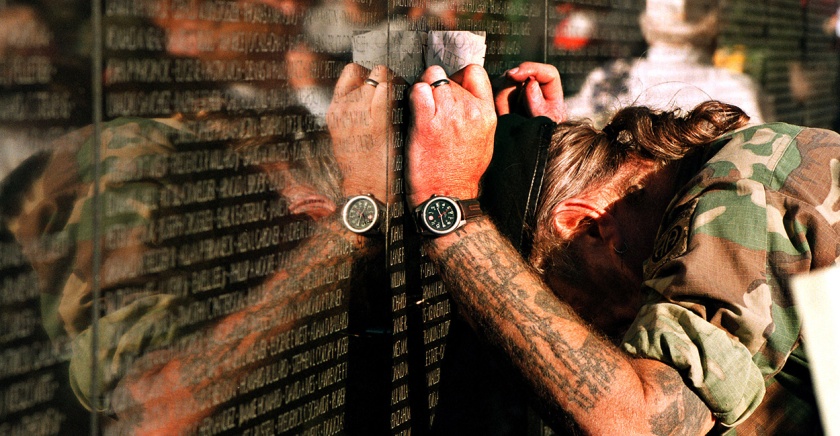
I shared this a few months back as part of a “Loving Well” series of posts about what grieving parents feel and what ministers to their broken hearts.
I long to know my son is remembered and still matters.
Please, Just Say His Name.





 thelifeididntchoose