Five Minutes Or Less Is All It Takes To Encourage a Broken Heart

I have to admit that I’m not nearly in the fog as much with my mama’s death as I was with Dominic’s death.

I’ve found this time around I can kind of stand a little apart and be a little more objective.

It’s no less horrific or painful or sad, but it IS an orderly death (parents before children) and gives me space to take a step back and observe some things instead of having to filter every single interaction through my emotions.

So can I share a little secret?

It literally takes five minutes or less to encourage a broken heart.

I know people often think that if they don’t have the perfect words or lots of time it’s better to do or say nothing.

That’s just not true.

Send a text, a private message, an email, a card. Make a quick phone call (believe me, the bereaved will not keep you on the line!) or leave a voicemail.

What grieving hearts want to know is that someone sees their pain, someone has taken notice of the drastic and unwelcome change that’s been thrust upon them.

We don’t want to feel invisible. We don’t want to be overlooked because it makes you uncomfortable.

Be brave!

Face your own discomfort (which is microscopic compared to the heartache of the bereaved!) and make the call, send the message, write the email or card.

I promise you will waste more than five minutes today.

So take that tiny bit of time and focus your efforts on speaking courage to a hurting heart.

You don’t have to have the perfect words- “I’m so sorry” is just fine.

Then your head can hit the pillow tonight knowing you helped a heart hold onto hope.

You made a difference between someone giving up or going on.

So What SHOULD I Say or Do For My Grieving Friends or Family?

I have learned so much since that day when Dominic left us suddenly for Heaven.

Some of the things I know now are things I wish I didn’t know at all.

Many serve me well-not only in how I respond to my own pain and loss-but also how I respond to the pain and loss in the lives of those I love.

I had to practice them again when my mama was desperately ill and then joined Dominic and Jesus.

It reminded me how hard it is for those who have not walked this Valley of the Shadow of Death to really comprehend how their words and actions either truly support or subtly wound already hurting hearts.

So here’s a short list of things things to say and do that I believe actually HELP grieving friends and family:

  • Not everyone leaves earth quickly. Some are ill for a long time. It’s natural for friends to want to stop by home or hospital to see a sick loved one and show support for the family. Please call ahead to see if it’s convenient. If it’s not, then don’t come. Respect that while it may feel like a reunion to you and others gathered in the living room or the waiting room it’s a very sober and frightening and stress-filled time for the family. Loud laughing and back-slapping are often unwelcome reminders that the person in the bed can do neither.
  • Please don’t impose your desire to help on the family’s unwillingness to accept it. Offer-that’s wonderful and appreciated-but there may be circumstances you don’t know about that just make it hard or impossible for them to let you do what you would like to do. It’s really, really hard to use the limited energy available to politely turn down an offer.
  • When you stop by to pay respects, try not to overstay your welcome. You’ll probably never notice that the family is working hard to extend hospitality and make small talk. It’s exhausting. You are not the only people “stopping by for a minute” while the family is trying to take care of funeral details. They are deciding on what clothes their loved one will be buried in, what photos to include in a memorial slide show, what will be served at dinner after the service, who will sing or speak or play a piano solo. There’s just no energy left for small talk. Express condolences, leave the dessert or congealed salad and leave them to the little bit of quiet they may enjoy before the next few days of crazy.
  • Take time to write notes of remembrance if you can. Facebook comments, text messages, emails, written notes or cards are wonderful! These can be gathered together, printed and saved as a beautiful tribute.
  • If you haven’t played an active role in the deceased’s life or the life of their family recently, don’t show up and insist on “inner circle” privileges now that they are gone. This is not the time to force reconciliation or expect a family reunion type celebration. While that may be the ultimate outcome of this traumatic and life-altering event, respect those that have maintained relationship over the years.
  • Instead of asking, “Let me know if there’s anything I can do”, say, “How may I serve you in the days and months to come?”. Grievers may not have an immediate answer, but ask again in a week or so after others have drifted away. Also consider asking if specific things may be helpful.
  • Please don’t wander around the house. Respect the family’s privacy.
  • Don’t ask personal questions such as “How did he die?” or “What happened?”. If the bereaved want you to know, they will tell you.

Be attentive to body language.

Allow grievers to lead.

Don’t ignore comments that indicate it’s time to go.

Accept that what you may want to do and what is truly helpful may be two very different things.

Fewer words are almost always better than idle chatter.

Give grace.

Repost: Why Grievers Need Faithful Friends

My mama joined Jesus early Friday morning.

And I’m reminded once again how very important friends are along life’s journey.

So. many. people. have called, texted, messaged and expressed love and concern for our family.

It’s really encouraging!

But what I know, that others may not know (if they’ve been blessed to escape losing a close loved one so far) is that it’s not too long before all this attention fades away.

People usually don’t choose to stop connecting with broken hearts. It’s just that life gets busy and while grievers can’t ignore the palpable absence of their loved one, other folks have mostly filled in the space where they used to be.

Please don’t forget us.

Even years later, there are days when grief overwhelms a heart.

We NEED faithful friends to remind us that pain is not all that’s left in the world.

Read the rest here: https://thelifeididntchoose.com/2017/09/29/help-wanted-why-grievers-need-friends/

Most Shared Posts: Why Friends Abandon Grievers


It happens in all kinds of ways. 
 One friend just slowly backs off from liking posts on Facebook, waves at a distance from across the sanctuary, stops texting to check up on me.

Another observes complete radio silence as soon as she walks away from the graveside. 

Still another hangs in for a few weeks-calls, texts, even invites me to lunch until I can see in her eyes that my lack of “progress” is making her uneasy.  Then she, too, falls off the grid.

Why do people do that? 

Read the rest here: https://thelifeididntchoose.com/2018/03/08/why-friends-abandon-grievers/

Companioning The Bereaved

I’ve learned so much in this journey.

I’ve had to unlearn some things too.

One of the things I’ve had to unlearn is that the medical model of “identify, treat, cure” is not applicable to grieving hearts.

Grief is not a disease. It’s not an abnormality. It doesn’t need to be treated and cured so that it “goes away”.

It’s the perfectly normal and appropriate response to loss.

A more helpful model is compassionate companionship.

What grievers need is faithful friends and family who choose to come alongside and refuse to be frightened away when the process seems long, tortuous and challenging. We need others to be present, to truly listen and to bear witness to our wounds.

Recently I found this list from Dr. Alan Wolfelt, founder of the Center for Loss (http://www.centerforloss.com) and I love it!

It’s an elegant synopsis of what compassionate companionship looks like in practice:

  1. Being present to another person’s pain; it is not about taking away the pain.
  2. Going to the wilderness of the soul with another human being; it is not about thinking you are responsible for finding the way out.
  3. Honoring the spirit; it is not about focusing on the intellect.
  4. Listening with the heart; it is not about analyzing with the head.
  5. Bearing witness to the struggles of others; it is not about judging or directing these struggles.
  6. Walking alongside; it is not about leading.
  7. Discovering the gifts of sacred silence; it is not about filling up every moment with words.
  8. Being still; it is not about frantic movement forward.
  9. Respecting disorder and confusion; it is not about imposing order and logic.
  10. Learning from others; it is not about teaching them.
  11. Compassionate curiosity; it is not about expertise.

~Dr. Alan Wolfelt, Eleven Tenets of Companioning the Bereaved

At one time or another each of us need someone to be present, to truly listen and to bear witness to our wounds.

When your world is profoundly dark, an outstretched hand is often the only way a heart can hold onto hope. 

`

Animal Therapy: Meet Tilly

I got a new kitten the other day.

For those of you following along, it’s not like I needed another animal in my personal zoo.

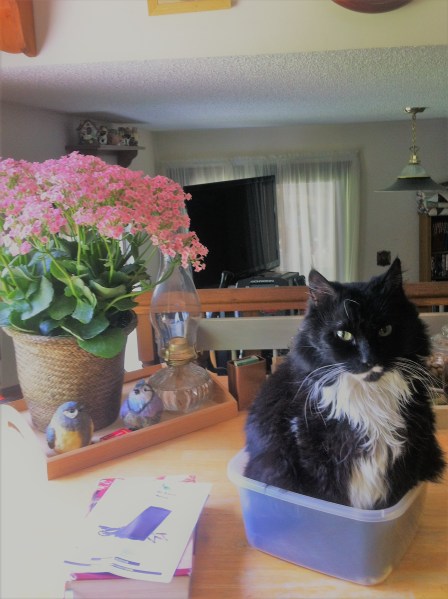
But my precious companion, Roosevelt , died in April. 

roosevelt in box on table spring 2017

Which was just in time to make the anniversary of Dominic going to Heaven, his funeral and his birthday harder since I didn’t have my favorite cat’s calming presence in my lap when grief overwhelmed me.

Once all the family festivities died down (seeing our grandson, celebrating our daughter’s wedding) I realized I really needed another cuddle bug.

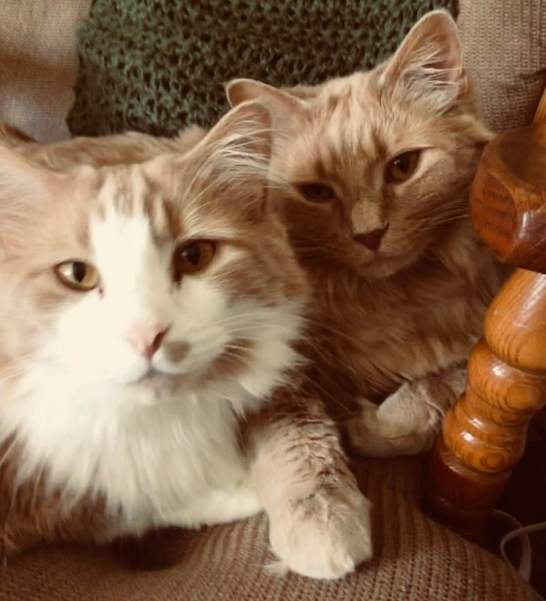
My two other indoor cats are giants-great at hanging close to me but lousy at sitting in my lap.

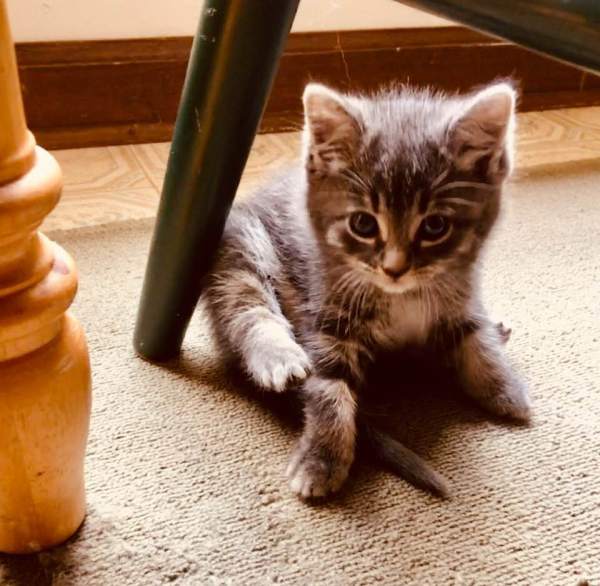
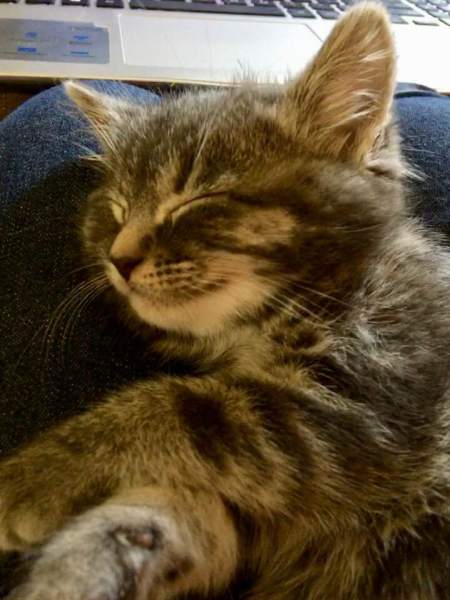
So, meet Miss Tilly the Kitty.  

Tilly under kitchen chair 6_16_19Isn’t she the cutest? 

I’m trying to do on purpose what I did by accident with Roosevelt.

I’m working on orienting her to me, getting her comfortable being held and training her as a good traveler on the cart and in the car.  I need her to sleep next to me in the bed at least until I fall asleep.

So far, so good.  

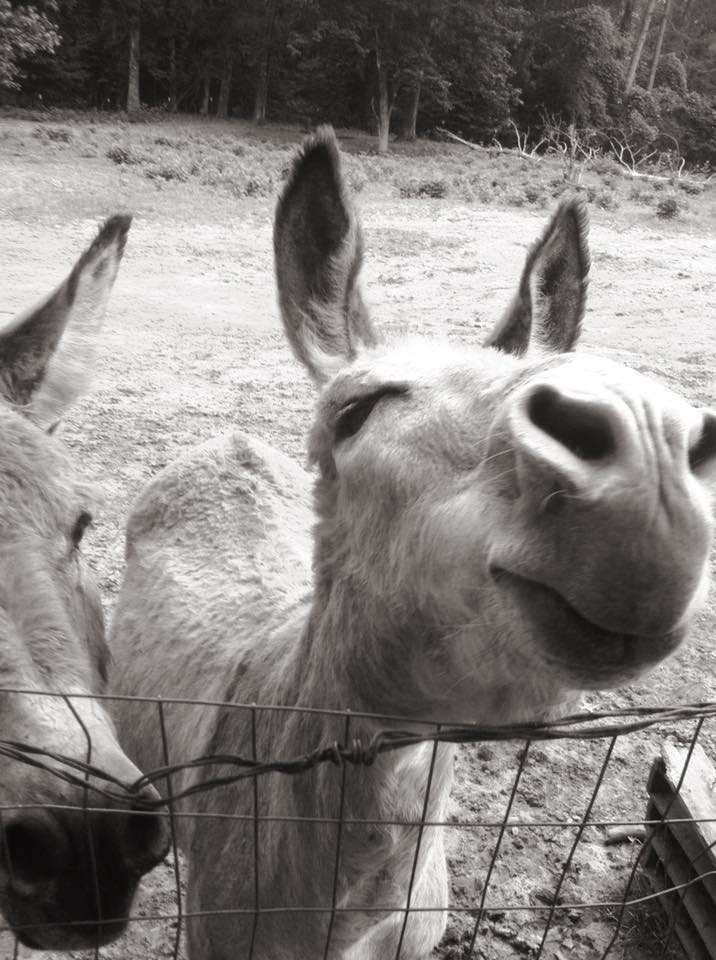
After one day going around with me to feed in the morning, she’s no longer afraid of anything except the donkeys’ loud greeting.  (Which could make a grown man jump if he didn’t expect it!)

She makes me laugh.  She runs like a bat out of you-know-where between the living room, kitchen and dining room.  She’s entertains me and herself for nearly an hour at a time by rolling a  jingle bell ball around on the floor.

And she’s been really good company. 

As I’m typing this, she climbed in my lap which is exactly what I want her to do.  She lies down with me at night and sleeps so hard I can reposition her like a limp dishrag.  That’s what Roosevelt used to do,so I’m hopeful.  I’ve slept better the past few nights than I have since he died.

Today Tilly finally convinced one of the big cats to play with her a little.  The other one just shakes his head and walks away.  I’m calling them the “bachelor uncles” because all they really want out of life is a routine that includes plenty of food and peace and quiet.  I think they are not pleased I’ve brought this young whipper snapper into their previously predictable home.


moonshine and lightening grown in my chair faces

They’ll adapt.

Eventually.  

As for me, I’m enjoying the animal therapy.  

tilly on my knees and computer june 19

Repost: Ask Me. Please.

I have been guilty of this more times than I ‘d like to admit. 

I assume someone else’s feelings mirror my own and act on that assumption by withdrawing or not showing up or “giving them space”.

But the problem is, most times, on reflection, I realize my action (or inaction) was really all about sparing my own feelings  or staying within my own comfort zone.

The heart is deceitful above all things
    and beyond cure.
    Who can understand it?

~Jeremiah 17:9 NIV

So I’m learning to ask hard questions.

Read the rest here:  Ask Me, Please.

I Know Why My Story Scares You

At first all I could feel was pain.

Pain of abandonment, of being misunderstood, of being pushed to the outside edges of groups that used to welcome me with open arms.

But as time passed, I began to understand.

My story scares you.  You are utterly afraid that if child loss can happen to ME, it can happen to YOU.

You’re right.

It CAN happen to you.

And no one wants to be reminded that the one thing every parent fears is not nearly as impossible nor as predictable as we would hope it is.

From the minute we take that baby home from the hospital, safely tucked in the approved and properly installed car seat, we assume we can control the future.  We think that if we eat right, get regular check ups, cover outlets and sharp corners, remove choking hazards and stuff that little mouth full of organic and healthful treats, it’s all good.

Except no one can account for random.  No one can see undetected and unsuspected genetic defects.  No one can predict or protect against every way a child might leave this life before his or her parents.

But we absolutely, positively do not want to think about that.

I don’t blame you.

I didn’t either.

So I understand why you distance yourself from me.  I get why even my presence in a room is sometimes uncomfortable.  I am not upset that you don’t add my name to the invitation list when the occasion is happy and you are afraid I might cast a shadow over the celebration.

I’m a walking advertisement for your worst nightmare.

You can afford to ignore it-and me.

I don’t have that luxury.

cant-fix-it-my-family-is-always-achingly-incomplete


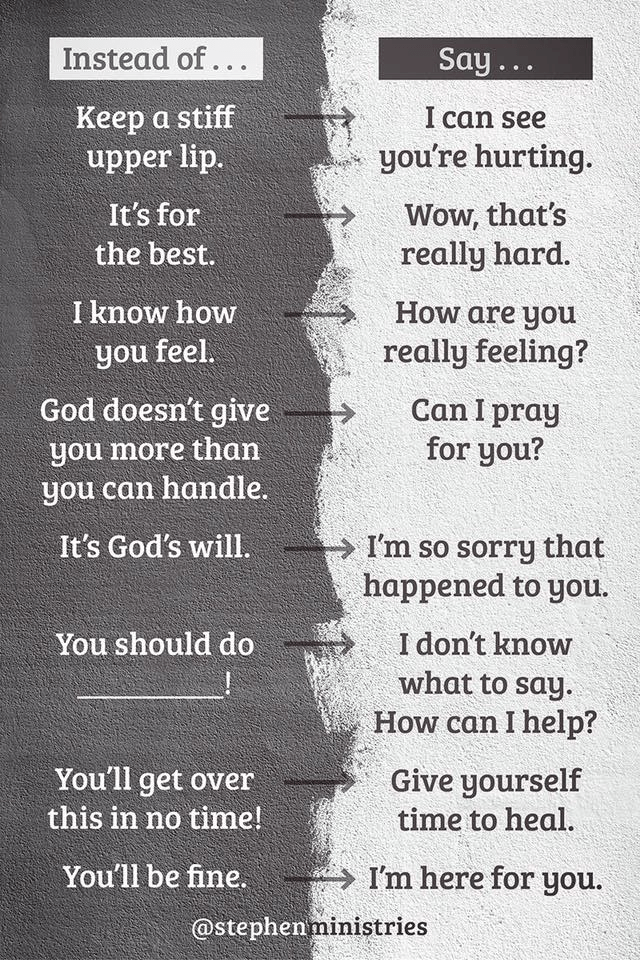
Instead Of Fixing, Offer Space To Share

I didn’t realize until I was the person who needed comforting how unhelpful and sometimes painful my own past comments were to my suffering friends and family.

There are many important and necessary conversations going on right now about how we talk to and talk about our fellow humans.  I’m thankful folks are learning that words are rarely (ever?) neutral.

They build up or tear down. 

And we are responsible for them.

I wish that along with other areas, we would consider how we discuss and address those who experience painful life circumstances.  But we rarely do.

This is one place where the right words can make such a difference.

Instead of shutting down the broken heart or lamenting soul, we can choose to invite them to share and then stick around to listen.

We can create safe spaces instead of closing the door to further conversation.

We can participate in healing instead of perpetuating the pain.


instead offering compassion.png

Fix It Or Forget It: Why Unfinished Stories Make Others Uncomfortable

Attention spans are shorter than ever.

It’s easy to understand why.  We live in a world full of sound bytes, memes, tweets and T-shirt slogans.

But life can’t be reduced to such little snippets, even if we wish it could.

Not every biography has the perfect “beginning, middle, end” arch that makes for a good and satisfying story.

Some of us can’t tie up our experiences in tidy boxes, with colorful bows and a lovely tag line that inspires thousands.

gift box with bow

We are living unfinished, messy, hard stories that keep shifting, changing and require us to face mountain after mountain and valley after valley.

And we stumble. 

A lot.

I suppose it’s tiresome for our friends to have to slow down, turn around, bend down and help us get back up over and over and over.

Many of our compassionate companions turn into personal trainers at some point:  “You can do it!  Try harder! Push farther!  You’ve got to work at it!  Don’t give up!  Come on, don’t you want to get stronger, fitter, better????”

personal trainer

The hidden message?  If I wanted to badly enough, would try hard enough, work long enough or get the right help, I could “fix” this.  I could emerge from child loss whole, healed and healthy.

And when I don’t, they get frustrated, disgusted or just plain bored and leave me lonely on the trail.  They walk away and forget-because they CAN forget.

I’ve said it before and I’ll say it again:  If you think it’s hard to watch your friend struggle with a broken heart, a shattered life, doubts and regrets, it’s harder to live it.


You can walk away.  I can’t.  You can go home, close the door and think of something else.  I go home, close the door and am flooded with thoughts, emotions and overwhelming grief.

mixed stages of grief


If I could “fix it” don’t you think I would?

But I can’t.

I will continue to have a messy, untidy, unfinished life this side of Heaven.

And I will keep climbing, struggling and stumbling.

Will you stick around and walk with me?

Or will you walk away?

walking-up-a-hill