Navigating Grief: Surviving Grief Anniversaries

There are more than you might think.  

Most folks would count the date of death and maybe the date of burial or memorial service.

But a mama’s heart counts it ALL.

I count the day he left, the day I was first able to view his body, the days of visitation, the day of the funeral and burial.

  • I count the day we cleaned out his apartment.
  • I count the day I notified credit card companies he would no longer require their services.
  • I count the day I received the death certificate.
  • I count the day I got his posthumous diploma.

And every year these dates roll around again to remind my heart of the pain I felt then and to pierce it afresh. 

grief as timeless as love

So how does a heart survive all these grief anniversaries?  How can I navigate the minefield of emotions and triggers that only I can see?

I believe the first step is to embrace them and not try to deny them. 

Earl-Grollman-grief-is-not-a-disorder

I remember the horror I felt when I realized I had survived 365 days since the deputy came to my door when I was certain I wouldn’t make it through the first 24 hours.  It did not feel like victory, it felt like betrayal.  

How in the world could my broken heart keep beating if I truly loved my son?

I cannot, by force of will, fend off the feelings that are sure to invade my heart when it recognizes that another year has passed.  

The most important thing is to have a plan, I think. That way it doesn’t slam you against the wall unawares. The feelings are impossible to outrun, but having a plan means you are anticipating them and in a kind of “fighting stance”.

The plan might be to go away or to go to the cemetery or other spot that evokes strong connection to your child.  It might be an elaborate gathering that includes friends or family or just lighting a candle next to a photograph.  Your heart may insist you stay in bed all day, covers over your head and wait out the ticking moments.

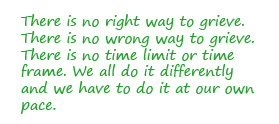
I think each family has to approach the day however makes sense to them. There is certainly no “right” way or “easy” way to do it.

no right way to grieve

I am sorry you have to do it at all.

Here’s the truth:  even THAT day will only last 24 hours. Just like the awful day when your child left you.

However you manage to survive is fine. 

mother and child painting

You are not abandoning your missing child if you don’t make a big public display.  You are not forgetting him or her if you let go of some of these grief anniversaries over time-you are learning to carry the load.  You are not a bad parent if you choose a getaway to distract your heart from the pain.

You are coping the best you can-choosing to carry on.  

And that makes you awesome and brave.  

courage is always an act of love

Navigating Grief: Why Does Coffee Make Me Cry?

Oh, the early days, weeks and even years of grief!

I was a giant walking nerve.

Every sight, sound, smell or even touch that reminded me of Dominic evoked a wave of sorrow that almost always ended in tears.

I cried in the grocery store, walking past Bath and Body Works in the mall, driving down the road when certain songs came on the radio, tidying up drawers and finding a long lost and forgotten something that Dominic tucked away for later.

Sometimes I just wanted to scream, “Don’t you know my son’s not here??!!”

But of course I couldn’t do that and walk around in society.

So the triggers were an outlet for that pent up energy, angst and sadness.

It was awful.

Especially when what I set out to do was something I really needed to do. I’d leave the house with a list of places to go, things to buy and people to see but often return having done only a fraction of it.

I’m better at it now.

I’ve grown stronger and am more skilled at carrying the burden of the disconnect between my heart and other hearts who haven’t experienced deep pain and loss.

I’ve learned how to fix my eyes on some distant point if cornered by a well-meaning friend asking how I am but not really wanting to hear about how Dominic’s death continues to impact our family.

I press my fingers together hard in an attempt to stop the sorrow rising up and threatening to undo me until I can escape to the bathroom, a quiet corner or my car.

And I’ve learned not to be ashamed of the tears that fill my eyes and slip down my cheek despite all my best efforts no matter where I am.

Navigating Grief: Hardly the Time for Being Taught


It seems to be the nature of humans to listen with an ear to respond rather than an ear to hear.

I’ve done it myself.

Jumped right in with all kinds of suggestions designed to “fix” someone else’s problem.

Or worse, heaped my own experience with something more or less (often less) similar onto an already overburdened heart.

I hate that tendency in myself and I’m working hard to try to change it.

Image result for listen to respond listen to understand

Those who feel compelled to just say SOMETHING often bombard grievers with platitudes, comparisons to their own grief or just empty, frivolous words that require we either stand there dumbfounded or find a gracious way to exit the conversation.

It’s especially painful for a broken heart when a well-meaning someone decides THIS is the moment for a theology lesson.

“God has something planned for you in this” or “God will use this for good”. (Romans 8:28-29)

“We don’t grieve as those without hope!” ( I Thessalonians 4:13)

“All our days are numbered.” (Psalm 139:16)

I get it-death is a heavy subject and the death of a child isn’t something anyone wants to talk about, contemplate or be forced to wrestle with. So it’s often easier to simply say something-anything-do your duty and walk away.

But it is hardly helpful.

Deep grief as a result of unbearable loss is not a teaching moment.

It’s an opportunity to listen well, think carefully about if or when you need to say anything and simply offer compassionate companionship to a broken heart.

Grieving felt hardly like the time for being taught, at least initially. Early grief was my time for pulling out of my past those truths that I had already learned — out of my ‘basement — so that I could begin to assemble them together into something even more meaningful to me than before. It was the time for understanding that even though I had always believed in heaven, it now looked to my perceptions to be more real than this world. It was the time when, even though I already believed in God’s control of the world, I now felt dependent upon him being sovereign over it for all my hopes. It was the time for realizing that even though I already believed that Christ conquered death, I now longed to see death die.

Lianna Davis, Made for a Different Land

Navigating Grief: Time, By Itself, Does NOT Heal All Wounds

Time, by itself, does not heal all wounds.  

But of all the factors that promote healing, there is NO SUBSTITUTE for time–not in the physical world of surgery and broken bones and deep wounds and not in the inner world of  emotional pain and brokenness and sorrow.

Our bodies are made to be amazingly resilient.  

Most people don’t really think of surgery as an assault on the body, but it is.

The surgeon knifes through layers of flesh and tissue that are designed to keep intruders out, mucks about inside, does what he or she came to do, and closes up–hopefully without introducing bacteria into the wound. Some medication may be prescribed to promote healing, control pain and reduce the risk of infection.

Then the patient goes home to recover.

But it is really TIME and the body’s own healing powers that do the lion’s share of the work.

Our hearts and minds can be resilient too.

Frequently, someone who suffers an assault on their emotions may not bear outward signs and symbols to mark what they’ve  been through.  And well-meaning friends and family can forget that healing has only begun and is far from complete.

Sometimes broken people feel pressured to put on a brave face and to stuff their feelings.

For the body, ignoring doctor’s orders to rest after surgery can mean another hospital stay due to complications that might have been avoided if the patient had been given sufficient time to recover.

Emotionally wounded people can end up with complications from pressure to rejoin regular activities and engage society in ways for which they are not yet ready.

It takes TIME to heal from burying a child or any other traumatic loss.

There is no way to rush the healing.  It takes HOURS AND HOURS to think about, respond to and process the feelings that overwhelm anyone who is grieving or trying to cope with emotional upheaval of any kind.

ok to just breathe

So be patient with yourself.

  • Understand that there will be good days and bad days.
  • There will be forward movement and steps backward.
  • Sometimes it will be easy to do something or go somewhere and the next time it might be really hard.

And don’t be afraid to let others know you are still healing.

Deep emotional wounds require great care and an extended period of time to heal if the healing is to be sound and free from unnecessary complications.

You are not selfish to draw boundaries around what you can and can’t do, what you will and won’t allow and where and when you engage with others-you are being wise.  

For those walking with the wounded:  extend grace and be patient.

Thank God you are not bearing this burden and be mindful of placing demands or pressure on the wounded to heal according to a predetermined timetable.

Then support them in their effort to give themselves the TIME they need to heal.

smiling through tears

Navigating Grief: To Deny the Presence of Pain is to Diminish the Power of the Cross

To deny the presence of pain is to diminish the power of the cross.  

Dying, Jesus honored His mother’s courage by acknowledging her pain. She was losing the Son she loved and it hurt in a way that only mothers can comprehend.  He didn’t tell her that it would “be alright” or that “the ending is ultimately victorious”.

Instead, He looked upon her trembling figure and saw her broken heart.

He made what practical provision He could by telling John to care for her. He knew it would not undo her sorrow.

Some in the church preach that pain and suffering are anomalies–that they are aberrations in the “victorious Christian life”.

And we place great emphasis on the idea that even though we may have trouble in this life–“We know the REST of the story!”  Jesus WINS!

Yes. He. does.

But some of our earthly stories-the ones we are living right now- do not have tidy, happy endings:

Some are burned in the fire.

Some die of cancer.

Some fall headlong into mental illness.

And some bury their children.

What to do when you are confronted by undeniable pain in your own or someone else’s life?

Acknowledge it.

Look with mercy on the broken heart.

Allow suffering to flow from the cracks unchecked and unjudged.

Be still and be love.

Offer practical aid without strings attached.  Be mindful of what is actually helpful even if it doesn’t make sense to you.  Come alongside for the long haul.

There is no greater gift to the one who is suffering than a faithful friend who refuses to be frightened away.

Loving burden-bearers help those of us living with no-happy-ending earthly stories cling more securely to the hope of ultimate victory in Christ.  

And by doing so, declare the power of the cross.  

For the message of the cross is foolishness [absurd and illogical] to those who are perishing and spiritually dead [because they reject it], but to us who are being saved [by God’s grace] it is [the manifestation of] the power of God.

I Corinthians 1:18 AMP

Navigating Grief: What is a Grief Circle?

Our family is navigating deep grief a second time.

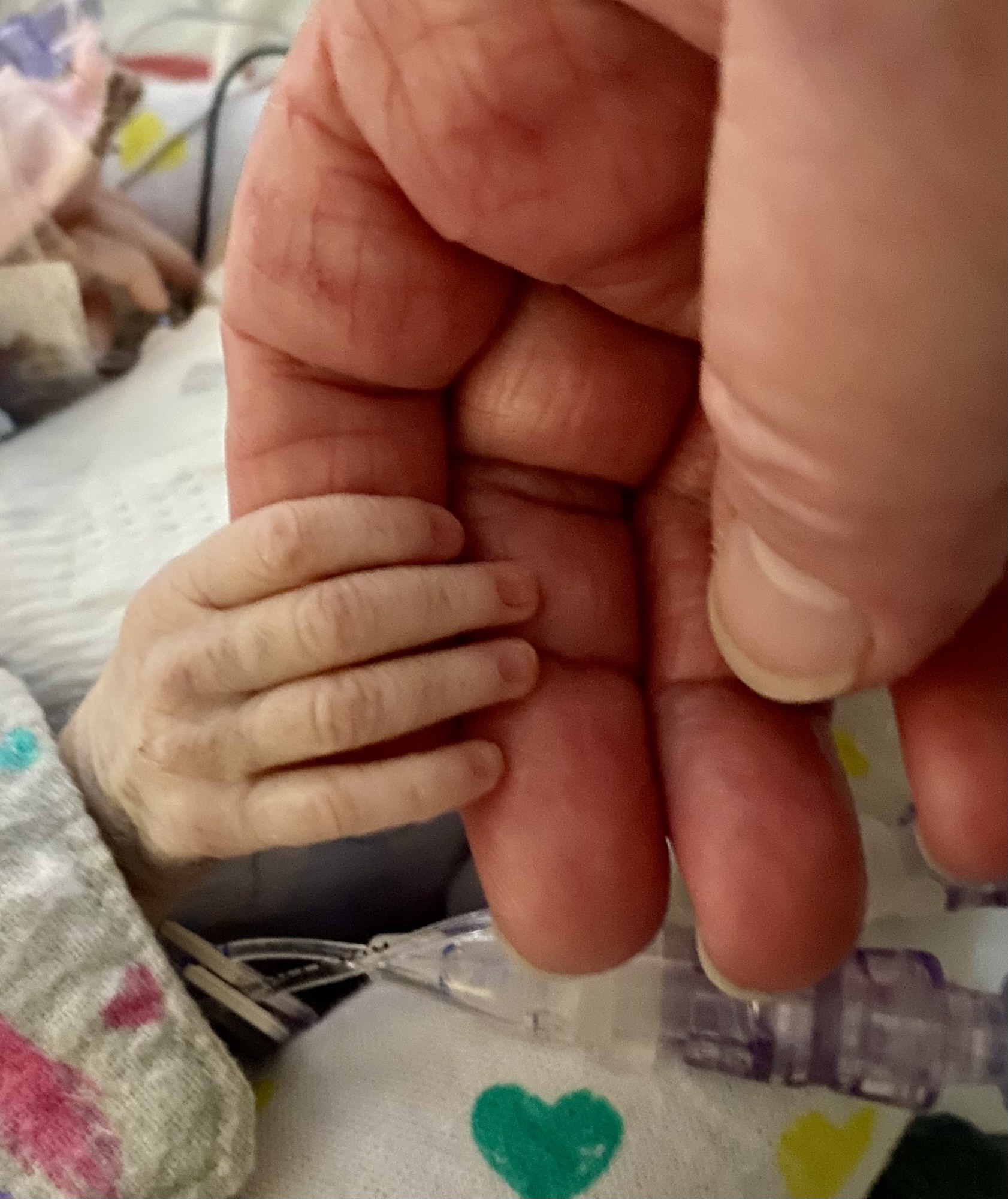
In January, my granddaughter, Holly, was gathered into the arms of Jesus after only two weeks on earth-almost to the minute.

Once again my children are plunged beneath the flood of hurt, pain, questions and sadness of child loss.

This time my oldest son and his wife are the center of the circle. Their sons are the immediate next ring. My two other earthbound children, my husband and I are slightly more removed.

But distance from the center does not necessarily indicate the degree to which the same loss might reignite old feelings, trauma, anxiety and unwanted physical, mental and spiritual responses to grief.

A grief circle is comprised of those most closely impacted by a loss.

The world likes to draw it tight because even if it doesn’t represent the reality of those involved. Expanding the circle expands the need for compassion and compassion might well demand action.

Drawing it smaller also gives the curious permission to ask personal questions from those close to the loss (and who may have information they desire) without feeling guilty about asking the question.

May I give a piece of (unsolicited) advice?

Please. Don’t.

Please don’t ask my children how I’m doing.

Please don’t ask my son and daughter, the uncle and aunt of Holly, how their brother is doing or how I am doing.

Please don’t ask my son how his wife is doing. He is also a parent of a child he can no longer hold.

Please don’t assume that being slightly removed from the center of loss means being removed from the pain and damage such a loss entails.

You are welcome to ask me anything. Both my experience and age mean I’m better equipped to answer or not answer as I am able.

I have found that Holly’s brief life and death have impacted me in ways I don’t understand and am still trying to process. She is my grandchild. I don’t love her less because her life on earth was brief.

Since I’ve walked this broken road, I am oh, so aware of what lies ahead for both my son and daughter-in-law as parents, their sons as surviving siblings and my own children as doubly grieved siblings.

I remember thinking when we gathered in the AirBnB the night after the long, long day Holly took her last breath how heavy, powerless and hopeless I felt.

No words could undo what had happened.

No hug could press the pieces of broken hearts back together.

No amount of wishing, wishing, wishing would turn back a clock that had relentlessly brought us forward to this very moment.

My family is knit together in ways and with bonds no one would choose.

We keep our phones with us “just in case”. We share travel itineraries, traveling companions’ contact information, and we answer phone calls from one another no matter where we are or with whom.

The grief circle is larger than most folks would like to admit and it remains intact over time and across distance.

There is no “fix” for grief.

No “getting over” or “past” loss.

There is moving forward and I am so, so proud of my family for choosing that hard path.

But here we are again.

And it is going to take more time than anyone outside our circle would like to admit.

Celebrating Love Beyond Valentine’s Day

My youngest son was born on Valentine’s Day.  

It wasn’t planned that way but escalating blood pressure meant that, ready or not, here he came!  

It’s been a lot of fun to have this day so often focused on romantic love (which, let’s be real rarely lives up to the hype!) focused instead on him and family love.  

My habit the past few years has been to expand that focus even further and explore the edges of God’s love, my love for others and what love in action looks like.

Too often I SAY I love someone but refuse to DO the loving thing.

Truth is, love is hard.  It’s costly.  It can be uncomfortable. 

It almost always involves sacrifice.  

love in action

And if I’m not careful, I can let valentines and candy and flowers be a paltry stand in for the real thing. 

February is not the only month in the year that tempts me to give a token and walk away instead of giving myself and sticking around to help in meaningful ways.  

So I try to keep Jesus’ words before my eyes: 

For the greatest love of all is a love that sacrifices all. And this great love is demonstrated when a person sacrifices his life for his friends.

~John 15:13 TPT

I try to focus on love in action instead of only love in words

Am I the Good Samaritan or am I one of those who toss a prayer from across the way and walk on, comfortable in my piety and clean clothes?  

Good-Samaritan-cropped

I want to be the Good Samaritan.  

Truly I do.  

Navigating Grief: Torches in the Dark

There are so many life circumstances that plunge a heart into darkness.  

Child loss is certainly one of them, although not the only one.  

And when you’re in the dark, stumbling around, trying to avoid the sharp corners and looking, looking, looking for a tiny sliver of light to guide you out, it is terrifying.  

If you don’t have a pocket full of matches or a flashlight or a lantern, you are at the mercy of whoever cares enough to come back for you.

I am so thankful for the friends and family who never tire of my fearful cries when I find myself in dark places.  

They come running.  

They don’t leave me there.  

Sometimes all they have is a tiny candle themselves, a sliver of hope they are clinging to.  But they raise it high , share its glow with me and together we take a step forward toward the brighter light of day.

I will never, ever forget the ones who come to me with a torch.

They help my heart when I can’t help myself.  

They refuse to leave me in the dark.  

you never forget a person who came to you with a torch in the dark

Navigating Grief: Helpful Tips for Interacting With Bereaved Families

I firmly believe that our friends and extended family want to reach out, want to help, want to walk alongside as we grieve the death of our child.

 I am also convinced that many of them don’t because they don’t know how.  

It may seem unfair that in addition to experiencing our loss, we also have to educate others on how to help us as we experience it, but that’s just how it is.

The alternative is to feel frustrated and abandoned or worse.  

So here’s a list of helpful tips (and a great infographic!) for interacting with bereaved families:  

Express condolences and show you care. Don’t avoid me, please!  You cannot make me any sadder.  I need to hear from you.

friends hugging

Refer to my child by name.  Dominic is STILL my son.  He is still part of my story.  But because he’s no longer visible, his name often goes unspoken.  Please talk to me about him, use his name, tell me a story of how he impacted your life or a memory that makes you smile.  It makes me smile too.

Actively listen and be supportive.  It’s hard to listen to someone tell you how much they are hurting and not offer advice or think of ways to “fix” them.  I can tell you from experience that what I need most on my darkest days is for someone to say, “It IS dark.  I’m so sorry.”  Silence is OK too.  Not every quiet moment needs to be filled with chatter.

listening is a postive act

Understand that each family and family member will grieve in different ways.  You may have observed child loss before but what you saw in one family may not translate to the next.  There are no hard and fast rules for this awful journey.  The age of the child, family background and structure, manner of death-all these impact grief.  In addition, mothers and fathers, sisters and brothers all bring their personalities, stage of life, beliefs and experiences to the journey.  There were five of us left behind when Dominic ran ahead.  We were each devastated but expressed it in very different ways.  Nearly five years later, those gaps have widened, not narrowed.

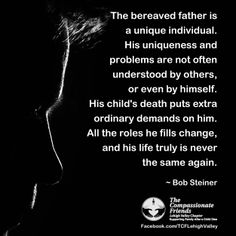
Fathers grieve too.  Sometimes support focuses almost exclusively on the mother.  In part because of a common notion that mothers are somehow emotionally closer to their children than dads.  In part because many men are less demonstrative and may do a good job hiding grief.  Whatever the reason, don’t assume one parent is dealing “better” with the loss than another (mother or father) just because he (or she) is not crying openly.  No one escapes this awful blow unscathed.

bereaved fathers

Don’t overlook siblings.  Surviving siblings are sometimes referred to as “forgotten grievers”.  If they are very young, people may think they are relatively unaffected by the death of a brother or sister. If they are grown and out of the home, people may figure that the siblings’ own, very full and very busy, lives keep them preoccupied.  While some of that may be true-to an extent-most surviving siblings are deeply impacted by the death of a brother or sister, regardless of age.  Not only have they lost a member of the family and changed birth order, they have also lost the family they knew, the parents they knew and a co-keeper of memories and secrets.  Bereaved parents are often overwhelmed with grief for their living children as well as the child that is missing. One of the best gifts anyone gave me was reaching out to my surviving children.  It helped my heart to know that they had friends who were supporting and loving them well.

kids cartoon

Be yourself.  People often feel awkward and stiff when approaching a bereaved parent or family member.  That’s perfectly understandable.  The bereaved seem so fragile (are so fragile!) that folks are afraid the wrong word or touch might shatter them into a thousand pieces.  But what your friend or family needs right now is the you they’ve always known and loved.  If you are a hugger, hug!  If you are a storyteller, tell stories (appropriate ones, ones of the missing child).  If you are a cook and cleaner, then cook and clean.  Our family was blessed by our friends doing exactly what they had always done-come alongside in their own special way.  So much had changed in our world that familiar touchstones, familiar routines and familiar faces were a real comfort.

Keep in mind words matter.  Now is not the time to try to satisfy your curiosity about exactly “what happened”.  Loud joking is rarely welcome.  Many bereaved families find it hard to laugh in the first days, weeks, months because it feels like betrayal.  Don’t offer platitudes intended to help them “look on the bright side” or consider that “it could be worse”.  There is nothing worse than burying your child.  Nothing.  Listen and take direction from the person you are comforting.  Follow his or her lead.  And if something less than helpful slips out, own it and apologize.

pencil-drawing-bereaved-mother

It’s never too late to reach out.  NEVER.  Sometimes people stay away at first for lots of reasons.  Or they show up for the memorial service and then fade into the background.  After a bit, even if they want to reach out, they may feel embarrassed by the long absence.  Don’t be.  So many people stop calling, visiting and texting within the first weeks that your outstretched hand of friendship will be a welcome beacon of hope.  If you need to, apologize for your absence.  Be honest.  Admit you were scared or whatever.

Then show up. 

Stick around.

You don’t have to be perfect.  

Just be present.  

bereaved families infographic

Navigating Grief: 31 Practical Ways to Love Grieving Parents

When Dominic died, I didn’t get a manual on what to do.  I didn’t get an orientation into how to be a grieving parent.  So when some people asked how they could help me and my family, I really didn’t know.

A comment repeated often by bereaved parents is, “Please don’t use the phrase, ‘let me know if there is anything I can do’, people mean well, but this is unhelpful.”

Another mom put it this way, ” There are too many meanings to this phrase.  It can mean anywhere from, ‘I really want to help’ to ‘I don’t know what to say so I’ll say this but I don’t really want you to ask’.  Also it’s so hard to make any decisions–trying to figure out what you might want or be able to do is overwhelming.  Instead, offer specific things you can do and make plans to do them.”

For those that want to help, here ia a list of 31 ways you can provide practical and timely help to grieving parents:

Show up and answer phones, open the door to visitors, find room for food they bring.  Act as a buffer zone for the parents.

Consider donating PTO, sick leave or vacation days to a bereaved parent if your employer allows it. Many employers allow three (3) days leave for a death in the family with no special consideration for the death of a child.  Three days is not long enough and many parents can’t afford to stay home without pay.

Donate sky miles, rental car points, hotel points or other loyalty points to the parents or family members that need to travel.  There are many expenses associated with burial and the family may not have extra money for travel.

Pick up family members from the airport that are coming for services.

Offer to accompany the parents to the funeral home as they make arrangements.

Donate a burial plot.  Few people have one picked out for their child.

With the family’s permission, set up an account to take donations to help with burial expenses or the medical bills that will be arriving soon.

Offer an extra bedroom to out-of-town family members or friends.  Not every home can accomodate extra guests and the parents need some space of their own.

Bring folding tables and chairs to the home–they are easy to set up and take down as needed to accomodate extra people in the house.

Respect a grieving parent’s need for some private time and space.  If we retreat to a back room, let us.  Check on us quietly and gently, but don’t follow us around asking, “Are you OK?”  No, we are not.  And being asked over and over is stressful.

It is always helpful to bring food.  Set up a meal schedule on Takethemameal.com. There is a way to note any special dietary restrictions.  When people sign up, they can see what others are bringing/have brought.  Driving directions are available on the site and the family can ask that meals be brought at a standard time so there is someone home to receive them.

Bring ice in an ice chest for drinks.

If a parent has a chronic health condition like diabetes or heart problems, check in with them regularly to see if they are taking their medication and if they are experiencing new symptoms.

Offer to drive grieving parents where they need to go.  Deep grief can impair driving as much as or more than alcohol or drugs.  Be willing to sit in the lobby or parking lot–we may not want company finalizing arrangements or speaking with our pastor.

Clean the house. And don’t allow your intimate glimpse to become a source of gossip.

Don’t turn on the television or radio unless the family asks you to or does it themselves. If you want to know the score, check your phone or go to your car.

Mow the yard, tidy flower beds, sweep, rake leaves.

Bring toilet paper, paper towels, paper plates and napkins.

If one or both of the bereaved parents are caregivers to an elderly relative, offer to take over that responsibility for awhile.  (Only if you are willing and competent to do so.)

Take surviving younger children for a walk in the park, to get ice cream or a hamburger. Not all children will be comfortable leaving their parents.  Even if they don’t understand what is going on, they may feel insecure and upset.

Sit with and minister to surviving older children.  We are concerned about our surviving children as well as the child we lost.  Knowing someone is loving on our kids is a great comfort.

Clean the family’s car before the funeral.

Make sure there are bottles of water and maybe a snack in the car for afterwards–often family members can’t eat and forget to drink before the day of the funeral.

Begin assembling electronic photos from friends for a slideshow at the funeral, if the family requests one.  Make sure you run choices by the parents before you flash them on a screen.

Make a list of appropriate songs that might help the family choose.  Don’t be hurt or offended if we use other songs instead–your list may very well have nudged our memory and been helpful.

Offer to drive the family to the funeral and burial.

Attend the funeral.  We want to know our child mattered.  We need to know you care.

If your church provides a meal for the family after burial, and you are asked to bring a dish, bring one.

Offer to help pack up a child’s dorm room or apartment.  We may welcome the help or we may want to do it alone–it has nothing to do with you.

Many grieving mamas want something that smells like their child.  If you are helping to clean in the first hours or days, don’t wash all the child’s clothing.  Put a few worn items in a ziploc bag for her to have later.

Don’t abandon the family after service.  There is such a sense of finality when the coffin is lowered or the memorial over.  Usually lots of people are around and then we go back to the house and quiet overwhelms us.  If you are close to the family, consider joining them for a little while when they first get home.

Dear friends, do you think you’ll get anywhere in this if you learn all the right words but never do anything? Does merely talking about faith indicate that a person really has it? For instance, you come upon an old friend dressed in rags and half-starved and say, “Good morning, friend! Be clothed in Christ! Be filled with the Holy Spirit!” and walk off without providing so much as a coat or a cup of soup—where does that get you? Isn’t it obvious that God-talk without God-acts is outrageous nonsense?

James 2:16-17 MSG

Are you a bereaved parent?  Have you walked this path with a friend or family member? Please add your suggestions to these in the comments section.