Grief Work 2026: How Grief Affects Your Body

Grief is not *just* feelings. It is so much more.

Often there are random or unusual physical symptoms that show up days, weeks or even years after a child has gone to Heaven.

An important and necessary part of grief work is learning to recognize the physical manifestations of grief and advocating for care from professionals who may not be able to make the connection unless the bereaved speak up and speak out.

❤ Melanie

It’s a well known fact that stress plays a role in many health conditions.  

And I think most of us would agree that child loss is one of (if not THE) most stressful events a heart might endure.  

So it’s unsurprising that bereaved parents find themselves battling a variety of physical problems in the wake of burying a child.  

grief head in hands and stress words

What may be surprising is how uninformed medical and even psychological professionals are with respect to the very real ways child loss intersects with chronic conditions and often creates new symptoms.  

Here is a list of only SOME of the physical manifestations of grief (via What’s Your Grief?) with my own comments :  

Fatigue.  If you’ve always been an energetic sort, you might find this aspect of grief particularly disconcerting.  This kind of fatigue doesn’t get better with rest.  I’ve written about that here. 

Some days I can barely make myself get out of bed and when I do, I struggle to do any but the most necessary tasks.  Don’t automatically dismiss this symptom as ONLY grief (although it most certainly could be!) get a thorough check-up to rule out other causes such as low thyroid, diabetes, heart disease, major depressive disorder or a number of conditions that can be treated effectively with medicine.  Don’t beat yourself up if the doctor decides “nothing is wrong” with you.  You are grieving and grief is work!  I know this symptom has improved for me over time as I’ve established boundaries, admitted limitations and learned to rest when necessary.

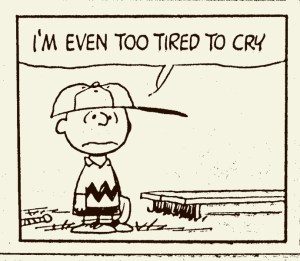
charlie brown too tired to cry

Aches and Pains.  Our bodies and minds are connected in ways not well understood.  Mental and emotional distress can make any underlying pain condition that much worse.  When I’m feeling especially lonely, desperate or sad my autoimmune disease flares AND my perception of the very real pain that causes is heightened.  Pain and heartache can lead to a downward spiral that is hard to undo.  Get help and treatment for the physical and give yourself grace and space to endure the emotional causes of body aches.  Don’t self-medicate with drugs, alcohol or other self-destructive coping strategies.  Reach out to a safe person and let them help you find a better way.

painlevels

Headaches.  Needless to say, stress makes tension headaches more likely.  Sometimes, though, a headache can be a symptom of something more serious.  Don’t dismiss an especially sudden, intense or long-lasting headache as “just grief”.  It could be previously undiagnosed high blood pressure, stroke or migraine.  Those being ruled out, various relaxation techniques, cold or warm compresses, over-the-counter analgesics and gentle stretches might help.

Sometimes grief headaches can be alleviated by the simple act of telling our stories.  Bottling up emotions and thoughts adds to the ongoing stress and tension of my child loss burden.  When I spill them-either on paper in a journal, in a closed online bereaved parents’ group or in person to a safe friend or family member-often I feel the band around my head relax and the pain fade away.

Tightness in Chest, Shortness of Breath.  The day I got the awful news, I remember asking friends who came to sit with me over and over, ” Am I still breathing?”  My world was spinning out of control and my body responded.  Anxiety after child loss is real. Broken Heart Syndrome is real.  Heart attacks are not uncommon.  Don’t ignore these symptoms.  But don’t be surprised if they persist despite all tests to the contrary.  When I feel trapped and overwhelmed, a walk outside or even to another room can help.  Deep breathing exercises and grounding exercises can often interrupt an episode.

Broken_Heart_syndrome_EN-01

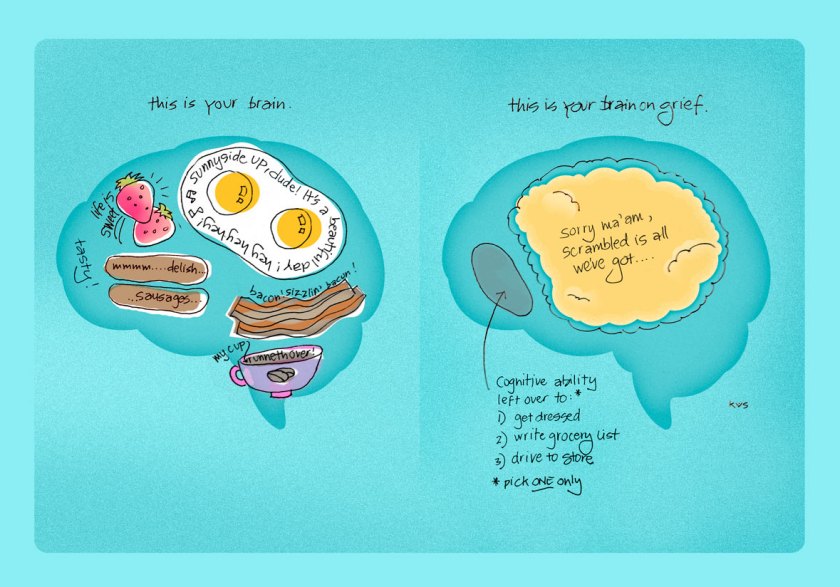
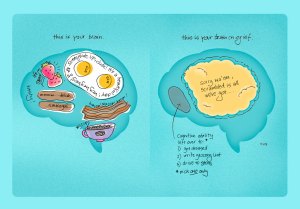
Forgetfulness.  I wrote this post on Grief Brain: It’s a Real Thing! a couple years ago and am always surprised to see it shared repeatedly.  But I think it strikes a chord with any heart walking through grief.  You are not crazy!  You are not experiencing early onset dementia (most likely).  Like other symptoms, get checked out if they persist or worsen.  But odds are, your experience falls within the range of normal for anyone whose life has been shattered by child loss.  Losing things, forgetting things, getting lost in familiar places, missing appointments or bill payments, inability to remember names of people you know well-all of these are common after loss.  In time, the symptoms usually diminish.  They have for me.  I still have to rely on lists and reminders much more often, though.  And that’s OK.

griefbrain1

Inability to Focus.  Like grief brain, this is another cognitive manifestation that’s not only annoying, it can impact life in significant ways.  Before Dominic ran ahead to Heaven, I was an avid reader.  I often had three or four books going at the same time.  I could spend hours focused on a single project.  Not anymore.  I sometimes find it difficult to read a recipe.

I have to take frequent breaks when working on something because my mind gets fuzzy and I just can’t pay attention for more than a few minutes at a time.  Some bereaved parents have to change jobs or careers because they are not able to perform necessary tasks anymore.  This particular symptom has not improved very much for me although I’ve found ways around it.  I use lists to keep an external record of what I should be doing and when.  I mix up mindless chores with ones that require more attention to give my brain a break.  I try to dissect larger jobs into smaller, manageable chunks.  And sometimes I just have to admit that today a particular thing just isn’t happening. 

Appetite or Digestive Issues.  Stress has long been linked to gut problems.  I suspect we’ve all had that “rumbling in our tummy” from time to time even before child loss.  For many of us it’s exponentially worse after.  Some bereaved parents try to stuff emotions by stuffing themselves with food.  Others can’t eat at all.  Still others experience stomach ulcers or bowel disease ranging from acute to chronic.  I was hospitalized twice in the first year after my son’s death for serious colon issues.

Again, don’t ignore sudden or persistent symptoms.  Try to eat well and avoid self-medicating with food.  Added pounds rarely add up to better emotional or mental health.  I let pounds I’d lost ten years ago find me again.  Get help if you need to from someone willing to act as an accountability partner.  I’ve recently joined a friend in setting goals for ourselves and sharing recipes and meal prep.  Try to treat food as another aspect of grief work and manage it the best you can.

the struggle bus

Getting Sick More Often.  Stress lowers the immune system.  That’s a fact.  So when bereaved parents encounter germs (as we all do from time to time) it may well be our bodies don’t have the energy or resources to combat them.  Colds, flu, strep throat, skin infections may all be more likely this side of child loss.  Don’t be discouraged to seek treatment.  There is so much we can’t control in life, but getting antibiotics for an infection is pretty easy.

It’s not in your head, mom or dad! 

Grief has real physical manifestations.   

Don’t be dismissed or denied the care you need. 

Educate your healthcare providers and insist on being heard. 

the weight of grief without words

*photo credit:  The Weight of Grief  Scupture ~ Celeste Roberge*

Grief Work 2026: What Exactly IS Grief Work?

A few years ago I was encouraged to assemble some of my posts into a series I titled “Grief Work”.

They definitely do NOT cover everything I would want to share with a bereaved parent but they are a place to start if you are early on this journey and you can explore any topic further by using the search bar any time you’d like.

I’m sharing again for those who may need them now or may want to pass these on to someone else who needs them.

❤ Melanie

I have used the term for years and only recently has someone asked me to define it.

I guess I never realized that in all the writing about it, I’d never really explained what it meant.

So here goes.

The term was coined by psychiatrist Erich Lindemann in the 1940s. He worked with survivors of the Cocoanut Grove tragedy and observed that grievers experienced common symptoms, feelings and faced similar challenges. Through his work, he developed a theory of grief incorporating his observations and his technique for walking grievers through these common issues.

Image result for six stages of grief erich lindeman

Today the term has been expanded and is used widely to describe almost any approach to grief that includes specific techniques for helping someone walk the path of loss.

I use “grief work” to mean all the ways I (and others) must actively seek to identify, face, process, and ultimately incorporate the feelings, trauma and changes loss force upon us.

Grief work (in no particular order) can include but is not limited to:

  • Attending sessions with a professional, spiritual or lay counselor. Some people find it helpful to have a safe person outside the immediate grief circle to discuss feelings, concerns and relationship challenges that are generated by loss or exacerbated by loss. It’s best to find a counselor who specializes in grief, preferably child loss and/or traumatic loss (all child loss can be classed as traumatic loss). Other counselors may be too quick to label a bereaved parent’s grief as “abnormal” or “too lengthy” or “complicated” when it is, in fact, closely following observed timelines for dealing with child loss. If the first counselor you find isn’t a fit, try another. It’s OK to insist that you are heard, your feelings respected and your loss recognized for the life-shattering event that it is.
  • Finding, joining and participating in online or in person support groups. There are literally dozens of online support groups for bereaved parents. Some are designed to meet the needs surrounding specific types of loss such as sudden death, suicide, drug overdoses or loss to cancer or another disease or condition. Some are organized around certain faiths. Others may be rooted in geographic proximity and the online group might have a monthly or quarterly face-to-face meeting in the area. While it can sometimes be overwhelming to see the number of parents in such a group, it’s also extremely helpful to have a safe space to share things only another bereaved parent can understand.
  • Setting aside quiet time to think, process and possibly journal feelings. So much grief work must be done alone. Counselors can equip me with tools, support groups can give me real-life examples and encouragement but only I can do the nitty-gritty labor of teasing apart all the feelings and change grief brings with it. Journaling has been very helpful for me in putting words to what can sometimes be rather nebulous thoughts swirling around in my head. When I name what I’m feeling or experiencing, I can better construct a strategy for processing and living with it.
  • Walking back through memories, noting regrets, forgiving yourself and making peace with the past. We ALL have things we would have done differently. Death, being final, forces a heart to face that there is no chance to atone for past behavior. Words unsaid, things undone, opportunities missed are carved in the stone of yesterday. I spent many nights recounting my shortcomings as a mother, berating myself for what I didn’t do. Eventually I was able to rest on the simple fact that one thing I DID do was make sure Dominic knew he was loved.
  • Setting boundaries to give yourself and your family space and time to do grief work as well as to conserve emotional, relational and physical energy that’s in limited supply after child loss. So many of us live with few or no boundaries-responding to every request with a “yes”, adding things to the calendar without a thought to how exhausted we might be at the end of a day or week. Some of us are overtaxed at work or school. Some of us are hyper-involved in our churches, civic organizations or local politics. There are dozens of ways to be extended and just as many ways to live with that constant drain. Child loss forced me to recognize that I could no longer BE that person. I couldn’t afford the time, energy, mental space and emotional burden of saying “yes” anymore. I learned that “NO” is a complete sentence and began using it.
  • Practical considerations regarding your child’s belongings and other personal property. Many people might not consider this part of grief but it is. So many details to take care of, so many times I had to repeat the words, “My son was killed in an accident. I need to close this account.” So many copies of his death certificate mailed out to different agencies or companies, documenting the awful reality that he was never coming home again. Then there are questions of what to keep, what to store, what to give away. Should a room remain untouched if your child still lived at home? We had to clean out Dominic’s apartment only a few days after his funeral. It felt like I was boxing up everything beautiful about my boy.
  • Learning how to do holidays, birthdays, family gatherings, vacations and other gatherings. The empty chair looms larger when all the others are filled. If you have been the primary organizer of such events, it might surprise you to find the rest of the family still expecting you to be that person. Even if you aren’t the host for holidays, you will need to communicate to others if or how you feel comfortable participating.
  • Maintaining or regaining health after loss. Stress is one of the greatest contributors to so many health issues. Child loss is an unbelievably stressful experience. So it’s no wonder that many parents find themselves post loss with new or aggravated health problems. I had an appointment with my rheumatologist just one month after Dominic ran ahead to Heaven. It was critical that I tell her of my loss because in addition to whatever medical interventions she was prepared to prescribe, she needed to know I would be experiencing an extended period of intense stress that might necessitate closer observation and follow-up. As difficult as it may be to talk about, it’s important to inform your healthcare providers of your loss and to be absolutely honest about changes you’ve noticed in your body as a result.

There are probably a dozen or more subcategories of grief work I could list and some of you might think of ones I wouldn’t.

Grief IS work.

It is important, necessary and exhausting WORK.

It requires time, resources, effort and energy and cannot be hurried along.

But it is the only way a heart can begin to put the pieces back together.

❤

Navigating Grief: Time, By Itself, Does NOT Heal All Wounds

Time, by itself, does not heal all wounds.  

But of all the factors that promote healing, there is NO SUBSTITUTE for time–not in the physical world of surgery and broken bones and deep wounds and not in the inner world of  emotional pain and brokenness and sorrow.

Our bodies are made to be amazingly resilient.  

Most people don’t really think of surgery as an assault on the body, but it is.

The surgeon knifes through layers of flesh and tissue that are designed to keep intruders out, mucks about inside, does what he or she came to do, and closes up–hopefully without introducing bacteria into the wound. Some medication may be prescribed to promote healing, control pain and reduce the risk of infection.

Then the patient goes home to recover.

But it is really TIME and the body’s own healing powers that do the lion’s share of the work.

Our hearts and minds can be resilient too.

Frequently, someone who suffers an assault on their emotions may not bear outward signs and symbols to mark what they’ve  been through.  And well-meaning friends and family can forget that healing has only begun and is far from complete.

Sometimes broken people feel pressured to put on a brave face and to stuff their feelings.

For the body, ignoring doctor’s orders to rest after surgery can mean another hospital stay due to complications that might have been avoided if the patient had been given sufficient time to recover.

Emotionally wounded people can end up with complications from pressure to rejoin regular activities and engage society in ways for which they are not yet ready.

It takes TIME to heal from burying a child or any other traumatic loss.

There is no way to rush the healing.  It takes HOURS AND HOURS to think about, respond to and process the feelings that overwhelm anyone who is grieving or trying to cope with emotional upheaval of any kind.

ok to just breathe

So be patient with yourself.

  • Understand that there will be good days and bad days.
  • There will be forward movement and steps backward.
  • Sometimes it will be easy to do something or go somewhere and the next time it might be really hard.

And don’t be afraid to let others know you are still healing.

Deep emotional wounds require great care and an extended period of time to heal if the healing is to be sound and free from unnecessary complications.

You are not selfish to draw boundaries around what you can and can’t do, what you will and won’t allow and where and when you engage with others-you are being wise.  

For those walking with the wounded:  extend grace and be patient.

Thank God you are not bearing this burden and be mindful of placing demands or pressure on the wounded to heal according to a predetermined timetable.

Then support them in their effort to give themselves the TIME they need to heal.

smiling through tears

When It’s Anything BUT a Happy New Year

I don’t know how you have responded to the chipper “Happy New Year” messages flooding your social media and inboxes but they generally land painfully on my fragile heart even after all these years.

It didn’t take long for me to realize after Dominic ran ahead to Heaven that so much of what we say in casual conversation is not helpful to those going through a hard time.

Even asking, “How are you?, “if you aren’t prepared for an honest answer, is an affront to an aching soul begging for someone, anyone to help bear the load.

New Year’s Eve I exchanged texts with someone who is well aware of all our family is going through only to have her send back: “Happy New Year! I hope your year is full of blessings!”.

At first I wanted to throw up. But then I literally laughed out loud in the darkness of my son’s truck because she has. no. clue.

Right after Dom left us, I was a walking nerve. Everything that anyone said or did that hit me as less than compassionate felt like a punch in the gut. It was physically painful. I didn’t want to be around anyone for very long except those in my immediate grief circle.

But over time, by the grace of God and by doing the work grief requires, I grew stronger and better able to carry this load. It wasn’t any lighter. I didn’t miss my son any less or “move on from” or “get over” his death.

I was able to gain perspective, though.

I could accept that before it was ME, I was just as ignorant as those who were saying and doing what they thought was the right thing (or maybe just the easiest thing) yet were causing pain instead of bringing hope and light.

If you are early on this journey, you may have to set strong boundaries to protect your broken heart. That’s not only OK, it’s good. Don’t expose yourself any more than necessary to those who (especially!) demonstrate repeatedly that they are not willing to learn more about how to compassionately companion the bereaved.

But be willing to expand your world a little bit as you heart begins to heal.

I don’t believe we will ever be “healed” until eternity. Yet when we invite Jehovah Rapha to do what only He can do, He will bind up our wounds.

There will be scars and tender places. We will never be able to walk in the world as those who have no enduring pain. But we CAN learn to walk in the world again.

Happy anything just isn’t something I say to folks anymore.

Instead I wish them a gentle and peace filled whatever the holiday might be.

And that’s what I wish and pray for you, my dears.

May this year be one in which the Lord’s Presence is very real and in which you feel seen, loved and held.

Holidays 2025: Emotional Overload

There are so many ways child loss impacts relationships!

Some of the people you think will stand beside you for the long haul either never show up or disappear right after the funeral.

Some people you never expected to hang around not only come running but choose to stay.

And every. single. relationship. gets more complicated.  

When your heart is shattered, there are lots of sharp edges that end up cutting you and everyone around you.  It is pretty much inevitable that one or more relationships will need mending at some point.

Read the rest here: Emotional Overload and T.M.I.

A Beautiful Moment: The Light Finally Gets Through

A few years ago, I had a grace-filled, heartwarming visit with another bereaved mama who came all the way from Maine just to hang out with me. And that was so, so good.

As she and I shared over coffee and tea, shopping and meals, lounging and walking we found so many ways in which our journeys have been similar even though the details are really very different.

One is this: There was a distinct moment along the way when each of us began to see light and color again in the midst of our darkness and pain and it was a turning point.

Read the rest here: There’s A Moment When The Light Makes It Through Again

Share this:

Grieving a Child: Raw Emotions and Healing

I hid this post in my draft folder for months before I published it the first time.

It seemed too raw, too full of all the pain inside my mama heart to put out in the wide world for everyone to see.

And then it was time (like now) to change the flowers on the place where my son’s body rests and I couldn’t stand it anymore.

I wanted to scream at the top of my lungs, “THIS IS NOT ALL THERE IS OF MY BOY!” I wanted to stop people on the street and make them listen to his story, to give away a piece of him for others to carry in their hearts.

Read the rest here: My Child Existed. He Matters.

Grief Work 2025: I Have to FEEL All The Things In Order to Heal

It’s so tempting to try to run or numb the pain of child loss!

Who willingly submits to 24/7 excruciating pain?

But the truth is, unless I face my feelings, give my heart and mind time to experience them and work toward processing them, I cannot even begin to heal.

One of the most difficult and time consuming aspects of grief work is setting aside space and giving myself grace to do just this. In the first couple of years I would venture to say that the majority of my waking hours-intentionally or unintentionally-were spent on this very thing.

Even eleven years later, I still spend some portion of every day (although now it may be fleeting) feeling, dealing and trying to work on healing part of my broken heart.

 ❤ Melanie

If I touch a hot stove my hand jerks away almost before my mind registers the searing pain.  It’s reflex.  Our bodies were designed to react to and protect us from things that cause pain.

Run away.  Don’t go back.  Set up barricades and warning signs so that others can be protected.

Most of the time, this reaction serves us well.

But sometimes those reflexes keep us from healing.

Anyone who’s had major surgery knows that when the nurses come in the next morning saying, “We’re going to get you out of bed today!”, the last thing you want to do is swing your legs over and stand up.  It HURTS!

We want to avoid what hurts, not embrace it.

So it’s no surprise that when we suffer deep emotional wounds, our first response is to try to run away or bury them or ignore them.  The last thing we want to do is face them.

But if I am to heal, I have to face them.  I have to take hold of each place where the dagger of grief and sorrow and regret and anger has pierced my heart and examine it closely.  I have to decide what to do with it, how to integrate it into my life after loss.

Grief is work!  That is one of the reasons grievers need solitude as well as companionship on this journey.  And that is why grief can’t be hurried along.  It takes a great deal of time to do the work grief requires.

If instead of facing our pain, we try to run away or distract ourselves or numb ourselves with alcohol, food or drugs, we only prolong the process.  Grief will not be ignored forever.

healing doesnt mean damage never existed

We must FEEL what we need to feel.

Then we must DEAL with those feelings-it might mean seeking a professional counselor or a trusted friend.  Online or in-person grief support groups are a wonderful resource. Journaling can help too.  But we have got to acknowledge and work through these feelings.

And then we can begin to HEAL  Hearts that have embraced and made some sense of grief can begin to beat again.  They can begin to love again and feel joy again.  They can learn to carry both sorrow and happiness-to remember and honor the missing child while also honoring and loving family and friends still here.

It’s not a “once and done” exercise.

I have repeated these steps over and over in the soon to be [nine] years since Dominic ran ahead to heaven.  New feelings show up at the door of my heart and I have to choose to feel them, to search for what they mean and why they are here and then allow them to be woven into the fabric of who I am NOW-this side of child loss.

It takes courage and stamina and determination, but it is the only way forward.  

owning-our-story-and-loving-ourselves-through-the-process

There Is NO Rush, Dear Heart. Take Your Time.

Time, by itself, does not heal all wounds.  

But of all the factors that promote healing, there is NO SUBSTITUTE for time–not in the physical world of surgery and broken bones and deep wounds and not in the inner world of  emotional pain and brokenness and sorrow.

Our bodies are made to be amazingly resilient.  

Most people don’t really think of surgery as an assault on the body, but it is.

The surgeon knifes through layers of flesh and tissue that are designed to keep intruders out, mucks about inside, does what he or she came to do, and closes up–hopefully without introducing bacteria into the wound. Some medication may be prescribed to promote healing, control pain and reduce the risk of infection.

Then the patient goes home to recover.

But it is really TIME and the body’s own healing powers that do the lion’s share of the work.

Our hearts and minds can be resilient too.

Frequently, someone who suffers an assault on their emotions may not bear outward signs and symbols to mark what they’ve  been through.  And well-meaning friends and family can forget that healing has only begun and is far from complete.

Sometimes broken people feel pressured to put on a brave face and to stuff their feelings.

For the body, ignoring doctor’s orders to rest after surgery can mean another hospital stay due to complications that might have been avoided if the patient had been given sufficient time to recover.

Emotionally wounded people can end up with complications from pressure to rejoin regular activities and engage society in ways for which they are not yet ready.

It takes TIME to heal from burying a child or any other traumatic loss.

There is no way to rush the healing.  It takes HOURS AND HOURS to think about, respond to and process the feelings that overwhelm anyone who is grieving or trying to cope with emotional upheaval of any kind.

ok to just breathe

So be patient with yourself.

  • Understand that there will be good days and bad days.
  • There will be forward movement and steps backward.
  • Sometimes it will be easy to do something or go somewhere and the next time it might be really hard.

And don’t be afraid to let others know you are still healing.

Deep emotional wounds require great care and an extended period of time to heal if the healing is to be sound and free from unnecessary complications.

You are not selfish to draw boundaries around what you can and can’t do, what you will and won’t allow and where and when you engage with others-you are being wise.  

For those walking with the wounded:  extend grace and be patient.

Thank God you are not bearing this burden and be mindful of placing demands or pressure on the wounded to heal according to a predetermined timetable.

Then support them in their effort to give themselves the TIME they need to heal.

smiling through tears

Time, By Itself, Does NOT Heal All Wounds

time does not heal its a lie

 Time, by itself, does not heal the pain of child loss.

But time, plus the work grief requires, plus God’s grace poured out on my heart and in my life, does bring a measure of healing.

heals the broken hearted

I did not believe that in the first months or even years. But I can testify to that truth today.  It has been a slow and very painful process full of stops and starts, one step forward, two steps back.  

Am I still very broken?

Absolutely!

Am I still limping?

YES!

Until the day I die I will never be the same.

But I have grown stronger and better able to carry this load of sorrow and God is helping me turn the ashes into something beautiful.

beauty-from-ashes-clothespin

That something bears witness to my son, to my pain and to the truth that, with God’s help, I can endure faithfully to the end.

And God is no respecter of persons-He has not given me anything He will not pour out on every single heart that asks.  

My prayer for each wounded reader is that you will feel the Father’s loving arms around you and that He will flood your broken heart with His grace, mercy and comfort.   

close to the brokenhearted