Go Ahead-Yell, Scream and Throw Things!

A mom who is also coming up on her season of sorrow this spring wrote that she felt like screaming and throwing things.

I get it.

And because I live in the middle of the woods, far from neighbors or nosy passers-by, I’ve done it.

Sometimes I walk in the woods and just holler out my questions, my pain, my indignation that this is my life.

Image result for yelling images

Other times I cry as loud as I want to, not trying to hold in the sobs.

When I’m really angry that it will soon be seven years since Dominic has crossed the threshold of home, I take old eggs and toss them at trees. I work myself to a frazzle stacking sticks to burn. I use my clippers and chop away at underbrush, releasing pent up feelings with every satisfying snap of a twig.

Image result for throwing eggs image

The longer it is since his leaving, the more I feel I need to have it together in public. Others have long moved on and my tears are inexplicable to those who have forgotten.

And while I have gotten stronger and better able to carry this load called “child loss” this time of year makes it all fresh again.

The pressure builds with no place to go.

It’s going to force its way through the weakest part of my character if I don’t release it on purpose.

This image has an empty alt attribute; its file name is angry.png

So I do.

If you need me, I’ll be outside for the next few weeks.

If you hear something, don’t worry.

I’m just letting off steam.

What, Exactly, IS “Grief Work”?

I have used the term for years and only recently has someone asked me to define it.

I guess I never realized that in all the writing about it, I’d never really explained what it meant.

So here goes.

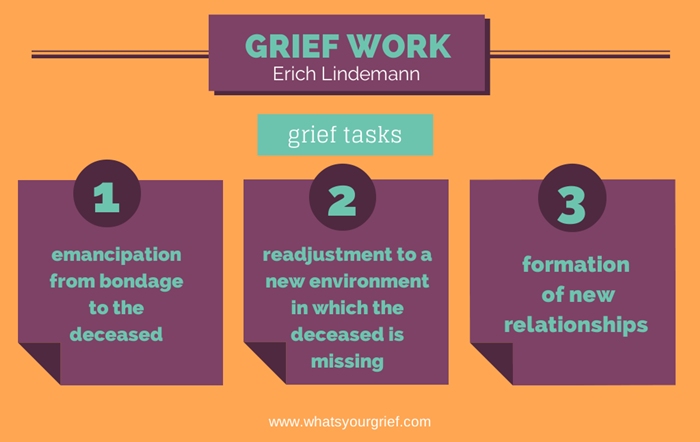
The term was coined by psychiatrist Erich Lindemann in the 1940s. He worked with survivors of the Cocoanut Grove tragedy and observed that grievers experienced common symptoms, feelings and faced similar challenges. Through his work, he developed a theory of grief incorporating his observations and his technique for walking grievers through these common issues.

Image result for six stages of grief erich lindeman

Today the term has been expanded and is used widely to describe almost any approach to grief that includes specific techniques for helping someone walk the path of loss.

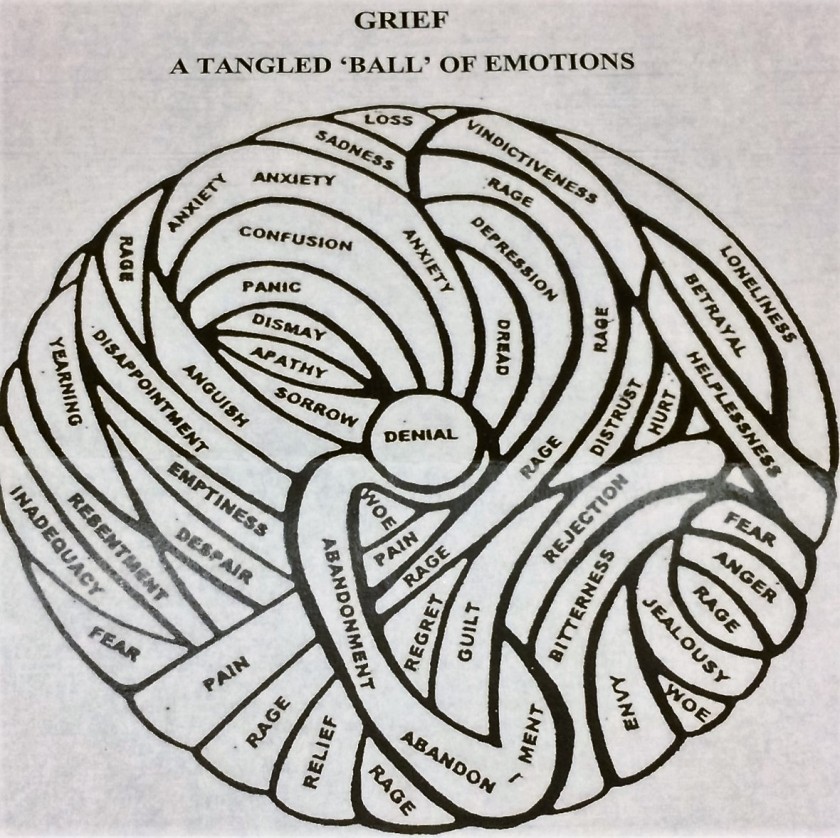
I use “grief work” to mean all the ways I (and others) must actively seek to identify, face, process, and ultimately incorporate the feelings, trauma and changes loss force upon us.

Grief work (in no particular order) can include but is not limited to:

  • Attending sessions with a professional, spiritual or lay counselor. Some people find it helpful to have a safe person outside the immediate grief circle to discuss feelings, concerns and relationship challenges that are generated by loss or exacerbated by loss. It’s best to find a counselor who specializes in grief, preferably child loss and/or traumatic loss (all child loss can be classed as traumatic loss). Other counselors may be too quick to label a bereaved parent’s grief as “abnormal” or “too lengthy” or “complicated” when it is, in fact, closely following observed timelines for dealing with child loss. If the first counselor you find isn’t a fit, try another. It’s OK to insist that you are heard, your feelings respected and your loss recognized for the life-shattering event that it is.
  • Finding, joining and participating in online or in person support groups. There are literally dozens of online support groups for bereaved parents. Some are designed to meet the needs surrounding specific types of loss such as sudden death, suicide, drug overdoses or loss to cancer or another disease or condition. Some are organized around certain faiths. Others may be rooted in geographic proximity and the online group might have a monthly or quarterly face-to-face meeting in the area. While it can sometimes be overwhelming to see the number of parents in such a group, it’s also extremely helpful to have a safe space to share things only another bereaved parent can understand.
  • Setting aside quiet time to think, process and possibly journal feelings. So much grief work must be done alone. Counselors can equip me with tools, support groups can give me real-life examples and encouragement but only I can do the nitty-gritty labor of teasing apart all the feelings and change grief brings with it. Journaling has been very helpful for me in putting words to what can sometimes be rather nebulous thoughts swirling around in my head. When I name what I’m feeling or experiencing, I can better construct a strategy for processing and living with it.
  • Walking back through memories, noting regrets, forgiving yourself and making peace with the past. We ALL have things we would have done differently. Death, being final, forces a heart to face that there is no chance to atone for past behavior. Words unsaid, things undone, opportunities missed are carved in the stone of yesterday. I spent many nights recounting my shortcomings as a mother, berating myself for what I didn’t do. Eventually I was able to rest on the simple fact that one thing I DID do was make sure Dominic knew he was loved.
  • Setting boundaries to give yourself and your family space and time to do grief work as well as to conserve emotional, relational and physical energy that’s in limited supply after child loss. So many of us live with few or no boundaries-responding to every request with a “yes”, adding things to the calendar without a thought to how exhausted we might be at the end of a day or week. Some of us are overtaxed at work or school. Some of us are hyper-involved in our churches, civic organizations or local politics. There are dozens of ways to be extended and just as many ways to live with that constant drain. Child loss forced me to recognize that I could no longer BE that person. I couldn’t afford the time, energy, mental space and emotional burden of saying “yes” anymore. I learned that “NO” is a complete sentence and began using it.
  • Practical considerations regarding your child’s belongings and other personal property. Many people might not consider this part of grief but it is. So many details to take care of, so many times I had to repeat the words, “My son was killed in an accident. I need to close this account.” So many copies of his death certificate mailed out to different agencies or companies, documenting the awful reality that he was never coming home again. Then there are questions of what to keep, what to store, what to give away. Should a room remain untouched if your child still lived at home? We had to clean out Dominic’s apartment only a few days after his funeral. It felt like I was boxing up everything beautiful about my boy.
  • Learning how to do holidays, birthdays, family gatherings, vacations and other gatherings. The empty chair looms larger when all the others are filled. If you have been the primary organizer of such events, it might surprise you to find the rest of the family still expecting you to be that person. Even if you aren’t the host for holidays, you will need to communicate to others if or how you feel comfortable participating.
  • Maintaining or regaining health after loss. Stress is one of the greatest contributors to so many health issues. Child loss is an unbelievably stressful experience. So it’s no wonder that many parents find themselves post loss with new or aggravated health problems. I had an appointment with my rheumatologist just one month after Dominic ran ahead to Heaven. It was critical that I tell her of my loss because in addition to whatever medical interventions she was prepared to prescribe, she needed to know I would be experiencing an extended period of intense stress that might necessitate closer observation and follow-up. As difficult as it may be to talk about, it’s important to inform your healthcare providers of your loss and to be absolutely honest about changes you’ve noticed in your body as a result.

There are probably a dozen or more subcategories of grief work I could list and some of you might think of ones I wouldn’t.

Grief IS work.

It is important, necessary and exhausting WORK.

It requires time, resources, effort and energy and cannot be hurried along.

But it is the only way a heart can begin to put the pieces back together.

Setting Aside Time To Grieve Helps My Heart Hold On

One of the commitments I made out loud and in my heart the day Dominic left us was this:  I was not going to let his death tear my family apart.  

I was not going to let him become the sainted brother that stood apart and above his siblings.  

I was going to continue to give as much of my time, effort, love and presence to each of the three I had left as I had done when there were four on earth beside me.

I’ve been more or less successful in keeping this promise.

Read the rest here: Child Loss: Setting Aside Time To Grieve Helps My Heart Hold On

So Many Grief Anniversaries: A Survivor’s Guide


There are more than you might think.  

Most folks would count the date of death and maybe the date of burial or memorial service.

But a mama’s heart counts it ALL.

I count the day he left, the day I was first able to view his body, the days of visitation, the day of the funeral and burial.

  • I count the day we cleaned out his apartment.
  • I count the day I notified credit card companies he would no longer require their services.
  • I count the day I received the death certificate.
  • I count the day I got his posthumous diploma.

And every year these dates roll around again to remind my heart of the pain I felt then and to pierce it afresh. 

Read the rest here: https://thelifeididntchoose.com/2018/02/12/how-can-i-survive-grief-anniversaries/

Can My Marriage Survive Child Loss?

A few decades ago, faulty research methods made popular an inaccurate statistic that a disproportionate number of marriages fail after a couple experiences child loss.

Like many urban legends, once fixed in the minds of many, it’s nearly impossible to dislodge.  

And that is more than unfortunate because when marriages falter (and they often do) after child loss, lots of people just give up because they think failure is inevitable.

But it’s not. 

Read the rest here: https://thelifeididntchoose.com/2019/02/10/child-loss-can-my-marriage-survive/

Rewired

No matter how a child leaves this earth, it’s traumatic.

And trauma rewires our brains.

The “fight or flight” response that had previously been reserved for truly life-threatening situations gets woven in with memories and feelings and our bodies remain on high alert.

So before we know it, all kinds of ordinary, daily, and definitely not life-threatening situations evoke rapid heartbeat, shortness of breath, anxiety and fear. And the absolutely reasonable response is to get away from those things that make us feel that way.

So we do (or try to!).

Image may contain: possible text that says '"Our brains are wired for connection, but trauma rewires them for protection. That's why healthy relationships are difficult for wounded people."'

We find ourselves running away from people who love us, who want to help us but who just might not understand why we’re running. We cocoon in our homes, in our own bodies and try to find that one safe space where fear and anxiety can’t find us.

But there is no such absolutely safe space.

Trauma rewires our brains, it’s true.

They can be rewired again.

So many good therapies are available for those of us who suffer in silence. Many are based on using physical cues to help a brain learn to distinguish between truly dangerous and only the memory of dangerous.

PTSD treatments and therapies

It is possible to venture out in the world again, to reach for and sustain connection, to lean into company instead of shying away.

Don’t stay hidden, afraid and alone.

Find a trained trauma counselor

Ask for help.

There Are Some Things I CAN Control

When I opened the door to that deputy and received the news, my world suddenly spiraled out of control.

Over the next days, weeks months I would have to do things I never imagined I might do and certainly things I did not WANT to do.  So, so much I couldn’t change.  So many ways I lost the right to choose.  

And I hated it!  

Wasn’t long and that sense of helplessness permeated every corner.  Even when it didn’t belong there.  I began to feel as if I couldn’t control anything.

So in many ways I stopped trying. 

Read the rest here: https://thelifeididntchoose.com/2019/02/02/things-i-can-control/

Every Tiny Step Counts

When Dominic ran ahead to heaven, I felt like I was physically, mentally, emotionally and spiritually knocked to the floor.  I had no idea how I was going to make a life after this great blow.   I could barely get dressed, much less do anything that took more thought or energy than that.

I was overwhelmed.   I had to learn to walk all over again.

And I did it with baby steps, in a judgement free-zone I created for myself where I refused to gauge my progress against anyone else’s.

its all about the baby steps

Because baby steps count.

Read the rest here: Baby Steps Count

New Year Goals Revisited: When Blank Slate Meets Full Plate

Oh, how I love a fresh new calendar!

It’s full of promise and lots of space for all the wonderful ideas I jot down when sitting in my chair fantasizing about how much time, energy and strength I’ll have in the coming weeks.

And then comes reality.

So even though THIS year I only publicly shared self care goals for 2020, I’m here to tell you-it ain’t lookin’ good.

I admit that many kind readers pointed out that twenty goals for anything (self care or not!) was a little ambitious.

They were right.

I got about a week into the new year when three commitments for February were added to the list. One is a scripture study conference which I will absolutely love and doesn’t require anything but my presence. One is a speaking engagement at a local church’s women ministry event (I’m working on the notes now) and another is a three day retreat for bereaved moms in Mississippi.

While that might not seem like much, in addition to daily writing, feeding critters, work in and outside our house plus administration of a closed Facebook group for bereaved parents, it adds up.

So some of those lofty goals are being laid aside or modified.

I promised accountability so here’s an update.

I’ve been much better at reading Scripture every day. Not as much as I had hoped, but more than I had toward the end of last year.

I’m walking every single day that the weather allows. I’m up to 1.4 miles in about 30 minutes and my hips have gone from screaming to only whispering their objections. I hope to make it to 2 miles most days at a pace of 15 minutes per mile. (We’ll see how that goes!)

I am limiting the number of times I automatically say “yes” to every request for my attention. I’ve even (gasp!)let the phone go to voicemail when it’s someone I know but it’s simply not convenient to talk right now. I call back later when it works better for me.

I’m decluttering and establishing a daily rhythm that supports some of my goals and learning to let go of others that apparently just aren’t going to happen right now.

I’m reading more.

Image result for stacks of books"

I’ve watched many sunsets and even caught January’s full moon!

I’m making lists of “Things to Do on Rainy Days” and “Things to Do on Sunny Days” and work from whichever is most appropriate on a given day. Slowly, slowly I’m whittling down my outdoor work. I’ll never be finished but I’ve stopped accusing myself as I walk the property and enjoy the fresh air.

I don’t know what, exactly, I expected from middle age and an empty nest, but I think I thought it might be a little less hectic than those years of raising and educating a household of kids.

It is, in many respects, less hectic. Most of the demands placed on me are not time sensitive to the minute or hour.

But there is just as much to do.

And perhaps that’s how it should be.

I’ve always said that, like Amy Carmichael, “I want to burn out, not rust out”.

I’ve got a new grandbaby who is going to be one in March!

Image may contain: 1 person, sleeping

I might not accomplish all the goals I set for myself earlier this year but I hope to accomplish every single thing God has for me to do as long as I have breath.

Image result for amy carmichael quote burn out"

Do You Wonder If Will It Ever Get Better?

I know that when I first stumbled onto a bereaved parent group, it was one of the things I was looking for: evidence that the overwhelming pain of child loss would not last forever.  

Some days I was encouraged as those who had traveled farther down this path posted comments affirming that they could feel something other than sorrow.

Some days I was devastated to read comments from parents who buried a child decades ago asserting that “it never gets better”.

Who is right?  

What’s the difference?

Do I have any control over whether or not this burden gets lighter?

Read the rest here: https://thelifeididntchoose.com/2019/01/12/will-it-ever-get-better/