What Helps and What Hurts

I am committed to continue to trust Jesus and to look to the Word of God for my hope and direction in this life and in the one to come.

I speak truth to my heart through Scripture, worship songs, testimonies of others who have gone before and remaining in community with other believers.

But I’ve yet to reach the place where I can plan on most days being better days rather than hard ones.

I’m trying.

And I’m working to tease out the influences that make a difference-both the ones that help and the ones that hurt.

So here’s the list so far:

WHAT HELPS

  • Starting the day with Bible reading
  • Writing out a verse or two that speaks hope to my heart
  • Listening to worship music
  • Feeling well-less physical pain translates to an overall sense of well-being
  • Having a plan for the day-even if it is simple and created in broad strokes, knowing what I plan to do gives me a reason to get up and get going
  • Seeking companionship with other believers either via Facebook groups, telephone calls, in person get togethers or messaging.
  • Allowing myself a set time to grieve-cry, pray, lament, or whatever-then moving on with the day
  • Mixing up physical activity with rest-changing my body position often reorients my attitude.
  • Striving to get proper sleep, eating good food (not junk and not mindlessly), exercising and stretching.
  • Crying-if I need to cry I’ve found allowing the tears to fall is much better than fighting them off all day.
  • Retreating when necessary-if I find a situation is too much for me to handle, I give myself permission to retreat.  Most things can be done another day.  Sometimes just granting myself permission means I have the courage to press on and face it.
  • Planning for hard things.  If I know I’m going to have to face a hard thing, then I try to plan it.  I prepare myself by thinking through (as much as possible) various outcomes.  I’m more prepared and usually it goes better than I anticpated.
  • Not overscheduling my days/weeks-it is harder than it used to be to get going in the mornings so I take that into consideration when making appointments.  If I have a busy day on Monday, I will try to make Tuesday open and relaxed.  Having space between commitments gives me time to recoup and minimizes anxiety.
  • Doing as many things via Internet and telephone as possible-I can do needful things even if I’m having a bad day if I don’t have to get dressed and go out to do them.

WHAT HURTS

  • Neglecting my spiritual life-if I don’t read Scripture, don’t engage with other believers and refuse to acknowledge and thank God for the blessings He still bestows-I can quickly succumb to the dark whispers of the enemy of my soul.
  • Ignoring physical needs-when I don’t prioritize sleep, good nutrition, adequate exercise and appropriate pain control (for my RA) then sadness is multiplied and it is so much harder to climb out of the pit of despair.
  • Carrying unnecessary burdens-I cannot MAKE anyone understand the pain and ongoing challenge of child loss.  So when people outside my immediate grief circle question my feelings or try to make me conform to their expectations of what grief should look like and how long it should last, I have to shake it off. If it’s an important and ongoing relationship, I try to help them understand but if they choose not to or if it is a tangential relationship, I let it go.  I refuse to carry the burden of others’ expectations in addition to the burden of burying my child.
  • Being ignored-it hurts to be ignored.  It hurts when someone asks how I am yet doesn’t allow the space and time for me to answer.  It hurts when I answer and they ignore my pain or dismiss it with a story or platitude or Bible verse or just don’t say anything.
  • Being shamed-it hurts for others to shame me by implying that I am not strong in my faith or not trusting Jesus or not hoping hard enough for heaven when I admit I still struggle in grief and still miss my son.
  • Disregarding my triggers:  There are certain situations that I know will guarantee a breakdown, panic or a crying fit.  I avoid them when I can.  If I can’t-then I make a plan of escape (just in case).
  • Being “on display” for others-I am one woman doing the best I can to walk faithfully with Jesus through an unbelievably painful experience.  I am not the Author and Finisher of your faith-Jesus is.  It hurts when I feel like others are watching to see if I’ll make it, if I’ll say the “wrong” thing, if I’ll admit that I doubt.  I want the same freedom others have to grow in my faith and to make mistakes and learn from them.  I don’t want to be a “poster child” for anything.
  • Friends staying away.  I know it is hard to be my friend right now.  You never know what you might get when you call.  But if you ARE my friend, please don’t stay away.  Please reach out even when it makes you uncomfortable.  A good word at the right moment is often the difference between a very bad and very lonely day and a pretty good and generally hopeful one.
  • Hiding my sorrow-when I try to pretend I am stronger than I really am or when I try to hide my tears it takes so much energy and makes me so less capable to do the other things life requires.

These are just some of the things that help/hurt me in my journey.  I would love to have others share what helps/hurts them in theirs.  There’s strength in community.

Leave your thoughts in the COMMENTS below!



Safe Friends

I hope you have one.  

That one person who knows your greatest joys and deepest pain and keeps it locked in her heart as if the secrets were her own.  

She is a gift from God to me, that friend.  

She’s the one I call when I’m wracked with sobs and the words won’t come.  She knows it’s me and just waits on the line until I can speak. She gets my jokes, knows my weaknesses, my strengths and helps me steer a better path on this hard road called “Life”.

She is a safe friend.

listening is a postive act

A safe friend listens.  

Just listens.  

She isn’t formulating an answer while I am talking, she isn’t rounding up cliches or Bible verses or platitudes meant to make her sound wise and shush my sharing.  She hears my heart even when my words might not make sense.

A safe friend sees.  

Really sees.  

She looks in my eyes and pays attention to my expression. She notices when my smile doesn’t match the tone of my words or the silent language of my hands.

She won’t let me by with a quick, “I’m fine!” meant to brush off the real need to spill my guts.

A safe friend stays.  

As long as it takes.

She doesn’t leave in the middle of a hard conversation.  Even if life gets in the way, she will come back and pick it up.  She checks in with me and doesn’t let time unwind the threads that bind us together.  If I don’t contact HER, she contacts ME.


A safe friend walks with me.  

No matter how steep the path, no matter how rocky the road. We might be hobbling along, broken together, but she keeps going and she keeps me going.


A safe friend encourages me to look to Jesus.

She admits that she doesn’t have all the answers.  She agrees that there are many things we will have to wait to understand.  But she reminds me that for this, we have Jesus.  We have a High Priest Who was tempted in every way yet was without sin.  We can enter boldly into the Holy of Holies because by His blood the veil is rent.

She doesn’t issue spiritual ultimatums that undermine, instead of strengthen, my faith in Christ.

friends pick us up


A safe friend doesn’t cut me out of her life when my life is a mess.  

Even if the mess is of my own making.  She helps me untangle the knot, own up to the sin, reach out to Christ and make amends.


A safe friend doesn’t just “happen”.

She allows the grace and mercy and love of Jesus to mold her heart so that He can use her.

Everyone NEEDS a safe friend.

Anyone willing can BE that friend.

kindness


Love: No Talent Required

So many times I choose to designate those who are doing great things for the Kingdom of God as having special talent, or a special calling or extraordinary grace.

In doing so I try to excuse myself from my obligations as a Christ follower.

I set those “super Christians” aside as “holy” and “other” to make it easier to trudge blindly on, ignoring the people God places in MY path as MY assignment.

And that is sin.

If my life is too busy to bend down,

if my calendar is too full to make room for helping my neighbor,

if my heart is too hard to break over the pain and suffering and hopelessness that is splattered across headlines and newsfeeds,

then I am not listening to my Savior.

When my heart is turned toward Christ, it is filled with His love, His compassion, His mercy and grace.

Loving others is not a special calling or talent or gift.

It is a command.

[Jesus said] So I give you a new command: Love each other deeply and fully. Remember the ways that I have loved you, and demonstrate your love for others in those same ways. Everyone will know you as My followers if you demonstrate your love to others.

John 13:34-35 VOICE


small things with great love


Where Does My Help Come From?

I’m old enough to remember Maranatha Praise albums. Fifty to sixty minute sets of themed worship songs, they were a wonderful blessing.

When we got our first CD player, I kept a stack of these CDs next to it-they were the background music to life with littles and often just what I needed to make it through the day.

Many of my favorite songs were scripture set to music in ways that made it easy to memorize.

My Help Comes From the Lord, Hosanna Music

I lift up my eyes to the hills, where does my help come from?

My help comes from the Lord,

My help comes from the Lord,

My help comes from the Lord-Maker of Heaven and Earth.

When faced with a seemingly undefeatable enemy,  Jehoshaphat led the charge with a worship band.  

When he had consulted with the people, he appointed those who sang to the LORD and those who praised Him in holy attire, as they went out before the army and said, “Give thanks to the LORD, for His lovingkindness is everlasting.” 2 Chronicles 20:21 NASB

These days find me humming or singing old tunes that speak truth to my heart,  lift my spirit and declare the victory of Christ when things look dim.  

In the midst of the Valley of the Shadow of Death, God uses these songs to remind me of His faithfulness, even here.  

comfort

Loving Well: Some Things Hurt

Before I lost Dominic, I know that I, like others who had never experienced the death of a child, undoubtedly said and did things that were hurtful instead of helpful.

I painfully remember sharing at a Thanksgiving women’s gathering and, meaning to encourage the ladies, said something like, “I think we are able to better face the big disappointments or trials in life, but find the daily drip, drip, drip of unfulfilled expectations to be a greater challenge.”

 A bereaved mom in attendance set me straight (in a very kind and gracious manner!).

That exchange has come often to my mind in these months after burying my son. I wish I could go back and have a do-over.

I hope that my pain has made me more compassionate, more sensitive to those around me.  I pray that I will extend grace and mercy to everyone I meet.  I want to be a light, not a candle-snuffer!

I’m convinced that most people want to bless and not hurt.

So here is a list of things (from my own experience and from the experience of others) that can be particularly damaging to bereaved parents when dealing with their loss:

Offering platitudes and quoting Bible verses is unhelpful.

Don’t say, “At least you have your other children.”  Which of your own children are you willing to give up?

“God needed another angel!” This is just bad theology as well as unhelpful.  God doesn’t need anything and my child is not an angel.  He is a redeemed member of the Body of Christ and in heaven with Jesus.

“He or she isn’t suffering anymore.”  That may very well be true, but it’s not comforting to hear it.

“All things work together for good…” I may believe that in my heart of hearts, and may come to feel it again one day, but in the days immediately following my son’s death, I didn’t need to be reminded.

“He (or she) wouldn’t want you to be sad.”  How do you know what my child would want? Being sad and expressing my pain honors his or her memory.

“God will use your son’s death to bring people to Jesus.” Yes, He might.  But He did not need my son to die in order for anyone to receive Christ.  He may use my son’s death, but I will speak honestly and say that I would not have exchanged Dominic’s life for anyone.

“It could have been worse” or any sentence beginning with, “At least…”. My child is dead.  I cannot have him back.  I’m sure there are more painful ways to lose a child besides a motorcycle accident,but it is a matter of degree, not kind. Just please, don’t.

“Don’t try to make your grief ‘equal’ to the parents. Sometimes in an effort to comfort we might say things like “I understand how you feel. I was devastated when my grandfather, or aunt, or best friend died”.  My mom and sister proceeded my daughter in death and their loss, as difficult as it was, didn’t even come close to how difficult it has been to lose her.  And don’t compare the loss of your beloved pet to the loss of someone’s child. JUST DON’T! Almost everyone I know who has lost a child has had their loss compared to that of someone’s pet. My daughter’s death was compared to that of someone’s pet lizard.”

Asking for details of the cause of death or the conditions surrounding the death of any child is not helpful.  If a parent wants to talk about it, listen.  Otherwise, keep curiosity in check.

“I did not appreciate [a close family member] persisting to know why our son took his own life. I don’t want to tell her as she will dwell on that forever and I want to celebrate his life, not his death. I also didn’t appreciate those folks telling me to stay strong. I am strong, but if I wanted to be a puddle, I am allowed to do that too.”

Please don’t label us as “strong”–you may mean it as a compliment but we hear it in many ways.  One way might be that we are not honoring our child by grieving hard enough.  Another way might be that we are expected to act strong even when we don’t feel strong.  Trust me, you have no idea what it costs a bereaved mama to hold back the tears.

“I get so tired of people telling me I’m so strong also. I too am a puddle often but no one sees me during these days alone.”

It’s true that no one can fully comprehend our pain if they have not felt it.  But it is possible to educate yourself about ways to support grieving parents.

“I wish people were more understanding but the problem with that is about the only way to understand is to go through it and I don’t want that for anyone.”

Please don’t withdraw from us as if we have a communicable disease.  I know it makes you uncomfortable to be around me and my grief.  It makes me uncomfortable too.  But companionship and encouragement can mean the difference between grieving well and being overwhelmed by sorrow.

“I wish one of my good friends had reached out to me more. See we both work for the school system so we had the summer off. I never once heard from that friend all summer. It really hurt.”

“When I got home my church family was there then suddenly I was home alone. Everybody left me home ”

Show up to the funeral.  Put aside petty differences.  Extend grace.  It’s not about you.

“His father didn’t even come. Not even to the funeral. No one brought food or sent flowers. Not even after the funeral. I was left alone a lot frightened and confused. Within a few months I was homeless.”

Be the church.  Be the person that writes notes weeks and months after the funeral. Check in with grieving parents and keep checking in.  Even if they don’t return a phone call, the act of letting them know you care is meaningful.

“After the funeral, there was a huge sense of abandonment from everyone. I don’t think that was intentional by anyone (except my family members, lovely!) but yeah…..there were hundreds of people at his funeral, and I probably didn’t know half of them. I wanted to thank people, but didn’t know who to thank! Lot of support, but when it was over…….it was over.”

“[Some close family members] were total jerks about the entire ordeal, so if there were anything really, I wish they had sucked up their egos and petty jealousies, and been there more for my other kids. I no longer have ties with them.”

“One huge topic that is discussed in my bereaved parents Facebook group is the response from the church for grieving parents. Sadly, most churches just don’t know what to do so they do…..nothing. Some are great for the first couple of weeks after the death and then….nothing. A very few provide the needed support in the months after such a devastating loss.”

Please don’t rush us to meet your timetable of when our grief should subside.  It will take as long as it takes.  Sometimes we can participate in life and sometimes we can’t.  Sometimes we smile, sometimes we cry– but we will always miss our child.

“People, for different reasons, want you to get back to normal. We can’t even remember what normal was ”

One of the biggest fears of bereaved parents is that their child will be forgotten. Don’t forget. Speak to them about their child.  Share memories.  Say their name.  Be present (even with a text, call or card) on important dates.

“No one would come for my son’s first anniversary. I was left home alone…abandoned felt like.”

Loss will enter everyone’s life at some point–there is no escape.

We educate ourselves (as we should) on so many issues–work hard not to offend, to understand, to reach out. Bereaved parents don’t want pity, they would like to be better understood.  We did not choose this journey, it was thrust upon us.

A little bit of kindness goes a long way.


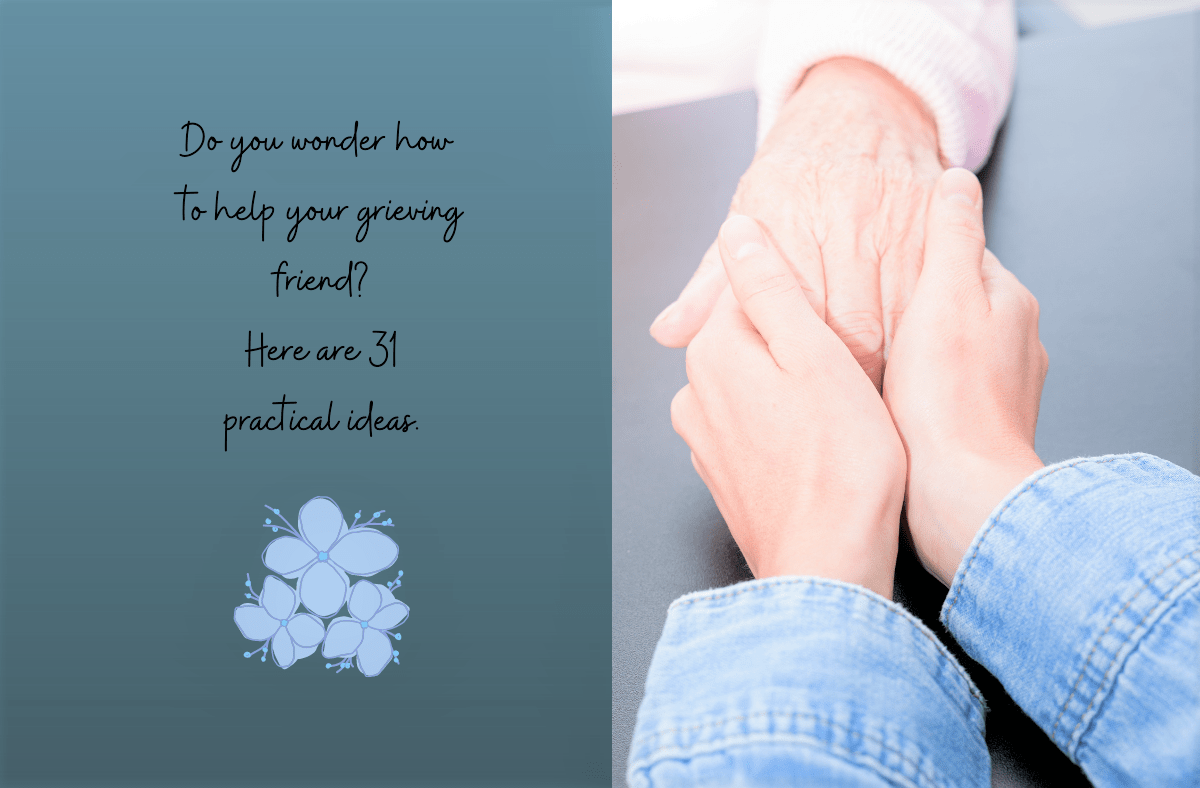
31 Practical Ways to Love Grieving Parents in the First Few Days

When Dominic died, I didn’t get a manual on what to do.  I didn’t get an orientation into how to be a grieving parent.  So when some people asked how they could help me and my family, I really didn’t know.

A comment repeated often by bereaved parents is, “Please don’t use the phrase, ‘let me know if there is anything I can do’, people mean well, but this is unhelpful.”

Another mom put it this way, ” There are too many meanings to this phrase.  It can mean anywhere from, ‘I really want to help’ to ‘I don’t know what to say so I’ll say this but I don’t really want you to ask’.  Also it’s so hard to make any decisions–trying to figure out what you might want or be able to do is overwhelming.  Instead, offer specific things you can do and make plans to do them.”

For those that want to help, here ia a list of 31 ways you can provide practical and timely help to grieving parents:

Show up and answer phones, open the door to visitors, find room for food they bring.  Act as a buffer zone for the parents.

Consider donating PTO, sick leave or vacation days to a bereaved parent if your employer allows it. Many employers allow three (3) days leave for a death in the family with no special consideration for the death of a child.  Three days is not long enough and many parents can’t afford to stay home without pay.

Donate sky miles, rental car points, hotel points or other loyalty points to the parents or family members that need to travel.  There are many expenses associated with burial and the family may not have extra money for travel.

Pick up family members from the airport that are coming for services.

Offer to accompany the parents to the funeral home as they make arrangements.

Donate a burial plot.  Few people have one picked out for their child.

With the family’s permission, set up an account to take donations to help with burial expenses or the medical bills that will be arriving soon.

Offer an extra bedroom to out-of-town family members or friends.  Not every home can accomodate extra guests and the parents need some space of their own.

Bring folding tables and chairs to the home–they are easy to set up and take down as needed to accomodate extra people in the house.

Respect a grieving parent’s need for some private time and space.  If we retreat to a back room, let us.  Check on us quietly and gently, but don’t follow us around asking, “Are you OK?”  No, we are not.  And being asked over and over is stressful.

It is always helpful to bring food.  Set up a meal schedule on Takethemameal.com. There is a way to note any special dietary restrictions.  When people sign up, they can see what others are bringing/have brought.  Driving directions are available on the site and the family can ask that meals be brought at a standard time so there is someone home to receive them.

Bring ice in an ice chest for drinks.

If a parent has a chronic health condition like diabetes or heart problems, check in with them regularly to see if they are taking their medication and if they are experiencing new symptoms.

Offer to drive grieving parents where they need to go.  Deep grief can impair driving as much as or more than alcohol or drugs.  Be willing to sit in the lobby or parking lot–we may not want company finalizing arrangements or speaking with our pastor.

Clean the house. And don’t allow your intimate glimpse to become a source of gossip.

Don’t turn on the television or radio unless the family asks you to or does it themselves. If you want to know the score, check your phone or go to your car.

Mow the yard, tidy flower beds, sweep, rake leaves.

Bring toilet paper, paper towels, paper plates and napkins.

If one or both of the bereaved parents are caregivers to an elderly relative, offer to take over that responsibility for awhile.  (Only if you are willing and competent to do so.)

Take surviving younger children for a walk in the park, to get ice cream or a hamburger. Not all children will be comfortable leaving their parents.  Even if they don’t understand what is going on, they may feel insecure and upset.

Sit with and minister to surviving older children.  We are concerned about our surviving children as well as the child we lost.  Knowing someone is loving on our kids is a great comfort.

Clean the family’s car before the funeral.

Make sure there are bottles of water and maybe a snack in the car for afterwards–often family members can’t eat and forget to drink before the day of the funeral.

Begin assembling electronic photos from friends for a slideshow at the funeral, if the family requests one.  Make sure you run choices by the parents before you flash them on a screen.

Make a list of appropriate songs that might help the family choose.  Don’t be hurt or offended if we use other songs instead–your list may very well have nudged our memory and been helpful.

Offer to drive the family to the funeral and burial.

Attend the funeral.  We want to know our child mattered.  We need to know you care.

If your church provides a meal for the family after burial, and you are asked to bring a dish, bring one.

Offer to help pack up a child’s dorm room or apartment.  We may welcome the help or we may want to do it alone–it has nothing to do with you.

Many grieving mamas want something that smells like their child.  If you are helping to clean in the first hours or days, don’t wash all the child’s clothing.  Put a few worn items in a ziploc bag for her to have later.

Don’t abandon the family after service.  There is such a sense of finality when the coffin is lowered or the memorial over.  Usually lots of people are around and then we go back to the house and quiet overwhelms us.  If you are close to the family, consider joining them for a little while when they first get home.

Dear friends, do you think you’ll get anywhere in this if you learn all the right words but never do anything? Does merely talking about faith indicate that a person really has it? For instance, you come upon an old friend dressed in rags and half-starved and say, “Good morning, friend! Be clothed in Christ! Be filled with the Holy Spirit!” and walk off without providing so much as a coat or a cup of soup—where does that get you? Isn’t it obvious that God-talk without God-acts is outrageous nonsense?

James 2:16-17 MSG

Are you a bereaved parent?  Have you walked this path with a friend or family member? Please add your suggestions to these in the comments section.


Help Me, Please!

Burying my son and living life without one of my children walking with me continues to be the hardest thing I have ever done.  I wouldn’t wish the pain and struggle on my worst enemy.

But I am determined not to waste the things that God is teaching me through this experience.

I want to allow Him to redeem this brokenness.

That’s why I share my journey.

I am working on a series of posts that will highlight some of the most helpful things people did for me and our family in the early days of our grief journey.  I will also share the physical, emotional, spiritual and psychological challenges and experiences of bereavement.

I am asking other bereaved parents who are willing,  to share their experiences so people can have the benefit of many and varied voices:

(I will never reveal any names or identifying information)

  • What did people do for you and your family that was particularly helpful around the time of your child’s death?
  • What do you wish had been done differently?
  • What advice would you give to a parent in the first few weeks of grief?
  • What support did you receive from your church or faith community?
  • What support did you wish you had received from your church or faith community?
  • What were the greatest challenges with extended family?
  • What was helpful for your surviving children as they grieved?
  • What surprised you most about grieving your child?
  • What do you want others to know about your grief journey?

These are just a few questions that I would like to explore–you may think of others. Please feel free to respond in the “comments” section or send me an email to Godsgrdnr@aol.com.

You can also join the discussion on the public Facebook page:  Heartache and Hope: Life After Losing a Child.

There is nothing easy about grieving a child, but I pray that sharing our experiences can help ease the pain of other parents just beginning this journey.


Practical Ways to Love Grieving Parents at Christmas

Bereaved parents feel increasing pressure as the days count down toward December 25th.

Everywhere we look families are celebrating togetherness and happy moments.  Our hearts rejoice for each home that has a full table and an unbroken circle.  But our own loss is magnified in comparison.

With Christmas less than two weeks away, I’m reblogging this post, with an addition or two.

If you know someone who has lost a child, here are some ways you can bless them this holiday season.


Most parents feel a little stressed during the holidays.

For bereaved parents, the rush toward the “Season of Joy” is doubly frightening.

Constant reminders that this is the “most wonderful time of the year” make our broken hearts just that much more out of place. Who cares what you get for Christmas when the one thing your heart desires–your child, alive and whole–is unavailable…

It is so hard to find a way to trudge through the tinsel when what you really want to do is climb into bed and wake up when it’s all over.

Here are some practical ways family and friends can help grieving parents during the holidays:

  1. Don’t resist or criticize arrangements a bereaved parent makes to help him or her get through this season.If they are brave enough to broach the subject, receive their suggestions with grace and encourage them with love.  Do your best to accommodate the request.
  2. If the bereaved parent doesn’t approach you–consider thoughtfully, gracefully approaching him or her about what might make the holidays more bearable.But don’t expect a well-laid plan-I didn’t get a “how-to” book when I buried my child…this is new to me and very, very painful.  I am doing the best I can to keep my head above the waves and I cannot be expected to captain the boat through these turbulant waters.
  3. Don’t be surprised if a bereaved parent doesn’t want to exchange gifts (or at least, not receive gifts). No one can rewind time or restore my family circle to wholeness and I just can’t think of anything else that I want or need.
  4. Don’t assume that the bereaved parent should be relieved of all meal duties around the holiday.For some of us, doing the routine things like baking and cooking are healing.  For others, there just isn’t energy for anything other than the most fundamental daily tasks. ASK if they want to contribute.
  5. Don’t corner surviving children for a private update on their parent’s state of mind.My children are grieving too.  When you expect them to give an update on me you diminish their pain and put them in a difficult position.  If you want to know, ask me.
  6. If there are young children in the family, it might be helpful to offer to take them to some of the parties/gatherings/church services that their parent may not be up to attending. Ask, but don’t be upset if they say “no”–it might still be too traumatic for either the child or the parent to be separated from one another.
  7. Ask them to share about the one they miss.  One of my greatest fears as a grieving parent is that my child will be forgotten.  But we might not speak up because we don’t want to make others feel uncomfortable.

I know that life goes on, the calendar pages keep turning and I can’t stop time in its tracks.  I greet each day with as much faith and courage as I can muster. This season requires a little more-and I will need help to make it through.