Those hours before I planted one last kiss on my son’s forehead, I held his hand.
I nodded at the people filing past to pay their respects with my arm tucked behind me, desperate to cling to my child.
And I’m still clinging.
I will not let him go.
I don’t care how many days or months or years march on taking me further from the sound of his voice, the touch of his hand or the brightness of his smile-I refuse to release my grasp.
I edit my words, costume my body and fix my face so I can act the part. But truth is, I never manage to fool anyone who looks closer than my plastic smile.
I can’t hide my heart.
And I don’t know why I try-I don’t get points for pretending.
There’s no prize at the end of this long road for the one who makes it with fewest tears.
When children are young and growing every birthday is a celebration. And it absolutely should be!
But when you’ve walked a few (0r more than a few!) years on this old world, birthdays begin to morph into something else.
They remind a heart that life is short, that not all of the people we love will enjoy fullness of years and even those that do seem to leave us way too soon.
Birthdays-after precious people have run ahead to Heaven-mark one more year without them.
Instead of cake and balloons, flowers and presents, we sit with silence and absence, memories and wishes for more time…❤
Today my heart hurts more than usual.
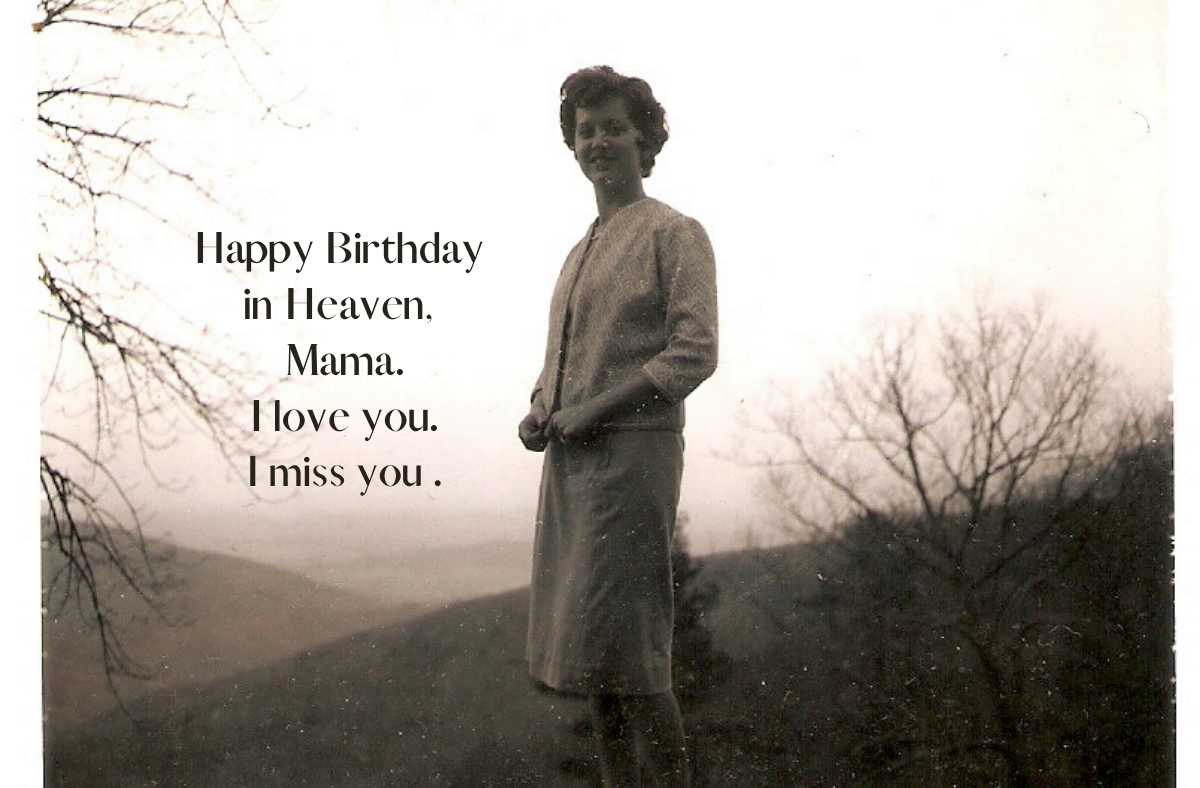
It’s my mama’s birthday-the fourth one we will celebrate without her here to blow out the candles.
It’s also the fourth anniversary (do you call it that?) of the day Papa had to call an ambulance to rush her to the hospital.
It was a timid foray into the wider world just a year and a half after Dominic ran ahead to Heaven.
I was truly frightened that once I began sharing my intimate thoughts, good (and not-so-good) experiences and things I was learning in this Valley of the Shadow of Death I would either: (1) find out no one really cared and/or; (2) offend friends and family.
But what motivated me to overcome that fear was a sense that for all the information out there on grief in general, I couldn’t find nearly enough first-person experience written in bite-sized chunks on child loss in particular.
After Dom ran ahead, it was difficult for me to sit down and read a whole book. I needed bits I could read on a single computer screen.
I also needed someone to be upfront and honest about what it meant to continue to cling to faith even when it was hard and even when it meant acknowledging doubts and living with unanswered questions.
It’s difficult to believe now with the plethora of popular books (both secular and religious) on “open broken” but seven years ago, there weren’t many around.
So I decided I’d just say what I had to say and let it fall on the ears that might need to hear it regardless of who didn’t like it or chose to ignore it.
And here we are seven years later.
I don’t know how long I’ll keep writing-probably as long as I feel like I have something to say, people are listening and my fingers can still tap-tap-tap the keyboard.
For now, writing is what I do.
Even when life interrupts almost everything else I will find a few moments to jot down thoughts and hit “publish”.
I know some posts are much thinner than others-maybe just a meme or two and an encouraging word. Some are just reworked posts from years gone by.
But I want to show up in case THIS morning someone’s having an especially rotten one.
Experiencing deep loss has a way of winnowing the frivolous from your life.
That doesn’t mean for one moment that (after those first years of heart wrenching, breath robbing pain) I don’t have fun.
I love to laugh!
But it does mean that I cut to the chase with daily decisions that aren’t going to make one whit of difference in five hours, much less five years.
Don’t have time for that nonsense!
I try hard to maintain relationships. I try hard to speak courage to the hearts around me. I try hard to be gracious (not always successful!) when others upset or disappoint me.
And I absolutely, positively insist that Scripture be taught in context.
Jesus is a gentle Shepherd. I want to be one too.
❤ Melanie
2016: A Few of My Favorite Things
When I had a child, suddenly I cared about everything. When I lost a child, suddenly I cared about nothing.
~ a bereaved mother
When I read this comment, I thought about it for a moment to see if it was true for me.
And I realized that, yes, it WAS true at the very beginning.
Mind-numbing pain and soul-crushing agony pressed down so heavily that I couldn’t care about anything other than reminding myself to
I’m a kinder, gentler person than I was before Dominic ran ahead to Heaven.
It’s a high price to pay to learn to walk more grace-filled through this life.
I’ve come to find out that every heart has a story. Every heart is carrying a burden.-perhaps not the same as mine, but a burden nonetheless.
And what causes the most pain in this life (next to the burden itself) is when another person runs over my heart without thinking about the burden it may hold inside.
So I have purposed not to do that to other people.
Romans is a dense book full of quotable verses often taken out of context.
Today’s verses include some of the most hopeful and, frankly, hurtful verses tossed at broken hearts.
“And we know that in all things God works for the good of those who love him, who have been called according to his purpose. ” (Romans 8: 28 NIV)
Often this verse is shared by well-meaning friends who want us to “look on the bright side”. They can’t comprehend that the darkness of child loss is so complete our hearts can’t imagine light still exists.
Joe Amon via Getty Images
But when you see that verse and the ones that follow in context, a heart can find a foothold.
Labels and categories can be helpful. When cruising the grocery aisles I’m thankful for the signs that point the way to “vegetables” or “baking needs”.
It’s interesting how God gives a similar message to many in His family around the same time. My friend and fellow bereaved mom, Kathleen Duncan posted just yesterday Dear Momma Who’s Feeling Not Enough. She had no idea that I had this post lined up over a week ago for today. So maybe we should all take a moment to realize that we ARE enough-just us. Because of Christ, we ARE enough. ❤
It has taken me decades to internalize the message that I don’t have anything to prove.
It has taken many, many heartbreaking moments to realize that no matter how hard I try to please everyone and met each expectation held over my head, I will fail.
It’s kind of counterintuitive really-that my initial response to Dominic’s death would be affirmation of my faith and my response weeks later would be doubt.
But it makes a lot of sense really.
When the unthinkable happens, if your heart is already turned in a particular direction the path of least resistance is to keep flowing downhill.
A bit later, when shock has worn off and your brain wakes up and you begin to do the “math” suddenly it’s not so easy to believe that God is good, He is sovereign and He has a perfect plan.
One of the things I’m learning this side of burying my precious child is that there is no upper limit to the sorrow and pain I may have to carry in this life. And it’s no use comparing my burden to that of another-begging God to consider the differing weights and to make adjustments to lighten my load because it is heavier than that of another.
I do not get a pass on daily stress and strain.
I’m not guaranteed physical health.
I am just as likely as anyone else to get the grumpy cashier, to drop a dish or lose my keys.Or worse.