Navigating Grief: No Such Thing as “Safe”

I remember as a  young mother of four working hard to keep my kids safe. 

dominic and siblings little children at nannys

Next to fed and dry (two still in diapers!) that was each day’s goal:  No one got hurt.  

It never occurred to me THEN to add:  No one got killed.  

Because the most outlandish thing I could imagine was one of them falling or touching a hot stove and us having to rush to the emergency room.

Then I became a mother of teens and one by one they acquired a driver’s license and motored away from our home.  

That’s when I began to beg God to spare their lives.

One particularly frightening test was when all four went to Louisiana-my eldest driving and the rest in the van with her.  I made them call me every hour and tell me they were OK.  It was the first time I realized that I could lose every one of them in a single instant should they crash-all my eggs in one basket.

I was glad when that day was over.  Although the irony is they were no “safer” at the end of those 24 hours than they were at the beginning.

Because what I know now, but didn’t know then is this:  There is no such thing as “safe”

Not the way we like to think of it-not the way we add labels to devices, seat belts to cars, helmets to everything from bicycles to skateboards.  Of course we should absolutely take precautions!  Many lives are saved by them every single day.  

But.  BUT…

Life is more random than we want to admit.  And there is no defense against random. 

There is no way to screen for every underlying physical abnormality, no way to drive so well you can stop the drunk or inattentive driver from plowing through a stop sign, no way to anticipate every foolish choice a young person might make that ends in disaster instead of a funny story.

IMG_1795

My first response when Dominic died driving his motorcycle was that I wanted my surviving sons to sell theirs.  They did so out of respect for me.  Neither of them wanted their mama to have to endure a second knock on the door and the same message delivered twice.

I receive it as a sacrifice offered in love from them. 

Because it was.  

Since Dominic left us almost [twelve] years ago, I have had to deal with my desperate need to keep my living children safe. 

And it is a real struggle.

Each child is involved in a career that includes inherent risk.  None of them are foolhardy, but they are exposed-perhaps more than many-to potential bad actors and dangerous circumstances.
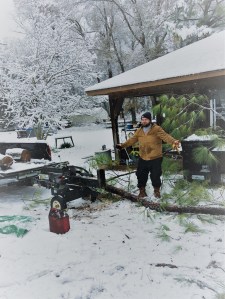
julian and branch in snow
This branch fell just minutes after my son was standing in that spot splitting logs.

How I long for those days when I could tuck everyone in, turn out the lights and sleep soundly because all my chicks were safe inside my own little coop!  How I wish the only danger I thought about or knew about was a bump on the head from hitting a coffee table!

How my heart aches for one more moment of blissful ignorance!

But I can’t live in some imagined water color past.  I have to live in the world as it is.  

So I remind my heart that safe is an illusion-no matter where we are.  Life is not living if it’s only about preserving breath and not about making a difference.

And I let go.  

Over and over and over.

I release them  to be who they were meant to be. 

Even if it costs more than I am willing to give.  

fiona james and julian at james wedding by water

Navigating Grief: Helpful Tips for Interacting With Bereaved Families

I firmly believe that our friends and extended family want to reach out, want to help, want to walk alongside as we grieve the death of our child.

 I am also convinced that many of them don’t because they don’t know how.  

It may seem unfair that in addition to experiencing our loss, we also have to educate others on how to help us as we experience it, but that’s just how it is.

The alternative is to feel frustrated and abandoned or worse.  

So here’s a list of helpful tips (and a great infographic!) for interacting with bereaved families:  

Express condolences and show you care. Don’t avoid me, please!  You cannot make me any sadder.  I need to hear from you.

friends hugging

Refer to my child by name.  Dominic is STILL my son.  He is still part of my story.  But because he’s no longer visible, his name often goes unspoken.  Please talk to me about him, use his name, tell me a story of how he impacted your life or a memory that makes you smile.  It makes me smile too.

Actively listen and be supportive.  It’s hard to listen to someone tell you how much they are hurting and not offer advice or think of ways to “fix” them.  I can tell you from experience that what I need most on my darkest days is for someone to say, “It IS dark.  I’m so sorry.”  Silence is OK too.  Not every quiet moment needs to be filled with chatter.

listening is a postive act

Understand that each family and family member will grieve in different ways.  You may have observed child loss before but what you saw in one family may not translate to the next.  There are no hard and fast rules for this awful journey.  The age of the child, family background and structure, manner of death-all these impact grief.  In addition, mothers and fathers, sisters and brothers all bring their personalities, stage of life, beliefs and experiences to the journey.  There were five of us left behind when Dominic ran ahead.  We were each devastated but expressed it in very different ways.  Nearly five years later, those gaps have widened, not narrowed.

Fathers grieve too.  Sometimes support focuses almost exclusively on the mother.  In part because of a common notion that mothers are somehow emotionally closer to their children than dads.  In part because many men are less demonstrative and may do a good job hiding grief.  Whatever the reason, don’t assume one parent is dealing “better” with the loss than another (mother or father) just because he (or she) is not crying openly.  No one escapes this awful blow unscathed.

bereaved fathers

Don’t overlook siblings.  Surviving siblings are sometimes referred to as “forgotten grievers”.  If they are very young, people may think they are relatively unaffected by the death of a brother or sister. If they are grown and out of the home, people may figure that the siblings’ own, very full and very busy, lives keep them preoccupied.  While some of that may be true-to an extent-most surviving siblings are deeply impacted by the death of a brother or sister, regardless of age.  Not only have they lost a member of the family and changed birth order, they have also lost the family they knew, the parents they knew and a co-keeper of memories and secrets.  Bereaved parents are often overwhelmed with grief for their living children as well as the child that is missing. One of the best gifts anyone gave me was reaching out to my surviving children.  It helped my heart to know that they had friends who were supporting and loving them well.

kids cartoon

Be yourself.  People often feel awkward and stiff when approaching a bereaved parent or family member.  That’s perfectly understandable.  The bereaved seem so fragile (are so fragile!) that folks are afraid the wrong word or touch might shatter them into a thousand pieces.  But what your friend or family needs right now is the you they’ve always known and loved.  If you are a hugger, hug!  If you are a storyteller, tell stories (appropriate ones, ones of the missing child).  If you are a cook and cleaner, then cook and clean.  Our family was blessed by our friends doing exactly what they had always done-come alongside in their own special way.  So much had changed in our world that familiar touchstones, familiar routines and familiar faces were a real comfort.

Keep in mind words matter.  Now is not the time to try to satisfy your curiosity about exactly “what happened”.  Loud joking is rarely welcome.  Many bereaved families find it hard to laugh in the first days, weeks, months because it feels like betrayal.  Don’t offer platitudes intended to help them “look on the bright side” or consider that “it could be worse”.  There is nothing worse than burying your child.  Nothing.  Listen and take direction from the person you are comforting.  Follow his or her lead.  And if something less than helpful slips out, own it and apologize.

pencil-drawing-bereaved-mother

It’s never too late to reach out.  NEVER.  Sometimes people stay away at first for lots of reasons.  Or they show up for the memorial service and then fade into the background.  After a bit, even if they want to reach out, they may feel embarrassed by the long absence.  Don’t be.  So many people stop calling, visiting and texting within the first weeks that your outstretched hand of friendship will be a welcome beacon of hope.  If you need to, apologize for your absence.  Be honest.  Admit you were scared or whatever.

Then show up. 

Stick around.

You don’t have to be perfect.  

Just be present.  

bereaved families infographic

Children Grieve Too: Children’s Grief Awareness Day

Today is Children’s Grief Awareness Day.

I’m thankful a day is set aside to focus on children’s grief because it’s so easy for their grief to be overlooked, underrated and even dismissed.

Grown ups often tout the line, “Kids are resilient. They will adapt.

And while it’s true that from the OUTSIDE it might look like a child is OK or even thriving, on the INSIDE she may be curled up into a ball or he may be angry and resentful.

Sometimes these feelings find unhealthy expression through addiction or risky behavior. Sometimes they simply grow into a giant overwhelming shadow that darkens the child’s whole world.

Image result for images child grief day

My own mother’s mama died suddenly from a stroke when she was only ten years old. Within days, Mama was whisked away from everyone and everything she knew to live with her oldest married sister.

No one understood then that children needed to grieve so Mama never really did.

At least not out loud where anyone could hear.

But that grief informed her entire life-it made her kinder to many people and made it harder for her to develop deep attachments to others. She was only able to talk about it in the last couple of years of her life when failing health, my own loss and many hours spent in hospital rooms together created safe spaces for her to share.

Children grieve whether we observe it or not.

Children need safe spaces to express that grief even when it hurts our hearts to hear the words or see the tears.

No child should have to wait until they are grown to acknowledge his pain or her brokenness.

Image result for images child grief day

Just like we parents, surviving siblings grieve what they’ve lost AND what will never be. Graduations, weddings, new babies, holidays, birthdays and other occasions mark their hearts too.

Children bear other burdens as well.

They are often targeted by those outside the grief circle for updates on the family while their own grief goes unnoticed. After five years, my kids have developed a standard answer to the question, “How’s your mom doing?”

“About as well as you’d expect.”

Next.

Sometimes children feel they must be extra good and extra quiet in an effort to make up for the sadness in a home after the death of a child. Sometimes they take on adult roles, shouldering responsibilities a depressed or grieving parent can’t manage right now. Sometimes they struggle with misplaced guilt when their hearts are jealous of all the attention focused on the missing child.

Often they just wish things were back to how they were before tragedy struck.

Your children may never tell you these things unless you ask.

And they may not confirm them even if you do.

But rest assured, they are grieving too.

Give them permission to do it out loud.

Grief Work 2025: Grief is a Family Affair

Child loss is also often sibling loss.  

In addition to their own heartache, bereaved parents carry the heartache of their surviving children.  

The family everyone once knew is now a family no one recognizes.  Hurting hearts huddle together-or run and hide-and it is so, so hard to find a way to talk about that pain. 

There is definitely a time and place for professional counseling.  Many, many families benefit from having a trained individual, outside the immediate grief circle, guide them in exploring feelings, developing coping strategies and learning to live life this side of loss.

But there is also something to be said for arranging casual open-ended activities with surviving siblings, parents and even grandparents where space and a more relaxed atmosphere often leads to honest sharing.

This graphic has lots of excellent suggestions for how to craft such a space.

Not all will be suitable for every family, but every family should be able to find a few that fit.

I’ll add these guidelines that may help your family make the best choice for YOU:

  • Don’t force it.  If you make an offer of an activity and it drops with a thud to the ground, let it go.  You might be able to do it another time.
  • Don’t make it (what my kids like to say!) a “mandatory option”.  There must be no guilt or coercion invading this space.  If one or more of your family members consistently refuse to join in, consider asking a close family friend to take that individual out alone and see what might be going on.
  • If you choose a movie or other story-themed activity, LOOK UP THE PLOT!  I can’t tell you how many times we were sideswiped by a death scene or some other heavy emotional plot twist.  There may be a time when your family is prepared to experience those things together (we can now) but it may not be yet.
  • Mix and match more structured activities with open-ended ones like walks outside, watching the sunset, sitting on the beach, hanging at the pool, playing a game (not too competitive-that will sometimes bring out hidden anger).
  • If you have a family with a broad range of ages you might have to do some things with the littles and some with the older kids.  You can always add one or two activities a month or quarter where everyone (or as many as are available) gets together.
  • If your children, spouse, parent or other close griever begins to talk-let them.  If tears flow-that’s progress!  If ugly feelings are expressed, listen.  Try not to be defensive.  Try to hear the hurt behind the words.  It’s OK to set ground rules like using “I” statements and not blaming.  But don’t shut them out or shut them down.  

These are just ideas.  

Google is your friend and your phone is probably already in your hand or pocket-use it.

Find things that fit YOUR family. 

The only way through is through.  

You have to feel and deal to heal.

selfcare for families

Grief In Real Life: Mind the Gap

I think often about the things my children know that others don’t have to know.

The fact that life is precious, short and never guaranteed no matter how young or healthy you may be.

The reality that doing everything right or keeping your nose clean or staying “prayed up” doesn’t guarantee you’ll be spared from death, destruction or devastation.

It’s true that several generations ago folks grew up knowing all these things as a matter of course. But we’ve forgotten so much of this with antibiotics, life extending interventions, emergency medicine and abundant food, water and other resources.

I never interact with my earthbound kids without thinking about all the ways we are changed because death has invaded our home and our lives.

❤ Melanie

My youngest son worked hard to retrieve some precious digital photos from an old laptop.

Being very kind, he didn’t tell me that we might have lost them until he was certain he had figured out a way to get them back.

So he and I had a trip down memory lane the other evening.

It was a bumpy ride.

Because for every sweet remembrance there was an equally painful realization that Dominic would never again be lined up alongside the rest of us in family pictures.

The British have a saying, “mind the gap” used to warn rail passengers to pay attention to the space between the train door and the platform.  It’s a dangerous opening that one must step over to avoid tripping, or worse.

I was reminded of that when I looked at those old pictures-my children are stair steps-averaging two years apart in age.

But now there will always be a gap between my second and fourth child-a space that threatens to undo me every time we line up for a picture.

I cannot forget that Dominic SHOULD be there.  I will never, ever be OK with the fact that he is missing.

To be honest, I miss him most when the rest of us are all together.  The space where he should be is highlighted because all the others are filled in.

No one else may notice, but I have to step carefully to keep from falling into a dark hole.

Mind the gap.

Be careful.

Don’t fall.

I Want to Live Unafraid, Like Dominic

I’ve never been really big on fear.

I jumped from the high dive at three years old-that belly flop hurt but I survived and it fueled my adventurous spirit.

I rode horses other people didn’t like-was bucked off a time or two but no broken bones so that didn’t slow me down.

IMG_0210

My dad had an open cockpit biplane and we flew aerobatics over Colorado Springs-fanny pack parachute strapped to my butt “just in case”-upside down and round and round. We never needed to jump and landed safely every time.

great lakes biplane

Never been afraid of speaking in public.

Never been afraid of strangers.

Never been afraid of heights.

UNTIL.

Until I had children and then I was afraid of nearly EVERYTHING for them.

I didn’t want any harm to befall these tiny humans carrying my heart outside my body.  I wanted to protect them, to cushion them, to wrap them in a bubble so that nothing bad ever happened to them.

As they grew, I learned to let go- a little at a time.  I learned you can’t prevent the scrapes and bruises and heartaches and disappointments of life.  And I learned that a little “harm” made them stronger.

IMG_1977

I forgot most of my fears and was again unafraid.

UNTIL Dominic was killed.

And all the old fears came rushing back.  I wanted to lock my surviving children in a room and slip food under the door.  I HAD to keep them safe.

Only I can’t.  It is not possible for me to keep. them. safe.

All I could possibly do is make them afraid.  I could make them afraid of choosing their hearts’ desires in an attempt to prevent more pain for mine.

I won’t do that.

I will not allow part of Dominic’s legacy to be that our family lives afraid.

NO.

I choose to release my children and grandchildren to make the best choices they can and to live boldly and unafraid.

Mother’s Day 2025: A Letter to My Living Children *

I shared this for the first time eight years ago.

Before my mother’s illness and death, before the frighteningly early arrival of our little Captain and the less-frightening and less early arrival of his brother, LT, before an overseas deployment, a destructive hurricane, Covid19, and too many other stressful events to list.

I have watched my kids meet every challenge-sometimes with grace, sometimes with grit, sometimes with both.

They are different people than they would have been if Dominic still walked beside us. They know things their peers can’t even guess.

We all lost so much when we lost Dom. But we still have each other.

And that’s a treasure.❤

I never thought it possible to love you more than I already did.

But I do.

Your brother’s untimely departure has opened my heart in a whole new way to the glory that is your presence.  It has made me drink you in like water in the desert.

Read the rest here:  A Letter To My Living Children*

Grieving Siblings: National Siblings Day and Silent Sorrow

Today is National Siblings Day. It’s fun for those of us who haven’t had to bury a brother or sister to post silly photos and memories.

But for those who have lost a sibling today is bittersweet.

Want to know how to love someone who is missing a brother or sister?

Ask them for a favorite memory. Tell them you recognize it hurts. Don’t dismiss their grief and rush to ask about a surviving mother or father.

Love them. Be there.

❤ Melanie

I am always afraid that Dominic will be forgotten.  

I’m afraid that as time passes, things change and lives move forward, his place in hearts will be squeezed smaller and smaller until only a speck remains.

Not in my heart, of course.

Or in the hearts of those closest to him, but in general-he will become less relevant.

But he is not the only one who can be forgotten.  I am just as fearful that my living children will be forgotten.

Read the rest here: The Forgotten Ones: Grieving Siblings

Children’s Grief Awareness Day 2024

I’m thankful a day is set aside to focus on children’s grief because it’s so easy for their grief to be overlooked, underrated and even dismissed.

Grown ups often tout the line, “Kids are resilient. They will adapt.”

And while it’s true that from the OUTSIDE it might look like a child is OK or even thriving, on the INSIDE she may be curled up into a ball or he may be angry and resentful.

Read the rest here: Children’s Grief Awareness Day

Grieving Siblings: Remembering the Ones Left Behind

I realized the morning I received the news that an important part of my work as a grieving parent was going to be protecting and advocating for my living children.

It’s just so easy to fall into a habit of reciting only the good attributes of the child that has run ahead to heaven and to forget the ornery moments.

But sibling rivalry doesn’t die just because a sibling does.

It’s so, so important to remember that these living children need an engaged mama.  They need to know that they are loved, cherished and treasured.

I am always afraid that Dominic will be forgotten.  

I’m afraid that as time passes, things change and lives move forward, his place in hearts will be squeezed smaller and smaller until only a speck remains.

Not in my heart, of course.

Or in the hearts of those closest to him, but in general-he will become less relevant.

But he is not the only one who can be forgotten.  I am just as fearful that my living children will be forgotten.

Read the rest here:  The Forgotten Ones: Grieving Siblings