Bereaved Parents Month 2026: The Hard Work of Letting Go

I’m pretty sure I’m not the only bereaved parent who has boxed up things post loss and left them untouched for years.

Life kept moving at a fast pace after Dominic ran ahead to Heaven and it’s only been in the last couple of years that I’ve had the time to even consider going through his stuff.

Time alone was not enough to push me toward doing the hard work of deciding what to keep, what to give away and (most painfully!) what to throw away. But various circumstances forced my hand and I’ve spent much of the last couple of years digging through stuff and digging up memories.

To be sure, not everything has a direct connection to Dominic. I have a giant pile of craft materials that needed sorting and organizing.

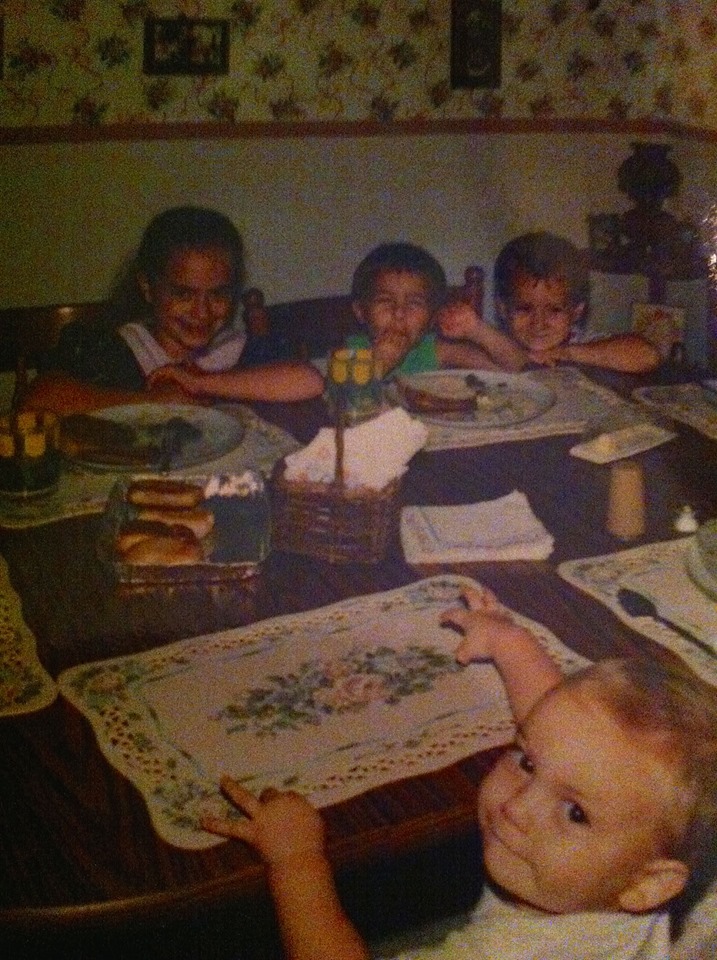
Even then, as I put like items together I remembered pushing two littles in a buggy with two older children on either side through the craft store or Walmart. I knew where this tidbit was purchased and what school or church project prompted buying dozens of a certain sticker or wooden cut out.
This past week I’ve been working on “my” side of our two-car garage.

It’s never been used as a garage but instead as a catch-all for a house that has no basement. My side is where I store pantry overflow and all kinds of supplies from toilet paper to party goods.

It’s also where I put some things from Dominic’s kitchen when we had to hurriedly empty his apartment over twelve years ago.

Twelve years. How can it be twelve years?

I finally had to do the hard work of deciding what I should REALLY keep and what it was time to let go of. I don’t like it. I don’t like it one little bit. But it is necessary.

I’m taking it in small doses-two or three hours a day-and trying to give myself grace when even that amount of time doesn’t seem to make a dent.

It’s grueling labor to dig up memories and lay down dreams.

Unrelenting emotional work.

Every bit tossed in the trash is a declaration that he isn’t coming back to claim it. I can’t ask him if he deems it worthy of saving because I can’t ask him anything.

That in itself is a kind of concession to defeat.

Where he is he doesn’t need or miss this stuff but it represents hopes and dreams to me.

I have to lay them down.

And that hurts.
Bereaved Parents Month 2026: No ‘At Least’ in Child Loss

I know most folks are doing the best they can to come up with something to say when both they and I know there’s nothing to be said.

So sometimes they fall into the trap of pointing out what I still have as if it makes up for what I’ve lost.

But there really, truly is no “at least” in child loss.

None. At. All.

“At least you had him for 23 years.”

Yes, but I thought I’d have him for my whole life!

“At least you still have three other children.”

Yes, but which one of yours would you choose to do without?

“At least  you know he’s in Heaven.”

Of course that brings me comfort and hope, but it doesn’t take away my pain.

A wise friend once said that any comment to a griever that begins with “at least” needs to remain unsaid.

It’s especially true for those of us grieving our child.

Because there is no “at least” in child loss.

NONE.

child-and-mama-heart-together

Bereaved Parents Month 2026: But I Had All That BEFORE!

I absolutely understand that when people say things like, “Just think of all the wonderful memories you have” or “He brought you so much joy” they mean well.

Because it’s true-I have beautiful memories of Dominic.  And he DID bring me great joy.

But I had those things BEFORE he was beyond my reach.

Childhood memories, photographs, mementoes from school and athletic teams-they were already displayed on the walls and shelves of my home.

But there were things I had then that I don’t have now:

  • his physical presence;
  • his laughter ringing down the hallway;
  • his text messages telling his absent-minded mama that there were storms headed her way;
  • his level-headed relationship advice;
  • and his tech-savvy, “I can fix it” help when I crashed my computer or other electronic device.

I don’t have a hundred different uniquely Dominic parts of my life anymore.

And I miss every one of them.  

missing from me

Bereaved Parents Month 2026: Simple Things Aren’t Simple Anymore

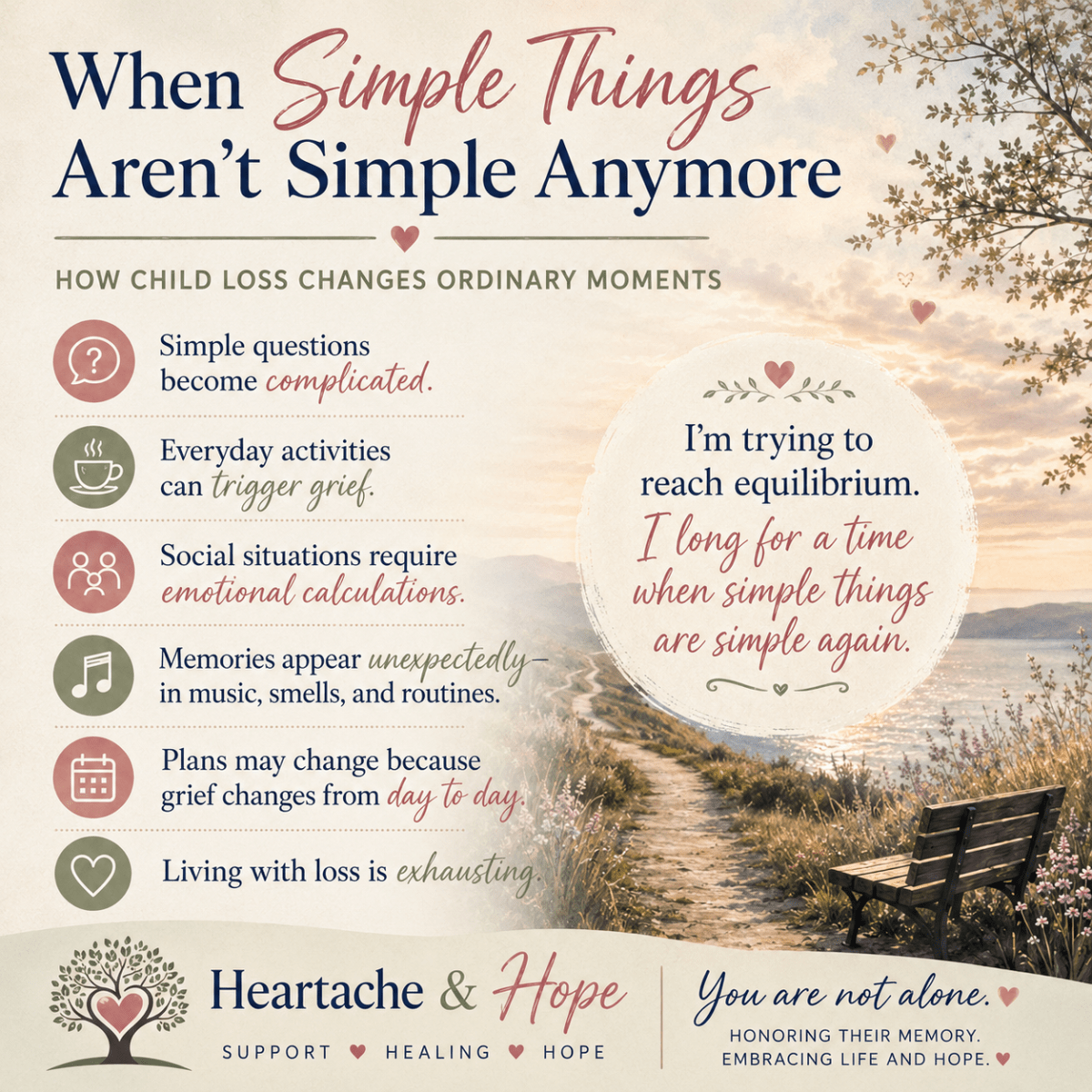
One of the things I’ve been forced to embrace in the wake of child loss is that there are very few questions, experiences or feelings that are simple anymore.

“How many children do you have?”

A common, get-to-know-you question lobbed across tables, down pews and in the check-out line at the grocery store.  But for many bereaved parents, it can be a complex question that gets a different answer depending on who is asking and where we are.

I decided from the beginning that I would say, “four” in answer to that query.

But that doesn’t always get me off the hook.  A follow-up of, “Oh, what do they do?” means that I have to make a decision:  do I go down the line, including Dominic in any kind of detail or do I gloss over the fact that one of my children now lives in heaven?

I try to gauge whether or not the person is deeply interested or just being polite. No sense making them feel uncomfortable if they are really only making chitchat.

All of these calculations flash through my mind in an instant but they are distracting and draining.

“Want to go to a movie?”

Maybe.  

First I have to look up the plot (something I never did before because I didn’t want to ruin it).  I can’t be stuck in a dark theater in the middle of a row full of people with no way out if larger-than-life there will be anything that sends me back to Dominic’s accident.

Same standards for television shows or books-but it’s easier to turn those off or set them down.

Sitting in church can be excruciating.  

A hymn or chorus, a Bible text, a random statement from the pulpit-any or all of those things can lead my thoughts down a path that takes me to a dark place where sorrow is overwhelming.

No matter how much I long to listen and participate, I find myself literally biting my tongue so that I don’t burst into loud sobs.

It doesn’t happen every Sunday, but I never know when it might.

Social media is an emotional minefield.  

first world problems

I confess that in the first days after Dominic left us, I had to limit the posts that showed up in my Facebook newsfeed.  It was too difficult to see complaints about children growing up or graduating and how hard it was to “let them go”. I could not take whiny status updates that included having to wait in line for the new iPhone.

It’s easier now that my grief isn’t so raw but there are days…

Making a meal, I reach for his favorite ingredient or leave something out because “Dominic doesn’t like it that way” and then I remember he won’t be here to eat it.

waves of grief

Music can transport me to a moment of joy or pain with a single note.

Sometimes I walk in a store and smell coffee-he loved coffee-and I have to turn around and leave.  Other times the fragrance draws my mind to sweet memories of shared Starbucks runs for a caffeine infusion.

If you ask me to do something next week or next month, I might say, “yes” and then find on that day I just. can’t. go.  

I used to be a woman who lived by her calendar and commitments, but now I’m someone who never knows what a day will bring.

Learning to live with this changed me is an ongoing process and exhausting at times.

So much energy is used up negotiating what used to be simple things that there’s not enough left for pursuing new interests or delving deeper into old ones.

I’m trying to reach equilibrium.  

I long for a time when simple things are simple again.

But I don’t think it will be today.

Grief Work 2026: Sorrow and Joy Can Live in the Same Heart

I’d like to encourage my fellow travelers in this Valley today.

Often I write about and share the hardest parts of this journey. Because there are so, so many hard parts!

And they are rarely spoken about above a whisper (if at all!) in greater society. I am determined to be as honest as possible lest I know of a hidden danger along the way and fail to warn you.

But there are also precious joys tucked away along the difficult path.

The trick is to train your eye to see them and your heart to receive them.

I’ll be the first to admit that for months (probably two years) despair and sorrow and loss were all I could truly feel.

Bereft is the word I’d choose if forced to choose only one.

I became so adept at finding the sad in every situation I fell out of practice in finding anything else.

To be honest, it didn’t take much to find the sad. Holidays were duller, celebrations were always missing one, even a sunrise didn’t shine as brightly knowing Dominic was never going to set eyes on that day’s bright glow.

At some point, unbidden, a tiny spark of gratitude-like a wildflower among weeds-drew my heart to joy. Even if I tried, I couldn’t help responding to the fact that not every moment of every day was clad in mourning clothes.

Little by little color seeped back into my life.

I found that if I grabbed those bits, held them close and meditated upon them, they soon came closer and closer together. They grew to fill not just moments but sometimes hours.

Do not be distant, O Lord, lest I become so mired in yesterday’s hurts, that I miss entirely the living gifts this day might hold.“Liturgy for Embracing Both Joy & Sorrow” from Every Moment Holy Vol. II: Death, Grief & Hope

I’ve written before that Gratitude and Grieving coexist.

I can’t weigh all my blessings on a giant cosmic scale against the bruising of child loss and make it balance. But I have also realized that I don’t have to live in a constant state of bitter sadness just to prove I love my son.

Life continues.

It brings good things, hard things, beautiful blessings and awful bruising. I have-in the years since Dom left us-had challenges and triumphs.

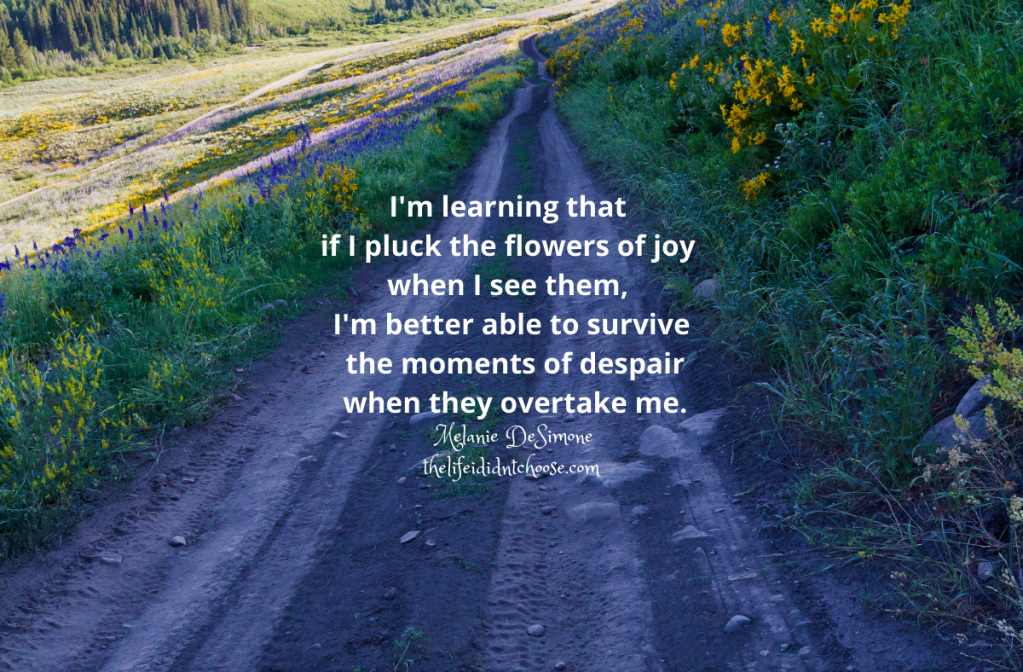
I’m learning that if I pluck the flowers of joy when I see them, I’m better able to survive the moments of despair when they overtake me.

Grief Work 2026: Importance of Boundaries After Child Loss

As a people-pleasing first born who hates conflict, giving in has always been  easy for me. It’s only later that I wish I hadn’t.  

So for most of my life, setting personal boundaries has been challenging.

But in the aftermath of child loss, healthy boundaries are no longer optionalthey are necessary for survival.  

So what are healthy boundaries?

  • Saying “no” without guilt
  • Asking for what you want or need
  • Taking care of yourself
  • Saying “yes” because you want to, not out of obligation or to please others
  • Behaving according to your own values and beliefs
  • Feeling safe to express difficult emotions and to have disagreements
  • Feeling supported to pursue your  own goals
  • Being treated as an equal
  • Taking responsibilty for your own emotions
  • Not feeling responsible for someone else’s emotions
  • Being in tune with your own feelings
  • Knowing who you are, what you believe, what you like

~sharonmartincounseling.com

What does this look like in real life?

  • Not being “guilted” into engaging in social/family/church activities before I am ready
  • Letting family and friends know when I need encouragement, companionship, solitude, help or space
  • Keeping or making doctor’s appointments and staying on top of my physical well-being by sleeping/eating/taking medication/exercising as best I can
  • Participating in what is helpful and life-giving to me when I want to and not because I feel like I have to.  
  • Giving myself space and time to figure out how losing a child impacts my beliefs, my sense of self, my understanding of the world-being honest about questions and about struggles.  If I have to take a break from church for awhile, that’s OK.
  • Expecting support from friends and family to do the work grief requires.  If some in my circle can’t do this, then I’ll put those relationships on hold until I feel stronger. I am not required to live up to other people’s standards.
  • Embracing and acknowledging my own emotions.  Not expecting someone else to “make me better”.  No one can take away the sorrow and pain of child loss.  It is excruciating.  There is no way through but THROUGH.  Face the feelings.  Get help from a counselor if necessary.  Join a support group.  Find safe friends.  But I will not be able to distract myself or ignore the heartache forever.
  • Understand that though I share the loss with others-a spouse, my surviving children, my child’s grandparents, etc-I am not responsible for how they are dealing with loss. I may offer help, may arrange counseling (especially for children), should strive toward an environment where feelings can be expressed-but I can’t work through their loss experience for them.  
  • Pay attention to my own feelings and what triggers grief attacks.  When I can, plan around the triggers.  When I can’t, accept the feelings and go with them.  If I need to leave a venue, leave.

What it doesn’t look like:  

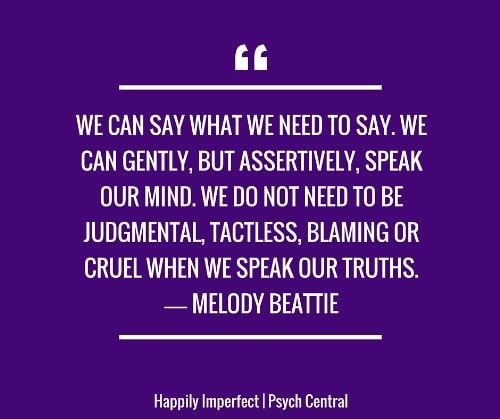
Healthy personal boundaries are not an excuse for bad behavior.  They are not to be used as blunt instruments to bully others into submission or to advance my own agenda against theirs.

My boundaries don’t give me the right to be hateful, hurtful or unkind.  They are not permission to pitch fits, make public displays or belittle others.  

say-what-we-need-to-say-gently

And they are absolutely NOT a reason to plaster hate speech across social media.  If I have a personal relationship issue then it needs to be handled personally and privately not publicly. Vague Facebook statuses that suggest I’ve been offended by half my friend list are off limits.

Establishing healthy personal boundaries is work.  

Already exhausted from grief, the last thing I want is more work.

But if I don’t defend the space and time I need to do the work grief requires I cannot make progress toward healing.

If I don’t limit my interaction with those who are unhelpful or downright hurtful, I will be dragged down further in the mire of sorrow and sadness.

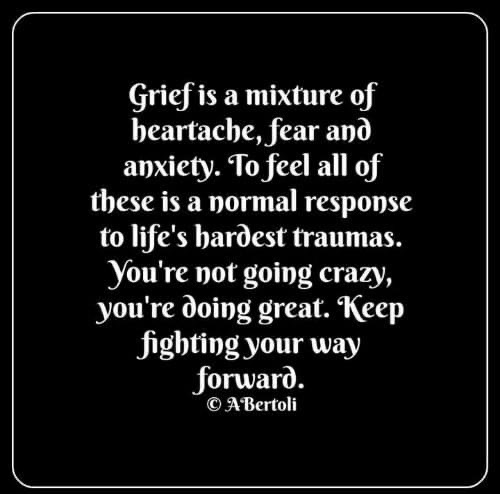
If I don’t purposely pursue physical, emotional and psychological healthgrief will kill me.

Grief Work 2026: How Trauma Affects Relationships and Healing

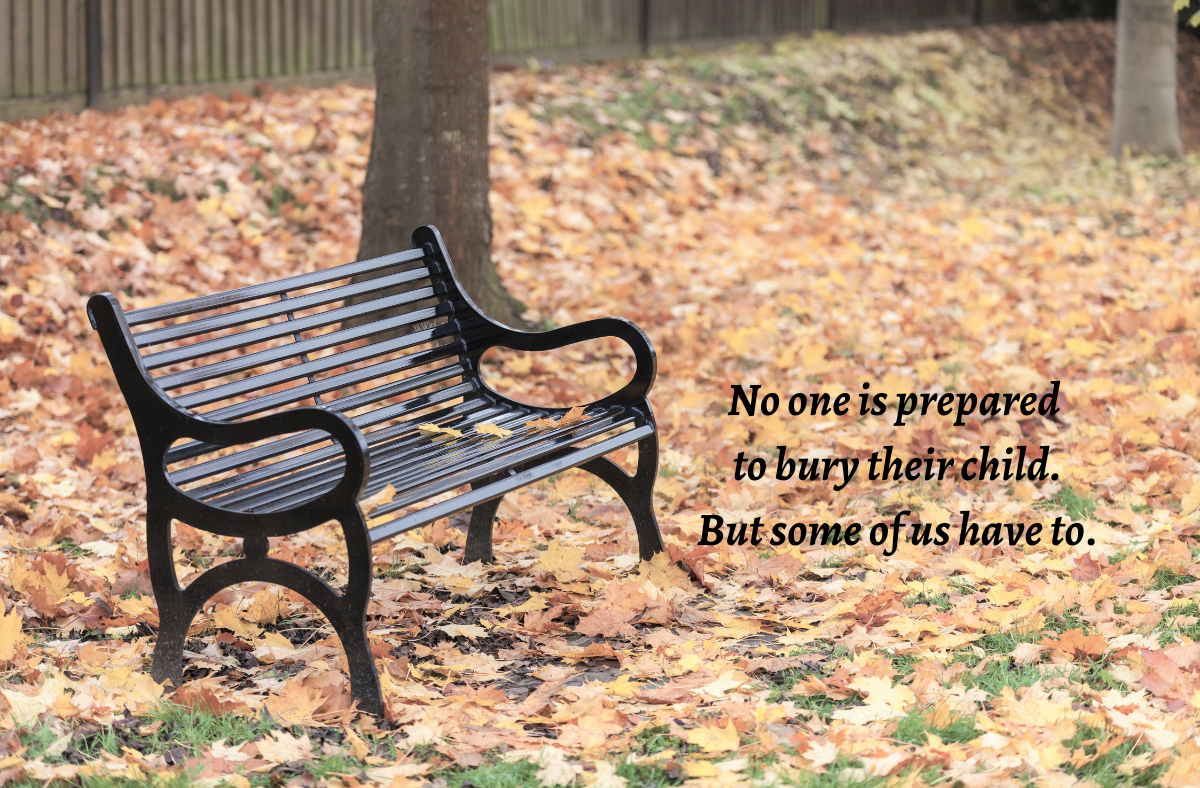
No matter how a child leaves this earth, it’s traumatic.

And trauma rewires our brains.

The “fight or flight” response that had previously been reserved for truly life-threatening situations gets woven in with memories and feelings and our bodies remain on high alert.

So before we know it, all kinds of ordinary, daily, and definitely not life-threatening situations evoke rapid heartbeat, shortness of breath, anxiety and fear. And the absolutely reasonable response is to get away from those things that make us feel that way.

So we do (or try to!).

We find ourselves running away from people who love us, who want to help us but who just might not understand why we’re running. We cocoon in our homes, in our own bodies and try to find that one safe space where fear and anxiety can’t find us.

But there is no such absolutely safe space.

Trauma rewires our brains, it’s true.

They can be rewired again.

So many good therapies are available for those of us who suffer in silence. Many are based on using physical cues to help a brain learn to distinguish between truly dangerous and only the memory of dangerous.

PTSD treatments and therapies

It is possible to venture out in the world again, to reach for and sustain connection, to lean into company instead of shying away.

Don’t stay hidden, afraid and alone.

Find a trained trauma counselor

Ask for help.

Grief Work 2026: Battling Despair With Truth

So much of this battle has been fought in my mind.

Really, even more than in my heart.

Because you can’t argue with sad or shock or missing or disappointment.

But you can absolutely argue with hopelessness (there is nothing to live for), apathy (there is nothing to do) and distrust (there is no one who can help me).

So I spend a lot of time filling my mind with truth and doing the best I can to empty it of lies.  Some days I’m more successful than others, but I battle on regardless.

dont let anyone rent space in your head toby mac

When hopelessness tries to take up residence I say:

Remember the word to Your servant upon which you have caused me to hope.

~Psalm 119:49

AND

Do you see what this means—all these pioneers who blazed the way, all these veterans cheering us on? It means we’d better get on with it. Strip down, start running—and never quit! No extra spiritual fat, no parasitic sins. Keep your eyes on Jesus, who both began and finished this race we’re in. Study how he did it. Because he never lost sight of where he was headed—that exhilarating finish in and with God—he could put up with anything along the way: Cross, shame, whatever. And now he’s there, in the place of honor, right alongside God. When you find yourselves flagging in your faith, go over that story again, item by item, that long litany of hostility he plowed through. That will shoot adrenaline into your souls!

~Hebrews 12:1-3 MSG

Apathy sits heavy on my chest and makes me want to give up and give in.  Why try if life is random and chaos is rampant? 

I push it off with:

28 We are confident that God is able to orchestrate everything to work toward something good and beautiful when we love Him and accept His invitation to live according to His plan. 29-30 From the distant past, His eternal love reached into the future. You see, He knew those who would be His one day, and He chose them beforehand to be conformed to the image of His Son so that Jesus would be the firstborn of a new family of believers, all brothers and sisters. As for those He chose beforehand, He called them to a different destiny so that they would experience what it means to be made right with God and share in His glory.

~Romans 8:28-30 VOICE

I remember that I still have work to do:  

“For we are His workmanship [His own master work, a work of art], created in Christ Jesus [reborn from above—spiritually transformed, renewed, ready to be used] for good works, which God prepared [for us] beforehand [taking paths which He set], so that we would walk in them [living the good life which He prearranged and made ready for us]. “

~Ephesians 2:10 AMP

The enemy of my soul whispers the same lie he told Eve in the garden, “God really doesn’t have your best interest at heart.  He’s holding out on you.  You can’t trust Him.”

I shout him down and declare:

all the promises of god are yes in christ

The God Who sent His only Son to save me will not let me go.  He will uphold me with His Righteous Right Hand.  Even in the flood of grief, the fire of trial and the darkness of despair, He is with me.  

carry you old age

I have verses and quotes and hymn choruses posted all over my house so that everywhere I turn, my eyes can land on encouragement.

I won’t win any awards with my decorating scheme, but I don’t care.

All of this will be dust one day. 

I’m building an eternal future that won’t rot, rust or decay.  

“3 Blessed is God, the Father of our Lord Jesus, the Anointed One! Because He has raised Jesus the Anointed from death, through His great mercy we have been reborn into a living hope— reborn for an eternal inheritance, held in reserve in heaven, that will never fade or fail. Through faith, God’s power is standing watch, protecting you for a salvation that you will see completely at the end of things.”

~ 1 Peter 1: 3-5 VOICE

Hallelujah!  Amen.

Grief Work 2026: Celebrate Those Baby Steps!

When my daughter was learning to walk, I would hover near-ready to catch her if she fell.

I covered sharp corners or moved furniture so that the chance of injury was minimized. I clapped and cooed each time she made a little progress-pulling up, cruising around the edge of the sofa and coffee table-those tentative moments when she was brave enough to let go and then plop on her bottom.

And finally, when she made her first unassisted steps between the security of holding on and my waiting arms.

It was a judgement free zone.  

I wasn’t looking for technical perfection or measuring progress according to any external metric.

crawling walking baby huff post

I didn’t rush the process. I couldn’t do it for her.  I could only support her own efforts toward the goal we both had in our hearts.  I never despised her baby steps.  

They were a beginning.  

And everything has a beginning.

When Dominic ran ahead to heaven, I felt like I was physically, mentally, emotionally and spiritually knocked to the floor.  I had no idea how I was going to make a life after this great blow.   I could barely get dressed, much less do anything that took more thought or energy than that.

I was overwhelmed.   I had to learn to walk all over again.

And I did it with baby steps, in a judgement free-zone I created for myself where I refused to gauge my progress against anyone else’s.

its all about the baby steps

Because baby steps count.

Here are some of the baby steps I’ve taken and am still taking:

  • Got up, got dressed, bought groceries.
  • Cooked dinner.
  • Cleaned the bathrooms.
  • Went to church.
  • Remembered a birthday and sent a card.
  • Drove to an unfamiliar place to meet someone for lunch.
  • Exercised.
  • Made phone calls.
  • Went to work.
  • Volunteered.
  • Slept through a whole night.
  • Organized a party.
  • Showed up to graduations, a couple funerals and a wedding.
  • Kept doctor’s appointments.
  • Laughed.

I have yet to hit my stride and I don’t think running is in my near future, but I am moving forward.  I’m making progress.  I don’t have to meet a timetable or get anyone else’s approval.  

It’s my journey.

And baby steps count. 

feet on path

Grief Work 2026: Balancing Solitude and Isolation

I’ve always loved my alone time.

As an introvert (who can, if pressed pretend not to be!) my energy is restored when I interact with one or two folks or no one at all.  A dream afternoon is writing while listening to nothing louder than the wind chimes outside my door.

I treasure solitude.

Since Dominic ran ahead to Heaven, I find I need even more alone time than before.

That quiet place is where I do my most effective grief work, undisturbed by interruptions and distractions.

But I need to be careful that solitude doesn’t shift into isolation. 

I have to remind my heart that spending time with others keeps me from falling so deeply down the well of despair that all I see is darkness.

I need human interaction to keep me connected to a world that, quite frankly, I might sometimes just as soon leave behind.

So how can I tell the difference between solitude and isolation?

Here are a few questions that help me figure that out:

  • Do I feel lonely, neglected or abandoned? If my alone time feels less like a gift and more like an unwelcome burden then it may be isolation rather than solitude.
  • Where are my thoughts taking me? Being alone is often the only way to “hear” my own thoughts without having to block out the noise and activity of other people. If I am sitting with myself, processing hard things or even beautiful things, resolving internal conflict, conjuring new ways to deal with difficult relationships or situations then solitude is doing its work. If, instead, I find my mind tangled up in fearful knots, filled with negative self-talk or unable to break a downward spiral into despair then I probably need to find someone to talk to.
  • Am I getting stronger or being drained? After the holidays or other hectic seasons I need time alone to recharge my batteries. Often it is almost a day-for-day exchange. I can feel tension melting away and strength returning. My mind begins to clear and life doesn’t feel so overwhelming. Solitude grants space for my body, mind and soul to be refreshed. When it slides into isolation I can feel the shift. Instead of waking refreshed and eager to greet a free day, I wake to dreading another long one alone. Instead of energy rising in my spirit, I can feel it draining away. Instead of thinking kindly of friends and family who choose to leave me be, I’m resentful no one has checked up on me.
  • Is there a helpful rhythm to my days alone or am I counting the hours until sundown? When I’m enjoying solitude, the hours feel like a welcome opportunity to do things (or not do things!) at my own pace and according to my own preferences. I sit with pen in hand and jot down a list knowing that if I complete it or if I don’t the only person I have to answer to is myself. No pressing appointments and no worrisome commitments. When I’m isolating, the hours feel like a long march through deep mud-every step tedious, treacherous and exhausting. I’m alone but I’m not getting any benefit from it. If I’m enduring instead of enjoying then I’m isolating.
  • Do I have an endpoint in mind? When I look ahead at a week on my calendar, I try to balance alone time with social commitments. A day or two alone (or with limited human interaction) is solitude. A week holed up in the house is isolation. If I find myself pushing off needed outings (to the grocery store, to run errands) then I ask myself, “why?”. Often it’s because I’ve drifted from solitude (helpful alone time) to isolation (unhelpful hiding).

I can shift myself out of isolation by choosing just one small social interaction.

I might text or message a friend, go to the grocery store and make a point of speaking to the clerk, call someone or show up at a church or community event even if I sit in the back and slip out early.

I’m never going to be that person who is up for every outing. That’s just not how I’m made and child loss has intensified my need for solitude.

But I don’t want to be alone and lonely, sinking deeper and deeper into a pit of my own making.

Some days it’s harder than others.

But I keep trying.