I first shared this post in 2016 when we had muddled through the first two holiday seasons after Dominic left us and were headed for a third.
Now facing our twelfth, there are some things that have changed a lot (adding grandchildren and losing my mama) and some things that remain the same (the ongoing struggle to balance everyone’s needs and expectations with the reality of sorrow).
I still find the principles I outlined years ago to be the best way to approach the season. We certainly don’t always get it right but we continue to strive to honor one another, to honor the true meaning of Christmas and to honor Dominic.
❤ Melanie
How do I honor the child for whom memories are all I have and love well the children with whom I am still making memories?
That’s a question I ask myself often.
And it is especially difficult to answer for celebrations and holidays, special events and birthdays.
I’ve probably had it a bit easier than many bereaved parents.
My children were all adults when Dominic left us for Heaven.
We have strong relationships and a track record of talking things through. So I can ask them about what is helpful to them and tell them what is hard for me. We all acknowledge that we are finding our way in the dark and that changing circumstances make it important to keep the lines of communication open.
We are experiencing our ninth set of holidays this year and have yet to establish a pattern or routine that works every time.
But here are some things we are learning together-some things my children are teaching me about surviving siblings and Christmas:
Parents shouldn’t try to hide their grief.This one is hard. As moms and dads we want so badly to create a safe world for our children-even our adult children! Yet we know by painful experience that it is impossible. When I try to hide my grief (which I cannot do successfully) I’m adding stress to an already stress-filled situation. That grief is going to escape somewhere-if not in tears, then in raised voices, impatient looks and short tempers. Children (even very young children) know that you are sad. Let them know by your example that it’s OK to be sad. Share your heart (in age-appropriate ways) and by doing so, give them permission to grieve as well.
Don’t force your child to grieve the same way you do. Some children find it easier to be open about emotions than others. The outward emotional expression of grief is different in each person. For some it looks like what we expect: tears, sadness, sorrow. For others it may look like anger or denial or an unwavering commitment to “keep everything the same”. Some children become very anxious about the safety of other family members. Some may remain stoic-don’t force emotional responses. Do some reading/research on grief in children and be prepared for the different ways a child may express their pain.
Ask you child(ren) how they feel about certain events/traditions/remembrance ideas. Even young children may have strong opinions about what feels good and what feels awful. It’s tough to find a balance among competing needs but at least knowing how different family members are experiencing the holiday gives parents an idea of how it might be accomplished. Sometimes surviving siblings can help parents find a creative solution to the quandary of how to honor the missing child and how to bless surviving children.
Don’t require that your child(ren) participate in every event or gathering. This is especially helpful for older children-but parents should be sensitive to the young ones as well. Give your child(ren) permission to say, “no” if they don’t want to be part of a particular event. Some parents want to do balloon releases or light candles at a special service for their missing child. What’s healing for the parent may not be healing for a surviving sibling.That’s OK. Do the same for family gatherings. Don’t force a sibling to contribute a “favorite memory” or “story” during a family memorial time.
Grant space and remain flexible. Things that sound like a good idea while still far off on the calendar can feel overwhelming as the day approaches. Sometimes no matter how much I WANT to do something, I. just. can’t.It’s the same for surviving siblings. Be gracious and allow for changing feelings/circumstances. They may truly wish they could commit or participate but realize that when the day is here, they just don’t have the emotional energy to do it.
On the other hand, be alert if a child withdraws completely.Withdrawal may be a silent scream for help. The pain may have become too great to process but the child doesn’t know how to ask for help. You are the parent. You can’t “fix” your child. But you can take him or her by the hand and lead them to someone who can discern the best way to give them the skills to cope with the loss of their sibling.
Affirm your living child(ren). Let them know that you love them in ways that are most meaningful to them. Every person has a unique “love language”-a preferred way to be loved. Learning what speaks to your child(ren)’s heart helps to ensure that they don’t feel forgotten or overlooked even as you grieve the child that is missing from your family circle.
Express appreciation for your child(ren)’s continued support for your own grief. My kids are a vital part of my grief support system-just as I am for them. We all love Dominic and our hearts all hurt and miss him. I am thankful every minute of every day that they listen to me, let me cry and love me through hard moments.
Understand that sometimes your surviving child(ren) might need to leave the missing sibling behind or set him or her aside for an event or celebration. It’s hard to remain in the shadow of “the one gone before”. They may not want that special day to be referenced as “so many days/months/years since we lost ______”. Of course our mama or daddy hearts can’t help but think of it that way! BUT-this is THEIR day, THEIR moment. Let them have it. It takes nothing away from your love for the missing child to affirm and lavish love on the child you can still hold.
Remember, that just like for you-each year may be different. What works one time may not work this time. Extend, and be willing to receive, grace
I am trying hard to love and honor and support the children still with me and also make room for Dominic, who lives in our hearts.
It’s a delicate balancing act on a spiderweb of intersecting strings-I’m still learning and it’s hard.
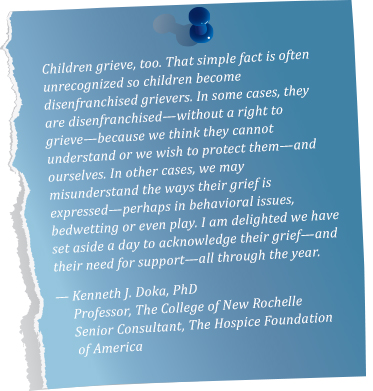
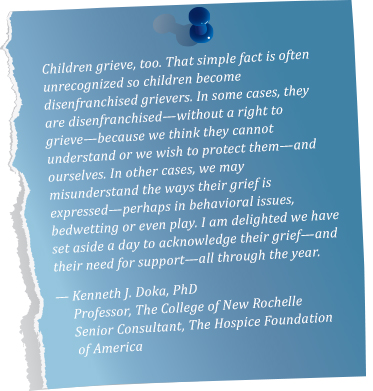
I’m thankful a day is set aside to focus on children’s grief because it’s so easy for their grief to be overlooked, underrated and even dismissed.
Grown ups often tout the line, “Kids are resilient. They will adapt.“
And while it’s true that from the OUTSIDEit might look like a child is OK or even thriving, on the INSIDEshe may be curled up into a ball or he may be angry and resentful.
Sometimes these feelings find unhealthy expression through addiction or risky behavior. Sometimes they simply grow into a giant overwhelming shadow that darkens the child’s whole world.
My own mother’s mama died suddenly from a stroke when she was only ten years old. Within days, Mama was whisked away from everyone and everything she knew to live with her oldest married sister.
No one understood then that children needed to grieve so Mama never really did.
At least not out loud where anyone could hear.
But that grief informed her entire life-it made her kinder to many people and made it harder for her to develop deep attachments to others. She was only able to talk about it in the last couple of years of her life when failing health, my own loss and many hours spent in hospital rooms together created safe spaces for her to share.
Children grieve whether we observe it or not.
Children need safe spaces to express that grief even when it hurts our hearts to hear the words or see the tears.
No child should have to wait until they are grown to acknowledge his pain or her brokenness.
Just like we parents, surviving siblings grieve what they’ve lostANDwhat will never be. Graduations, weddings, new babies, holidays, birthdays and other occasions mark their hearts too.
Children bear other burdens as well.
They are often targeted by those outside the grief circle for updates on the family while their own grief goes unnoticed. After five years, my kids have developed a standard answer to the question, “How’s your mom doing?”
“About as well as you’d expect.”
Next.
Sometimes children feel they must be extra good and extra quiet in an effort to make up for the sadness in a home after the death of a child. Sometimes they take on adult roles, shouldering responsibilities a depressed or grieving parent can’t manage right now. Sometimes they struggle with misplaced guilt when their hearts are jealous of all the attention focused on the missing child.
Often they just wish things were back to how they were before tragedy struck.
Your children may never tell you these things unless you ask.
I was unprepared for the many traveling companions grief brought with it. I knew to expect sadness and despair–but what about anxiety and guilt?
I had no idea how large a space guilt would soon occupy in my thoughts and heart-guilt over what I did or didn’t do when Dominic was still with us, guilt over what I do or don’t do now.
I can do nothing to change what happened in years past.
There is no magic time machine that will allow me to go back and linger long over his jokes or cling harder when he hugged me.
But I can choose to approach today in a way that frees me of foolish guilt and unnecessary regrets.
I can’t do everything but I can do something.
I can love big and brave and refuse to waste the days I have with the people that mean the most to me.
In addition to their own heartache, bereaved parents carry the heartache of their surviving children.
The family everyone once knew is now a family no one recognizes. Hurting hearts huddle together-or run and hide-and it is so, so hard to find a way to talk about that pain.
There is definitely a time and place for professional counseling. Many, many families benefit from having a trained individual, outside the immediate grief circle, guide them in exploring feelings, developing coping strategies and learning to live life this side of loss.
But there is also something to be said for arranging casual open-ended activities with surviving siblings, parents and even grandparents where space and a more relaxed atmosphere often leads to honest sharing.
This graphic has lots of excellent suggestions for how to craft such a space.
Not all will be suitable for every family, but every family should be able to find a few that fit.
I’ll add these guidelines that may help your family make the best choice for YOU:
Don’t force it. If you make an offer of an activity and it drops with a thud to the ground, let it go. You might be able to do it another time.
Don’t make it (what my kids like to say!) a “mandatory option”. There must be no guilt or coercion invading this space. If one or more of your family members consistently refuse to join in, consider asking a close family friend to take that individual out alone and see what might be going on.
If you choose a movie or other story-themed activity, LOOK UP THE PLOT! I can’t tell you how many times we were sideswiped by a death scene or some other heavy emotional plot twist. There may be a time when your family is prepared to experience those things together (we can now) but it may not be yet.
Mix and matchmore structured activities with open-ended ones like walks outside, watching the sunset, sitting on the beach, hanging at the pool, playing a game (not too competitive-that will sometimes bring out hidden anger).
If you have a family with a broad range of ages you might have to do some things with the littles and some with the older kids. You can always add one or two activities a month or quarter where everyone (or as many as are available) gets together.
If your children, spouse, parent or other close griever begins to talk-let them. If tears flow-that’s progress! If ugly feelings are expressed, listen. Try not to be defensive. Try to hear the hurt behind the words. It’s OK to set ground rules like using “I” statements and not blaming. But don’t shut them out or shut them down.
These are just ideas.
Google is your friend and your phone is probably already in your hand or pocket-use it.
Grieving parents often face the additional challenge of trying to help their surviving children process the death of a sibling.
While there are many factors that influence how a particular child understands and works through his or her grief, age at time of bereavement plays a significant role.
Children’s grief can look very different than that of the adults around them.
And that grief may resurface later on as the child grows and matures, even long after the death of a loved one.
I think often about the things my children know that others don’t have to know.
The fact that life is precious, short and never guaranteed no matter how young or healthy you may be.
The reality that doing everything right or keeping your nose clean or staying “prayed up” doesn’t guarantee you’ll be spared from death, destruction or devastation.
It’s true that several generations ago folks grew up knowing all these things as a matter of course. But we’ve forgotten so much of this with antibiotics, life extending interventions, emergency medicine and abundant food, water and other resources.
I never interact with my earthbound kids without thinking about all the ways we are changed because death has invaded our home and our lives.
❤ Melanie
My youngest son worked hard to retrieve some precious digital photos from an old laptop.
Being very kind, he didn’t tell me that we might have lost them until he was certain he had figured out a way to get them back.
So he and I had a trip down memory lane the other evening.
It was a bumpy ride.
Because for every sweet remembrance there was an equally painful realization that Dominic would never again be lined up alongside the rest of us in family pictures.
The British have a saying, “mind the gap” used to warn rail passengers to pay attention to the space between the train door and the platform. It’s a dangerous opening that one must step over to avoid tripping, or worse.
I was reminded of that when I looked at those old pictures-my children are stair steps-averaging two years apart in age.
But now there will always be a gap between my second and fourth child-a space that threatens to undo me every time we line up for a picture.
I cannot forget that Dominic SHOULD be there. I will never, ever be OK with the fact that he is missing.
To be honest, I miss him most when the rest of us are all together. The space where he should be is highlighted because all the others are filled in.
No one else may notice, but I have to step carefully to keep from falling into a dark hole.
I have a heart for ALL mamas-the ones who are just starting out all the way up to the ones who launched their fledglings and have an empty nest.
I especially have a heart for mamas who have had to say “good-bye” to one or more of their precious children-sending them on ahead to heaven.
I’ve never met one that didn’t wonder if she did enough, said enough, loved enough-WAS enough.
This one’s for you.
❤ Melanie
I have a love/hate relationship with social media.
On the one hand, it allows instant communication and easy sharing of special events among friends and family in ways we could only dream about when my kids were tiny. On the other hand, the perfect pictures and carefully curated lives posted for the world to see place great pressure on those of us who look around at our messy houses and messy lives.
Add to that the articles and memes passed around and you have a perfect combination to crush a mama’s spirit.
Are my children being kept safe? Are they being kept too safe? Are they in the right school, the right sport, the right music program? Should I feed them this or that? Am I doing enough?
Am I enough?
Am I a bad mama?
Can I just tell you something struggling mama? Can I give you a lifeboat in the ocean of doubt?
God chose you before the foundation of the world to be your child’s mama. He knows everything about you-past. present and future-and He chose YOU to help shape this little life into the person He created your child to be.
Yes, you make mistakes.
Yes, you are flawed.
Yes, you will do some things well and some things not so well.
But that is no surprise to God.
Look closely at the families in the Old Testament-you don’t have to get past Genesis to find dysfunction all over the place. But God isn’t limited by our limitations.His plan isn’t thwarted by our inability to follow directions.His purposes do not depend on perfect parenting.
Hallelujah! AMEN!
So buckle up and hold on-do the best you can to guide your family down the road God lays before you. You will make some bad decisions and need to do a few U-turns.
That’s OK.Lean into the One Who made you and made your children.
I jumped from the high dive at three years old-that belly flop hurt but I survived and it fueled my adventurous spirit.
I rode horses other people didn’t like-was bucked off a time or two but no broken bones so that didn’t slow me down.
My dad had an open cockpit biplane and we flew aerobatics over Colorado Springs-fanny pack parachute strapped to my butt “just in case”-upside down and round and round. We never needed to jump and landed safely every time.
Never been afraid of speaking in public.
Never been afraid of strangers.
Never been afraid of heights.
UNTIL.
Until I had children and then I was afraid of nearly EVERYTHING for them.
I didn’t want any harm to befall these tiny humans carrying my heart outside my body. I wanted to protect them, to cushion them, to wrap them in a bubble so that nothing bad ever happened to them.
As they grew, I learned to let go- alittle at a time. I learned you can’t prevent the scrapes and bruises and heartaches and disappointments of life. And I learned that a little “harm” made them stronger.
I forgot most of my fears and was again unafraid.
UNTIL Dominic was killed.
And all the old fears came rushing back.I wanted to lock my surviving children in a room and slip food under the door. I HAD to keep them safe.
Only I can’t. It is not possible for me to keep. them. safe.
All I could possibly do is make them afraid.I could make them afraid of choosing their hearts’ desires in an attempt to prevent more pain for mine.
I won’t do that.
I will not allow part of Dominic’s legacy to be that our family lives afraid.
NO.
I choose to release my children and grandchildren to make the best choices they can and to live boldly and unafraid.
When it first happened all I could think about was getting through a minute, then a day and then all the decisions and days leading up to a funeral or memorial service.
There’s no road map.
Even when others come alongside (and many, many did!) there’s just no easy way to navigate that part of the journey.
And then I realized that in addition to all the “regular” days that absolutely, positively break your heart, I had to forge a path through “special” days.
It was overwhelming!
Mother’s Day was especially challenging that first year. Our loss was fresh and we’d had to acknowledge and celebrate two graduations and a wedding was about a month away. How in the world could I honor my living children and also safeguard my broken heart?
We muddled through by having Mother’s Day at my daughter’s apartment co-hosted by some of her sweetest and most compassionate friends. Not a lot of fanfare, but good food, good company and a quiet acknowledgment of Dom’s absence but also my living children’s presence.
It was a gift.
This is my twelfth Mother’s Day. Every year is different. Every year presents new challenges and every year things change.
Since discovering there is an International Bereaved Mother’s Day my heart has taken advantage of having a day to think about and honor Dominic and then another day to think about and honor my living children.
That helps.
I wrote this post years eight ago but can’t really improve on it so I’ll share it again. I pray that each heart who finds Mother’s Day hard will lean in and take hold of the hem of His garment.