Can I Quit Now?

Yesterday was one of those days-a mixed bag.  I enjoyed an unseasonably cool yet sunny day but sorrow was sighing in the blowing breeze.

I’ll be honest:

I want to quit.

I want to give up.

I’m tired of hauling the extra weight of grief while trying to do the everyday.

charlie brown too tired to cry

Every. single. thing. is harder and takes more effort than it used to.

I want a time-out!  

I’d take even two minutes of absolute unadulterated rest and joy.

I am stronger and more capable than I was, but today, this minute-I’m just plain tired.

I’m often teetering on the brink of despair and forced to throw out my arms in a desperate attempt to maintain my  balance.

Six months ago, in one of my first posts, I wrote:

One reason grief is so exhausting is that every step I take is on a balance beam of faith and hope.

I must navigate every necessary task without falling off.

Read the rest here:  Walking The Balance Beam


Stronger

If you meet me now at the grocery store or pass me in church, I probably won’t cry.

I will most likely ask you how you are, what you’ve been doing and smile when you share the latest family news even if in the midst of the words a thousand alarms go off in my head, reminding me of Dominic.

Because I’m stronger.

There’s a common misconception about grief among those who have never experienced the loss of a close loved one.

It goes something like this:  The first few weeks, months and the first holidays celebrated without them are the hardest.  But once the bereaved make it through THOSE, things get EASIER.

I’m here to tell you that, at least for me, it’s just not true.

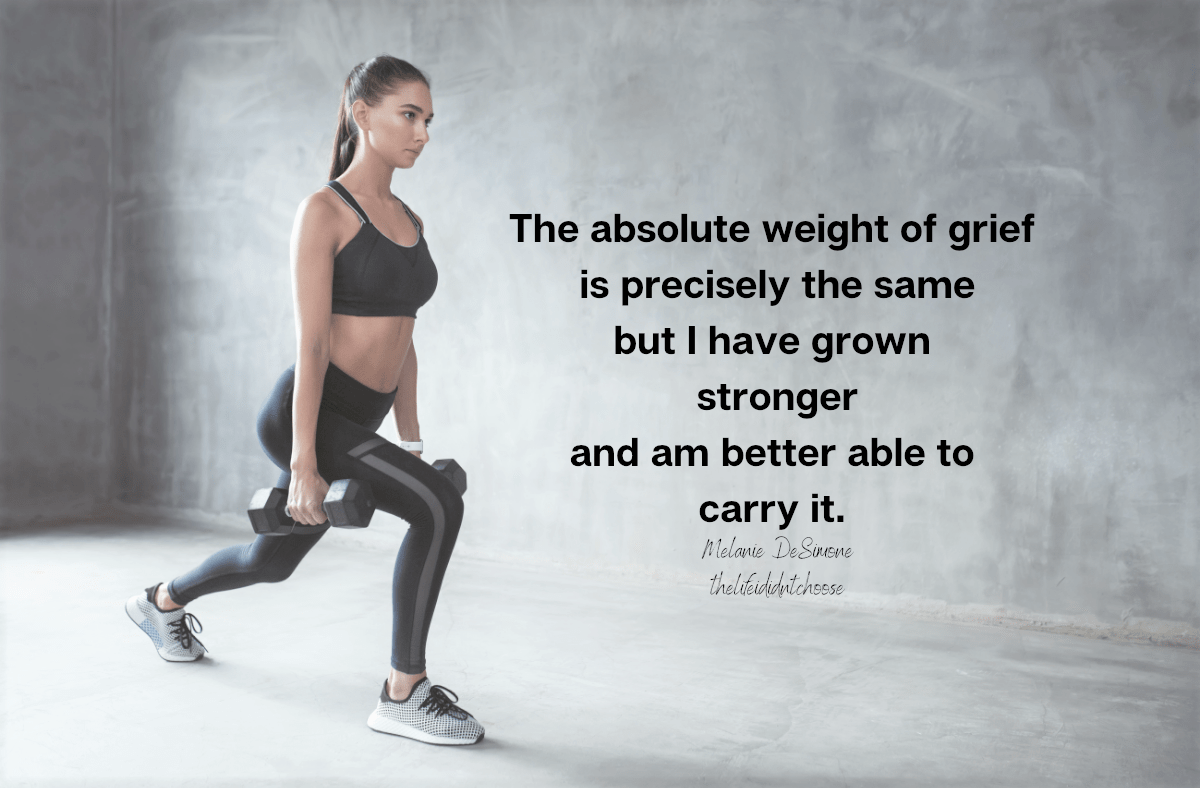
A better picture of how I am continuing in this grief journey is to think of it as weight lifting.   I started with a 250 pound barbell raised over my head-no warning, no training-that knocked me to my knees and threatened to press the life out of me.  But friends and family came alongside and helped me lift the heavy weight for a season.

And I survived.

Each day, I have to get out of bed and lift that weight.

  • Over time, my muscles have grown stronger.
  • Over time, I’ve become more adept at keeping my grip.
  • Over time, I’ve learned a few tips and tricks to balance the bar more evenly, to situate myself more strategically beneath it and to breathe through the lifting so that I don’t become light-headed and faint.

But there are still days, still moments, when my balance is off and I can be crushed by the weight of grief.  There are times when life adds a few more pounds onto the bar and even my stronger arms are unable to lift it up and carry on.

And in those moments or on those days, the full weight of sorrow and pain and longing overwhelm me.  That’s when I understand how Paul felt when he wrote:

We are pressed on every side by troubles, but not crushed and broken. We are perplexed because we don’t know why things happen as they do, but we don’t give up and quit. We are hunted down, but God never abandons us. We get knocked down, but we get up again and keep going. These bodies of ours are constantly facing death just as Jesus did; so it is clear to all that it is only the living Christ within who keeps us safe.  

2 Corinthians 4: 8-10

I sit in my floor and cry out to God for mercy, cry out to Him for strength, cry out to Him for grace to rise and carry on.

I am thankful that it’s no longer every day.  I’m relieved that I can do routine things more easily.  I can smile. I can even laugh.

I am stronger.  I am more capable.

But I am never completely free of the load.  

Not Quite So Dry Bones: Learning to Dance Again

I wrote this post several months ago–when falling autumn leaves turned my mind to how every living thing dies.  When the thought of another holiday season without a complete family circle pressed hard against my eyeballs and threatened to undo me.

I felt so very tired.  Some days I still do.  Some days are “dry bone” days.  But there are days when I hear laughter–look around and realize it flows from my own mouth.

I believe God is healing me.  He is restoring life to my bones.  He is redeeming my pain and resurrecting my hope.

It is a process.  So if you have only recently begun a grief journey, don’t despair.  It is hard and it is long.  But there is hope.

Grief has sapped the strength from my body and the life from my bones.  It has turned this forward-thinking planner into someone who rarely ponders even an hour from now.

I was a visionary.  

Now I’m a survivor.

I understand why Naomi changed her name to Mara-“bitter”.

When I read her story in the book of Ruth, I’m tempted to challenge her across time to “look on the bright side” and to “think of the future”.  But she felt her hope and her future had died and been buried with her husband and sons.  She was old.  She was spent.  She couldn’t understand what God was doing or imagine life beyond this moment or this day.

She was dried up all the way down to the bone.  

The breath of the promise of God had left her heart and she was barely there.

But God brought joy back into her life, He breathed life into her dry bones.

The book of Ezekiel records an amazing vision.  God shows the prophet a valley of dry bones.

Very dry bones.

No-life-even-in-the-marrow bones.  

And He challenges Ezekiel to prophesy to them:

Then he said to me, “Prophesy to these bones and say to them, ‘Dry bones, hear the word of the Lord!  This is what the Sovereign Lord says to these bones: I will make breath enter you, and you will come to life.  I will attach tendons to you and make flesh come upon you and cover you with skin; I will put breath in you, and you will come to life. Then you will know that I am the Lord.’” (Ezekiel 37: 4-6 NIV)

I long to have the LORD make His breath enter once again into my own dry bones, so I read His word and prophesy to my dry bones.

He is the God of the resurrection, and He will redeem my sorrow and pain.  

He IS the breath of life.   

I am clinging to His promises and trusting His heart.

One day, these dry bones will dance!

Perspective is Everything

NOTE:  I’m including links to another blog and an old post of my own.  You’ll see that I am unskilled at inserting them smoothly. Yet another in the list of losses–Dominic was my tech advisor…

When my husband and I visited the Sequoia National Forest, we were overwhelmed by the enormity and beauty of the trees.  Even standing beside them, it is hard to realize how very huge they are.  But when you are able to drive your car through one of them, that gives you  some perspective.

Losing a child changes your perspective.  Some things look bigger than they did before and some much smaller.

And some things I thought I understood, I find I don’t understand at all.

Lately I have been challenged to re-read Bible stories I once blazed through like a novel and pay more attention to the people in them and their feelings and lives.

I was reminded of the story of Hagar by fellow blogger Janet Boxx [Boxxbanter.wordpress.com] when she commented on my recent post Sparrows Do Fall:

(https://thelifeididntchoose.com/2016/01/12/sparrows-do-fall/)

And I am ashamed to realize that until now, I saw Hagar’s story as a kind of minor corollary to the over-arching and “more important” story of Abraham.

But to Hagar and Ishmael, this was THE story–it was THEIR story and it was as important as any other story that was happening at the same time.

Perspective is everything.

Eye-witness testimony is often touted as the most solid proof when presenting a criminal case.  But those who study eye-witness accounts know that there can be as many versions of a story as there are people who see it.

What stands out to one person will be ignored or misremembered by another. Different witnesses focus on different aspects of the same scene because their individual experiences make them vulnerable to having their attention turned to various details.

I know that before I lost a child, I was more likely to focus on the “good” that came from the child’s death:  testimonies of lives changed, people coming to Christ, community activism on behalf of a cause or a condition that contributed to the death.

But now, I’m consumed by thoughts of the child’s parents.  I think about the siblings left behind.  I know by experience that they are just beginning a life-long journey that will be so very hard.

When others view the lives of bereaved parents, it is easier for them to place the narrative that consumes the attention, energy and passion of the parents within the larger story of “what God is doing in the world” because they (the non-bereaved) can see the panorama while we (the bereaved) are looking through a keyhole.

And no matter how you twist and turn to try to expand your view when it is limited by physical facts that defy alteration, you just can’t do it.

Hagar called the LORD, Jehovah-Roi,” The God Who Sees”.  

As a slave, no doubt Hagar was often overlooked and undervalued.  But the God of the Universe, SAW HER.

I know in my bones that God does see.

I don’t know or understand what He’s doing, but I know He sees. It is both comforting and disturbing–part of my ongoing wrestling.

Being seen is powerful.  When another comes alongside as witness to my journey, it is helpful.  It speaks courage to my heart to keep on walking and to continue to trust.


Things I’m Learning

The way things are supposed to be isn’t always the way things are.

I can experience joy and sorrow in the same breath.

The capacity to love and extend grace is enlarged by suffering if I submit to it and don’t fight it.

Never, never, NEVER underestimate the power of presence or texts or the random, “thinking of you” card.

Encouragement comes from unexpected sources.

Truth is the best defense against lies.

I was not nearly as grace-filled or kind as I thought I was before Dominic died. I’m trying to do better.

Hard things are hard.

Sad things are sad.

There’s no use pretending to be stronger than I am, God knows already and no one else is served by my pretending.

Questions are o.k.

My faith is a gift from God, is kept by God and I cannot “lose” it.

Grief is exhausting.

Life is exhausting.

Doing both at the same time is REALLY exhausting.

There is no limit to the pain you may have to endure this side of heaven.

Lightning can strike twice in the same place, and fear of what you know by experience trumps fear of the unknown by miles.

I can decide where to focus my thoughts.

Feeding fear is a choice. feeling fear is not.


Reminded to Rest

I was reminded in the past few days that I am oh, so vulnerable to attack when I am already wounded.  And that even when I see it coming, I am often unable to fend it off successfully.

The enemy taunts me and encourages me to compare my life with the lives of others.  He stands on the sidelines and calls out, “Your Father loves others better than you!”  He accuses in the shadows, “You are a failure.  Your faith is pitiful.  You will not persevere to the end.”

But he is a liar and the father of lies and deception and untruth are his native tongue.

I have to go back, again and again and again, to the Truth and recite it, write it, declare it and hold fast to it.

I must remember that every promise of God in Christ is “yes” and “amen”.

I must remind myself daily that victory has already been declared even when I can’t see it or feel it.

And when I am too tired to fight, I must allow myself to withdraw and catch my breath-extending the same grace to me that I would extend to another in my place.

It is o.k. to draw boundaries and to create safe places where I can recuperate and regain my strength.

I am not in competition with anyone else.  God has marked my course and He will lead me home.


But I stand silently before the Lord, waiting for him to rescue me. For salvation comes from him alone.

Psalm 62:TLB


Fragile

If you’ve ever had major surgery you know that the outside looks whole way before the inside is healed.

That’s how it is with grief–those of us who have lost a child appear to be strong–we have to be, because life doesn’t stop.

Not even for burying a child.

No matter how tightly I strap on my armor, grief sends arrows through the tiniest unprotected chink and pierces my heart.

There is no defense against the sound, the smell, the wayward memory that sends me back in time to when Dominic was alive and with me.  And once there, to drag myself forward to today—where he is neither—is torture. 

Sometimes the process can be a matter of seconds, the only evidence a blank stare or a single tear.  Other times the memories and the forceful return to the here and now unleashes a flood from my eyes and ends my usefulness for that day.

Either way, it’s exhausting. 

I think that might be one of the most surprising aspects of grief for me.  When it strikes hard (as it still does sometimes) it robs me of energy and the desire to do anything.

I am a “get-it-done” kind of person.  But there’s no way to get grief “done”.  It works itself out in its own time and in its own way.

I can position my mind and my heart to heal by focusing on the promises of God in Scripture.  But I cannot hurry along the healing.

And healing, when it comes, will always be incomplete this side of heaven.

Please don’t mistake the fact that I can stand straight and look strong as proof that I am recovered. 

I am often frightened and sometimes I want to hide.

But vulnerable and wounded, I remain until God calls me home.

“In His feathers He shall deliver you and under His wings you shall have refuge; His truth shall surround you as a supply of armor.”

Psalm 91:4

grief and sleep

Boy, do I envy my cats’ ability to fall asleep any place, any time.

I’ve lived with chronic physical pain for over a decade and there are nights when it is hard to go to sleep-when it is impossible to ignore the pain.  But I have never thought of myself as having trouble sleeping.

Until now.

When grieving a child, you are oh, so very tired.  Yet often sleep eludes you.

“He who learns must suffer.  And even in our sleep pain that cannot forget falls drop by drop upon the heart, and in our own despair, against our will, comes wisdom to us by the awful grace of God.”

Aeschylus

Lying in bed, in the dark, my mind kicks in to hyper-drive.  With no external stimulation to provide distraction, images come unbidden and unwelcome to taunt me.  I work hard to guide the train of thought to a less tortuous route.

So I thought I would share some ways that help me make it through the long nights:

  • Only lie down when you are tired enough to expect that you can fall asleep.  I am physically active each day so that at least my body is ready for rest.
  • Don’t drink caffeinated beverages after 12 noon and don’t eat heavy foods past mid-afternoon.
  • Be selective about what you listen to, watch or read in the hours leading up to bedtime.  I try to feed my mind images and information that will help me focus on more positive themes when I close my eyes.
  • Keep a pad and pencil next to the bed to jot down last minute reminders of things you might need to remember tomorrow.  I try to think ahead and have a rough plan of action for the next day so that my mind can rest.
  • Make sure you are physically comfortable–room temperature and bed clothes appropriate to the season, pajamas in soft fabrics, well-hydrated, take analgesics as needed for physical pain, etc.
  • Make whatever concessions are needed to hold anxiety at bay.  I have a nightlight in my bathroom that casts a soft glow into my bedroom.  I keep my cell phone and home phone next to me because once you get “that call” you feel like you must be instantly accessible to loved ones.  My cat sleeps with me–purring is a great comforter.
  • When I turn out the light and turn over, I purposely focus my mind’s attention and heart’s affection on trusting God to help me drift off to sleep.

“I can lie down and go to sleep, and I will wake up again, because the Lord ·gives me strength [sustains/upholds me].”

Psalm 3:5 EXB

  • If you wake up in the middle of the night, try reciting Scripture, poems, humming hymns or other music to lull yourself back to sleep. I will sometimes do mental work like planning a project or trying to recall a childhood memory–anything that might make me tired.
  • If  you can’t go back to sleep in 30 minutes or so, get up and get on with the new day–even if it is only hours old.  There’s no use lying in bed and tossing and turning. While I may be exhausted for that day, I’m almost certain to be able to sleep better the next night.

Sleep is important.

If you find that you are unable to get more than a few hours sleep for longer than two weeks–talk to your doctor.  There is NO SHAME in asking for help. And there are many products available that are non-habit forming and suitable for short-term use.

It is impossible to do the work grief requires if you are worn out from lack of sleep in addition to carrying the pain of losing your child.

“We sleep, but the loom of life never stops, and the pattern which was weaving when the sun went down is weaving when it comes up in the morning.”

Henry Ward Beecher

If we can help ourselves get the rest we need, we are better able to face the challenge of each new day.

Worn

I used to think the expression, “the straw that broke the camel’s back” was an exaggeration meant to paint a comical picture of someone who didn’t have sense enough to remove pounds of heavy bricks but buckled under the tiniest extra weight of a single straw.

Now I think it accurately describes those of us with no control over the baggage we have to carry and who find that it really is the small things that force us to the ground.

Just when I’m convinced I have this grief load well-balanced so that the weight, though heavy, is bearable, along comes LIFE and throws the whole rig out of kilter.

Grieving my son means that while I can usually get through the day, I have no extra emotional, psychological, physical or spiritual energy to draw on when things get just a little more challenging:

  • I mean to encourage, but miscommunicate my heart to a friend and hurt her feelings.
  • Family members have needs I can’t meet.
  • People I expected to lend a listening ear spend our time together unloading on me instead.
  • My rheumatoid arthritis flares and moving around just plain hurts.

And I realize that the load I thought I was managing is much too heavy and threatens to crush the wind right out of my lungs.

With my strength gone, the sorrow and the missing and the unanswerable questions dog-pile on my prostrate spirit.

The song “Worn” by Tenth Avenue North describes perfectly how I felt last night:

I’m tired
I’m worn
My heart is heavy
From the work it takes to keep on breathing

I’ve made mistakes
I’ve let my hope fail
My soul feels crushed
By the weight of this world
And I know that you can give me rest
So I cry out with all that I have left

Let me see redemption win…Let me know the struggle ends…That you can mend a heart that’s frail and torn.

I want to know a song can rise…From the ashes of a broken life…And all that’s dead inside can be reborn…‘Cause I’m worn…

I know I need
To lift my eyes up
But I’m too weak
Life just won’t let up
And I know that You can give me rest
So I cry out with all that I have left

Let me see redemption win…Let me know the struggle ends…That you can mend a heart that’s frail and torn

I want to know a song can rise…From the ashes of a broken life…And all that’s dead inside can be reborn…Cause I’m worn…

And my prayers are wearing thin, I’m worn even before the day begins.
I’m worn I’ve lost my will to fight, I’m worn so heaven so come and flood my eyes.

Let me see redemption win… Let me know the struggle ends…That you can mend a heart that’s frail and torn.

I want to know a song can rise…From the ashes of a broken life…And all that’s dead inside can be reborn…

Repost: What Grieving Parents Want Others to Know

I’m sharing this post again because based on response, it continues to speak to grieving parents and to their family and friends.

If you know someone who has lost a child, I hope these words give you insight into how very hard it is to keep going while carrying that burden.

If you are a bereaved parent, you might find sharing this post helps your circle of friends and family get a glimpse inside your own heart.


People say, “I can’t imagine.

But then they do.

They think that missing a dead child is like missing your kid at college or on the mission field but harder and longer.

That’s not it at all.

It isn’t nostalgia for a time when things were different or better or you talked more: it’s a gut-wrenching, breath-robbing, knee-buckling, aching groan that lives inside you begging to be released.

There is no smooth transition up the ladder of grief recovery so that you emerge at the top, better for the experience and able to put it behind you.

We’ve all heard the much touted theory that grief proceeds in the following stages:

  • denial
  • anger
  • bargaining
  • depression
  • acceptance

And people (who haven’t experienced grief) tend to think it’s a straight line from one stage to another, gradually going from bottom to top and then on with life.

But it just isn’t true.

Reality is, these “stages” coexist and fluctuate back and forth from day to day and even hour to hour.

Grief remakes you from the inside out.

Losing a child has made me rethink everything I believe and everything I am.  It has changed and is changing my relationship with myself and with others in ways I couldn’t imagine and often don’t anticipate.

And it is hard, hard work.

Life around us doesn’t stop.  Grieving parents return to work, continue to nurture their surviving children, keep getting up in the morning and taking care of daily details.

We are doing all the things others do, but we are doing them with an added weight of sorrow and pain that makes each step feel like wading through quicksand.

We want you to know we are doing the best we can.

Life without my child is like having a leg amputated–I am forced to learn to manage without it, but everything will always be harder and different. And it will be this way for the rest of my life.

The one thing a grieving parent DOESN’T want you to know is how it feels to bury your child.

I don’t want anyone else to know what it means to leave part of your heart and a chunk of your life beneath the ground.

“But please: Don’t say it’s not really so bad. Because it is. Death is awful, demonic. If you think your task as a comforter is to tell me that really, all things considered, it’s not so bad, you do not sit with me in my grief but place yourself off in the distance away from me. Over there, you are of no help. What I need to hear from you is that you recognize how painful it is. I need to hear from you that you are with me in my desperation. To comfort me, you have to come close. Come sit beside me on my mourning bench.”

Nicholas Wolterstorff   LAMENT FOR A SON