Solitude or Isolation? Which is it?

I’ve always loved my alone time.

As an introvert (who can, if pressed pretend not to be!) my energy is restored when I interact with one or two folks or no one at all.  A dream afternoon is writing while listening to nothing louder than the wind chimes outside my door.

I treasure solitude.

Since Dominic ran ahead to Heaven, I find I need even more alone time than before.

That quiet place is where I do my most effective grief work, undisturbed by interruptions and distractions.

But I need to be careful that solitude doesn’t shift into isolation. 

I have to remind my heart that spending time with others keeps me from falling so deeply down the well of despair that all I see is darkness.

I need human interaction to keep me connected to a world that, quite frankly, I might sometimes just as soon leave behind.

So how can I tell the difference between solitude and isolation?

Here are a few questions that help me figure that out:

  • Do I feel lonely, neglected or abandoned? If my alone time feels less like a gift and more like an unwelcome burden then it may be isolation rather than solitude.
  • Where are my thoughts taking me? Being alone is often the only way to “hear” my own thoughts without having to block out the noise and activity of other people. If I am sitting with myself, processing hard things or even beautiful things, resolving internal conflict, conjuring new ways to deal with difficult relationships or situations then solitude is doing its work. If, instead, I find my mind tangled up in fearful knots, filled with negative self-talk or unable to break a downward spiral into despair then I probably need to find someone to talk to.
  • Am I getting stronger or being drained? After the holidays or other hectic seasons I need time alone to recharge my batteries. Often it is almost a day-for-day exchange. I can feel tension melting away and strength returning. My mind begins to clear and life doesn’t feel so overwhelming. Solitude grants space for my body, mind and soul to be refreshed. When it slides into isolation I can feel the shift. Instead of waking refreshed and eager to greet a free day, I wake to dreading another long one alone. Instead of energy rising in my spirit, I can feel it draining away. Instead of thinking kindly of friends and family who choose to leave me be, I’m resentful no one has checked up on me.
  • Is there a helpful rhythm to my days alone or am I counting the hours until sundown? When I’m enjoying solitude, the hours feel like a welcome opportunity to do things (or not do things!) at my own pace and according to my own preferences. I sit with pen in hand and jot down a list knowing that if I complete it or if I don’t the only person I have to answer to is myself. No pressing appointments and no worrisome commitments. When I’m isolating, the hours feel like a long march through deep mud-every step tedious, treacherous and exhausting. I’m alone but I’m not getting any benefit from it. If I’m enduring instead of enjoying then I’m isolating.
  • Do I have an endpoint in mind? When I look ahead at a week on my calendar, I try to balance alone time with social commitments. A day or two alone (or with limited human interaction) is solitude. A week holed up in the house is isolation. If I find myself pushing off needed outings (to the grocery store, to run errands) then I ask myself, “why?”. Often it’s because I’ve drifted from solitude (helpful alone time) to isolation (unhelpful hiding).

I can shift myself out of isolation by choosing just one small social interaction.

I might text or message a friend, go to the grocery store and make a point of speaking to the clerk, call someone or show up at a church or community event even if I sit in the back and slip out early.

I’m never going to be that person who is up for every outing. That’s just not how I’m made and child loss has intensified my need for solitude.

But I don’t want to be alone and lonely, sinking deeper and deeper into a pit of my own making.

Some days it’s harder than others.

But I keep trying.

Broken Legs, Broken Hearts, Broken Lives

Sometimes I’m envious of folks hobbling along in those plastic boots designed to support an injured leg or ankle and aid healing.

Not because of the injuryI’m thankful I’ve never broken a bone-but because it’s an outward warning to anyone who might otherwise be impatient or insensitive that they just can’t go any faster.

I think there ought to be a t-shirt, pin or banner that gives the same kind of warning for those of us walking around with broken hearts and broken lives.

But there isn’t.

Except for the first shell-shocked days immediately following Dominic’s death, I look pretty much the same as I always have.

Most of us do.

If you lined up a hundred parents and scattered ten in the group who had suffered child loss, very few people would be able to single them out.

The giant heart wound we bear is barely noticeable to the uninitiated.

Yet even years later, we need extra support, extra care, extra grace to help us continue to heal.

There’s no plastic boot to fit around a broken heart. But there are things friends and family can do to create safe spaces that protect it.

  • Remember my heart is tender and easily bruised.
  • Speak about my child in Heaven. When I hear his name it is music to my ears.
  • Allow me to graciously bow out of activities or gatherings that are noisy, busy or filled with people I don’t know.
  • Don’t change the subject when I become emotional because you are uncomfortable-acknowledge my pain as a perfectly acceptable response to an unfathomable loss or just hug me.
  • Help me carry the light and life of my missing child by sharing memories, photographs or mementos. It’s a great gift to know that my child is spoken about, remembered and loved by others.
  • Recognize that while I am stronger, the absolute weight of my burden isn’t lighter. On some days it’s heavier than others so don’t be surprised by tears that seem out of place or out of time.
  • Remember important dates like my child’s birthday or memorial service day or even when he or she would have graduated high school or college if denied that opportunity. My heart mark all those silent grief anniversaries even when no one else recognizes them. It can be awfully lonely. Compassionate companionship expressed in a note, text or call helps so very much.
  • Please don’t give up on me! There may be seasons when i isolate in an effort to protect my heart. I know it’s hard to continue to reach out to someone who won’t reach back, but sometimes I just don’t have the strength to do it even when the distance is short. Try again in a little while.

If you know someone whose child has run ahead to Heaven, don’t ignore the wound.

Reach out.

Don’t insist that they walk as fast or as unencumbered as you might.

Be willing to slow down and walk with them awhile.

Emotional Overload Means I Have to Be Careful With Those I Love

There are so many ways child loss impacts relationships!

Some of the people you think will stand beside you for the long haul either never show up or disappear right after the funeral.

Some people you never expected to hang around not only come running but choose to stay.

And every. single. relationship. gets more complicated.  

When your heart is shattered, there are lots of sharp edges that end up cutting you and everyone around you.  It’s pretty much inevitable that one or more relationships will need mending at some point.

Read the rest here: https://thelifeididntchoose.com/2018/12/29/emotional-overload-and-t-m-i/

I’m Still A Wife, Mother, Daughter, Sister, Friend


It would be helpful if the world could just stop for a day or a week (or a year!) when your heart is shattered by the news that one of the children you birthed into this world has suddenly left it.

But it doesn’t.

And immediately all the roles I have played for decades are overlaid by a new role:  bereaved mother.  Except instead of being definitive or even descriptive, this role is more like a foggy blanket that obscures and disorients me as I struggle to fulfill all the roles to which I’ve become accustomed.

Read the rest here: https://thelifeididntchoose.com/2018/12/16/wife-mother-daughter-sister-friend/

Repost: Lessons Learned

I don’t believe for one minute that child loss is a test or curriculum or punishment.  

But I  do believe there are things I can learn from it. 

I absolutely believe there are things I HAVE learned and am learning in this Valley of the Shadow of Death.

What are some of those lessons?

Read the rest here: https://thelifeididntchoose.com/2018/12/03/lessons-learned/

Holidays 2019: Practical Ideas for Dealing With Holidays After Child Loss

It cannot be overstated:  holidays are extremely hard after loss.  Every family gathering highlights the hole where my son SHOULD be, but ISN’T.

There is no “right way” or “wrong way” to handle the holidays after losing a child.

For many, there is only survival-especially the very first year.

These days also stir great internal conflict:  I want to enjoy and celebrate my living children and my family still here while missing my son that isn’t. Emotions run high and are, oh so difficult to manage.

So I’m including some ideas from other bereaved parents on how they’ve handled the holidays.  Many of these suggestions could be adapted for any “special” day of the year.

Not all will appeal to everyone nor will they be appropriate for every family.  But they are a place to start.

Read the rest here: https://thelifeididntchoose.com/2016/09/04/practical-ideas-for-dealing-with-the-holidays-after-child-loss/

Holidays 2019: What The Bereaved Need From Friends And Family

This is the most shared post on the site.

When I wrote it, I was writing my personal feelings after a couple of years trying to fumble through holidays with friends and family. It was an honest expression of how hard it was and continues to be to navigate the stress-filled season of Thanksgiving through New Year’s Day.

I’m not sure I’ve grown any more skillful in fitting all the pieces together-especially as our family grows and moves in different directions-but I continue striving to keep the lines of communication open and to try to acknowledge and accommodate everyone’s needs as best I can.


“I know it is hard.
  I know you don’t truly understand how I feel.  You can’t.  It wasn’t your child.

I know I may look and act like I’m “better”.  I know that you would love for things to be like they were:  BEFORE.  But they aren’t.

I know my grief interferes with your plans.  I know it is uncomfortable to make changes in traditions we have observed for years.  But I can’t help it I didn’t ask for this to be my life.

I know that every year I seem to need something different.  I know that’s confusing and may be frustrating.  But I’m working this out as I go.  I didn’t get a “how to” manual when I buried my son.  It’s new for me every year too.

Read the rest here: https://thelifeididntchoose.com/2016/09/03/grief-and-holidayswhat-the-bereaved-need-from-friends-and-family/

Holidays 2019: Grief, Holidays And Hard Conversations

One of the things I’m learning in this journey is that people are much more likely to listen and be willing to make accommodations for my tender heart if I approach them BEFORE the “big day”-whatever that may be.

And yes, it seems unfair that those of us carrying a load of grief are also the ones that have to alert others to the load we’re carrying, but that’s simply the way it is.

They don’t know what they don’t know.

So, if you need to change things around consider speaking up NOW instead of huffing off LATER.

Here are some tips on how to approach those hard conversations: https://thelifeididntchoose.com/2016/09/02/grief-holidays-and-hard-conversations/

Holidays 2019: Blessing The Brokenhearted

The question is starting to pop up with greater frequency in our closed bereaved parent groups: How do you make it through the holidays after child loss?

So for the next few days I’m going to share again from the many posts I’ve written in the past four years addressing different aspects of holiday planning, celebration, family dynamics and just plain survival for grieving parents and those who love them.

❤ Melanie

Most parents feel a little stressed during the holidays.

We used to be able to enjoy Thanksgiving before our 24/7 supercharged and super-connected world thrust us into hyper-drive.  Now we zoom past the first day of school on a highway toward Christmas at breakneck speed.

For bereaved parents, the rush toward the “Season of Joy” is doubly frightening.

Constant reminders that this is the “most wonderful time of the year” make our broken hearts just that much more out of place. Who cares what you get for Christmas when the one thing your heart desires–your child, alive and whole–is unavailable…

Read the rest here: https://thelifeididntchoose.com/2015/11/19/season-of-joy-blessing-the-brokenhearted-during-the-holidays/

I Need To Tell The Story (Even If You’ve Heard It Before)

I have so much more empathy for older folks since Dominic ran ahead to Heaven.

I’ve always tried to be a patient listener when hearing that same story over and over and over but have to admit that sometimes I’d drift off or internally mock an elder because I was tired of hearing it.

Not anymore.

Because I understand now that it’s in the telling that one both commemorates and honors people as well as the past.

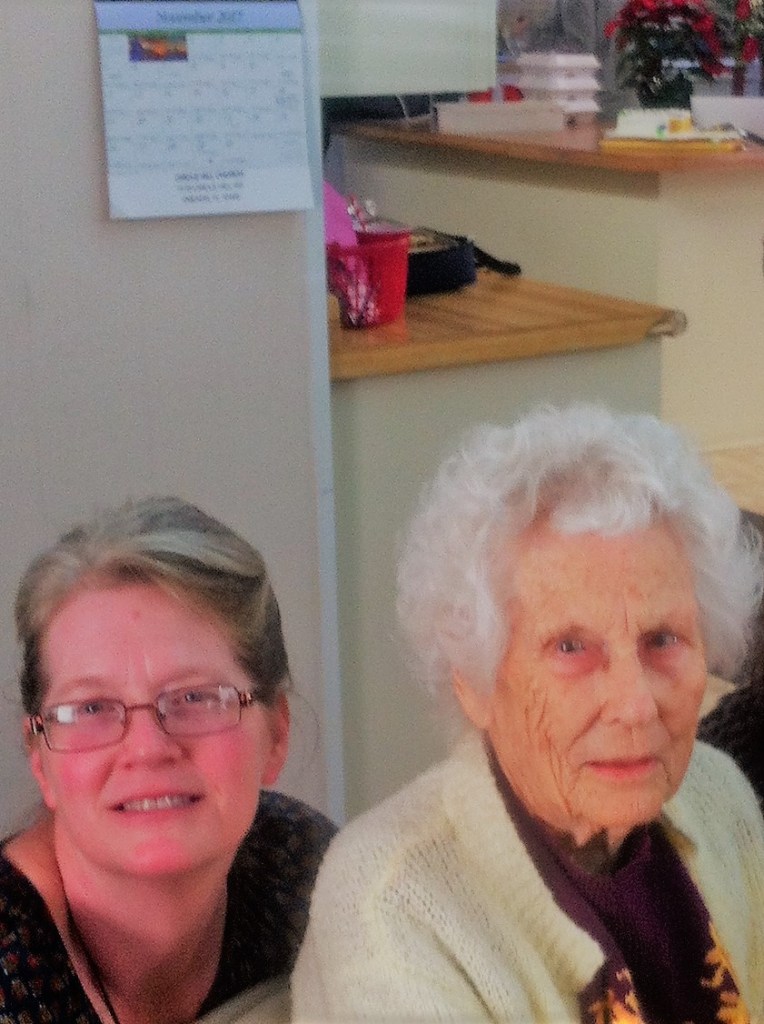
Me and Aunt Mattie Lou at her 99th birthday.

Stories are how we weave facts into narrative and give them meaning. It’s why so many of us love historical fiction or period dramas that not only reference actual people and events but also peek at emotions, motivation and draw conclusions.

I could hand you my daily calendar and you’d understand the outline of where I was and what I did.

But you wouldn’t know what I thought or felt that day unless I filled it in.

When Dominic ran ahead to Heaven, I was forced at first to deliver the most basic message to others who needed to know. I repeated it over and over, “I have to tell you something awful. Dominic is dead.”

I didn’t really know much more than that.

Details were added by friends and first responders in the days to come.

The story broadened to include how we reassembled our family from across the country, who showed up to help us through the first hours, where we chose to bury him, what the funeral service looked like and on and on and on.

For months afterward I found myself compelled to repeat the story of those days.

Compelled to rewind and play again the details, each time teasing out additional insights, questions and feelings.

It was an important part of unspooling and exploring what, exactly, it meant to live in a world that no longer included one of my children.

I know sometimes folks get tired of me telling the story. For them, it is a reminder of some awful event that is tucked neatly in the past. A date on a calendar somewhere that might occasionally tickle the back of their brain and evoke a, “that’s so sad” response but not something they live with every. single. day.

But for me, Dominic’s death is an ongoing experience.

Every day I have to fit his absence into my world. I have to find a way to live around the giant void where he SHOULD be but ISN’T.

So the story grows.

It’s not only what happened on the day he left, it’s what has happened since and is still happening now.

When you make space for me to tell, you make space for me to feel.

And that helps my heart hold on.