Bereaved Parents Month Post: Bereaved Parent’s Wish List

This list is adapted from a friend’s Facebook post (with permission) and a list published by Children’s Hospital of Colorado.

BEREAVED PARENT’S WISH LIST:

1. I wish my child hadn’t died. I wish I had my child back.

2. I wish you wouldn’t be afraid to speak my child’s name. My child lived and was very important to me. I need to hear that my child was important to you also.

Read the rest here:  Bereaved Parent’s Wish List

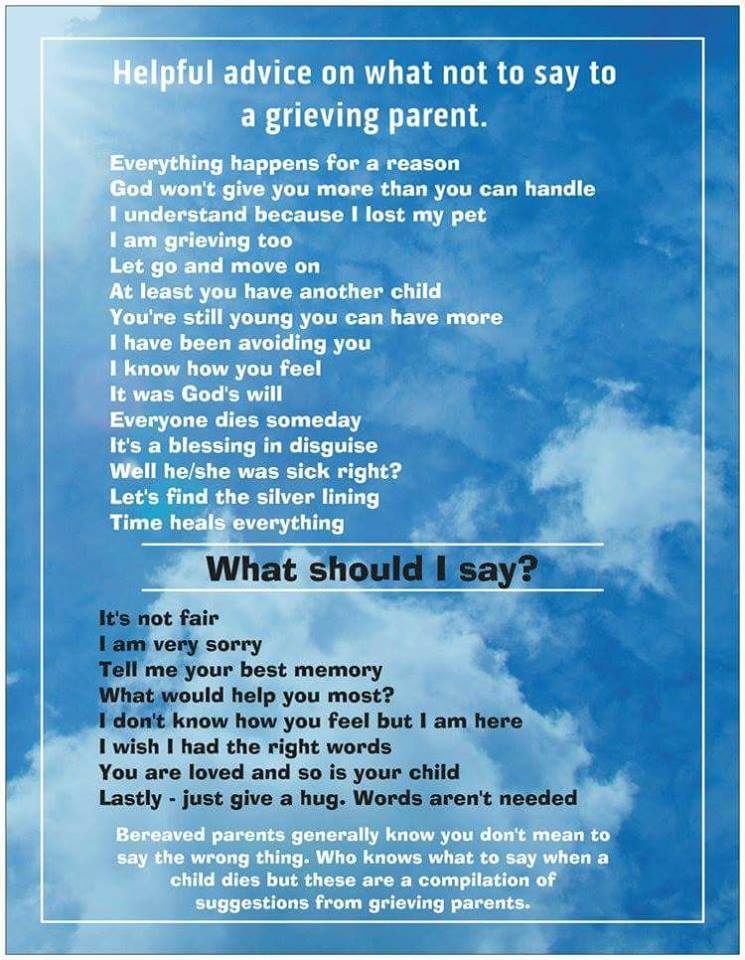
At Least?

“At least you had him for 23 years.”

Yes, but I thought I’d have him for my whole life!

“At least you still have three other children.”

Yes, but which one of yours would you choose to do without?

“At least  you know he’s in Heaven.”

Of course that brings me comfort and hope, but it doesn’t take away my pain.

A wise friend once said that any comment to a griever that begins with “at least” needs to remain unsaid.

It’s especially true for those of us grieving our child.

Because there is no “at least” in child loss.

NONE.

child-and-mama-heart-together

Bereaved Parents Month Post: How Do You Breathe?

It was the question I asked the bereaved mother that came to my son’s funeral.

It was the question a mother asked me as we stood by her granddaughter’s casket, surrounded by family and flowers.

And it is the right question.

Because when the breath leaves the body of your child, and you look down at the shell that used to be the home of a vibrant, living soul, you simply can. not. breathe.

Read the rest here: How Do You Breathe?

Feeling Our Way in the Dark

Often this journey through the Valley of the Shadow of Death is dark and lonely.  

man in woods with glowing light

I am frightened of what may lay in wait-tragedy has visited once, it could come again.

I know Jesus is my Shepherd and I never doubt His companionship.  But if I’m honest, as much as I lean into that truth, it’s oh, so helpful to have a living, breathing human being walk with me.

So when a friend reaches out and takes my trembling hand it calls courage to my heart.

When we huddle together in the dark places, waiting out the storm of grief or doubt, it gives me strength to carry on.

Never, never underestimate the power of presence.

For now we see in a glass darkly, but then face to face, and now we know in part, but then we shall know fully just as we have been fully known

I Corinthians 13:12

So until then, what?
We feel our way in the dark.
Until we find each other.
We huddle together in the storm.
Wet and shivering, but together.
And maybe in the end it will be our huddling in the storm that gives us more comfort than our understanding of the storm.”

~Ken Gire, The Weathering Grace of God


me too sharing the path

Bereaved Parents Month Post: What Grieving Parents Want Others to Know

I wrote this post December, 2015.  It hadn’t been long since I joined an online community of bereaved parents and began to see that I wasn’t the only one who had friends and family that misunderstood child loss.

I was spending a lot of time in my life trying to help others comprehend, just a little, what it felt like to bury a child.

Trying to give them a tiny taste of how this pain is so, so different than any other I had experienced.  Begging them to toss the popular ideas bandied around that grief followed “stages” and was “predictable”.

I re-share every so often because it seems to help, a little.  I’m re-sharing today in  honor of Bereaved Parents Month. ❤

People say“I can’t imagine.

But then they do.

They think that missing a dead child is like missing your kid at college or on the mission field but harder and longer.

That’s not it at all.

What Grieving Parents Want Others to Know

Mountains and Mole Hills

There’s a saying in the South, “You’re making a mountain out of a mole hill”.

It’s supposed knock sense into someone who is overreacting to a small and easily resolved problem.  Most of the time it works-stepping back and gaining perspective is a good thing.

But I find that this side of Dominic’s leaving, many, many things that were mole hills before are MOUNTAINS now.  Because my faith in my own ability to handle things has become so very small, nearly any challenge feels like a never-ending ascent up the mountain.

I used to be the person who crossed “t’s” and dotted “i’s”.

Shoot-my whole wedding was organized on 3×5 index cards kept in a tiny filing cabinet (long before online wedding sites!).  I still have that little metal box and can recite who received an invitation, who responded, who attended, what gift they gave us and when I wrote the “thank you” note.

Not anymore.

If I don’t put my truck keys in exactly the same spot, I will never find them.  And panic sets in about 60 seconds after I realize I don’t know where they are.

Everyday hiccups are absolutely exhausting and larger issues are downright debilitating.

It reminds me of a move my family made from Atlanta, Georgia to Denver, Colorado when I was twelve.

Denver is known as the “Mile High City” because on the first step of the capital building it is 5,280 feet above sea level.   My sea-level body had to work hard to live that much closer to the sun.

denver huff post

The first year was a real challenge because the red blood cells that had been sufficient to carry oxygen to my brain, vital organs and tissues at near sea-level, were woefully insufficient to carry enough oxygen to my extremities a mile closer to the sun. Eventually my body caught up to the new reality and made more corpuscles.

I’m afraid my mind, heart and spirit have yet to catch up to THIS new reality of life after child loss.

I am quickly struck down and discouraged when what SHOULD be a mole hill rapidly turns into a MOUNTAIN.

Regardless of what it looks like or feels like to anyone else, it IS a mountain to ME.

And that takes so much energy to scale.  It requires so much discipline to face.  It wears me out and uses up my resources so that I’m left depleted, panting and oh, so  tired from the effort.

I wish I could help those outside the child loss community understand just how much it takes for me and everyone like me to do what has to be done.

We aren’t being lazy or overly emotional or “making too much of nothing”.

We live in a different world than the rest of you.

Our air has less oxygen.  

Our bodies have to work harder to do what comes easily to the rest of you.

I promise we are trying.  But willpower can’t make up for the resources we just don’t have.

doing the best we can is all we should expect mr rogers

Bereaved Parents Month Post: I am NOT Crazy!

I shared this post for the first time a year ago.

Before I was part of the community of loss parents, I had no idea how quickly we are expected to “move past”, “get over” or “deal” with the death of a child.

I was horrified to find out that even though most parents would say something like, “I just don’t know how I would survive if my child died” they were the very ones who thought I should sail past this life-shattering event after what they deemed an “appropriate” amount of grief and/or time.

So I’m sharing again in honor of Bereaved Parents Month.  If these words speak to you or for you, please share them.  We need to help others understand our lives this side of child loss.  ❤ ~Melanie

It was just over a year after Dominic’s accident and a friend forwarded an article about odd behaviors of those who were “stuck’ in grief.  Along with the forward was a little tag, “Reminds me of you.”

It hurt my feelings.

And it was inappropriate.

Read the rest here:  I am NOT Crazy!

I Don’t Cry Every Day Anymore

I’ve never really been much for lots of tears.  

Most of my crying before Dominic ran ahead to heaven consisted of silent tears slipping down my cheeks and onto my chin. Every now and then I would have a good, old-fashioned sob.

But between April 12,2014 and that October or November, I cried every day.  I cried so much I thought surely I would run out of tears.  I cried so much I needed to drink more water to remain hydrated.  

Then it stopped.  

The ache settled deeper into my bones and tears no longer came as an easy outlet for the pain I was feeling.

I still cried a few times a week, but not as long or as loud as those first months.  I could tell (most of the time) what had triggered the tears-a photo, a song, an item his hands had touched, a memory or even a whiff of someone who wore the same cologne walking past in a crowd.

Then THAT stopped.

just because no tears doesnt mean heart doesnt hurt

I got so good at stuffing the immediate emotional response I hardly ever cried anymore.

Except that sometimes-random moments-the heavy lid I keep screwed down tight on all those feelings comes undone.  And I am helpless as the sorrow, missing and horror of child loss creeps up my spine, raises my heart rate and settles as a silent scream at the back of my throat.  

A sob escapes.  The tears flow.  Usually I’m done for that day-left a quivering mass of emotional jello, unable to pack it all up and get on with things.

And that’s OK.

I don’t cry every day anymore, but when I do, it’s a necessary and important part of the healing process.  

I won’t apologize for my tears.  

grief-is-loves-souvenir


Bereaved Parents Month

Before Dominic ran ahead to heaven I knew only a handful of bereaved parents, all of whom I met after their bereavement.

I had never walked with anyone through this Valley.

Now I am friends with dozens of them and there are hundreds more I “know” online through private groups and blogs.

Until this was MY life, I would have dismissed “Bereaved Parents Month” as another random and narrowly applicable declaration by some group trying to muster support for their own agenda.

I’m ashamed to say that, but it’s true.  

Like most folks,  I assumed my life would follow the typical trajectory of marriage, children, their marriages and grandchildren in an unbroken chain of generations-the younger burying the older.

That’s how it is supposed to be. 

But that isn’t how it has turned out for me and so, so many others.  

Now, “Bereaved Parents Month” is near and dear to my heart.  I understand that we need to raise awareness of the ongoing challenges parents face in the wake of child loss.

I see clearly that those outside the child loss community really have no clue.  

How could they?

So my challenge to readers for the remainder of this month is twofold:  

  • If you are a bereaved parent, please use this time to share articles, blog posts and personal experiences on your social media platforms.  One of the easiest ways to raise awareness and to educate the public is simply to make the topic unavoidable. (That’s what book tours and movie trailers and press releases do.)  Be honest.  Be bold.  Be unapologetic for the fact that you continue to miss your child, that you continue to love your child and that the life you have NOW is very different than the life you had before loss.
  • If you are the friend or family member of a bereaved parent, please read what we post-even if your first response is “Oh, no!  Not again!”  However tired you are of hearing about our loss and ongoing struggle cannot compare to the exhaustion of living it.  Honor our child and us by listening.

Compassionate response is only possible when we begin to understand what another heart is facing.  

This month is an opportunity to do that.  

Let’s make the most of it.

juliy bereaved parents month

Stuck or Unstuck in Grief? Who Gets to Decide?

“Stuck in grief”-it’s a theme of blog posts, psychology papers and magazine articles.  The author usually lists either a variety of “symptoms” or relates anecdotes of people who do truly odd things after a loved one dies.  “Complicated grief” is a legitimate psychiatric diagnosis.

But who gets to decide?  

What objective criteria can be applied to every situation, every person, every death to determine whether someone is truly stuck in grief?  How do you take into account the circumstances of a death, the relationship of the bereaved to the deceased, trauma surrounding the event or any of a dozen other things that influence how long and how deeply one grieves a loss?

Obviously there are certain signs that someone needs professional help, medication or intervention.  If a person is abusing drugs or alcohol, acting out in ways that harm or threaten harm to themselves or others, or is experiencing depression or uncontrollable anxiety then please, please, PLEASE get them to a doctor who can diagnose and treat them.

But for the rest of us, “normal” grief covers a wide variety of behaviors, feelings, attitudes and timelines:

Posting photos or videos of our missing child is normal.  It’s the last visual link we have to someone we can no longer see.

Mentioning my son in conversation is normal.  I mention my other children and his life is still intertwined with ours.

Crying-even years or decades after the loss-is NORMAL  Grief waves can hit with tsunami force from out of nowhere and slam me to the ground. The only thing I can do then is let them wash over and around me until they pass.

Keeping space for my son in my home, at my table, in my heart and on holidays is normal.  Some parents do this with a special candle, photo or ritual. Some do it with a stuffed animal or other item that represents their child. Some do it with words or deeds of kindness done in honor of the missing one.  No one has sat in Dominic’s space at my table in these three years.  It’s my silent witness to his ongoing influence and irreplaceable presence in our family circle.

Keeping a room exactly as it was is normal.  Boxing everything up is also normal.  Every heart is different and every heart has to decide what helps it heal.

Sleeplessness is normal.  Some parents never return to pre-loss sleep patterns.  I wake every morning at about the time the deputy came to our door.  Every now and then, if I am extremely tired, I may fall back asleep for an hour or two.  Sleeping the day away is normal, too.  Sleep may be a welcome relief to a weary heart and some parents find that when they can, they sleep a lot.  (Note:  if this continues for days or weeks, please check with your doctor about the possibility of depression.)

Anxiety is, sadly, VERY normal.  The worst has actually happened and that makes the possibility that it could happen again oh, so real.  Anxiety may well spread to things that seem to have no relationship to loss.  It’s also normal to have a “devil may care” attitude. The worst has actually happened, so what could be worse?  Might as well live life to the full.

Withdrawal is normal.  So is over-scheduling and staying busy.  Both are ways someone may try to deal with heartbreak.

You don’t have to be “stuck” in grief to still feel the pain and have it continue to affect your life.

I am and have been highly functional since the morning the deputy arrived with the news of my son’s fatal motorcycle accident.

But I am a very different “me” than I was before that doorbell rang.

Some things I can’t do anymore. Some things I do differently and some things are brand new and I have only done them since he left us.

Labels are rarely helpful when applied to people.

Every person is unique, every relationship unique and every situation unique.

And every grief journey will be unique as well.

roller coaster 2 better image