“It was the question I asked the bereaved mother that came to my son’s funeral.
It was the question a mother asked me as we stood by her granddaughter’s casket, surrounded by family and flowers.
And it is the right question.
Because when the breath leaves the body of your child, and you look down at the shell that used to be the home of a vibrant, living soul, you simply can. not. breathe.”
People see me, these years and months after Dominic left us and ask, “How are you doing?”
I come up with an answer because that’s the law of conversation-you ask something and I answer, then I ask something and you answer.
Gotta keep that ball rolling.
If it drops we are both forced to stand there wondering what to do with our bodies, our faces and our thoughts.
But right now, I don’t know HOW I’m doing.
I am definitely past the crying-every-single-day stage. The deep sense of loss still strangles me but I’ve learned to pretend it’s not there and just keep on keeping on.
I can look at his photo (most times) and not feel the sucker punch as my heart realizes-once again-he is not coming back.
Ever.
I’ve developed routines to work around the hardest part of a week-Friday night into Saturday morning-so my mind and body follow the rut like cows headed to water.
One-foot-in-front-of-the-other.
“A thousand mile journey begins with the first step” and all that.
I try to lean into the life I have NOW. The life I would have never imagined or chosen for myself but the one I wake up to every day.
There is no EASY way to lose a child but I almost envy parents whose child’s death has given them a cause to fight for. Sometimes the circumstances surrounding loss lend themselves to a crusade which at least gives a parent somewhere to focus his or her sorrow.
What can I say about Dominic’s leaving?
Don’t ride motorcycles?
Sure, but that was my position before they were ever purchased. I was always only barely able to contain my anxious thoughts as my sons went from here to there on two wheels with no protective shell.
I’ve learned to push down the pain and that means I stuff every other feeling as well.
I can’t select JUST the pain to hold inside.
So that leaves me here-not knowing how I’m doing.
Am I better?
Healing?
Or just plain numb because to feel whatever I’m really feeling is too hard to embrace?
Each time Dominic should be here but isn’t, I lose just a little bit more.
“It would be easier, in a way, if it happened all at once.
If the vivid memories of his voice, his laugh, his body language, his sense of humor just disappeared-POOF!-now-you-see-it-now-you-don’t. Then I could make a single adjustment.”
For the next few days I’m probably going to be cycling through some posts that received the most response from readers. A family member is facing serious and complex surgery Monday, October 24th and I’m going to be focused on that.
If I get a chance, I’ll add new content-but as all of us know, there’s no telling what a day will bring.
Until then, I hope that if you missed these, they will be helpful or if you’ve forgotten about them, they will be refreshing and encouraging again.
“People say, “I can’t imagine.“
But then they do.
They think that missing a dead child is like missing your kid at college or on the mission field but harder and longer.
I wrote this awhile back in an attempt to help those outside this community understand that every. single. day. we who have buried a child face an emotional minefield of choices.
“One of the things I’ve been forced to embrace in the wake of child loss is that there are very few questions, experiences or feelings that are simple anymore.”
Shame is a shackle as sure as any chains forged from iron.
And it often finds its home in the hearts of those who bury a child.
Bereaved parents may feel shame for lots of reasons:
Circumstances surrounding the death of their child-suicide, alcohol, drug abuse;
Inability to provide the funeral or burial they want due to financial constraints;
Missing signs or symptoms of an illness that may have led to death;
Family dynamics that pushed a child away from home or relationship.
The list could be endless-on the other side of child loss our brains pick apart every interaction, every choice, every moment that could have gone one way but went another.
Grief is WORK.
But it is impossible to make my way through the pile of emotions if I’m shackled by shame. I can’t move freely and effectively if I’m bound hand and foot by things I can’t control and can’t change.
In the midst of all this work, some bereaved parents find they are immobilized by depression and/or anxiety and need medication to help them through.
And they feel ashamed.
Can I just say this?
There is NO shame in seeking help.
There is nothing shameful about using whatever tools are available to make this awful journey more manageable.
A wise and kind doctor friend said, “Medication does not make the sorrow and pain go away, but it can calm the mind and create space so you can do the work grief requires.”
You are not a failure if you need medical help to quiet your mind. You are not weakif you take a pill to keep from feeling like you’re going to come out of your skin. You have done nothing wrongif you can’t sleep and require a sleep aid to allow your body the rest it needs to carry on.
Don’t compare your journey to anyone else’s.
You are unique. Your path through this heartache is your own.
From my friend and fellow bereaved mother, Janet Boxx:
“Talk to me when your world has collapsed around you. Talk to me when you are afraid. Talk to me when you can name your fears and when they are a vague Specter looming threateningly over your shoulder, unnamed but real nonetheless. Talk to me when you are afraid to take your Savior’s hand and when you are equally afraid not to. Talk to me when the ability to project a positive outlook has been striped from your arsenal of weapons. Talk to me when it becomes desperately and intimately personal. Then I will think you understand. . .”
“God is good all the time”, is not a flip statement you rattle off to project confidence in your Savior. It’s not a mantra you repeat hoping to convince yourself of its truth. Those six words are a sacrifice of praise that are torn from the depths of despair and lifted in defiance from the ashes of a life burned down around you.
I know many who wonder about the eternal destiny of loved ones.
God in His mercy extends grace to everyone who believes.
NOTHING can separate us from the love of God:
God promises that HE holds on to US–HEfinishes the work He began in us.
“And I am certain that God, who began the good work within you, will continue his work until it is finally finished on the day when Christ Jesus returns.”
Philippians 1:6 NLT
Even if the last choice someone made was a foolish one, or a desperateone, The Good Shepherd brings all His sheep home.
“My sheep recognize my voice. I know them, and they follow me. I give them real and eternal life. They are protected from the Destroyer for good. No one can steal them from out of my hand. The Father who put them under my care is so much greater than the Destroyer and Thief. No one could ever get them away from him. I and the Father are one heart and mind.” ~Jesus
When news that Dominic left us spread, our yard was filled with friends and family here to help bear the burden of grief and loss.
Our house was bursting with people and food and phone calls-more coming and going than our gravel lane had seen in a lifetime of living up in the woods.
It was beautiful and terrible all at the same time. Beautiful because we were not alone in our sorrow and terrible because it was due to that sorrow they were here.
In those days between the accident and the funeral I was boundary-less.
People hugged me, fed me, cleaned my house, cut my grass, tended the animals, asked me questions, told me stories and I just accepted it-whatever “it” was-because I was utterly unable to do anything else.
But in the weeks that followed, as the pain made itself more at home in my heart-as it expanded to fill every nook and crevice-I realized that I had to put up some fences.
My oldest son was getting married just a couple months after the accident.
There’s a lot of stuff to do for a wedding as most folks know. So I got a phone call one week after Dominic’s funeral and the person on the other end launched into a long saga regarding a minor detail and expected me to 1) listen attentively; 2) care as deeply as they did about something that absolutely didn’t matter; and 3) join with them in light-hearted, laughter-filled banter.
I just. couldn’t. do. it.
So I didn’t.
I politely but firmly explained that I was unable to continue the conversation and that in future they needed to contact me through my son. I promised I was 100% committed to making the wedding happen, to doing my part and to being as happy as possible on the day.
But until then, unless it was a true emergency, please leave me alone.
Drawing a boundary created space for me to DO what needed to be done without the added burden of extra emotional baggage.
Before Dominic left us I was a “yes” person.
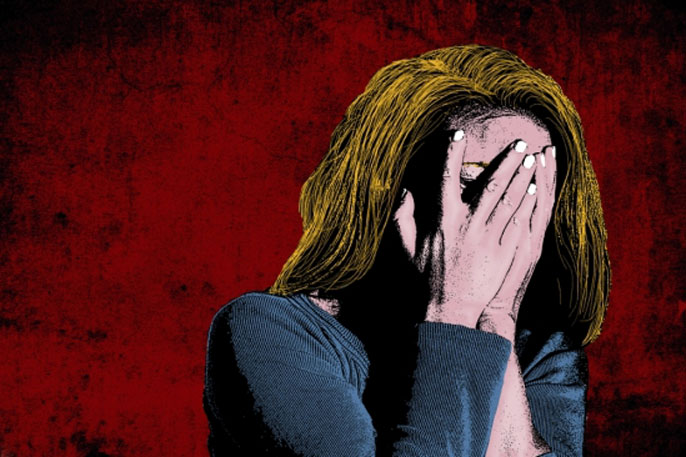
Smiling stylish woman showing sign excellently, isolated on red
Need help with an event?Why, sure I’m available.
Need someone to take your Sunday School class? Absolutely.
Keep your toddler? Just drop him off-we’ll play with the critters all day.
Phone call counselor and Homeschool Help Hotline-that was me.
Not anymore.
I’ve learned that if I am to have the energy needed to do necessary things, I have to protect my heart. I am too weak to carry everyone else’s burdens. If I am going to survive this journey I’ve got to prioritize.
I still listen.
I still help.
But I do it in a more healthy way-with respect for myself as well as others.
It is OK to say, “No.”And I don’t have to offer a reason. It’s a complete sentence all on its own.
All of my children had urged me over the years to draw boundaries. But I had grown from a parent-pleasing first born into a people pleasing adult and I just couldn’t do it.
Dominic even crafted a wire sign that hung on my kitchen curtains in the shape of a cursive “no”.
He made me repeat the mantra: Lack of planning on your part does not constitute an emergency on my part.
He’d be proud of me for finally taking his advice.










 thelifeididntchoose