I edit my words, costume my body and fix my face so I can act the part. But truth is, I never manage to fool anyone who looks closer than my plastic smile.
I can’t hide my heart.
And I don’t know why I try-I don’t get points for pretending.
There’s no prize at the end of this long road for the one who makes it with fewest tears.
I think it was second grade when I started a notebook dedicated to them-carefully copying out the words of others that spoke the truths of my own heart. Although the topics which draw me are different now, I’m still collecting them.
So here are fifteen quotes on grief that I hope will help another heart:
I once read the sentence ‘I lay awake all night with a toothache, thinking about the toothache and about lying awake.’
That’s true to life. Part of every misery is, so to speak, the misery’s shadow or reflection: the fact that you don’t merely suffer but have to keep on thinking about the fact that you suffer.
I not only live each endless day in grief, but live each day thinking about living each day in grief.
C. S. Lewis, A Grief Observed
Rather often I am asked whether the grief remains as intense as when I wrote. The answer is, No. The wound is no longer raw. But it has not disappeared. That is as it should be. If he was worth loving, he is worth grieving over.
Grief is existential testimony to the worth of the one loved. That worth abides. So I own my grief. I do not try to put it behind me, to get over it, to forget it… Every lament is a love-song.
Nicholas Wolterstorff, Lament for a Son
You will lose someone you can’t live without,and your heart will be badly broken, and the bad news is that you never completely get over the loss of your beloved. But this is also the good news. They live forever in your broken heart that doesn’t seal back up. And you come through. It’s like having a broken leg that never heals perfectly—that still hurts when the weather gets cold, but you learn to dance with the limp.
Anne Lamott
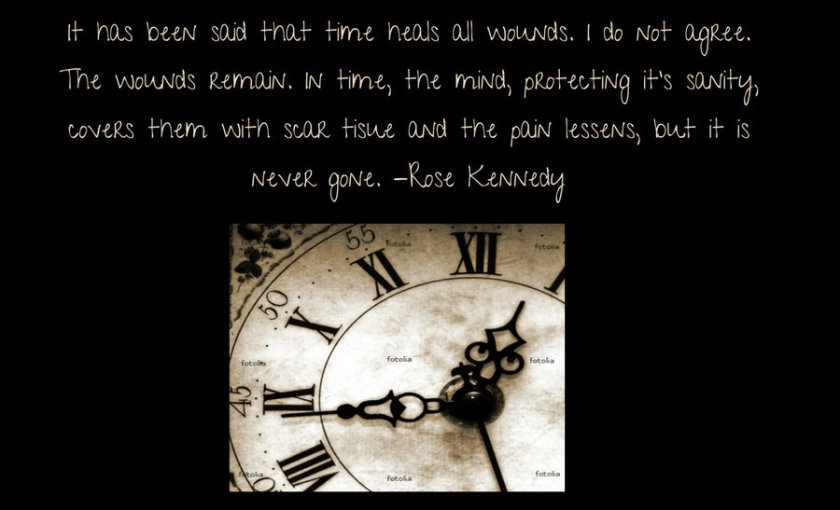
They say time heals all wounds, but that presumes the source of the grief is finite
Cassandra Clare, Clockwork Prince
What an awful thing then, being there in our house together with our daughter gone, trying to be equal to so many sudden orders of sorrow, any one of which alone would have wrenched us from our fragile orbits around each other.
Paul Harding, Enon
This was how to help a family who has just lost their child. Wash the clothes, make soup. Don’t ask them what they need, bring them what they need. Keep them warm. Listen to them rant, and cry, and tell their story over and over.
Ann Hood, The Obituary Writer
I guess I always thought it would be bigger, when a terrible thing happened. Didn’t you think so? Doesn’t it seem like houses ought to be caving in, and lightning and thunder, and people tearing their hair in the street? I never – I never thought it would be this small, did you?
Dan Chaon, Stay Awake
There are no words, not in English, Spanish, Arabic, or Hebrew, that have been invented to explain what it’s like to lose a child. The nightmarish heartache of it. The unexplainable trepidation that follows. No mother loses a child without believing she failed as a parent. No father loses a child without believing he failed to protect his family from pain. The child may be gone, but the years the child were meant to live remain behind, solid in the mind like an aging ghost. The birthdays, the holidays, the last days of school—they all remain, circled in red lipstick on a calendar nailed to the wall. A constant shadow that grows, even in the dark. As I was saying…there are no words.
Yesterday I stood next to my mama’s casket and met person after person who came to pay respects.
It was beautiful and awful all at the same time.
It was precious to hear the many ways Mama had brightened other people’s lives, extended hospitality, shared experiences and encouraged hearts.
It was awful to know she wouldn’t be doing that anymore. Her voice is silent, her smile is forever fixed into a not-really-like-her expression and her eyes closed.
I have been so busy that I really haven’t had time to mourn her yet. It’s coming.
Oh, how I know it’s coming.
But one thing I know now that I didn’t know when Dominic ran ahead to Heaven is this: Hope in Christ creates a safe space for all my questions, sadness and crying out.
God collects my tears. He does not disdain my sadness. He leans in and listens to my lament.
To have healthy fellowship with God we must be honest and realistic about our circumstances and our reactions to them. To have a healthy emotional, spiritual, and mental life, we must be honest with ourselves. One truth about our lives is that we are broken; we inevitably encounter our own suffering and that of others, and eventually we die. How does our Lord teach us to respond to this? He teaches us hope, and within that hope we use lament to speak to God of the painful delay of peace. All laments ultimately go to God, with whom we wrestle and rest.
Kelly M. Kapic, Embodied Hope
Peace is coming but it’s not here yet.
And it is perfectly OK to admit that, to mourn that, to take notice of the gap between the promise and the present.
I started writing because of Dominic and my family. I keep writing because of Dominic and my family and all the beautiful souls I’ve met along this journey-many who have never lost a child but whose hearts grieve for someone or something else.
I thought I’d share what I read at my sweet mama’s funeral yesterday-it was made easier and richer by all those who have walked with me so far in the Valley of the Shadow of Death.
Your comments, your messages, your thoughts and insights helped me express the most important lesson I’m learning in grief: Love Lives Forever.
When we walk through the graveyard or read an obituary, we almost always look for those two dates that bookend a life-for Mama it is September 23, 1938 and September 27, 2019.
Lots of sermons have been preached about that dash in between-about that what we do or don’t do, who we love or don’t love, how we use the years we are given as either a blessing or something else.
And that is very, very true.
We tend to think that the last date-the date when breath leaves the body and the soul escapes the trials of this world to enter the glory of Heaven-as the end. We can hardly help it because our relationship to the one we love changes so dramatically.
I can’t hug Mama anymore, I can’t hear her laugh, I can’t call her up and tell her, “I love you” or greet her in the morning with a “Hi Girlie!”.
That’s hard.
It creates a giant void for me and an unfathomably huge void for Papa. We are going to have to find a way to live with that empty space in our hearts and in our lives.
It takes lots and lots of work, lots and lots of tears and lots and lots of time. There’s no shortcut through the Valley of the Shadow of Death.
My Mama lost HER mother suddenly, to a stroke, when she was just ten years old. So she lived with that giant hole in her heart for over 71 years. She could have allowed the pain to make her cold and bitter, closed off and unavailable. It certainly would have been an understandable response to a traumatic loss.
But she didn’t.
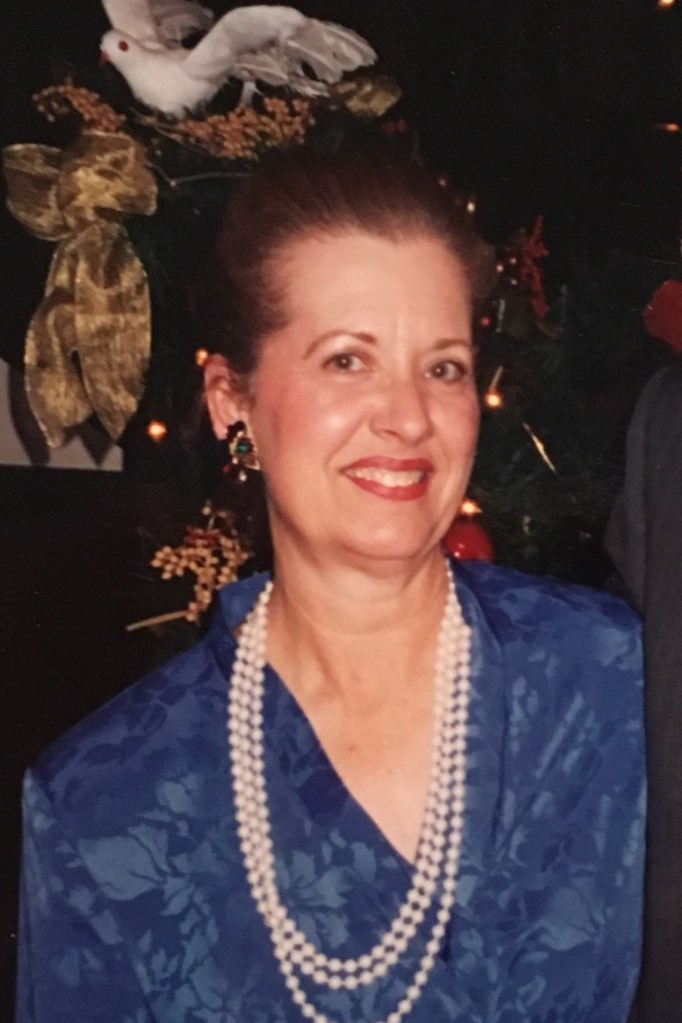
Without exception, every person who has called, written or come by to pay respects to Patty Hart describes her as gracious, lovely, kind, generous, welcoming, cheerful and bright.
Mama chose love.
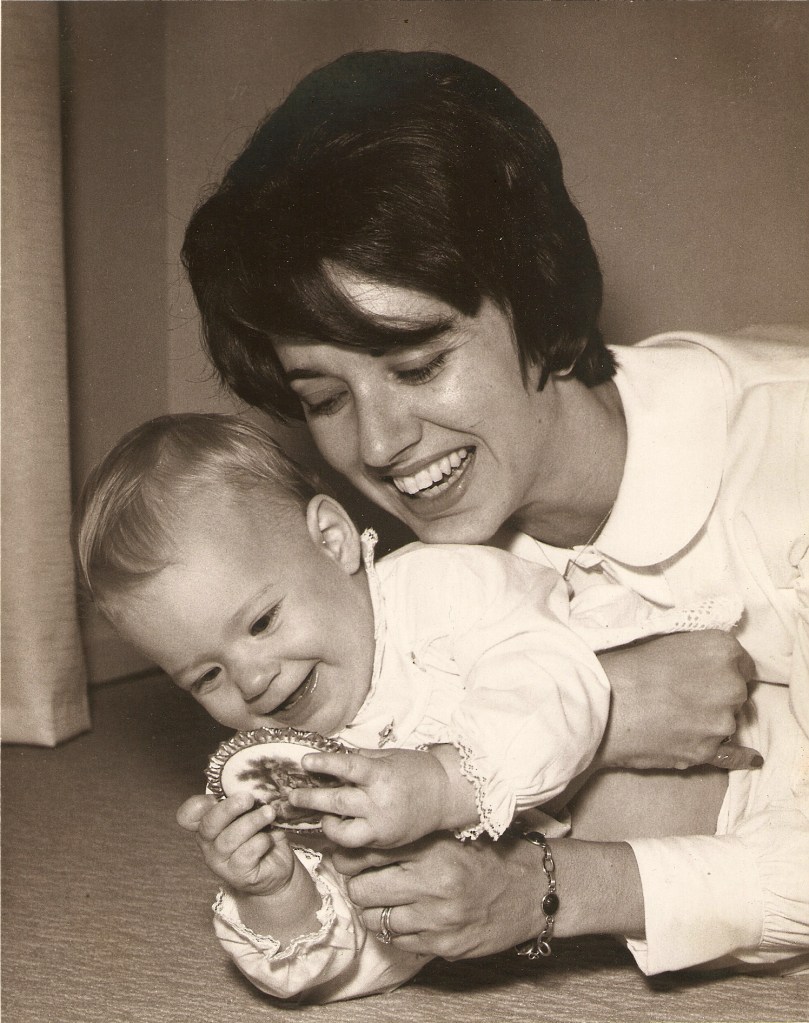
Mam and all my children, 1994
In just the past few weeks, before this last hospitalization, I got to see Mama begin to pour that love into a new generation. She had two visits from her great-grandson. One due to Hurricane Dorian (they had to evacuate) and one that was scheduled to give her the chance to meet him.
I won’t fib and say that having overnight visitors in the house was easy for her or Papa with all her medical conditions, but you’d never know it by the grin on her face when I put that chubby little stinker in her lap.
For a few minutes, she was Nanny again-singing, cooing, laughing and making eyes at him. She even got to be the first one to see him turn over. That tickled her!
All the Grandmas and Captain Ryker
Truth is, that last date isn’t the end. There’s no period after Patricia Ann Landrum Hart’s life. Of course she lives on in Heaven with Jesus, her mama and my Dominic.
But even here, on earth, love lives forever.
It lives in the lives she touched and will continue to touch through her friends and family as they honor her legacy of love.
Our circle is broken today. Death is awful and it’s hard. It’s a reminder the world is not as God intended it to be and we walk a broken road toward the promises of redemption and restoration.
But the chains of love forged in our hearts are never severed.
I have learned so much since that day when Dominic left us suddenly for Heaven.
Some of the things I know now are things I wish I didn’t know at all.
Many serve me well-not only in how I respond to my own pain and loss-but also how I respond to the pain and loss in the lives of those I love.
I had to practice them again when my mama was desperately ill and then joined Dominic and Jesus.
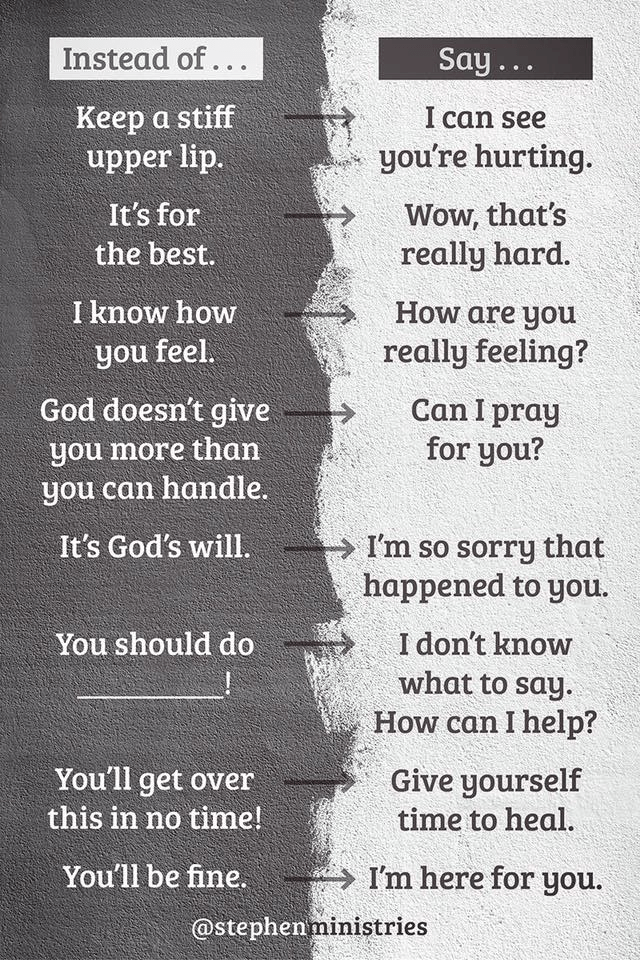
It reminded me how hard it is for those who have not walked this Valley of the Shadow of Death to really comprehend how their words and actions either truly support or subtly wound already hurting hearts.
So here’s a short list of things things to say and do that I believe actually HELP grieving friends and family:
Not everyone leaves earth quickly. Some are ill for a long time. It’s natural for friends to want to stop by home or hospital to see a sick loved one and show support for the family. Please call ahead to see if it’s convenient. If it’s not, then don’t come. Respect that while it may feel like a reunion to you and others gathered in the living room or the waiting room it’s a very sober and frightening and stress-filled time for the family. Loud laughing and back-slapping are often unwelcome reminders that the person in the bed can do neither.
Please don’t impose your desire to help on the family’s unwillingness to accept it. Offer-that’s wonderful and appreciated-but there may be circumstances you don’t know about that just make it hard or impossible for them to let you do what you would like to do. It’s really, really hard to use the limited energy available to politely turn down an offer.
When you stop by to pay respects, try not to overstay your welcome. You’ll probably never notice that the family is working hard to extend hospitality and make small talk. It’s exhausting. You are not the only people “stopping by for a minute” while the family is trying to take care of funeral details. They are deciding on what clothes their loved one will be buried in, what photos to include in a memorial slide show, what will be served at dinner after the service, who will sing or speak or play a piano solo. There’s just no energy left for small talk. Express condolences, leave the dessert or congealed salad and leave them to the little bit of quiet they may enjoy before the next few days of crazy.
Take time to write notes of remembrance if you can. Facebook comments, text messages, emails, written notes or cards are wonderful! These can be gathered together, printed and saved as a beautiful tribute.
If you haven’t played an active role in the deceased’s life or the life of their family recently, don’t show up and insist on “inner circle” privileges now that they are gone. This is not the time to force reconciliation or expect a family reunion type celebration. While that may be the ultimate outcome of this traumatic and life-altering event, respect those that have maintained relationship over the years.
Instead of asking, “Let me know if there’s anything I can do”, say, “How may I serve you in the days and months to come?”. Grievers may not have an immediate answer, but ask again in a week or so after others have drifted away. Also consider asking if specific things may be helpful.
Please don’t wander around the house. Respect the family’s privacy.
Don’t ask personal questions such as “How did he die?” or “What happened?”. If the bereaved want you to know, they will tell you.
Be attentive to body language.
Allow grievers to lead.
Don’t ignore comments that indicate it’s time to go.
Accept that what you may want to do and what is truly helpful may be two very different things.
Fewer words are almost always better than idle chatter.
I remember the moment I realized I was going to have to summarize my son’s life into a few, relatively short paragraphs to be read by friends, family and strangers.
It seemed impossible.
But as the designated author of our family I had to do it so I did.
Today I wrote my mama’s obituary and though her death was not as surprising as Dominic’s it was just as hard to swallow.
Mama suffered a stroke a few days ago and along with her other health problems the prognosis wasn’t good. So our family gathered, said what needed to be said to one another and to her and settled in to wait and see if her will to live could overcome the odds.
It didn’t.
She breathed her last in this world, fell asleep and woke up in Heaven at 1:45 am Friday morning.
I like to think that just after she saw Jesus she ran on to hug Dominic and her own sweet mama she’s been missing for seventy-one years.
I don’t know why I thought saying good-bye to my mama would be any easier than saying good-bye to my son.
It wasn’t.
Ain’t nothing easy about death.
Ain’t nothing easy about walking away from a hospital room or a morgue or an accident site knowing that whatever wasn’t said will never be said. Nothing easy about facing final arrangements, making phone calls, writing obituaries, finding photos for a slide show, wrapping up a life into a few words and a few songs and a few pictures.
My heart is used to the dull thumping pain of sorrow.
It’s grown accustomed to setting aside despair and doing what has to be done.
I know how to forge ahead and keep living and plan as if my world hasn’t imploded, making calendars and clocks and seasons and holidays irrelevant.
I’m sad today.
And I am all too aware that today’s sadness is small compared to what’s coming.
I’ll survive.
Compared to watching my son’s body lowered beneath the ground, watching my mama’s earthly shell lowered is easier.
She lived a beautiful, full and long life.
Still, there’s no way for the little girl inside this middle-aged woman to reconcile the fact that the world she inhabits no longer includes a mama she can touch.
I know it is hard. I know you don’t truly understand how I feel. You can’t. It wasn’t your child.
I know I may look and act like I’m “better”. I know that you would love for things to be like they were: BEFORE.But they aren’t.
I know my grief interferes with your plans. I know it is uncomfortable to make changes in traditions we have observed for years. But I can’t help it. I didn’t ask for this to be my life.
My mother was admitted to the hospital last night due to a stroke. It’s her eighty-first birthday today.
I’m oh, so thankful our family just recently spent quality time together and she got to meet her first great-grandchild.
Lots of precious pictures and memories were made.
I’m not sure how much time I’ll have in these next days to work on new posts so I’m going to do something I’ve wanted to do for a long time-set up a series of the five or six most popular posts so people can get them all in a row.
If you’ve read them, don’t feel like you have to read them again. (But maybe send up a prayer when you see them for my mama ❤ )
But many of them are two or three years old and some of y’all might have just joined us in this Valley. So they may be new to you.
In any event, here’s the very first post that got more than a few hundred shares and was picked up by Huffpost in 2016:
People say, “I can’t imagine.“
But then they do.
They think that missing a dead child is like missing your kid at college or on the mission field but harder and longer.
That’s not it at all.
It isn’t nostalgia for a time when things were different or better or you talked more: it’s a gut-wrenching, breath-robbing, knee-buckling, aching groan that lives inside you begging to be released.
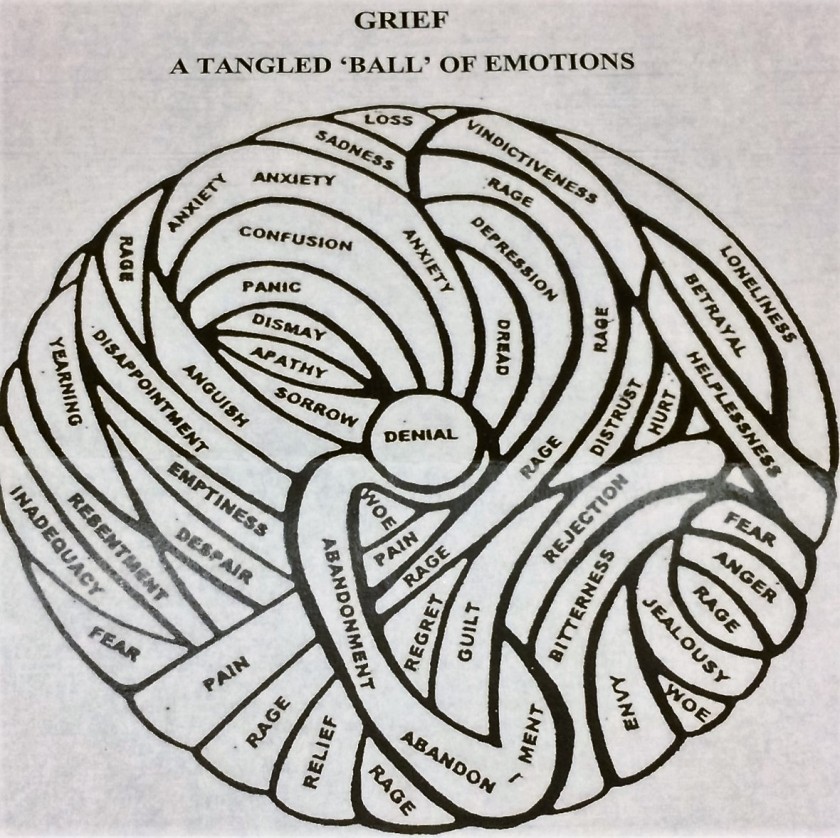
At first grief felt only like sorrow and longing and brokenness.
Then it felt like confusion and anxiety and despair.
A little further along this journey it mostly felt like apathy.
Now it feels like love.
It’s the same love that helped me hold on when I was face first in the toilet every morning for seven months. Morning sickness with Dominic lasted nearly the whole pregnancy! With two young children already in our home, it was one of the hardest seasons of my life.
It’s the same love that demanded they bring me my baby when they whisked him away due to “concerns” after birth. Twenty-four hours later, c-section or no c-section, I told the nurse I’d be marching my butt down to the nursery if they didn’t bring him to me right away. (It was a different time-no real “rooming in”.)
It’s the same love that worked with my frustrated little boy to make his words sound clear and correct. Slow down, hit the hard consonants, be precise in how you form your lips. He grew up to give the undergraduate address when he graduated from UAB in front of thousands.
It’s the same love that listened when he told me his troubles, his fears and his dreams. So, so many nights he’d come in, flop down backwards on my bed and proceed to talk until I was just about to drift off to sleep.
It’s the same love that held his hand as people walked by expressing condolences.
It’s the same love that kissed his cold cheek before they lowered the casket lid. Told him, “Good-bye” and walked upright from the sanctuary.
I refused to dishonor his brave life by giving in to my personal fear.
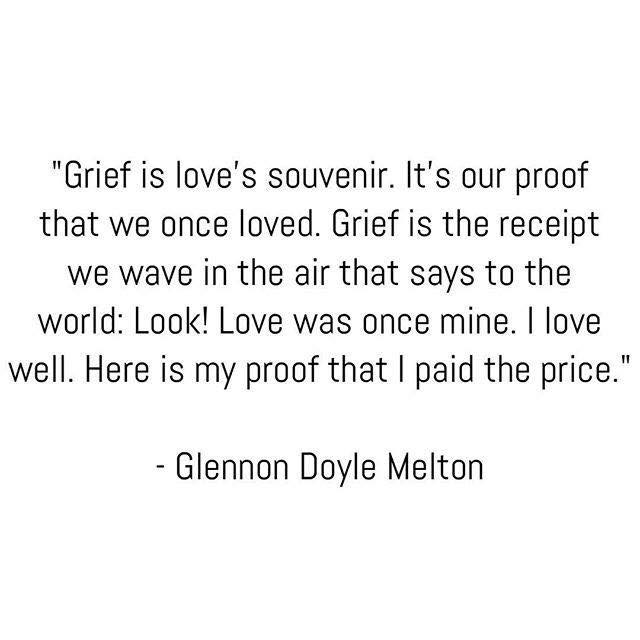
Grief is really just love.
Dominic has been my son since he sat safely in my womb.
He’s still my son.
My love is not diminished because I can no longer touch him.
I cling fast to words that speak aloud what I’ve only thought.
I collect sentences that eloquently express what I can only feel.
I pull them out on days when my head and heart are doing battle and I can’t find any middle ground.
Reading reminds me I’m not the first soul to travel this way.
Others have been here before and left breadcrumbs.
A friend said, “Remember, he’s in good hands.” I was deeply moved. But that reality does not put Eric back in my hands now. That’s my grief. For that grief, what consolation can there be other than having him back?
Nicholas Wolterstorff, Lament for a Son
The promise that I will one day see Dominic again makes the pain bearable. But it does nothing to treat the essential wound. He is not here and I will miss him, miss him, miss him until I draw my last breath.
The worst type of crying wasn’t the kind everyone could see–the wailing on street corners, the tearing at clothes. No, the worst kind happened when your soul wept and no matter what you did, there was no way to comfort it. A section withered and became a scar on the part of your soul that survived. For people like me and Echo, our souls contained more scar tissue than life.” ― Katie McGarry, Pushing the Limits
Katie McGarry, Pushing the Limits
I never knew a person could cry every day for months. Not just a tiny overflow that falls sweetly down a cheek but gigantic gut-wrenching, ear-shattering sobs. That was what I hid from everyone-the pillow-over-my-mouth-to-muffle it-crying in my room in the dark.
Maybe we all do.
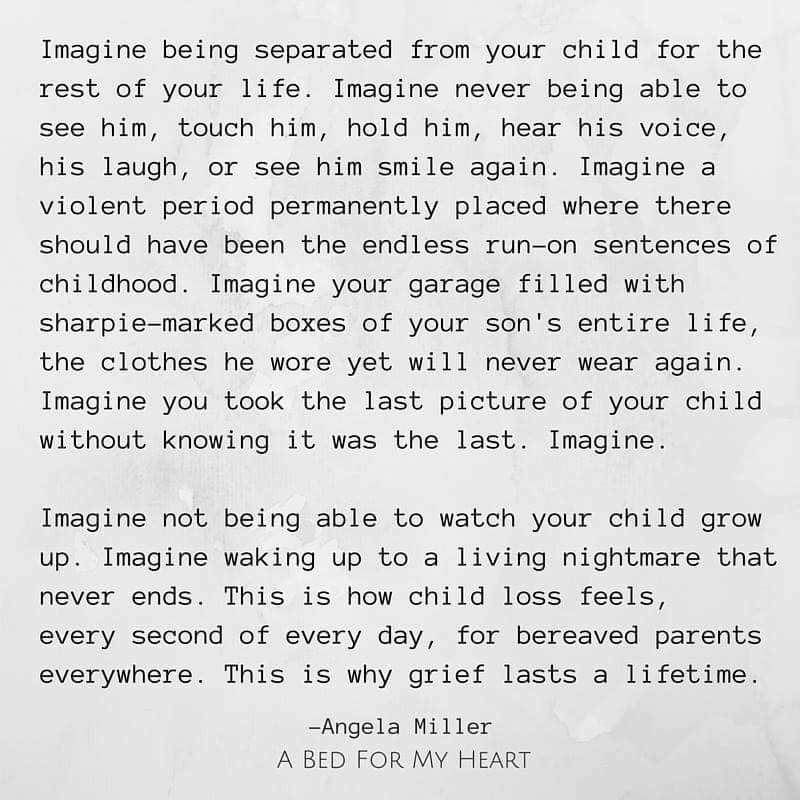
Maybe that’s why those untouched by child loss don’t really know how much it hurts and for how long.
grief is a house where the chairs have forgotten how to hold us the mirrors how to reflect us the walls how to contain us
grief is a house that disappears each time someone knocks at the door or rings the bell a house that blows into the air at the slightest gust that buries itself deep in the ground while everyone is sleeping
grief is a house where no one can protect you where the younger sister will grow older than the older one where the doors no longer let you in or out
Jandy Nelson, The Sky is Everywhere
When Dominic ran ahead to Heaven, he was living on his own. He’d been out of the house for a couple of years.
So I was utterly unprepared to find his earthly absence echoed in the house from which he had already been absent. Everything changed, everything was slightly askew.
And it is “a house where the younger [brother] will grow older than the older one”.
For in grief nothing “stays put.” One keeps on emerging from a phase, but it always recurs. Round and round. Everything repeats. Am I going in circles, or dare I hope I am on a spiral?
But if a spiral, am I going up or down it?
How often — will it be for always? — how often will the vast emptiness astonish me like a complete novelty and make me say, “I never realized my loss till this moment”? The same leg is cut off time after time.
C.S. Lewis, A Grief Observed
I remember being surprised the first time I circled back around in my grief and revisited places in my heart I thought I had subdued and conquered.
But that’s how it is.
Grief has so many layers that I honestly don’t believe we could survive it at all if forced to peel them back all at once. So I’ve resigned myself to the fact I will come back to many of the same sore spots over and over.
I do feel like I’m spiraling upward. Each time I circle around, I’m better equipped to face the fear or guilt or sorrow or despair.























 thelifeididntchoose