Grief Work 2025: Physical Manifestations of Grief

Grief is not *just* feelings. It is so much more.

Often there are random or unusual physical symptoms that show up days, weeks or even years after a child has gone to Heaven.

An important and necessary part of grief work is learning to recognize the physical manifestations of grief and advocating for care from professionals who may not be able to make the connection unless the bereaved speak up and speak out.

❤ Melanie

It’s a well known fact that stress plays a role in many health conditions.  

And I think most of us would agree that child loss is one of (if not THE) most stressful events a heart might endure.  

So it’s unsurprising that bereaved parents find themselves battling a variety of physical problems in the wake of burying a child.  

grief head in hands and stress words

What may be surprising is how uninformed medical and even psychological professionals are with respect to the very real ways child loss intersects with chronic conditions and often creates new symptoms.  

Here is a list of only SOME of the physical manifestations of grief (via What’s Your Grief?) with my own comments :  

Fatigue.  If you’ve always been an energetic sort, you might find this aspect of grief particularly disconcerting.  This kind of fatigue doesn’t get better with rest.  I’ve written about that here. 

Some days I can barely make myself get out of bed and when I do, I struggle to do any but the most necessary tasks.  Don’t automatically dismiss this symptom as ONLY grief (although it most certainly could be!) get a thorough check-up to rule out other causes such as low thyroid, diabetes, heart disease, major depressive disorder or a number of conditions that can be treated effectively with medicine.  Don’t beat yourself up if the doctor decides “nothing is wrong” with you.  You are grieving and grief is work!  I know this symptom has improved for me over time as I’ve established boundaries, admitted limitations and learned to rest when necessary.
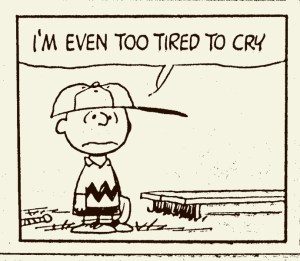
charlie brown too tired to cry

Aches and Pains.  Our bodies and minds are connected in ways not well understood.  Mental and emotional distress can make any underlying pain condition that much worse.  When I’m feeling especially lonely, desperate or sad my autoimmune disease flares AND my perception of the very real pain that causes is heightened.  Pain and heartache can lead to a downward spiral that is hard to undo.  Get help and treatment for the physical and give yourself grace and space to endure the emotional causes of body aches.  Don’t self-medicate with drugs, alcohol or other self-destructive coping strategies.  Reach out to a safe person and let them help you find a better way.

painlevels

Headaches.  Needless to say, stress makes tension headaches more likely.  Sometimes, though, a headache can be a symptom of something more serious.  Don’t dismiss an especially sudden, intense or long-lasting headache as “just grief”.  It could be previously undiagnosed high blood pressure, stroke or migraine.  Those being ruled out, various relaxation techniques, cold or warm compresses, over-the-counter analgesics and gentle stretches might help.

Sometimes grief headaches can be alleviated by the simple act of telling our stories.  Bottling up emotions and thoughts adds to the ongoing stress and tension of my child loss burden.  When I spill them-either on paper in a journal, in a closed online bereaved parents’ group or in person to a safe friend or family member-often I feel the band around my head relax and the pain fade away.

Tightness in Chest, Shortness of Breath.  The day I got the awful news, I remember asking friends who came to sit with me over and over, ” Am I still breathing?”  My world was spinning out of control and my body responded.  Anxiety after child loss is real. Broken Heart Syndrome is real.  Heart attacks are not uncommon.  Don’t ignore these symptoms.  But don’t be surprised if they persist despite all tests to the contrary.  When I feel trapped and overwhelmed, a walk outside or even to another room can help.  Deep breathing exercises and grounding exercises can often interrupt an episode.

Broken_Heart_syndrome_EN-01

Forgetfulness.  I wrote this post on Grief Brain: It’s a Real Thing! a couple years ago and am always surprised to see it shared repeatedly.  But I think it strikes a chord with any heart walking through grief.  You are not crazy!  You are not experiencing early onset dementia (most likely).  Like other symptoms, get checked out if they persist or worsen.  But odds are, your experience falls within the range of normal for anyone whose life has been shattered by child loss.  Losing things, forgetting things, getting lost in familiar places, missing appointments or bill payments, inability to remember names of people you know well-all of these are common after loss.  In time, the symptoms usually diminish.  They have for me.  I still have to rely on lists and reminders much more often, though.  And that’s OK.
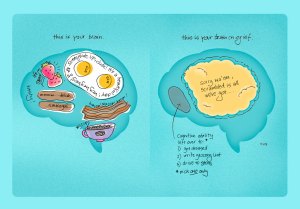
griefbrain1

Inability to Focus.  Like grief brain, this is another cognitive manifestation that’s not only annoying, it can impact life in significant ways.  Before Dominic ran ahead to Heaven, I was an avid reader.  I often had three or four books going at the same time.  I could spend hours focused on a single project.  Not anymore.  I sometimes find it difficult to read a recipe.

I have to take frequent breaks when working on something because my mind gets fuzzy and I just can’t pay attention for more than a few minutes at a time.  Some bereaved parents have to change jobs or careers because they are not able to perform necessary tasks anymore.  This particular symptom has not improved very much for me although I’ve found ways around it.  I use lists to keep an external record of what I should be doing and when.  I mix up mindless chores with ones that require more attention to give my brain a break.  I try to dissect larger jobs into smaller, manageable chunks.  And sometimes I just have to admit that today a particular thing just isn’t happening. 

Appetite or Digestive Issues.  Stress has long been linked to gut problems.  I suspect we’ve all had that “rumbling in our tummy” from time to time even before child loss.  For many of us it’s exponentially worse after.  Some bereaved parents try to stuff emotions by stuffing themselves with food.  Others can’t eat at all.  Still others experience stomach ulcers or bowel disease ranging from acute to chronic.  I was hospitalized twice in the first year after my son’s death for serious colon issues.

Again, don’t ignore sudden or persistent symptoms.  Try to eat well and avoid self-medicating with food.  Added pounds rarely add up to better emotional or mental health.  I let pounds I’d lost ten years ago find me again.  Get help if you need to from someone willing to act as an accountability partner.  I’ve recently joined a friend in setting goals for ourselves and sharing recipes and meal prep.  Try to treat food as another aspect of grief work and manage it the best you can.

the struggle bus

Getting Sick More Often.  Stress lowers the immune system.  That’s a fact.  So when bereaved parents encounter germs (as we all do from time to time) it may well be our bodies don’t have the energy or resources to combat them.  Colds, flu, strep throat, skin infections may all be more likely this side of child loss.  Don’t be discouraged to seek treatment.  There is so much we can’t control in life, but getting antibiotics for an infection is pretty easy.

It’s not in your head, mom or dad! 

Grief has real physical manifestations.   

Don’t be dismissed or denied the care you need. 

Educate your healthcare providers and insist on being heard. 

the weight of grief without words

*photo credit:  The Weight of Grief  Scupture ~ Celeste Roberge*

What Does Happiness Look Like For You?

It’s not uncommon for clients to be asked by their counselor, “What does happiness look like for you?”.

Because, let’s face it, few of us seek counseling unless we are unhappy or dissatisfied with our current life.

Unlike physical healing, mental, spiritual and emotional healing are rather subjective and it’s important to know what we’re aiming for when seeking help in moving our hearts toward wholeness (or at least, “less brokenness”).

So it’s not surprising that another bereaved parent was asked this question during a session recently. She brought it to the greater community because she felt that she didn’t have a good answer or, really, any answer at all.

I get it.

Child loss is devasting.

In the early days after Dominic ran ahead to Heaven, the idea of “happiness” was as foreign to me as living on Mars. Possible, maybe, but highly improbable and not something I wanted to pursue.

Before death walked through my door, I didn’t find it necessary to parse the difference between happiness, contentment and joy.

Now, I find it absolutely critical.

Happiness is a feeling that everything is going my way-sunshine and roses, no uncomfortable circumstances, no insurmountable challenges. If I’m honest, even before child loss, I wasn’t always happy. It’s easy to idolize my “before” life into somethin it was not.

Contentment, on the other hand, is a settled trust in God’s goodness, mercy and love regardless of my current circumstances. I, like Paul, can LEARN to be content when I focus on the eternal story the Lord is writing that will proclaim His glory for ever and ever. I have to remind my heart every day of truth-even when it doesn’t want to hear it.

Joy is a burst of sweetness and delight-like biting into a perfect strawberry or being greeted with a slobbery kiss from a toddler who has stood by the window, waiting for your arrival. I can choose to make much of these moments or overlook them.

Eleven years on this road, while I find happiness elusive and contentment a work-in-progress, I find looking for joy rewarding.

I live on acreage that is mostly native grasses and weeds. Sometimes when I look out at the rough, uncut vista all I see is a raggedy mess. It is so unlike the tidy, mowed, landscaped lawns I grew up with as a child.

But when I WALK through the fields and look closely, there are dozens of different wildflowers tucked amid the weeds.

That’s how I’ve come to think of life after my son ran ahead to Heaven.

Life itself isn’t what I want or how I thought it would be- not predictable or beautiful (by my earlier standards of beauty). But there are STILL beautiful moments, relationships and events that I can treasure.

I’ve learned to focus on those and hold them close.

Most days are pretty good now but this habit continues to feed my soul.

When a particularly hard day comes, it helps me from falling so far down the rabbit hole of despair that I can’t climb back out.

May the Lord help all of us find the beauty and blessing that remains even as we miss our children and look forward to seeing them again in Heaven.

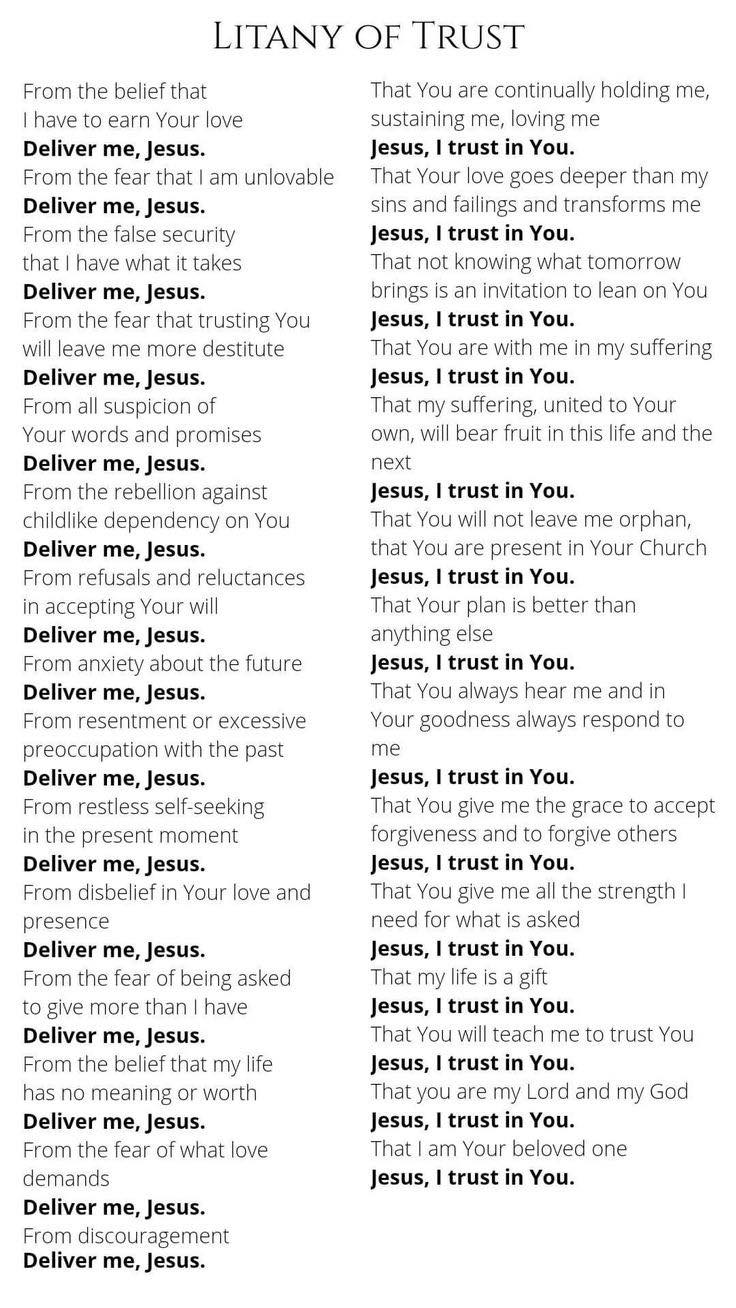
Litany of Trust

Another bereaved parent shared this “Litany of Trust” in one of our closed groups the other day.

It reminded me of the many quotes, verses and choruses I typed or wrote out and taped all over my house in the early days after Dominic ran ahead to Heaven.

My own head and heart were filled with doubt, sorrow and pain and I knew that if I didn’t keep truth in front of my eyes, those lies would take over and squeeze out any hope hiding in the corner.

I STILL have several of these reminders tacked up because there are days…

So I wanted to share this beautiful catalog of all the ways Jesus, our Great Shepherd King, delivers us from futile and unfruitful fear:

Many of us who grew up in non-liturgical churches (myself included), might be dismissive of repetitious prayers. But there is both beauty and power in repeating truth to our hearts and souls.

Paul said, “But how can they call to him for help if they have not believed? And how can they believe if they have not heard the message? And how can they hear if the message is not proclaimed?” (GNT).

He was speaking specifically about the gospel but isn’t the whole Bible full of Good News?

When we proclaim it aloud and anew, we are literally strengthening the inner man (or woman!).

May we take hold of the truth and every tool that helps our hearts cling to Hope❤

Bereaved Parent Month 2025: How Do You Breathe?

I’m ending Bereaved Parents Month by sharing this post because I still have moments when I marvel that I’ve survived.

It was the question I asked the bereaved mother that came to my son’s funeral.

It was the question a mother asked me as we stood by her granddaughter’s casket, surrounded by family and flowers.

And it is the right question.

Because when the breath leaves the body of your child, and you look down at the shell that used to be the home of a vibrant, living soul, you simply can. not. breathe.

Read the rest here: How Do You Breathe?

Bereaved Parent Month 2025: Support May Come From Surprising Sources. Look For It.

My life is filled with lots of different kinds of people.

Because of this ministry, I message or talk to bereaved parents every day but I also message and talk to friends and family who have no clue what living with child loss looks like.

I learn something from all of them.

I try to be open to support and encouragement even when it comes from unlikely sources.

I remember the first early, very tender, very emotional days, weeks and months when I felt like a walking nerve. Any stray word or look was likely to bring tears to my eyes and drive me into seclusion for hours.

I couldn’t imagine that anything anyone who hadn’t walked this path could say would be helpful.

How could it be when they just. didn’t. know?????

And yet…over time, my heart softened by pain and sorrow and I realized that while others may not know my particular brand of suffering, they are often carrying a burden as well.

Even if the size and shape of their load is different than mine, they are learning from the journey and some of their wisdom might help me just as some of mine might help them.

Self-care, good boundaries, safe friends who allow us to share openly when we are struggling, grace, helpful, healthy habits-all those things are useful regardless of what we are going through.

If I close myself off and refuse to share life with anyone who isn’t situated precisely as I am in this life I didn’t choose I will miss oh, so very much!

I love, love, love the deep friendships I’ve formed with other bereaved parents (although I hate, hate, hate the way we found one another).

Online groups, the community around this blog, at retreats and through book and Bible studies, these parents form the foundation of strength and encouragement that has helped my heart hold on to hope.

But I also have beautiful nonbereaved friends who listen to my stories, share my tears and fears and who have walked and continue to walk beside me on this rocky road.

So don’t overlook or undervalue support regardless of where it comes from.

Look around.

Listen closely.

You might just be blessed more than you think.

If your heart is struggling and longing for companionship, here are some online communities that might be just what you’re looking for:

Heartache and Hope: Life After Losing a Child (closed group)

https://www.facebook.com/groups/947404501987955

While We’re Waiting–Support for Bereaved Parents (closed group)

https://www.facebook.com/groups/WhileWereWaiting.SupportForBereavedParents

Our Hearts are Home Community (closed group)

https://www.facebook.com/groups/1980308615670336

Bereaved Parent Month 2025: Life Grows Around Grief

When days become months and months become years it’s hard to explain to others how grief is both always present but not always in focus.

I’ve struggled to help those outside the loss community understand that the absolute weight of the burden is precisely the same as when it fell on me without warning that dark morning.

Dominic’s absence, if anything, has seeped into more places, changed more relationships and influences more choices than it did eleven years ago when I was only just beginning to comprehend what a world without him would look like.

Read the rest here: Life Grows Around Grief

Bereaved Parent Month 2025: Broken Legs, Broken Hearts, Broken Lives

Sometimes I’m envious of folks hobbling along in those plastic boots designed to support an injured leg or ankle and aid healing.

Not because of the injuryI’m thankful I’ve never broken a bone-but because it’s an outward warning to anyone who might otherwise be impatient or insensitive that they just can’t go any faster.

I think there ought to be a t-shirt, pin or banner that gives the same kind of warning for those of us walking around with broken hearts and broken lives.

But there isn’t.

Read the rest here: Broken Legs, Broken Hearts, Broken Lives

Bereaved Parent Month 2025: “I Lost My Child Today”

My son’s death is a moment in time, a date on the calendar, a thing of the past for other people.

I understand that.

But for me, it’s an ongoing event.

Every time Dominic SHOULD be here but isn’t I lose him again.

Every milestone he should be marking but doesn’t I lose him again. 

Read the rest here: “I Lost My Child Today” by Netta Wilson

Bereaved Parent Month 2025: Hardly the Time for Being Taught

It seems to be the nature of humans to listen with an ear to respond rather than an ear to hear.

I’ve done it myself.

Jumped right in with all kinds of suggestions designed to “fix” someone else’s problem.

Or worse, heaped my own experience with something more or less (often less) similar onto an already overburdened heart.

I hate that tendency in myself and I’m working hard to try to change it.

Those who feel compelled to just say SOMETHING often bombard grievers with platitudes, comparisons to their own grief or just empty, frivolous words that require we either stand there dumbfounded or find a gracious way to exit the conversation.

It’s especially painful for a broken heart when a well-meaning someone decides THIS is the moment for a theology lesson.

“God has something planned for you in this” or “God will use this for good”. (Romans 8:28-29)

“We don’t grieve as those without hope!” ( I Thessalonians 4:13)

“All our days are numbered.” (Psalm 139:16)

I get it-death is a heavy subject and the death of a child isn’t something anyone wants to talk about, contemplate or be forced to wrestle with. So it’s often easier to simply say something-anything-do your duty and walk away.

But it is hardly helpful.

Deep grief as a result of unbearable loss is not a teaching moment.

It’s an opportunity to listen well, think carefully about if or when you need to say anything and simply offer compassionate companionship to a broken heart.

Grieving felt hardly like the time for being taught, at least initially. Early grief was my time for pulling out of my past those truths that I had already learned — out of my ‘basement — so that I could begin to assemble them together into something even more meaningful to me than before. It was the time for understanding that even though I had always believed in heaven, it now looked to my perceptions to be more real than this world. It was the time when, even though I already believed in God’s control of the world, I now felt dependent upon him being sovereign over it for all my hopes. It was the time for realizing that even though I already believed that Christ conquered death, I now longed to see death die.Lianna Davis, Made for a Different Land

Bereaved Parent Month 2025: Surviving Grief Anniversaries

I know I’m not the only one who carries a calendar in my head that threatens to explode like a ticking timebomb.  Days that mean nothing to anyone else loom large as they approach.

The date of his death.

The date of his funeral.

His birthday.

My birthday.

The day he should have graduated from law school.

On and on and on.

How can I survive these oppressive reminders of what I thought my life would look like? How can I grab hold of somethinganything that will keep my heart and mind from falling down the rabbit hole of grief into a topsy-turvy land where nothing makes sense and it’s full of unfriendly creatures that threaten to gobble me whole?

Read the rest here: Surviving Grief Anniversaries