Grief In Real Life: Picking My Path

We are only officially a few days into summer here in Alabama but we’ve already suffered weeks of extra hot weather.

And while I can’t do a thing about the absolute temperature outside, I can make choices that help me tolerate it.

It’s the same in my grief journey.

Everyday decisions make a difference in how well I cope.

❤ Melanie

I walk the half-mile stretch down and back on my driveway at least four or five times a day.

In the winter I follow the sun.

In the summer I follow the shade.

The path I choose to take either adds to or subtracts from my ability to make the trek in relative comfort.

It would be foolish for me to not take advantage of available provisions.  It would be silly for me to shiver or sweat more just because I was too lazy to adjust my trajectory.

I can’t change the absolute temperature outside but I can influence how I experience it.

I’ve found that the same practical wisdom applies to my grief journey:  I can make things easier or harder on my heart by making even small changes in how I face a day or situation.

I can’t change the fact that my son is dead.  But I can influence how I experience it.

On days when I am struggling with sorrow, I seek out some “sunshine”-both actual sunshine by getting outdoors and figurative sunshine by feeding my soul with positive images, thoughts and the truth of Scripture.

sunrise brightest

I minimize my interaction with “negative Nellies” and sites or shows or books or places that send me further down the path of despair.

I share my struggle with safe people who will listen and not try to correct me or force me into pretending that sorrow is not what I feel.

I go to bed early, knowing that each sunrise brings new mercies from our Heavenly Father and that one bad day does not have to define a week.

steadfast-love-in-the-morning

On days when I’m overwhelmed with the “heat” of commitment or too many people or too much activity, I seek out some “shade”-I look for a spot in my schedule where I can rest a bit and catch my breath.

I reassess and find things I can give up.  I find other ways to meet obligations that give me more space and require less frantic scrambling.

I make myself sit down and slow down, even if it is for just fifteen minutes.

let-yourself-rest

I’m honest with my family and friends, because if I’m not I will end up being ugly and hurting someone’s feelings.

So, so many things about grief are outside my control.  I cannot anticipate every random trigger that might land me in a puddle of tears.

Life goes on and continues to demand my participation.

I want to be fully present for my loved ones.  I want to show up and make merry for all the special occasions.

So I try to use wisdom in how I approach each day, assessing my grief “temperature” so that I can do what’s necessary to ensure I’m emotionally healthy enough to do what I really want to do.

Shade in summer.

Sun in winter.

between stimulus and response

Grief In Real Life: Why Is the Second Year SO Hard?

It’s not true for everyone but it is true for enough of us. The second year after child loss can be especially hard.

Numbness and the rhythm of all the “firsts” in the twelve months following Dominic’s death kept me both anticipating the shock and protecting me from its full impact.

The second year was when it dawned on me that I was doomed to repeat this cycle as long as I lived.

I was absolutely overwhelmed.

❤ Melanie

I remember very well the morning I woke on April 12, 2015-it was one year since I’d gotten the awful news; one year since the life I thought I was going to have turned into the life I didn’t choose.

I was horrified that my heart had continued to beat for 365 days when I was sure it wouldn’t make it through the first 24 hours. 

And I was terrified.

During that first year there were multiple punctuated stops along the way-the first major and minor holidays scattered throughout the year, a family wedding, two graduations, Dominic’s birthday and on and on.  I’d muddle through and then turn my face forward towards the next one looming in the future.

There was so much emotional upheaval, so many things to process that I was unbalanced, focused only on survival without a thought to anything beyond the next hill.

But when I realized that I’d made it through one year, was still standing, was still breathing and was (apparently) going to survive this horrible blow, I began to think about living this way for the rest of my days.

And it was overwhelming.

Facing something for a defined period of time-even an awful something-is doable.  There’s an end in sight, relief on the way, endurance will be rewarded-just hang on.

But when a heart can’t lay hold of the finish line-well, that’s enough to undo even the bravest among us.

exhausted-over-trying-to-be-stronger-than-i-feel

All the things I muddled through the first year were just going to circle back around over and over and over for decades!

My grief took on a new dimension-it wasn’t something that was going away-it was life long.  

I spent the entire second year and most of the third just wrapping my mind and heart around that FACT and trying to develop tools to carry this burden for the long haul.

Every heart is different, every family unique.  

The second year is NOT harder for everyone. I’m not even sure it was HARDER for me.  But it was definitely different and full of new challenges.

It forced me to dig deeper than the first year when I was mainly in survival mode.  

The crying tapered off but the reality of my son’s absence loomed larger.  The breathless agony of his death really did grow more manageable but the prospect of this being a life sentence weighed more heavily on my heart.

But God’s grace has been sufficient in every season of my grief.  He has sustained me, strengthened me and carried me.  

i made you and i will carry you

Here I am-six weeks into year [eleven]-still standing, still fighting and still holding on to hope.

God is faithful.  

What He did for me,

He will do for you.  

Grief In Real Life: Why Still Write After All These Years?

I first shared this years ago when I was reflecting on half a decade of living without one of my children beside me. I’ve now had more than another half decade to think about why or IF I’ll continue to write.

Every so often I take a day or two to consider whether I want to keep posting. I have to admit sometimes that I wonder if I bang the same drum for too long it will sound loud and obnoxious to some people’s ears.

But then I get a message or a comment from someone fresh on this journey and they feel seen, heard, validated and safe.

So I write on.

And I find that writing brings clarity and comfort to my soul. I still have things to say and I hope what I say still brings some small measure of light, love, life and hope to other hearts.

❤ Melanie

I was one of those people years ago who set her sights on starting and maintaining a blog.  

I thought I would post a few times a week and share anecdotes about my family and critters, insight into daily living and inspiration from Scripture and interesting quotes. 

No, not THIS blog-the other two I started and quickly abandoned to who-knows-where in cyberspace.

Trouble was that the subject matter, while near and dear to my heart, wasn’t personally compelling enough to keep me disciplined and actively writing. 

If someone had said, “Pick any topic to write about”, child loss wouldn’t have been in the first million choices.

No one CHOOSES child loss (Thus the name of the blog:  The Life I Didn’t Choose).

But untold numbers of parents EXPERIENCE it every year.  This very day,  parents somewhere got a knock on the door or a phone call or sat next to a hospital bed as life slipped slowly from their child’s tired body.

Since I was already journaling and had walked this Valley for nearly a year and a half, it dawned on me that the ramblings I’d put down might be helpful to another heart.  So I started THIS blog in September, 2015.

And I’ve been here ever since.  

I’m not in the raw, breathless place I once was.  But grief and loss are part of every breath I take, part of every moment I experience.

whole in my heart mama

I miss Dominic.  I still consider death an enemy.  Every day I hate what was stolen and long for what was.  I mourn the changes grief has wrought in my family.  I wish things were different.  I discover new ways loss impacts my life and new ways of coping with it.

So I keep writing.  

I don’t want anyone to feel alone in this journey.  I don’t want anyone to think there’s no way to survive.   I don’t want a single broken heart to doubt that God is here and that He will help you hold onto hope. 

me too sharing the path

I’ll spill my heart out in words until the words are exhausted. 

It helps me.

I pray it helps others too. 

hope holds a breaking heart together

Grief In Real Life: Nothing New Between Us

Why are the photographs of him as a little boy so incredibly hard to look at? Something is over. Now instead of those shiny moments being things we can share together in delighted memories, I, the survivor, have to bear them alone. So it is with all the memories of him. They all lead into blackness. All I can do is remember him, I cannot experience him. Nothing new can happen between us.

~Nicholas Wolterstorff, Lament for a Son

dominic and siblings little children at nannys

Death is never welcome.  

It is always a reminder that I live in a broken world where sickness and time, accidents and sinful choices press the life out of bodies and I am left behind to mourn.

But when people die at a ripe old age, I look back fondly on what they’ve done, where they’ve been, the legacy of work and love and family they leave behind.

No one lives forever.

In the back of my mind I can make room for that fact, even though I don’t like to bring it out and consider it very often.  Those that are much older than me will (all things being equal) leave this world before us.

I joined them. 

There is part of their lives I know nothing about.  And there will be part of mine they will not share.

But my child?

I have known my child since before he entered the light of this world!  I felt him in my womb.  I experienced who he was before anyone else met him.

I never, ever expected for my life to outlast his!

I always thought there would be new experiences between us, new memories to tuck away, new adventures to look forward to.  

Out of order death is unexpected, unnatural, unbelievable.  

“Nothing new between us.”  

Breaks my heart every time. 

handprint on my heart

Grief In Real Life: Choosing to Stay

Today is forty-one years since we said, “I do” and had absolutely NO idea what that would look like.

I first shared this years ago on our anniversary because I wanted other bereaved parents to know that while it is hard (and isn’t marriage always hard?), it is not impossible for a marriage to survive child loss.

We are definitely not the perfect couple. We fuss and we struggle. We sometimes retreat into our own separate worlds as we process some new aspect of living this earthly life without one of our children.

But we have learned that we are stronger together and that we are willing to do the work necessary to stay that way.❤

Today my husband and I celebrate 41 years of marriage.  

Our thirtieth anniversary was a mere two months after we buried our son.

Here’s the last “before” anniversary photo (2013)-unfeigned smiles, genuine joy, excitement to have made it that far:

hector and me 29 anniversary

This is us on our thirtieth anniversary, at our oldest son’s wedding -holding one another up as best we could:

IMG_2151

This is us a couple of years ago:  

We are definitely the worse for wear, but we are still here.

Together.

There are a lot of myths floating around about what happens to a marriage on the other side of child loss.  The one tossed out most often cites a “study” reporting 90 percent of marriages fail after the death of a child.  

It’s just not true.

But the danger is that if you believe it is trueyou may stop trying.  You may stop reaching out across the painful abyss that threatens to keep you apart forever.  You may decide that living alone with your broken heart is better than living alongside someone who may be broken in very different ways than you are.

It can become a self-fulfilling prophecy. 

The truth is that child loss is no more likely to destroy a marriage than a list of other terrible life events-even though child loss is the most terrible.

A child’s death shakes a marriage to its foundations and reveals the weak spots. And EVERY marriage has weak spots.

So the challenge in this season of marriage-like every season of marriage-is to turn toward one another instead of away.  Choose to do the work necessary to make it:

  • Do the best you can to take care of your own emotional, physical, psychological and spiritual health so that you can come together stronger and better able to help one another.
  • Assume the best and not the worst about your spouse.
  • Allow for different grieving styles and different ways of honoring your missing child.
  • Get help from others.
  • Don’t expect your spouse to carry your load of grief as well as his or her own.

It takes energy and commitment right when we don’t have any to spare. But at least in this, we have a choice.

I have already lost so much over which I had no control.  

I will fight for what I CAN hold onto as hard as I know how.

wedding rings

Grief In Real Life: On Suffering and Redemption

If there is anywhere on earth a lover of God who is always kept safe, I know nothing of it, for it was not shown to me. But this was shown: that in falling and rising again we are always kept in that same precious love.

~Julian of Norwich

Truth is this life is not easy.

There is joy. 

Absolutely amazing awe-inspiring, breath-taking joy.

But there is also suffering. 

Utterly devastating, heart-breaking suffering.

Mark then, Christian, Jesus does not suffer so as to exclude your suffering. He bears a cross, not that you may escape it, but that you may endure it. Christ exempts you from sin, but not from sorrow. Remember that, and expect to suffer.
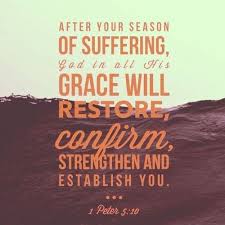
~C. H. Spurgeon, Morning and Morning

When I ponder the pain of child loss, it helps to remember that Jesus suffered too.

Not just at the end, when He allowed evil men to crucify Him, but throughout His life when friends abandoned Him, people tried to kill Him, religious leaders mocked Him and sought to destroy His reputation and work.

It helps me to know that my wounds and scars, like His, will be transformed from evidence of pain and loss into a testimony of grace and redemption.  

The cross is both the symbol of our salvation and the pattern of our lives. Everything that happened to Christ in some way happens to us. When darkness envelops us and we are deaf to everything except the shriek of our own pain, it helps to know that the Father is tracing in us the image of his Son, that the signature of Jesus is being stamped on our souls. For Jesus, the darkness of night gave way to the light of morning.

~Brennan Manning, The Signature of Jesus

When Thomas doubted, Jesus didn’t perform another miracle or call down angels from Heaven to testify on His behalf.  He said, “Here, touch my wounds.”  

I don’t know what that felt like for Thomas, but it was the only proof he needed to believe.

And while Christ accommodated Thomas, He spoke a special blessing on those who would not have such proof.  

blessed are those who believe without seeing

I have doubts some days too.  

There are moments when suffering washes over me like a flood and I am swept under with the tide.  

It’s then I cling tenaciously to the promise that my wounds, like Christ’s, will one day not only be proof of pain but also evidence of God’s redemptive power. 

Could it be that God will wipe the tears from our eyes, but not from our memories, that the renewed experience of the glorified saint will be to recall those sadnesses with the transforming joy which God’s presence and God’s disclosed providence will bring? Surely part of our praise in heaven will not merely be that we are now saved, but that we have been saved, that the very title of being those who have conquered means that our memory of victory will include a transformed awareness of what the whole battle meant.

What a difference this could make to my suffering. The scars I bear in my body, my mind, my soul, the adversities and setbacks, the pains that may yet await me before I get to heaven, the relational wounds, the memories from which I struggle to recover, the darkness of doubt and the battles with unbelief, will not necessarily be removed when I get to heaven, but they will be redeemed, they will be transformed by the long view that being perfected in the presence of my perfect God will bring. What an experience it will be to probe the scars, but to no longer feel their pain – to see them as contour lines of God’s grace by which I ascended into glory. What could it mean for my wounds to sing his praise, for my scars to record his perfections, for my memory of old pains to be set in the context of a new and never failing joy. That makes suffering sufferable now, and glory all the more glorious then.

~Andrew Roycroft, Thinking Pastorally blog, 6.23.19

Grief in Real Life: Give Sorrow Words

A few summers ago, I participated in an online discussion group with others who read ATLAS OF THE HEART* by Brene Brown.

It was a helpful exercise to map, name and explore emotions so that I can create more meaningful connections to myself and others.

I think I’ve been doing some version of this my whole life. Language matters. Being able to give any emotion-especially the deep pain and sorrow of child loss-matters.

Language is our portal to meaning-making, connection, healing, learning, and self-awareness….

Language shows us that naming an experience doesn’t give the experience more power, it gives us the power of understanding and meaning.

Brene Brown, ATLAS OF THE HEART, xxi

The morning Dominic ran ahead to Heaven, after I made the awful phone calls I reached for my journal.  

I knew if I didn’t start spilling the grief onto paper my heart would explode with sorrow.  

Since I learned to hold a pencil I’ve been writing. 

It’s how I sort my thoughts, figure out my feelings and express my heart. 

i-write-because-i-dont-know

A few months after and I found several online support groups. 

There I learned a whole other  Language of Grief and Loss.  The more I read what others shared, the better I understood my own experience and understood how to communicate that truth to others.

You might not keep a journal or write poetry or craft lengthy essays about your pain and that’s just fine.  There’s no magic in written words.

Find a safe space or person and speak it aloud.  

Sorrow unspoken swells. 

It can’t be contained.  

It will absolutely consume you.  

Give-sorrow-words shakespeare

*Warning: ATLAS OF THE HEART contains language that may offend some folks. I just don’t want anyone to be surprised. ❤

Grief In Real Life: It’s OK to Talk About Death

We wall off our world with words.

The ones we speak and the ones we swallow down so they don’t escape our lips.

But, as Mr. Rogers says, “Anything human is mentionable.”

Even death.

We don’t like to talk about death. It’s unpleasant and frightening and often divisive. We all know it’s coming-no one (except Enoch and Elijah) have left this world any other way. Yet the polite thing to do is pretend it doesn’t exist or at the very least, isn’t likely to happen any time soon.

But that serves no good purpose.

It stops us from having meaningful conversations with those we love as they approach the end of their days. It keeps us from making amends while there is still time, saying the things that need to be said, wrapping up loose ends and frayed relationships.

It stops us from listening to the bereaved. If we get too close and pay too much attention to the aftermath of loss then we have to think about what it really means to live on without someone we love.

And it has shaped a society in which those who grieve too loudly or too long are shushed and shamed.

Refusing to talk about death doesn’t make it disappear.

It only makes it harder to deal with.

The rest of the Mr. Rogers quote is this:

…and anything mentionable is more manageable. When we can talk about our feelings, they become less overwhelming, less upsetting, and less scary. The people we trust with that important talk can help us know that we are not alone.

Fred Rogers

Learning the language of loss and lament is part of the healing process in grief.

We’ve never been very good in Western society talking about or dealing with death. So many hearts are hurting and have nowhere to go, no one to talk to, no safe refuge for their pain.

If someone trusts you with his or her feelings, receive it as a gift.

Make space for them to be honest about what they are experiencing.

Remind them that “Anything human is mentionable”.

And listen. 

I don't believe in best friends {discuss amongst yourself ...

Grief In Real Life: Hiding Behind Small Courtesies

It’s what you do, it’s what you say.

Please”and “thank you” are how we live in community with others.

Even when our world is crumbling and our hearts are breaking, we don’t toss these courtesies away.

You begin to realize that everyone has a tragedy, and that if he doesn’t, he will. You recognize how much is hidden beneath the small courtesies and civilities of everyday existence. Deep sorrow and traces of great loss run through everyone’s lives, and yet they let others step into the elevator first, wave them ahead in a line of traffic, smile and greet their children and inquire about their lives, and never let on for a second that they, too, have lain awake at night in longing and regret, that they, too, have cried until it seemed impossible that one person could hold so many tears, that they, too, keep a picture of someone locked in their heart and bring it out in quiet, solitary moments to caress and remember.

Roseanne Cash, Composed: A Memoir by Roseanne Cash

I remember walking down the grocery store aisle wondering if the face I smiled into was faking it like I was. I wondered if they were hiding behind pleasantries because they form a good shield.

I imagine, on some level, most were. Because nearly everyone has a secret wound.

And, like Cash said, if they haven’t yet, they will be.

Grief In Real Life: Heartache and Hope

I am so very thankful for the hope I have in Christ.

I am dependent every moment on the strength of Jesus and the Word of God to point my heart to the eternal truth that my son is safe in heaven and that I will be reunited with him one day.

I honestly don’t know how a person who does not share my hope in the finished work of Christ can bear the burden of child loss.

But hope, strong as it is, and effective as it is, does not erase the pain.

It gives me the endurance to bear the pain.

It allows me to see past the pain to something better.

But I still feel the pain.

Hope is not anesthesia.

Hope does not dull my senses nor does it render my heart hard to the longing and missing and hurting of life without the son I love.

substance

I believe in Christ.

I believe that “God so loved the world He sent His only begotten Son that whosoever believeth in Him should not perish but have everlasting life”. (John 3:16)

And often, when inviting someone to believe in Jesus I will explain that God loves them SO much, He gave up His Son, just to save them.

Only the hardest heart would think such sacrifice was small or insignificant.

If it was painful for the Father to allow wicked men to kill His Son, then it is painful to me for death to take mine.

It is unhealthy to ignore pain.

heal and acknowledge

But when it comes to emotional pain, we sometimes shut people out or shut them down.

I submit that we diminish the power of the cross when we deny or minimize the presence of pain.

Believing that God is in control and Jesus lives does not undo grief’s storm-it is a lifeline that keeps my desperate and hurting heart from sinking under the waves.

hope holds a breaking heart together

One day my hope will be made sight.  One day the faith I hold onto will be realized in full.

jesus wept

Jesus wept at the tomb of Lazarus, even though He knew that death would not win and Lazarus would walk out of the grave.

For now, I place my broken heart in the hands of the One Who made it because I know He knows my pain.

And I know that He longs as much as I do for the day when all will be redeemed and restored.

rev 21_4