Navigating Grief: Why Does Coffee Make Me Cry?

Oh, the early days, weeks and even years of grief!

I was a giant walking nerve.

Every sight, sound, smell or even touch that reminded me of Dominic evoked a wave of sorrow that almost always ended in tears.

I cried in the grocery store, walking past Bath and Body Works in the mall, driving down the road when certain songs came on the radio, tidying up drawers and finding a long lost and forgotten something that Dominic tucked away for later.

Sometimes I just wanted to scream, “Don’t you know my son’s not here??!!”

But of course I couldn’t do that and walk around in society.

So the triggers were an outlet for that pent up energy, angst and sadness.

It was awful.

Especially when what I set out to do was something I really needed to do. I’d leave the house with a list of places to go, things to buy and people to see but often return having done only a fraction of it.

I’m better at it now.

I’ve grown stronger and am more skilled at carrying the burden of the disconnect between my heart and other hearts who haven’t experienced deep pain and loss.

I’ve learned how to fix my eyes on some distant point if cornered by a well-meaning friend asking how I am but not really wanting to hear about how Dominic’s death continues to impact our family.

I press my fingers together hard in an attempt to stop the sorrow rising up and threatening to undo me until I can escape to the bathroom, a quiet corner or my car.

And I’ve learned not to be ashamed of the tears that fill my eyes and slip down my cheek despite all my best efforts no matter where I am.

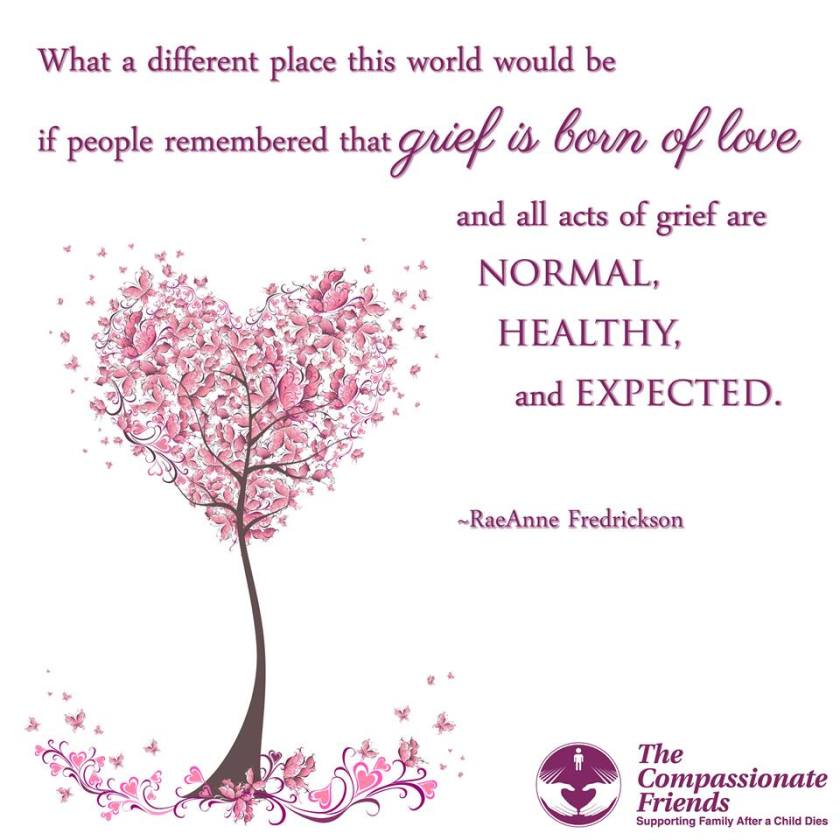
Navigating Grief: What’s Normal?

Every time I come home from a retreat, a conference or a bereaved parent support group meeting I am reminded again that the range of “normal” in grief-especially child loss-is so very wide.

Still crying after a decade? Absolutely normal.

Trouble getting dinner on the table or remembering your child’s school schedule? Yep. That’s normal.

Struggling with crowds, back-peddling on commitments, feeling trapped by phone conversations, shopping when you are least likely to run into someone you know? Perfectly normal.

Our losses range from very recent to decades old and we all acknowledge that our behavior, our feelings, our ability to handle change, nearly every aspect of our lives is impacted by the death of our child.

So if you are wondering if your expression of grief is normal, it is.

Our lives were shattered.

Our hearts were broken.

Picking up the pieces, whatever that looks like, is absolutely, positively normal.

Navigating Grief: Time, By Itself, Does NOT Heal All Wounds

Time, by itself, does not heal all wounds.  

But of all the factors that promote healing, there is NO SUBSTITUTE for time–not in the physical world of surgery and broken bones and deep wounds and not in the inner world of  emotional pain and brokenness and sorrow.

Our bodies are made to be amazingly resilient.  

Most people don’t really think of surgery as an assault on the body, but it is.

The surgeon knifes through layers of flesh and tissue that are designed to keep intruders out, mucks about inside, does what he or she came to do, and closes up–hopefully without introducing bacteria into the wound. Some medication may be prescribed to promote healing, control pain and reduce the risk of infection.

Then the patient goes home to recover.

But it is really TIME and the body’s own healing powers that do the lion’s share of the work.

Our hearts and minds can be resilient too.

Frequently, someone who suffers an assault on their emotions may not bear outward signs and symbols to mark what they’ve  been through.  And well-meaning friends and family can forget that healing has only begun and is far from complete.

Sometimes broken people feel pressured to put on a brave face and to stuff their feelings.

For the body, ignoring doctor’s orders to rest after surgery can mean another hospital stay due to complications that might have been avoided if the patient had been given sufficient time to recover.

Emotionally wounded people can end up with complications from pressure to rejoin regular activities and engage society in ways for which they are not yet ready.

It takes TIME to heal from burying a child or any other traumatic loss.

There is no way to rush the healing.  It takes HOURS AND HOURS to think about, respond to and process the feelings that overwhelm anyone who is grieving or trying to cope with emotional upheaval of any kind.

ok to just breathe

So be patient with yourself.

  • Understand that there will be good days and bad days.
  • There will be forward movement and steps backward.
  • Sometimes it will be easy to do something or go somewhere and the next time it might be really hard.

And don’t be afraid to let others know you are still healing.

Deep emotional wounds require great care and an extended period of time to heal if the healing is to be sound and free from unnecessary complications.

You are not selfish to draw boundaries around what you can and can’t do, what you will and won’t allow and where and when you engage with others-you are being wise.  

For those walking with the wounded:  extend grace and be patient.

Thank God you are not bearing this burden and be mindful of placing demands or pressure on the wounded to heal according to a predetermined timetable.

Then support them in their effort to give themselves the TIME they need to heal.

smiling through tears

Navigating Grief: Darkness and Fear

I was afraid of the dark until I was almost forty years old.

My fear was rooted in scary childhood moments and even years of adult experience could not rip it from the soil of my psyche. I never could convince my heart what my head knew to be true: there was nothing in the dark that wasn’t also there in the light.

It was fear, not darkness, that controlled me.

There is great darkness in grief.  So many unanswerable questions, so much anquish, so much pain.

And there is darkness in many other painful, unchangeable circumstances.

The darkness can hide things that I see clearly in the light.  And if I’m not careful, I  can allow the darkness to foster fear and keep me from venturing futher.

In my own strength, depending on my own resources, I am afraid.

But when I call out from my scary place to the God Who made me, I can face the fear in confidence He hears and cares.

When I am afraid, O Lord Almighty, I put my trust in you.

Psalm 56:3 GNT

Sometimes believers in Christ can convince themselves that admitting their world is dark with pain or suffering or questions diminishes the power of God–that it speaks ill of God or that it means God is insufficient to uphold us in our weakness.

If I pretend that I’m never afraid, or that I never experience darkness, I am denying others my aid.

Even worse, I may be shaming them to silence, sending the message that if they are experiencing pain, something is wrong with THEM.

How many people are sitting in our pews with broken hearts and broken lives, afraid to reach out for help because–in addition to the pain of their broken life–they live under condemnation?

Life is full of pain and darkness.  Even for those who follow Jesus.

When I deny that truth, I also refuse to testify to God’s power to help me carry on and give me the courage to face my fear.

God is the God of the day AND the God of the night.  

I do not diminish Him by admitting that I experience both.

He invites me to lean into Him and to hold hands with His children as I journey on, even when it’s dark.

“Christians with this unflinching faith in the sovereign God do not deny grief. But even in their darkest hours, they borrow God’s strength. In their tears and pain they cling to God who will never let them go. What the Savior has done for others He will do for you. When you are shaken, and you know that life will never be the same again, you can trust and not be afraid. You can live in HOPE with the sturdy confidence that God will dry your tears and put you on your feet again.”

“Grief, Comfort for Those Who Grieve and Those Who Want to Help” by Haddon W. Robinson

A Prayer for the Broken-Blessing the Dust

There are many times in my life when I’ve felt small and unseen.

Many times when my spirit sank so low I couldn’t even remember “up” much less find it.

But there is no moment so humbling as the one when I came face-to-face with the undeniable FACT that my son had exhaled for the last time.

Walking into the sanctuary where his body lay still, unnatural and absolutely silent, my heart shattered into even smaller pieces.

So I understand Job’s cry.

I cry out to You for help, but You do not answer me; when I stand up, You merely look at me.

Job 30:20 HCSB

I know what it is to fall to the ground in utter dejection, complete hopelessness and pray, pray, pray that life leaves my body because the pain is unbearable.

That’s one reason Lent is a kind of relief every year.

It’s a season when others join me in admitting that from dust we came and to dust we will return.

Image result for from dust to dust

But it’s also a season of hope.

Because while Lent forces my heart to focus on my frailty, it points me toward my Savior.

The One who made us is the One who rescues us.

The One who saves us is the One who sees us.

The One who sees us is the One who longs to comfort us.

I love this blessing by Jan Richardson:

“All those days
you felt like dust,
like dirt,
as if all you had to do
was turn your face
toward the wind
and be scattered
to the four corners

or swept away
by the smallest breath
as insubstantial—

did you not know
what the Holy One
can do with dust?

This is the day
we freely say
we are scorched.

This is the hour
we are marked
by what has made it
through the burning.

This is the moment
we ask for the blessing
that lives within
the ancient ashes,
that makes its home
inside the soil of
this sacred earth.

All those days
you felt like dust,
like dirt,
as if all you had to do
was turn your face
toward the wind
and be scattered
to the four corners

or swept away
by the smallest breath
as insubstantial—

did you not know
what the Holy One
can do with dust?

This is the day
we freely say
we are scorched.

This is the hour
we are marked
by what has made it
through the burning.

This is the moment
we ask for the blessing
that lives within
the ancient ashes,
that makes its home
inside the soil of
this sacred earth.

So let us be marked
not for sorrow.
And let us be marked
not for shame.
Let us be marked
not for false humility
or for thinking
we are less
than we are

but for claiming
what God can do
within the dust,
within the dirt,
within the stuff
of which the world
is made
and the stars that blaze
in our bones
and the galaxies that spiral
inside the smudge
we bear.”

—Jan Richardson, Blessing the Dust, For Ash Wednesday

It’s no secret I am frail, prone to break-even shatter-into the tiniest bits of dust.

But that doesn’t stop my God from gathering what’s left to make something beautiful.

When I find myself face down in the dirt, no strength to lift my head, I remind my heart, “[Do] you not know what the Holy One can do with dust?”

Praying You Never Know

I participate in a number of online support groups for bereaved parents.

And one topic that makes the rounds at least once a week-often once a day-is how those outside our experience cannot truly understand our experience.

Because it’s true-you THINK you can imagine the pain of child loss if you have children, but even the most vivid imagination can’t conjure the utter blackness that waits on the other side of hearing, “Your son is dead.”

There’s a great divide between me and those who have not experienced child loss.

But it’s one I hope they never have to cross.

Because it’s a mercy to not know.

If all of us could fathom the pain of losing a child, no one would bear childrenthe risk would be too great.

So while the gap can be a source of misunderstanding and isolation for ME, it is a safeguard for YOU.

And I am grateful for it.

pain-behind-every-tear

Hope in Bare Branches

The sun rises behind bare branches and they look beautiful.

In just the right light and at the perfect angle, anything can be lovely.

bare winter branches

It’s true that every living thing needs rest.  Every working part must be oiled.

And while winter can be hard and heartless and cold and cruel, it is also space and time for re-creation.

If I only look harder I can already see tiny buds of springtime promise on the tips of branches overhead.

Death is winter.

Cold, hard, gray.  Every lovely thing fallen and dry underfoot.

A season of rest-not chosen, unwelcome, resisted.

But rest just the same.

Yet the sun still shines and spreads warmth and light on even these bare branches.

winter sunrise pines and zeke filter

After such a long time can the sap still rise?

Is there life left here?

Will spring come again and flowers bloom?

I’m counting on it.

IMG_1795

It will all happen so fast, in a blink, a mere flutter of the eye. The last trumpet will call, and the dead will be raised from their graves with a body that does not, cannot decay. All of us will be changed!  We’ll step out of our mortal clothes and slide into immortal bodies, replacing everything that is subject to death with eternal life.  And, when we are all redressed with bodies that do not, cannot decay, when we put immortality over our mortal frames, then it will be as Scripture says:

Life everlasting has victoriously swallowed death.
     Hey, Death! What happened to your big win?
    Hey, Death! What happened to your sting?

Sin came into this world, and death’s sting followed. Then sin took aim at the law and gained power over those who follow the law.  Thank God, then, for our Lord Jesus, the Anointed, the Liberating King, who brought us victory over the grave.

My dear brothers and sisters, stay firmly planted—be unshakable—do many good works in the name of God, and know that all your labor is not for nothing when it is for God.

I Corinthians 15:52-58 VOICE

An Uncomfortable Exchange

The other day I had an uncomfortable exchange with someone that started with a phone call and ended with a series of texts.

I’ve learned a lot about the unhelpful things folks say to grievers and at this point I can let most remarks roll off like raindrops.

When someone says, “God needed another angel” or “I know just how you feel” (and they do not share my experience) or “at least you have other children/grandchildren” I usually smile, cut the conversation short and hang up or walk away.

So when this old family friend called and asked in a chipper voice, “How are you??!!”, I told them not well since my granddaughter just went to Heaven two days ago.

That invited several platitudes.

I endured them, hoping for a quick end to a painful conversation.

Then the spouse chimed in because they could not contain themselves and felt compelled to share a bit of friend circle news with me.

When I said, firmly but politely, I could not listen to that right now, they got upset.

I genuinely try to educate people outside the grief community when I can so I sent a text explaining that (especially!) when a loss is fresh, such conversations are incredibly painful.

The person responded by telling me I was rude and they were highly offended.

In the early days after Dominic ran ahead to Heaven, I would have curled up on my bed and slept away the pain such an exchange inflicted on my wounded heart.

I’m stronger now.

And I’m not just fighting for myself, I’m fighting for my newly bereaved son and his wife.

So after giving it some time and some thought, I wrote a text.

People might consider it harsh but I will not make death easy for others. It’s not easy on the families directly impacted and it’s not my responsibility to manage the feelings of folks who are not even in the grief circle.

I gave graphic details (which I will not recount here to spare my precious readers who actually lived through things like them) regarding the brief life and difficult death of my precious Holly.

I wanted to shock them into realizing the giant gap between the imagined experience of child loss and the LIVED experience of child loss.

I concluded by saying that if “rude” was the epitome of awful in their world, I was thankful they didn’t have anything to compare it to.

I am quicker to extend grace after all these years because I know many, if not most, folks are genuinely doing the best they can.

But I have boundaries.

I am not required to set myself on fire to keep others warm.

And I’m doing no one a favor by allowing someone who wields words like swords to go unchallenged.

There are still lots of times I remain quiet.

This wasn’t one of them.