Child Loss: Helpful Tips for Interacting With Bereaved Families

I firmly believe that our friends and extended family want to reach out, want to help, want to walk alongside as we grieve the death of our child

 I am also convinced that many of them don’t because they don’t know how.  

It may seem unfair that in addition to experiencing our loss, we also have to educate others on how to help us as we experience it, but that’s just how it is.

The alternative is to feel frustrated and abandoned or worse.  

So here’s a list of helpful tips (and a great infographic!) for interacting with bereaved families:  

Express condolences and show you care. Don’t avoid me, please!  You cannot make me any sadder.  I need to hear from you.

friends hugging

Refer to my child by name.  Dominic is STILL my son.  He is still part of my story.  But because he’s no longer visible, his name often goes unspoken.  Please talk to me about him, use his name, tell me a story of how he impacted your life or a memory that makes you smile.  It makes me smile too.

Actively listen and be supportive.  It’s hard to listen to someone tell you how much they are hurting and not offer advice or think of ways to “fix” them.  I can tell you from experience that what I need most on my darkest days is for someone to say, “It IS dark.  I’m so sorry.”  Silence is OK too.  Not every quiet moment needs to be filled with chatter.

listening is a postive act

Understand that each family and family member will grieve in different ways.  You may have observed child loss before but what you saw in one family may not translate to the next.  There are no hard and fast rules for this awful journey.  The age of the child, family background and structure, manner of death-all these impact grief.  In addition, mothers and fathers, sisters and brothers all bring their personalities, stage of life, beliefs and experiences to the journey.  There were five of us left behind when Dominic ran ahead.  We were each devastated but expressed it in very different ways.  Nearly five years later, those gaps have widened, not narrowed.

Fathers grieve too.  Sometimes support focuses almost exclusively on the mother.  In part because of a common notion that mothers are somehow emotionally closer to their children than dads.  In part because many men are less demonstrative and may do a good job hiding grief.  Whatever the reason, don’t assume one parent is dealing “better” with the loss than another (mother or father) just because he (or she) is not crying openly.  No one escapes this awful blow unscathed.
bereaved fathers

Don’t overlook siblings.  Surviving siblings are sometimes referred to as “forgotten grievers”.  If they are very young, people may think they are relatively unaffected by the death of a brother or sister. If they are grown and out of the home, people may figure that the siblings’ own, very full and very busy, lives keep them preoccupied.  While some of that may be true-to an extent-most surviving siblings are deeply impacted by the death of a brother or sister, regardless of age.  Not only have they lost a member of the family and changed birth order, they have also lost the family they knew, the parents they knew and a co-keeper of memories and secrets.  Bereaved parents are often overwhelmed with grief for their living children as well as the child that is missing. One of the best gifts anyone gave me was reaching out to my surviving children.  It helped my heart to know that they had friends who were supporting and loving them well.

kids cartoon

Be yourself.  People often feel awkward and stiff when approaching a bereaved parent or family member.  That’s perfectly understandable.  The bereaved seem so fragile (are so fragile!) that folks are afraid the wrong word or touch might shatter them into a thousand pieces.  But what your friend or family needs right now is the you they’ve always known and loved.  If you are a hugger, hug!  If you are a storyteller, tell stories (appropriate ones, ones of the missing child).  If you are a cook and cleaner, then cook and clean.  Our family was blessed by our friends doing exactly what they had always done-come alongside in their own special way.  So much had changed in our world that familiar touchstones, familiar routines and familiar faces were a real comfort.

Keep in mind words matter.  Now is not the time to try to satisfy your curiosity about exactly “what happened”.  Loud joking is rarely welcome.  Many bereaved families find it hard to laugh in the first days, weeks, months because it feels like betrayal.  Don’t offer platitudes intended to help them “look on the bright side” or consider that “it could be worse”.  There is nothing worse than burying your child.  Nothing.  Listen and take direction from the person you are comforting.  Follow his or her lead.  And if something less than helpful slips out, own it and apologize.
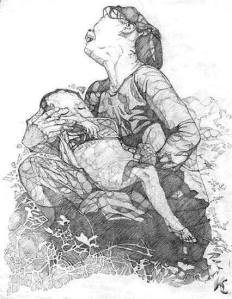
pencil-drawing-bereaved-mother

It’s never too late to reach out.  NEVER.  Sometimes people stay away at first for lots of reasons.  Or they show up for the memorial service and then fade into the background.  After a bit, even if they want to reach out, they may feel embarrassed by the long absence.  Don’t be.  So many people stop calling, visiting and texting within the first weeks that your outstretched hand of friendship will be a welcome beacon of hope.  If you need to, apologize for your absence.  Be honest.  Admit you were scared or whatever.

Then show up. 

Stick around.

You don’t have to be perfect.  

Just be present.  

bereaved families infographic

Repost: What is Safe?

I remember as a  young mother of four working hard to keep my kids safe. 

dominic and siblings little children at nannys

Next to fed and dry (two still in diapers!) that was each day’s goal:  No one got hurt.  

It never occurred to me THEN to add:  No one got killed.  

Because the most outlandish thing I could imagine was one of them falling or touching a hot stove and us having to rush to the emergency room.

Then I became a mother of teens and one by one they acquired a driver’s license and motored away from our home.  

That’s when I began to beg God to spare their lives.

Read the rest here:  What is Safe?

Child Loss: When It’s Been YEARS-How To Bless a Grieving Parent

Please hear me. 

I do NOT blame you that my son and my sorrow have drifted down your list of “things that need attention”.  Your life is as busy as mine once was and your calendar full of commitments and celebrations that require your attendance.

There is no way you would know it’s 69 days until the fifth anniversary of Dominic’s sudden absence. 

There is no reason for you to be aware that as the southern landscape turns to spring, my heart and mind turn to death.  

But it’s the truth. 

Read the rest here:  When It’s Been YEARS-How to Bless a Grieving Parent

Child Loss and Secondary Losses

While I certainly had no real idea in the first hours or even weeks what losing a child entailed, I understood plainly that it meant I would not have Dominic to see, hold or talk to.

I wouldn’t be able to hug his neck or telephone him.  

He wouldn’t be sitting at my table any more.

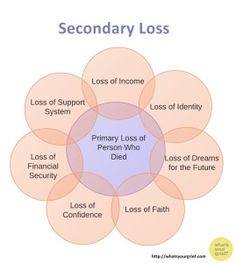
But the death of a child or other loved one has a ripple effect.  It impacts parts of life you might not expect.  As time went on, I was introduced to a whole list of losses commonly called “secondary losses”.

secondary losses

Here are just a few:

Loss of a large chunk of “self”.  Dominic possessed part of my heart and part of my life.  It was violently ripped away when he died.  There is part of me that was uniquely reflected from him-like a specialty mirror.  I can never access that part of me again.

Loss of identity.  Before Dominic died I was one kind of mother.  I was a mother of four living children who were making their way in the world as successful adults.  I was a mother looking forward with happy anticipation to the next years.  Now I am still a mother of four children but one whose heart has been changed by tragedy and sorrow. Tomorrow is still bright, but there’s a shadow just behind it.

desimones uab family

Loss of self-confidence.  I used to enter a room without a thought to how I’d be received or perceived.  That’s definitely not the case now.  I’m self-conscious-constantly wondering if I’m saying or doing the right thing.  I never know if a grief trigger will (at best) pull my attention away from conversation or (at worst) send me scurrying for the bathroom.

Loss of sense of security.  I think every parent has moments of fear over his or her child.  When they first go off someplace without us, when they get a driver’s license, travel abroad, go to college.  But all the awful things I imagined didn’t hold a candle to the reality of waking one morning to a knock on my door and the news that Dominic had been killed.  The bottom fell out of my (relatively) safe world.  Bad things, random things can and do happen.  Once it happened to ME, it changed how I processed everything.  The passing years have softened some of the anxiety but I will never be able to assume safety again.

Anxiety

Loss of faith.  I did not “lose” my faith.  I never once doubted that God was still working, was still loving and was still in control.  But I most certainly had to drag out every single thing I thought I knew about how I thought He worked, loved and superintended the world and examine it in light of my experience of burying my son.  It took a long time to work through all the pat answers I had been offered and myself doled out to others for years that didn’t fit with my new reality.  I am learning that doubt is not denial and that I have to live with unanswered questions.

Loss of family structure.  I’ve written before that a family is more than the arithmetic total of the number of members.  There were six of us.  But we were so much more than six when we were all together!  Our talents, personalities and energy were amplified in community.  When Dominic’s large presence was suddenly whisked away, every relationship got skewed.  We’ve fought our way back to a semblance of “whole” but still miss him terribly.  We can function, but we will never be the same.

empty chair

Loss of my past.  Memories are funny things.  They are plastic and subject to change.  And my recall of an event is limited to my own perspective.  For a memory to be rich and full, I need input from others who were there as well.  One vessel of family memories is no longer available to add his unique contribution.  Every time I pull out a photo or dig down deep in my heart to draw up a treasured moment, I realize I’ve lost something I can not recover.  The joke, the glance, the odd detail are all gone.

Loss of the future I anticipated.  I’m a planner by nature.  Not a detailed, OCD, got-everything-in-order kind of planner, but a “big picture” kind of planner.  When Dominic left us in 2014, things were going (pretty much) according to plan.  Each child was well on his or her way to the career path they had chosen.  I was easing into an empty nest and exploring options for life after homeschooling.  My husband was entering his last few years of a lengthy career.  It’s hard to explain to anyone who hasn’t experienced it, but when your world is shaken by child loss, everything gets scrambled.  You can’t just pick up where you left off and keep going with the pieces that remain. 

There’s a prolonged period of confusion and everyone is impacted differently and in ways you could never imagine.  All of us have changed dramatically in the years since Dominic left us.  He is not the only thing missing from the rest of our lives.  Holidays are altered.  Birthdays are different.  We have to plan special events around uncomfortable milestone dates that roll around every year whether we want them to or not.  It’s a constant readjustment to life as it IS instead of life as I thought it WOULD be.

Loss of ability to focus and function.  Oh, how this surprised me!  I was in some kind of zone for the first month after Dominic left.  My other children were home, we had to make it through planning his funeral, two graduations and cleaning out his apartment.  I also had to handle paperwork for my husband to take short-term disability due to grief.  I cried a lot, wrote down dozens of notes but managed to do what I had to do.  Then I crashed. I couldn’t remember a thing.  I couldn’t read more than a couple sentences at a time.  I hated the telephone.  I could barely stand to hear the television.  I had to make a list of the most basic things like brushing my teeth, feeding my animals, turning off all the lights before bed.  It was awful!  And it didn’t really get better for well over a year.

I still suffer from a very short attention span, low tolerance for noise and an inability to accommodate last minute changes.  I don’t schedule anything back to back.  I live in a rural area and sometimes shop in the nearby town.  I will start the day with a long list and shorten it repeatedly as I go along because driving in traffic, crowds and random sounds ramp up my anxiety and make me want to go home with or without what I came for.  I have changed the way I do so many things.  My pre-loss memory has never returned.  

griefbrain1

Loss of patience.  I am at once impatient and long-suffering.  I have zero patience for petty grievances, whining and complaining.  Yet I have compassion for other people living hard and unhappy stories.  I berate myself for not being “better” and, at the same time, extend grace to others who aren’t “better” either.  I want to shake people who bowl over weak, hurting, desperate souls.   I don’t have time for moaning about rain when you were planning a picnic but will listen for hours to a mama tell me about her missing child.

Loss of health.  I had a number of chronic health conditions before Dominic ran ahead.  Within the first year of his departure, I was hospitalized twice.  My experience is not unique.  Some parents suffer immediate health effects (heart attack, blood sugar spikes, anxiety/depression) and some see a slow decline over time.  In part because child loss, like any stressor, will negatively impact health and also because sometimes bereaved parents stop doing the things that help them stay healthy.  At almost five years, I’ve learned how to manage the stress better although some of my health issues continue to get worse.  It’s hard to tease apart what is age, what is disease and what is grief.

When your child leaves this life before you do, it changes everything.  

Not only things you might expect, but many you’d never imagine.  

It’s a constant balancing act, readjusting every day to new challenges.  

Struggling to keep my head above the waves.  

grief like the ocean learn to swim


Child Loss: Marking the Milestones

When your child is born you take notes.

You plan to mark this day as a special milestone for the rest of your life.

You absolutely, positively NEVER think you will have to mark another one:  the day he or she leaves this life and leaves you behind.

But some parents have to mark both.  The dash in the middle is shorter than we anticipated, and our child’s life ends before ours.

grieving mother at grave

So how do you do it?  How in the world do you observe the polar opposite of a birthday?

Here are some ideas (shared with permission) that parents shared recently in an online discussion sparked by one mom’s very honest admission that she just didn’t have it in her to create another video montage from the same old photos to mark yet another year without the earthly companionship of her precious son:

Don’t do anything.  That is an option. We do not have to draw a red circle around THAT day on the calendar, gather folks as if  it’s a celebration.  As one mama said, “Yes, the day they left us does not need to be ‘remembered’.”  For some parents, going to work like it’s a regular day, engaging in whatever normal activities are required, ticking the hours off on the clock until night falls and the earth turns to the next day may be the very best choice.  Another mama wrote this:  “I have friends who celebrate a ‘heaven day’ for their son.  I can’t.  I just can’t.  If it were up to me, I would probably go camp somewhere all alone, and not move a muscle for the entire day.”

Do something big (or small).  Some parents choose this day to hold an annual “Celebration of Life”.  It might take the form of a balloon release, or lantern release at home, at a park or other outdoor venue or at the cemetery.  It might be lunch or dinner out at your child’s favorite restaurant or at home with your child’s favorite menu.  Invite friends and family to join you and ask that they bring a photograph or memory and share.  One mom said that such an event kind of happened organically and spontaneously when contacted by her son’s widow:  “We went to one of [his] favorite restaurants.  Told funny stories about him, talked about how missed he is, then went o his grave and put fresh flowers.”

balloon release

Serve others.  Did your child have a special interest in a particular charity or community organization?  Maybe you can spend this day volunteering or raising awareness/money for that group.  Often having something to do helps a heart from sinking into despair.  If the group allows, maybe put up a sign saying, “Volunteering today in honor of __________” and attach appropriate photos of your child.  Some parents whose child died from cancer or suicide or violence participate in walks or fundraisers that highlight those causes.

Encourage Random Acts of Kindness (RAK).  I plan to do this one in April.  It will be seven years (!) and I can barely stand it.  But so many of the comments from Dominic’s friends after he left for Heaven went something like this one, “He was always doing something for someone else.  Fixing their car or showing up when they needed an encouraging word.”  He was known for his many acts of generosity and kindness and I feel like he lives on in the hearts of others because of that.  I had cards printed ( I intentionally let his “dates” off) which I will distribute well in advance of April 12th for friends and family to leave behind when they do a RAK in memory of Dom.  Vistaprint and other online publishing companies offer reasonable prices and will guide you through the process step-by-step.

random act of kindness

Escape.  Lots of us find being at home (alone or in the company of others) too hard to bear.  Many received word of their child’s death at home and as the day creeps closer, the memories crowd every corner of mental and physical space and are inescapable.  So sometimes parents plan a trip around this time.  Go somewhere your child would have loved to go or go somewhere he or she enjoyed visiting.  Take photos and post them in honor of your child if you want to.

Focus on family.  You may not want to be alone, but the thought of being with anyone outside your closest grief circle is overwhelming.  That’s OK.  Spend time with the people who, like you, are most affected by your child’s absence.  You don’t have to do anything special.  You can make room for them to speak or not speak about their grief as they choose.  Sometimes just having another warm body in the room is enough to ward of the chill of despondency.

grieving dad

Flip the script.  For those of us who believe that this life is not all there is, the day can be one of celebration.  Our children have escaped life full of sorrow and trouble and are safe forever in the arms of Jesus, where we will also be one day.  Waiting is hard, but waiting is not forever.

Simply allow yourself to feel the full force of missing and grief.  “As far as his death day, for me, that is a day when I allow myself to fully feel and express the pain of my loss.  It is a way to (temporarily) empty myself of all this pain, so I can breathe again to face another day.  I will sit in his sweatshirt, listen to reflective music, cry a lot, talk to him, pray to God, and just allow myself to feel all the pain and emotion that everyday responsibilities cause me to stuff away.”  If you can manage it, taking the day off work and giving yourself grace and space to grieve in ways that are denied so often may be the very best way to experience the day.

Here’s a list of ways some parents honor their child on this day:  

  • Giving away stuffed toys with a card or note explaining why.
  • Taking goodies to first responders and/or nurses who were served their family during an accident or illness.
  • Handing out Bibles or books in memory of their child.
  • Making memory baskets for parent whose child will be born straight into heaven.
  • Adding to a scholarship fund or other charitable fund in honor of their child.
  • Placing balloons, flowers or other special decorations on their child’s final resting place.
  • Lighting candles, releasing butterflies, balloons or lanterns.
  • Placing a memorial advertisement in a local paper.

Do or don’t do whatever helps you make it through those twenty-four hours that represent another year of sorrow, another year of missing.  

missing child from arms

There is NO wrong way to mark or not mark this day. 

It’s up to you and your heart.  

And absolutely does not require anyone else’s permission or approval.  

dont trade authenticity for approval

Repost: I Get It-I Really DO Get It

I write a lot about what bereaved parents (me!) wish others knew or understood about child loss and this Valley we are walking.  And I am thankful for every person outside the child loss community who chooses to read and heed what I write.

But I want to take a minute to tell those of you who are not part of this awful “club” that I get it-I really do get itwhen you need to put distance between yourself and me or other people walking a broken road.

We all love to think that life is a never-ending ascent toward bigger, better and more enjoyable moments.

Our children are born and we think only of their future, not their future deaths.

Read the rest here:  I Get It-I Really DO Get It.

Repost: Step Back, Don’t React

It is possible not to react to every single thing someone says or does.  It is possible to scroll past social media posts that get under your skin and not look back.  It is possible to ignore a snarky comment or an unhelpful piece of advice from someone who ACTS like they know what you’re going through but really has. no. idea.  

Now if you are new on this journey, you will read these first few lines and think, “Is this woman crazy????” 

I felt EXACTLY the same way in the first months and even through the first couple years in this Valley.

Read the rest here:  Step Back, Don’t React

Feedback Loops and Grief

I wasn’t there when Dominic left the road but I’ve imagined it in detail hundreds of times since that night nearly five years ago.

I can’t help it.

I wonder what he thought, what he felt, whether he knew…

It’s not the only tape that plays over and over in my head.

I think about his childhood and the times I probably overlooked my third of four children as I hurried to get this or that done.  I think about the arguments we had, the laughter we shared, the disappointments and challenges we faced together.

I replay birthdays and holidays and ordinary days.

Sometimes I get in a cycle that makes me smile:  Dominic playing drums in church and subtly shaking his head and sharing an eye roll with me as the congregation claps in awkward rhythm to a song-dozens of different beats, none of which were the right one.

dominic at gray haven

Sometimes I get in a cycle that draws sobs from a place I thought I had sealed off after the first two years of his absence. 

My thoughts fall into an emotional feedback loop that, like the sound wave counterpart, is all screeching, mind-numbing and painful noise.

Like a microphone too close to a speaker, the only way out of the loop is to back away and keep backing away until the cycle is broken.

Most days I can shepherd my thoughts down safe paths.  Those are the ones I share with others when they ask me to tell them about my son.

But when I’m alone and everything is quiet and my mind is left to its own devices or cued up by a random sight, sound or smell I can find my thoughts running places I’d rather they not go.

And the loop begins again.  


Will It Ever Get Better?

I know that when I first stumbled onto a bereaved parent group, it was one of the things I was looking for: evidence that the overwhelming pain of child loss would not last forever.  

Some days I was encouraged as those who had traveled farther down this path posted comments affirming that they could feel something other than sorrow.

Some days I was devastated to read comments from parents who buried a child decades ago asserting that “it never gets better”.

Who is right?  

What’s the difference?

Do I have any control over whether or not this burden gets lighter?

It will be eight years in April since Dominic ran ahead to Heaven and I’ve learned a few things since then.

letting-go

Time, by itself, heals nothing.  But time, plus the work grief requires, brings a measure of healing.  

If I cling with both hands to my loss, I can’t take hold of the good things life still has in store for me.  

Longing for the past all the time only brings sorrow.  I cannot turn back time.  Days, weeks, years will keep coming whether or not I choose to participate in them.  I will rob my heart of potential joy by focusing exclusively on the sorrow I can’t undo.

Daily choices add up.  When I lean into the small things required each day, I build confidence that I can do the bigger things that might still frighten me.  Making phone calls eventually helps me show up to a meeting or to church.  I strengthen my “can do” muscle every time I use it.

Doubt doesn’t disappear. Facing my doubt forces me to explore the edges of my faith.  It does no good for me to stuff questions in a drawer and hope they go away.  They won’t.  I have to drag them into the light and examine them.  Doubt is not denial.  If God is God (and I believe that He is!) then my puny queries don’t diminish His glory.  He knows I’m made of dust and He invites me to bring my heart to Him-questions and all.

My mental diet matters more than I might think.  I have to be very careful what I feed my mind.  If I focus on sadness, tragic stories, hateful speech and media that feeds my fears and despair then those feelings grow stronger.  If instead I focus on hopeful stories, good conversation with faithful friends and inspiring quotes, verses and articles I feed the part of my heart that helps me hold onto hope.

I need a space where I can be completely honest about what this journey is like.  Bereaved parents’ groups have been that space for me and have been an important component of my healing.  But even there I must be cautious about how much time I spend reading other parents’ stories if I notice that I’m absorbing too much pain and not enough encouragement.

me too sharing the path

Grief is hard.  

It’s work. 

And that work is made up of dozens of daily choices that are also often difficult.  

I don’t expect to be healed and whole this side of eternity.  But I do know that if I consistently do the work grief requires I will be stronger, more whole and better able to lean into the life I have left than if I don’t.

I want to live. 

I want to honor my son by living a life that’s more than just limping along, barely making it, struggling for each step.  

So I do the work grief asks of me.  

Even when it’s hard.  

give yourself space to do the work grief requires

No Substitute for My Missing Child

Bereaved parents hear lots of things from folks who truly do wish to bring comfort but often miss the mark by a mile.

One of them goes something like this, “Well, at least you have your other children (and/or grandchildren) and they need you!”

Now, if they gave it a bit of thought, they would know right away that’s at best an uninformed remark and at worst, a very painful one.

before you tell a grieving parent to be grateful which of yours could you live without

People are not interchangeable.  

There is no substitute for my son.  

He is a unique individual who holds a unique space in my heart.  

dominic at olive garden

As much as I rejoice in my surviving children and look forward to grandchildren, no one else can take his place.  

It’s little comfort to think that no matter how large our family circle grows in years to come, it will always-ALWAYS– be a broken circle.

The place where Dominic should be, but isn’t, will remain unfilled. 

I will never stop missing him.  

Never.  

missing child from arms