I have loved Scripture as long as I can remember. When I was in second grade I got the notion to read the whole Bible straight through-in the King James Version. I made it to Leviticus before I threw in the towel.
By the time my kids were grown I had read and studied Scripture for decades.
But three years before Dominic ran ahead to Heaven I realized my reading had become rote-I felt like I “knew” all the stories. So I slowed my study to a crawl-only one chapter a day-and I usually copied the whole chapter plus my notes into a journal. I had just finished this time through the Bible in January before Dom was killed in April.
And all that truth stored in my mind and heart was what I “read” for months when my eyes were too full of tears to see print on a page.
I can’t stop the clock or the sun or the days rolling by.
Those of us who are more than a couple months along in this journey (or any journey that involves tragedy and loss) know that it is ABSOLUTELY POSSIBLEto feel worse than in the first few days.
Maybe it’s the time of year or maybe I’m just more attentive to the questions of others right now.
Whatever the reason, I’ve encountered so many hurting hearts recently struggling to square their experience of devastating loss with their faith in a loving and all-powerful God.
I write about my own struggle over and over in this space but this series of posts is an orderly exploration of doubt, pain, faith and the hope I’ve found in Christ Jesus.
When my perfectly healthy, strong and gifted son was killed instantly in a motorcycle accident on April 12. 2014 my world fell apart. My heart shattered into a million pieces. And after three and a half years, I’ve yet to even FIND all of those pieces much less put them back together.
So what does a heart do when that happens?Because, try as I might, I cannot stop time.
Even THAT awful day only lasted 24 hours.
When the sun rose again, the pain was still there. And behind that pain and mixed with it was something else-disappointment, disaffection, distrust.
A mom who is also coming up on her season of sorrow this spring wrote that she felt like screaming and throwing things.
I get it.
And because I live in the middle of the woods, far from neighbors or nosy passers-by, I’ve done it.
Sometimes I walk in the woods and just holler out my questions, my pain, my indignation that this is my life.
Other times I cry as loud as I want to, not trying to hold in the sobs.
When I’m really angry that it will soon be seven years since Dominic has crossed the threshold of home, I take old eggs and toss them at trees. I work myself to a frazzle stacking sticks to burn. I use my clippers and chop away at underbrush, releasing pent up feelings with every satisfying snap of a twig.
The longer it is since his leaving, the more I feel I need to have it together in public. Others have long moved on and my tears are inexplicable to those who have forgotten.
And while I have gotten stronger and better able to carry this load called “child loss” this time of year makes it all fresh again.
The pressure builds with no place to go.
It’s going to force its way through the weakest part of my character if I don’t release it on purpose.
So I do.
If you need me, I’ll be outside for the next few weeks.
Driving down the road I look to the right at the pond overflowing its banks and find myself drifting out of the lane and onto the shoulder.
I never intend to run off the road.
But I steer where I stare. Every time.
I do the same thing with my thought life.
Even before Dominic left us I realized that if I stared long enough and hard enough at the challenges before me (educating and raising four children), the world around me (full of danger and potential danger) or the looming prospect of some giant future obligation, I’d drift from the firm foundation of peace and contentment in Christ and end up in an ocean of worry and despair.
It was critical that I redirect my mind’s attention and my heart’s affection to Jesus and I used Scripture to help me do just that.
I remember the first time I copied out and held onto this verse:
Dominic was only six months old and I absolutely, positively HAD to have my gallbladder removed. I was anxious about leaving him and his siblings for the twenty-four hour hospital stay and even more anxious to be placed under general anesthesia.
The last time I’d been wheeled down a hospital hallway for an operation other than a cesarean section was as a three year old.
There’s something very eerie and frightfully final about having that mask placed over your nose and being asked to count backwards. I didn’t count. Instead I repeated my verse.
And when Dominic ran ahead to Heaven, this was one of the verses that helped my heart hold on.
What was once a good habit became a lifeline.
Peace was elusive in those first days, months and even years, but I clung desperately to the truth that if I continued to meditate on, recite and copy out God’s Word my heart would eventually hear it.
Life may be swirling all around me, threatening to steal my hope, my peace, my joy. But I am declaring right now that I will not be swept up into a storm of fear and wild emotions. The Lord has promised me that He will keep me in perfect peace when I fix my mind on Him. I very much recognize I will steer where I stare. So I must watch what I fixate on. If I keep staring at the wrong things, I’ll go in wrong directions. I am choosing to place my attention on the Lord in this very moment. I am choosing to focus on trusting Him and believing His promises. And as I steer my attention more and more toward Him, His peace will come and flood my heart and settle my anxious mind.You will keep in perfect peace those whose minds are steadfast, because they trust in you. (Isaiah 26:3)
Lisa TerKeurst, It’s Not Supposed to be This Way
My heart is headed somewhere.
Focusing solely on what I’ve lost, what I’m afraid of, or the emotional and relational storm around me will lead to despair.
When I lift my eyes and fix my gaze on Jesus, He will lead me to hope.
When I reach out my hand for the edge of His garment, He will help me hold on.
I have used the term for years and only recently has someone asked me to define it.
I guess I never realized that in all the writing about it, I’d never really explained what it meant.
So here goes.
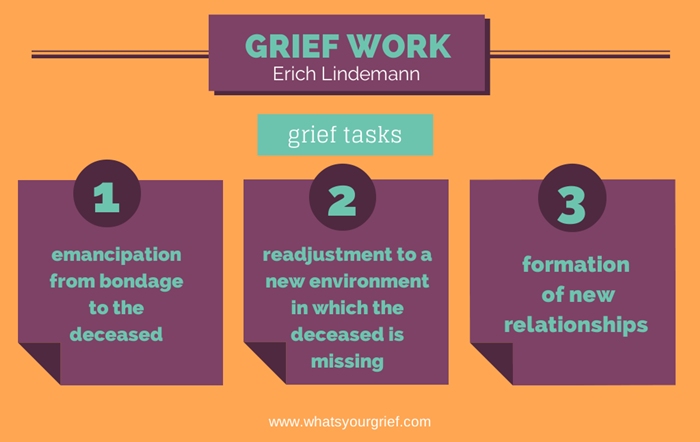
The term was coined by psychiatrist Erich Lindemann in the 1940s. He worked with survivors of the Cocoanut Grove tragedy and observed that grievers experienced common symptoms, feelings and faced similar challenges. Through his work, he developed a theory of grief incorporating his observations and his technique for walking grievers through these common issues.
Today the term has been expanded and is used widely to describe almost any approach to grief that includes specific techniques for helping someone walk the path of loss.
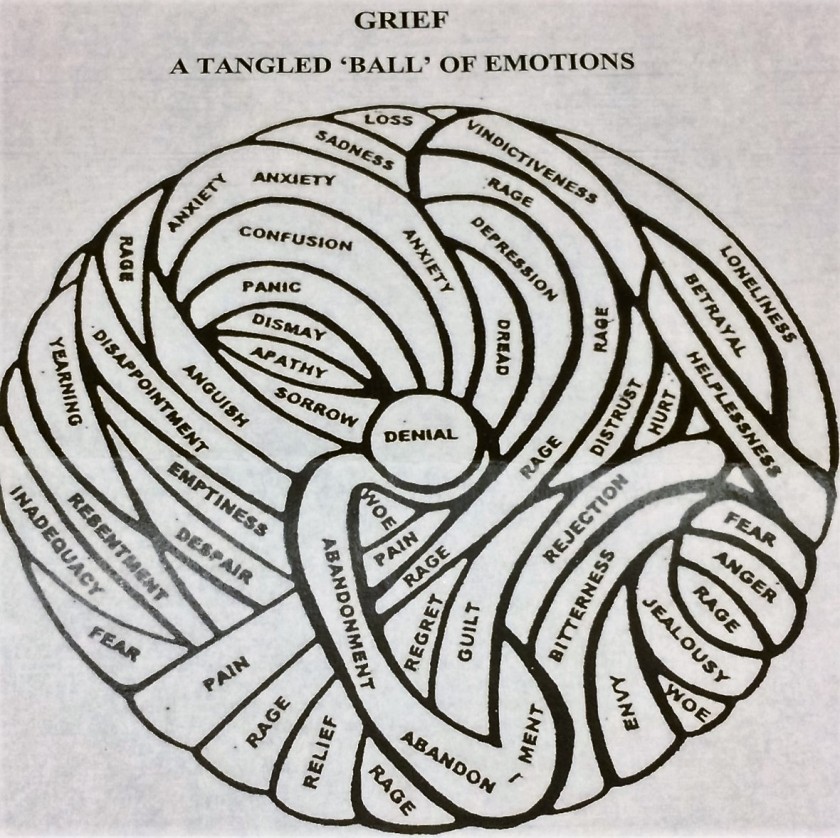
I use “grief work” to mean all the ways I (and others) must actively seek to identify, face, process, and ultimately incorporate the feelings, trauma and changes loss force upon us.
Grief work (in no particular order) can include but is not limited to:
Attending sessions with a professional, spiritual or lay counselor. Some people find it helpful to have a safe person outside the immediate grief circle to discuss feelings, concerns and relationship challenges that are generated by loss or exacerbated by loss. It’s best to find a counselor who specializes in grief, preferably child loss and/or traumatic loss (all child loss can be classed as traumatic loss). Other counselors may be too quick to label a bereaved parent’s grief as “abnormal” or “too lengthy” or “complicated” when it is, in fact, closely following observed timelines for dealing with child loss. If the first counselor you find isn’t a fit, try another. It’s OK to insist that you are heard, your feelings respected and your loss recognized for the life-shattering event that it is.
Finding, joining and participating in online or in person support groups. There are literally dozens of online support groups for bereaved parents. Some are designed to meet the needs surrounding specific types of loss such as sudden death, suicide, drug overdoses or loss to cancer or another disease or condition. Some are organized around certain faiths. Others may be rooted in geographic proximity and the online group might have a monthly or quarterly face-to-face meeting in the area. While it can sometimes be overwhelming to see the number of parents in such a group, it’s also extremely helpful to have a safe space to share things only another bereaved parent can understand.
Setting aside quiet time to think, process and possibly journal feelings. So much grief work must be done alone. Counselors can equip me with tools, support groups can give me real-life examples and encouragement but only I can do the nitty-gritty labor of teasing apart all the feelings and change grief brings with it. Journaling has been very helpful for me in putting words to what can sometimes be rather nebulous thoughts swirling around in my head. When I name what I’m feeling or experiencing, I can better construct a strategy for processing and living with it.
Walking back through memories, noting regrets, forgiving yourself and making peace with the past. We ALL have things we would have done differently. Death, being final, forces a heart to face that there is no chance to atone for past behavior. Words unsaid, things undone, opportunities missed are carved in the stone of yesterday. I spent many nights recounting my shortcomings as a mother, berating myself for what I didn’t do. Eventually I was able to rest on the simple fact that one thing I DID do was make sure Dominic knew he was loved.
Setting boundaries to give yourself and your family space and time to do grief work as well as to conserve emotional, relational and physical energy that’s in limited supply after child loss. So many of us live with few or no boundaries-responding to every request with a “yes”, adding things to the calendar without a thought to how exhausted we might be at the end of a day or week. Some of us are overtaxed at work or school. Some of us are hyper-involved in our churches, civic organizations or local politics. There are dozens of ways to be extended and just as many ways to live with that constant drain. Child loss forced me to recognize that I could no longer BE that person. I couldn’t afford the time, energy, mental space and emotional burden of saying “yes” anymore. I learned that “NO” is a complete sentence and began using it.
Practical considerations regarding your child’s belongings and other personal property. Many people might not consider this part of grief but it is. So many details to take care of, so many times I had to repeat the words, “My son was killed in an accident. I need to close this account.” So many copies of his death certificate mailed out to different agencies or companies, documenting the awful reality that he was never coming home again. Then there are questions of what to keep, what to store, what to give away. Should a room remain untouched if your child still lived at home? We had to clean out Dominic’s apartment only a few days after his funeral. It felt like I was boxing up everything beautiful about my boy.
Learning how to do holidays, birthdays, family gatherings, vacations and other gatherings. The empty chair looms larger when all the others are filled. If you have been the primary organizer of such events, it might surprise you to find the rest of the family still expecting you to be that person. Even if you aren’t the host for holidays, you will need to communicate to others if or how you feel comfortable participating.
Maintaining or regaining health after loss. Stress is one of the greatest contributors to so many health issues. Child loss is an unbelievably stressful experience. So it’s no wonder that many parents find themselves post loss with new or aggravated health problems. I had an appointment with my rheumatologist just one month after Dominic ran ahead to Heaven. It was critical that I tell her of my loss because in addition to whatever medical interventions she was prepared to prescribe, she needed to know I would be experiencing an extended period of intense stress that might necessitate closer observation and follow-up. As difficult as it may be to talk about, it’s important to inform your healthcare providers of your loss and to be absolutely honest about changes you’ve noticed in your body as a result.
There are probably a dozen or more subcategories of grief work I could list and some of you might think of ones I wouldn’t.
Grief IS work.
It is important, necessary and exhaustingWORK.
It requires time, resources, effort and energy and cannot be hurried along.
But it is the only way a heart can begin to put the pieces back together.
One of the commitments I made out loud and in my heart the day Dominic left us was this: I was not going to let his death tear my family apart.
I was not going to let him become the sainted brother that stood apart and above his siblings.
I was going to continue to give as much of my time, effort, love and presence to each of the three I had left as I had done when there were four on earth beside me.
I’ve been more or less successful in keeping this promise.
I just came home a couple days ago from a weekend retreat for bereaved moms and was reminded again that the range of “normal” in grief-especially child loss-is so very wide.
Still crying after a decade? Absolutely normal.
Trouble getting dinner on the table or remembering your child’s school schedule? Yep. That’s normal.
Struggling with crowds, back-peddling on commitments, feeling trapped by phone conversations, shopping when you are least likely to run into someone you know? Perfectly normal.
Our losses ranged from very recent to decades old and all of us admitted our behavior, our feelings, our ability to handle change, nearly every aspect of our lives was impacted by the death of our child.
So if you are wondering if your expression of grief is normal, it is.
Our lives were shattered.
Our hearts were broken.
Picking up the pieces, whatever that looks like, is absolutely, positively normal.
Today I’ll toss all the random bits and pieces I’ve assembled for this weekend’s retreat into my car and drive away.
I’m always a little nervous until I’m far enough down the road that turning back isn’t a realistic option.
Even though this is the third retreat in the same place with some of the same moms (plus some new ones) I always fret over whether or not the message God gave me is the one that will bless their hearts.
But I have to trust in this as in all things and keep moving.
One thing that is always, always, always a blessing-Every. Single. Time.-is the compassionate companionship of women who, like me, know what it is to bury a child.
I try to encourage every heart that might even think about joining us with this: you can be yourself.
No mask*No filter*No worrying about whether or not your tears will upset the person next to you*No wondering if your questions or queries or doubts will be considered a failure of faith*No need to hide the ugly truth that child loss is awful and time does NOT heal all wounds.
There’s nothing magical about this retreat or these moms.
It’s simply a shared experience, a shared commitment to transparency and a shared trust in the Word of God that makes our time together fruitful, strengthening and restorative.
So if you have an opportunity to join or create a small group in your neck of the woods, centered on the truth of who God is, founded on the principle of transparent sharing and committed to creating a safe space where masks are unnecessary-go for it!
It seems to be the nature of humans to listen with an ear to respond rather than an ear to hear.
I’ve done it myself.
Jumped right in with all kinds of suggestions designed to “fix” someone else’s problem.
Or worse, heaped my own experience with something more or less (often less) similar onto an already overburdened heart.
I hate that tendency in myself and I’m working hard to try to change it.
Those who feel compelled to just say SOMETHING often bombard grievers with platitudes, comparisons to their own grief or just empty, frivolous words that require we either stand there dumbfounded or find a gracious way to exit the conversation.
It’s especially painful for a broken heart when a well-meaning someone decides THIS is the moment for a theology lesson.
“God has something planned for you in this” or “God will use this for good”. (Romans 8:28-29)
“We don’t grieve as those without hope!” ( I Thessalonians 4:13)
“All our days are numbered.” (Psalm 139:16)
I get it-death is a heavy subject and the death of a child isn’t something anyone wants to talk about, contemplate or be forced to wrestle with. So it’s often easier to simply say something-anything-do your duty and walk away.
But it is hardly helpful.
Deep grief as a result of unbearable loss is not a teaching moment.
It’s an opportunity to listen well, think carefully about if or when you need to say anything and simply offer compassionate companionship to a broken heart.
Grieving felt hardly like the time for being taught, at least initially. Early grief was my time for pulling out of my past those truths that I had already learned — out of my ‘basement — so that I could begin to assemble them together into something even more meaningful to me than before. It was the time for understanding that even though I had always believed in heaven, it now looked to my perceptions to be more real than this world. It was the time when, even though I already believed in God’s control of the world, I now felt dependent upon him being sovereign over it for all my hopes. It was the time for realizing that even though I already believed that Christ conquered death, I now longed to see death die.




















 thelifeididntchoose