Ten Years and Ten Things (plus one) I’ve Learned About Child Loss

The first time I shared this I was trying to distill years of walking the broken road of child loss into a relatively few, easy to think about, “lessons”.

Since then I could add a dozen more but today I’ll only add one: Being a bereaved parent is not my IDENTITY but it impacts who I am in ways I’m still figuring out.

Just as being married or being female or being from the southern United States informs how I walk in the world and interact with others so, too, does having buried a child.

There’s a lot of pressure to pretend that’s not true.

But I won’t do that.

❤ Melanie

I’ve had awhile to think about this.  Nine years is a long time to live with loss, to live without the child I carried, raised and sent off in the world.

So I’ve considered carefully what my “top ten” might be.

Here’s MY list (yours might be very different):

Read the rest here: Ten Things I’ve Learned About Child Loss

Ten Years: What’s Helped and What’s Hurt

If I’m honest, the things that hurt in the first days, weeks and months could fill a book.

But now, I’ve developed a thicker skin and a better perspective.

If you are still early in your journey and, like me, a giant walking nerve, then your list would definitely be different.

I can narrow them down at this point to a few.

What really hurts:

  • Assuming you understand my pain (unless you also have buried a child).
  • Insisting that time=healing.
  • Ignoring the ongoing nature of child loss.
  • Questioning my faith because I question what happened.
  • Refusing space to share about my missing child.
  • Not saying Dominic’s name.
  • Acting like I should “be over it”.
  • Pretending like it never happened or Dominic never existed because it makes you uncomfortable to talk about him.
  • Not acknowledging my surviving children’s grief.
  • Ignoring the times of year when grief is especially heavy like birthdays, holidays, and the anniversary of Dom’s leaving.

What helps:

  • Admitting that you STILL might not know what to say or do to support me and my family in marking the loss of and missing Dominic. It’s OK. I’ll help you.
  • Listening. Even if it’s something you’ve heard before.
  • Reacting to social media posts about Dominic. I’d love to have new photos but I don’t. But I may be sharing a newly recovered memory or exposed feeling.
  • Notes, cards, messages and calls that let me know you KNOW. That you haven’t forgotten and that you still help carry Dom’s light in the world.
  • Granting space and grace when milestones loom large and my capacity for interaction is limited. Don’t ditch me because I don’t get back to you. Please.
  • Accepting that I will never be the person I was BEFORE but that I’m still a person. I need affirmation, love and kindness like everyone else.
  • Asking questions, staying curious and compassionate and allowing me to help you understand how grief is experienced over time.
  • Respecting my boundaries. These have changed since the early days but I still have hard stops that mark the edges of what I can and can’t do and maintain my sanity.
  • Sharing photos or experiences you may have had with Dom. He was an adult when he left us and there are parts of him I don’t know. I always love to see and hear about him.
  • Patience. I didn’t get a manual on how to live after burying my child. I’m learning as I go. I make mistakes, say things I wish I hadn’t said, step on toes. I’m genuinely sorry. I’m doing the very best I can.

I will not say that Dominic’s death is good.

It’s not.

Death is awful and should be recognized for the enemy it is.

But I will say I have gained wisdom through this experience.

I’ve paid a price I would never willingly have paid. And I would trade it all for my boy in the flesh, my arms around him, his deep voice added to the chorus at our table.

I won’t waste it.

I will share it.

I pray every day that it helps other hearts walk this Valley and instructs those walking with us.

Ten Years: Broken Hearts and Broken Lives

I woke this morning to a frantic voice mail left overnight when my phone was on sleep mode which silences all but my few “favorites” from ringing through.

A precious young woman from my family’s past was reaching out because she knew I was a safe person. I wish I had been able to talk to her when she needed me most but I was left with the only option available: call her back and leave a voice mail message.

It’s a poor substitute for being there when someone is hanging on by a thread.

It made me think of the dozens of ways my children and I have learned to “be there” for broken hearts and broken lives.

It’s an easy yes for any one of us when someone calls and says, “Can you talk?”.

Even when it’s inconvenient or worse, we answer the phone and allow that heart to spill its contents until there is some relief and possibly some way forward.

Some days I’m tapped out.

I may not haul feed bags or lift boxes but my heart is wrung dry by mid-morning.

Hours long telephone conversations in which there is no real answer and no way to untangle complex webs of addiction or family history or personal trauma leave me needing a nap.

I try to take a break when I need to and come back fresh when I can.

In this Season of Sorrow I have a little less to give.

But I am committed to helping other broken hearts limp along toward healing for as long as I am able.

So many have helped me.

I want to share the gift.

My Shepherd King

I’m so thankful for this truth.

I had a large goat and sheep herd for over 20 years. In that time I learned a great deal about a shepherd’s heart.

I was privileged to lead, feed and protect the creatures in my care. More than once, a lamb who was near death or an older animal, injured and despairing, was nursed back to vibrancy with tender care and attention.

My favorite way to picture Jesús is as my Shepherd King.

He is the Shepherd whose heart is always for me, whose love is perfect and my King who is supremely able and powerful to work His will in my life.

If even the idea of hope has long vanished, precious heart, lean into Him.

He will carry you until you find it again.

Holy Week 2024: Living Between the Cross and the Resurrection

It is tempting to forget that there were three long days and nights between the crucifixion and the resurrection beause the way we observe this season rushes us past the pain to embrace the promise.

But it’s not hard for me to imagine how the disciples felt when they saw Jesus was dead.  It was neither what they expected nor what they prayed for.

There were many points in the story when things could have gone a different way:

  • When taken by the religious leaders-surely, they thought, He will explain Himself, they will let Him go.
  • When taken before Pilate-Rome will refuse to get involved with our spiritual squabbles, Pilate won’t authorize His death.
  • When presented to the crowd-no Jew would rather have a wicked murderer released instead of a humble, healing Rabbi.

At every turn, every expectation they had for a “happy ending” was dashed to the ground.

Read the rest here:  Living Between the Crucifixion and the Resurrection

Lenten Reflections 2024: Fasting Criticism, Making Space for Grace

Chole identifies several groups that were in proximity to Jesus as He was dying on the cross.

Perhaps two people were silenced by grief or gently sobbing.

The others were taunting Him, mocking Him and reveling in His [apparent] inability to save Himself or be rescued by the Father He claimed close connection to.

They had no idea that His death was a last act of willing submission and laying aside of His power, position and possible retribution against those who had put Him there.

Read the rest here: Lenten Reflections: Fasting Criticism, Making Space for Grace

Lenten Reflections 2024: Letting Go of Bitterness

I’ll be honest-it’s not that often that after three plus decades of in-depth Bible study that I hear or read a unique insight into familiar passages.

But today’s devotion and reflection helped me think of Jesus’ service to His disciples in a new way.

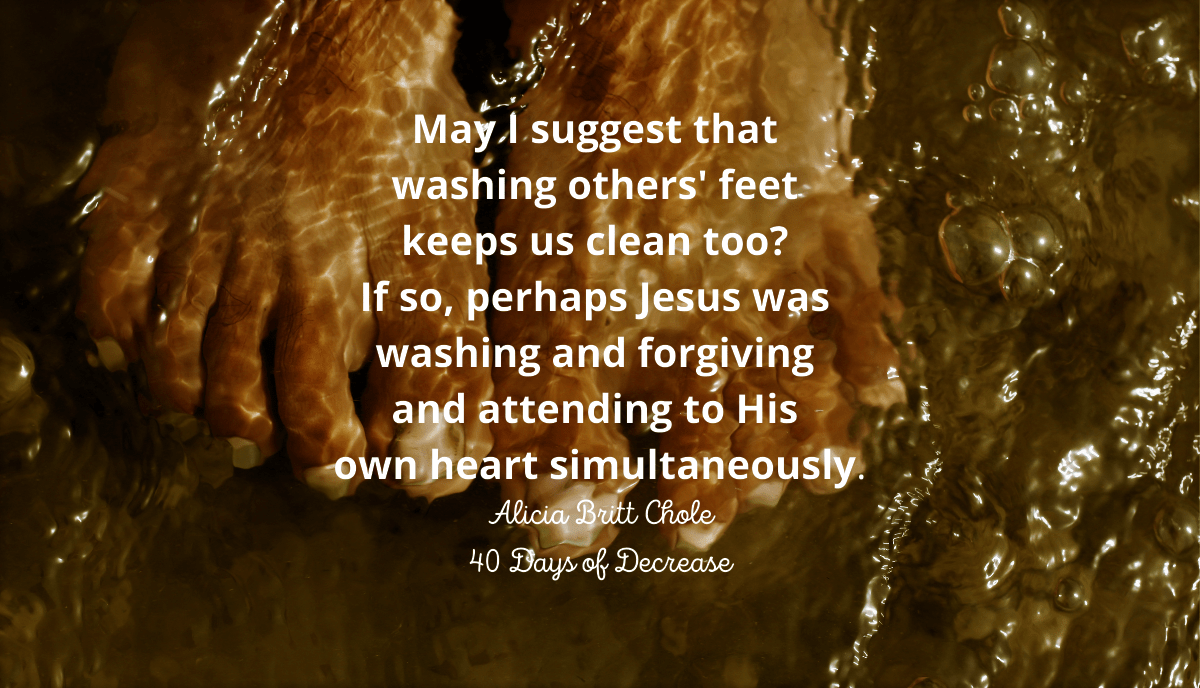
Jesus washed the feet of a betrayer, a denier, and ten deserters….Think of someone who has betrayed you, denied your love, or run away in your time of need. What would it take, what would it mean, for you to wash their feet?

Alicia Britt Chole

Chole’s words made me think back to moments where I’ve made an intentional choice to serve someone who had wounded or disappointed me.

Read the rest here: Lenten Reflections: Letting Go of Bitterness, Embracing Servanthood

Lenten Reflections 2024: Making Space For the TRULY Holy

If you’ve ever spent even a minute in an museum of art you’ve probably run across some old paintings where saints are signified with round rings of light over their heads.

Halos were meant to be a shorthand for identifying the truly righteous from ordinary folk.

Problem is, more often than not the standards applied by those making the distinction are not the true standards God reveals in His word and by the example of Jesus, His Son.

So today we are fasting halos-false definitions of holy-and making room for the TRULY holy which often makes us uncomfortable.

Read the rest here: Lenten Reflections: Making Space For the TRULY Holy

Compassion 2024: Understanding the Grieving Heart

In the last post I shared the difference between mourning and grief. While the outward ceremonies have long passed, the inward struggle to embrace and understand the pain and sorrow of losing my son continues.

If you love someone who has lost a child, perhaps these thoughts might help you understand a bit of their pain and how completely it changes the way bereaved parents encounter the world.

Please be patient. Please don’t try to “fix” us. Please be present and compassionate. And if you don’t know what to say, feel free to say nothing-a hug, a smile, an understanding look-they mean so very much.

❤ Melanie

A bereaved parent’s grief doesn’t fit an easy-to-understand narrative. And it flies in the face of the American “pull yourself up by your bootstraps” mentality.

You can’t beat it–it’s not a football game-there is no winning team.

You can’t lose it–it’s not the extra 10 pounds you’ve been carrying since last Christmas.

You can’t get over it–it’s not a teenage love affair that will pale in comparison when the real thing comes along.

You can only survive it.  You can heal from it, but it will take a lifetime and require very special care.

Read the rest here: Loving Well: Understanding the Grieving Heart

Compassion 2024: Transitioning From “Good-bye” to Grief

A funeral or memorial service seems like a final chapter.  We close the coffin, close the doors and everyone goes home.

But for bereaved parents and their surviving children, it’s not an end, it is a beginning.

Much like a wedding or birth serves as the threshold to a new way of life, a new commitment, a new understanding of who you are, burying a child does the same.

Read the rest here: Loving Well: Transitioning From “Good-bye” to Grief