There are lots of opportunities for offense surrounding the death of a child.
Once your heart is broken open wide with great sorrow, there’s no defense against the bumps and bruises that are a natural product of human relationship and interaction.
Friends and family that didn’t show up.
Friends and family that showed up but said or did the wrong thing.
Friends and family that abandoned me as soon as the casket closed.
People that make me feel guilty for grieving or question my sanity or my “progress”.
But I’m learning to let go of offense.

Not only because it is too heavy to carry in addition to my grief, but because the Lord has commanded it.
I grew up reciting what’s commonly called, “The Lord’s Prayer” without much thought to the individual phrases or their meaning. It wasn’t until adulthood that I read it in context and continued on to the rest of the chapter.
What I found there was chilling.
These are some of the hard words of Christ that most lay persons and many theologians prefer to gloss over.
“For if you forgive other people their failures, your Heavenly Father will also forgive you. But if you will not forgive other people, neither will your Heavenly Father forgive you your failures.”
~Jesus (Matthew 6:14-15 PHILLIPS)
WOW! The plain reading of this text tells me thatif I refuse to forgive others, I place myself outside the forgiveness of my Father.
It makes sense though-if my sins were borne by Christ on the cross, then so were yours.
If His grace covers me, it covers you.
If I want to be seen through the eyes of mercy, then I must be willing to look through those same eyes at my fellow man.
At first this feels like bondage instead of freedom.
But the truth is, forgiveness is liberating.
It sets me free to operate in the fullness of who I am in Christ. It forces me to trust Him with my pain, with my sorrows, with my offenses and with balancing the scales of justice.
Forgiveness opens the path to relationship and community.It testifies to the mercy and grace of God.
It shines like a beacon of light in a dark world.
It is the power of Christ in me.
To forgive another person from the heart is an act of liberation. We set that person free from the negative bonds that exist between us. We say, “I no longer hold your offense against you” But there is more. We also free ourselves from the burden of being the “offended one.” As long as we do not forgive those who have wounded us, we carry them with us or, worse, pull them as a heavy load. The great temptation is to cling in anger to our enemies and then define ourselves as being offended and wounded by them. Forgiveness, therefore, liberates not only the other but also ourselves. It is the way to the freedom of the children of God.
My first instinct as a mother and a shepherd is always, “How can I help?”
I routinely set aside my own needs for the needs of others. Not because I’m so selfless but because that’s how I’m made-I’ve always had the heart of a caretaker.
That’s not a bad thing, most of the time.
But if taking care of others means NOT taking care of myself, then in the end, I’m of no use to anyone. When I allow every bit of energy-emotional, physical, psychological and spiritual-to drain away until there’s nothing left, I am unable to meet my most basic needs, much less the needs of others.
I’ve written before that grief puts a hole in my bucket. It guarantees that no matter how much is poured in, I’m never truly full.
I’ve also written about setting boundaries and trying to preserve margin as I walk this Valley. I have to create space between me and the people around me if I’m going to make it through.
But there are some other steps I can take to help ensure my heart is strong enough for the journey. It’s not always about what I don’t do.
Sometimes it’s about what I choose TO do.
Here are some ideas for self-care in grief (or reallyANYhard place in life):
Be patient with yourself. There is no time frame for grief. Each heart is unique. Extend grace to yourself, just as you would to a friend. Try not to take on extra responsibilities. It’s better to allow for some flexibility in obligations during this time (even around holidays!).
Listen to your body and your heart: If you need to cry, then cry. If you need to sleep, then do so. If you need to talk to someone, seek out someone who will listen. If you need to reminisce, then take the time. It is important for the grieving process that you go with the flow.
Lower expectations for yourself and communicate this new reality to others. You are not able to operate as you did before loss. Your capacity for interacting with others, managing tasks and being available for the needs of others has been dramatically altered. Own up to it, and let others know that it will be some time before you can shoulder the responsibilties you once did.
Let others know what you need from them. No one is a mind reader. While we who are bereaved think our needs are obvious, it’s simply not the case. Communicate to family and friends how they can support you.
Accept the help of others. Understand that grief is hard work. It requires a great deal of energy and can be exhausting. Even though we place a high value on self-sufficiency, it is important to ask for, and accept, help from those close to you. Others careand genuinely want to be of assistance, but usually do not know what to specifically offer. In particular, it is vital to know who will listen and be supportive. Sharing your story out loud is one key to healing. And, remember that professional guidance is also available
If you need counseling, get it! There is NO shame in asking for help. Get all the support you need. There are many bereavement support groups as well as counselors or spiritual advisors who specialize in bereavement counseling. Don’t hesitate to contact a medical and or mental health specialist if you have feelings of hopelessness or suicidal thoughts.
Accept your feelings. Feelings are neither right nor wrong, they just are. Sadness, loneliness, fear, confusion, anger—these are among the many feelings you may experience, and are completely normal. Emotions are often raw early in the grief process, but it is important to express them. Attempting to stifle feelings usually leads to an emotional outburst at an inconvenient time.
Face your feelings. The painful emotions associated with grief are a natural and normal response to loss. You can try and suppress them or hide from them all you want but in the end this will only prolong the grieving process. Acknowledging your pain and taking responsibility for your feelings will help you avoid the complications often associated with unresolved grief such as depression, anxiety, substance abuse, and health problems.
Express your feelings. The most effective way to do this is through some tangible or creative expression of your emotions such as journalling, writing a letter expressing your apologies, forgiveness and the significant emotional statements you wish you had said, or art projects celebrating the person’s life or what you lost.
Keep a journal. Writing down your thoughts and feelings can help you to validate and work through your grief.
Feel whatever you feel. It’s okay to be angry, to yell at God, to cry or not to cry. It’s also okay to laugh, to find moments of joy, or to let go when you’re ready. Your grief is your own and no one can tell you when you should be “over it” or when to “move on.”
Pay attention to physical needs. It’s easy to ignore your health when all you want to do is give up and give in. However, it is even more important NOW to take care of yourself. Eat balanced meals (set an alarm if you have to), try to get adequate rest (get medication if you need to) and make sure to get in some physical activity every day (set a timer if necessary).
Get physical exercise. If you exercised prior to your loss, try to maintain the same routine. If you did not exercise prior to your loss visit your doctor before embarking on a physical exercise routine. Physical exercise can improve the way you feel.
Eat right and get enough sleep. Maintaining a healthy diet and getting proper sleep is essential for functioning as well as you can. If you are having difficulty with either, visit your doctor.
Be aware of short-term relievers – these can be food, alcohol/drugs, anger, exercise, TV, movies, books, isolation, sex, shopping, workaholism, etc. Most of these things are not harmful in moderation but when used to cover-up, hide or suppress our grief they get in the way of the work grief requires.
Take the time to do the things you need to do for yourself. When you feel up to it, engage in activities to which you feel drawn. It could be visiting a place you haven’t been to in a while, walks in nature, reading, etc.
Pamper yourself. Treat yourself well. Do things for yourself that are helpful like walks, being with people who are nurturing to you, and inexpensive activities
Grief is a lifelong process-a marathon, not a sprint.
Maintaining space to do the work grief requires and engaging in activities and health habits that help me do that work is the only way to endure.
When I wrote this a few years ago I had fallen outside when feeding the animals.
But I was reminded of the post when I fell-hard!-on sharp rocks in our creek playing with my grandson. I was holding his hand and both of us went down when my foot slipped.
I hobbled up the bank with a giant bleeding gash on my knee and I’m still living with a permanent knot on my kneecap. Poor little guy was frightened but not hurt.
He has recited that incident over and over and always ends it with, “I’m okay. Mama D okay. We’re okay.”
He couldn’t wait to get in again on their next visit.
I absolutely love, love, love that my sweet little boy has already learned the lesson of getting back up, even when it hurts.
It’s something I need to remember every. single. day.
❤ Melanie
I hate that question that every doctor’s office asks now, “Have you had any falls in the past twelve months?”
I always say, “no” even though that’s rarely true.
Because I know what they are looking for is evidence of disease that might be impacting balance and I’m perfectly free of that so I don’t want to place a red flag in my medical chart.
But I fall down pretty regularly. Mostly because I trip over something as I’m walking from one animal enclosure to another, hands full of buckets and mind somewhere else.
The other day was one of those moments.
I was done feeding our beagles, headed back to the house when my feet found a random piece of looped wire on the ground. (I still have no idea where it came from!)
There’s that split second when you know a fall is coming and your mind tries to figure out how to stop it even as your body is giving in to gravity.
Down I went! Hard! On my left knee and right wrist but sparing my head.
It really, really hurt. In fact, it hurt so badly that I simply rolled over and rocked back and forth for a second or two.
Then I realized there was no help for it but to put weight on those knees and wrists and get up. So I took a deep breath, counted to ten and pushed myself up. I hobbled back into the house to survey the damage and put ice on my knee.
And I reminded myself once again that I can do things that are hard, that are painful and that seem impossible.
Life is full of falls-real ones that bang up body parts and figurative ones that wreak havoc with hearts.
They all hurt.
When I find myself down and out I have a choice.
I can sit in the pain and lie helpless and hopeless.
Or I can take a deep breath, gather my courage and get up.
Every time I choose courage, I build up my reserve and strengthen my resolve and make it more likely I’ll get up every time.
For those of us who follow Jesus, perhaps the most difficult and important grief work we must do is deciding how our faith fits into the new and awful reality of child loss.
I’ve encountered so many hurting hearts struggling to square their experience of devastating loss with their faith in a loving and all-powerful God.
I write about my own struggle over and over in this space but this series of posts is an orderly exploration of doubt, pain, faith and the hope I’ve found in Christ Jesus.
When my perfectly healthy, strong and gifted son was killed instantly in a motorcycle accident on April 12. 2014 my world fell apart. My heart shattered into a million pieces. And after almost eight years, I’ve yet to even FIND all of those pieces much less put them back together.
So what does a heart do when that happens?Because, try as I might, I cannot stop time.
Even THAT awful day only lasted 24 hours.
When the sun rose again, the pain was still there. And behind that pain and mixed with it was something else-disappointment, disaffection, distrust.
Where were You, God???
God is sovereign-He rules.
God is good-He loves.
How do those two truths live together in a universe that includes child loss? How can I trust the rest of my life and my eternal future to a God who lets this happen?
It’s a process. And it takes time. It involves purposeful choices by me to place my heart where it can hear truth even when it doesn’t want to hear and doubts every word.
The first step toward trusting again is to ADMIT THE PAIN.
You may be thinking, “Are you crazy?”.
“Of course I know I’m hurting-my child is no longer here!”
But that’s the easy pain to recognize and own up to. For those of us who have swallowed the western church model of “Sunshine Christianity”*, we will have a much harder time admitting our dismay that as victors in Jesus we feel discouraged, defeated and disgusted.
And should we dare to whisper it aloud we may well be shouted down by voices afraid to hear what they themselves sometimes secretly think but never speak. So we convince our hearts these are phantom pains like those of a lost limb and try to ignore them.
But they will not be ignored.
The Bible is full of broken people bringing their hearts and their hurts to God.
He doesn’t despise my pain.
He doesn’t turn away from my tears.
He doesn’t hurry me through hearbreak.
Death is awful! We dare not make it small!
It was the penalty for sin and the price of salvation. To deny the presence of pain is to diminish the power of the cross.
I must admit my pain:
Own it.
Feel it.
Name it.
Speak it.
I’m not the first nor will I be the last to wonder about where God is and what He is doing. Nicolas Wolterstorff’s adult son was killed in a climbing accident and his little book, Lament for a Son, was one of the best I have read in grief.
It struck a chord with me both because of the similarity of our loss and his honesty in exploring the edges of pain and doubt.
He writes:
Will my eyes adjust to this darkness? Will I find you in the dark-not in the streaks of light which remain, but in the darkness? Has anyone ever found you there? Did they love what they saw? Did they see love? And are there songs for singing when the light has gone dim? Or in the dark, is it best to wait in silence?
Noon has darkened. As fast as they could say, “He’s dead”, the light dimmed. And where are you in the darkness? I learned to spy you in the light. Here in this darkness, I cannot find you. If I had never looked for you, or looked but never found, I would not feel this pain of your absence. Or is it not your absence in which I dwell, but your elusive troubling presence?
Nicholas Wolterstorff, LAMENT FOR A SON
C.S. Lewis wrote A Grief Observed after the loss of his wife, Joy. And he also is honest and raw-asking aloud the questions that hide in our hearts, admitting the fear that the God we serve may not be the God we thought we knew.
Giants in faith-both men.
Yet they, like us, had to bring the shattered pieces of their broken hearts to the foot of the cross and beg God to put them back together.
Admit the pain.
God already knows.
*Sunshine Christianity is the notion that once one belongs to Jesus the road is smooth (God can make a way), the path clear of obstacles (if you have enough faith), and if I simply claim the promises of Scripture I have victory over every circumstance. It does not square with either Jesus’ own experience nor that of the 12 apostles.
I remember clearly walking around like a giant nerve for the first days, weeks and months after Dominic left us.
It didn’t take much for me to burst into tears.
Everywhere I went I was forced to endure words and actions that pierced my heart.
It was hard not to take it personally. It was impossible not to react. Surely people should know better, be better, do better!
But the truth is, they don’t know. And if I’m honest I have to admit that before it was ME, I didn’t know either.
So part of the work grief required was for me to develop thicker skin.
I had to learn to scroll past social media posts, overlook careless comments and not expect those outside my immediate grief circle to understand how Dominic’s death continues to impact me and my family.
❤ Melanie
If you’ve joined me here for more than a minute you know I am a fierce advocate for bereaved parents in particular and all grievers in general.
But you’ve probably also noticed that, at least in my own life, I recognize how traumatic and/or difficult circumstances can make it hard to see past the hurt and the shattered world a broken heart inhabits. I can judge others harshly without meaning to.
A couple of recent incidents have reminded me how easy it is to interpret every offhand comment or heartfelt opinion as targeted at ME when, in fact, they are simply a reflection of that person’s experience in the world.
I can’t insist that others see the world through MY eyes if I’m not equally prepared to try to see it through THEIRS.
Look, I know how painful it is to scroll through social media posts and feel the darts land square in the center of my heart. Parents bemoaning their children leaving home (all the while I’m thinking, “yeah-but you can call, visit and still hug your child”); folks complaining about how hard it is to manage schedules and meals or trying to figure out family vacations with teens or young adults (“gee, I wish I had the privilege of including ALL my kids for holidays“); and then there are the “miraculous deliverance from a wreck” posts (I’m wondering why Dom wasn’t delivered).
ButNONEof those folks are posting or commenting with me in mind. They are simply sharing their thoughts and feelings just like I share my own.
I’ve learned to just scroll on past.
It’s neither healthy nor helpful for me to type some long (or short!) snarky comment trying to “correct” them. I’m not entirely sure they need correcting.
Before it was ME that sent a child to Heaven I had No. Idea.
They don’t either.
So save your energy for the work grief requires. Save it for the family you’ve got left. Save it for a rainy day when tears fall as fast as drops from the sky.
Often there are random or unusual physical symptoms that show up days, weeks or even years after a child has gone to Heaven.
An important and necessary part of grief work is learning to recognize the physical manifestations of grief and advocating for care from professionals who may not be able to make the connection unless the bereaved speak up and speak out.
❤ Melanie
It’s a well known fact that stress plays a role in many health conditions.
And I think most of us would agree that child loss is one of (if not THE) most stressful events a heart might endure.
So it’s unsurprising that bereaved parents find themselves battling a variety of physical problems in the wake of burying a child.
What may be surprising is how uninformed medical and even psychological professionals are with respect to the very real ways child loss intersects with chronic conditions and often creates new symptoms.
Here is a list of only SOMEof the physical manifestations of grief (via What’s Your Grief?) with my own comments :
Fatigue. If you’ve always been an energetic sort, you might find this aspect of grief particularly disconcerting. This kind of fatigue doesn’t get better with rest. I’ve written about that here.
Some days I can barely make myself get out of bed and when I do, I struggle to do any but the most necessary tasks. Don’t automatically dismiss this symptom as ONLY grief (although it most certainly could be!) get a thorough check-up to rule out other causes such as low thyroid, diabetes, heart disease, major depressive disorder or a number of conditions that can be treated effectively with medicine. Don’t beat yourself up if the doctor decides “nothing is wrong” with you. You are grieving and grief is work! I know this symptom has improved for me over time as I’ve established boundaries, admitted limitations and learned to rest when necessary.
Aches and Pains. Our bodies and minds are connected in ways not well understood. Mental and emotional distress can make any underlying pain condition that much worse. When I’m feeling especially lonely, desperate or sad my autoimmune disease flares AND my perception of the very real pain that causes is heightened. Pain and heartache can lead to a downward spiral that is hard to undo. Get help and treatment for the physical and give yourself grace and space to endure the emotional causes of body aches. Don’t self-medicate with drugs, alcohol or other self-destructive coping strategies. Reach out to a safe person and let them help you find a better way.
Headaches. Needless to say, stress makes tension headaches more likely. Sometimes, though, a headache can be a symptom of something more serious. Don’t dismiss an especially sudden, intense or long-lasting headache as “just grief”. It could be previously undiagnosed high blood pressure, stroke or migraine. Those being ruled out, various relaxation techniques, cold or warm compresses, over-the-counter analgesics and gentle stretches might help.
Sometimes grief headaches can be alleviated by the simple act of telling our stories. Bottling up emotions and thoughts adds to the ongoing stress and tension of my child loss burden. When I spill them-either on paper in a journal, in a closed online bereaved parents’ group or in person to a safe friend or family member-often I feel the band around my head relax and the pain fade away.
Tightness in Chest, Shortness of Breath. The day I got the awful news, I remember asking friends who came to sit with me over and over, ” Am I still breathing?” My world was spinning out of control and my body responded. Anxiety after child loss is real. Broken Heart Syndrome is real. Heart attacks are not uncommon. Don’t ignore these symptoms. But don’t be surprised if they persist despite all tests to the contrary. When I feel trapped and overwhelmed, a walk outside or even to another room can help. Deep breathing exercises and grounding exercises can often interrupt an episode.
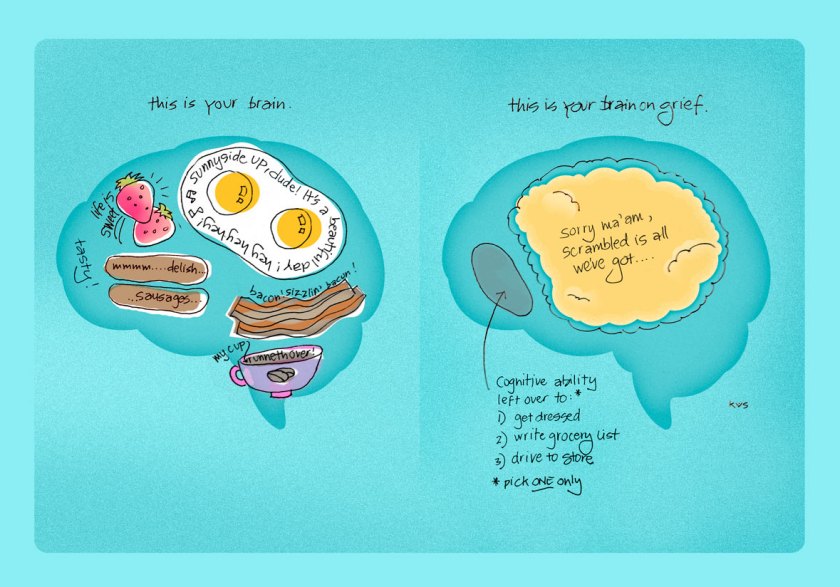
Forgetfulness. I wrote this post on Grief Brain: It’s a Real Thing! a couple years ago and am always surprised to see it shared repeatedly. But I think it strikes a chord with any heart walking through grief. You are not crazy! You are not experiencing early onset dementia (most likely). Like other symptoms, get checked out if they persist or worsen. But odds are, your experience falls within the range of normal for anyone whose life has been shattered by child loss. Losing things, forgetting things, getting lost in familiar places, missing appointments or bill payments, inability to remember names of people you know well-all of these are common after loss. In time, the symptoms usually diminish. They have for me. I still have to rely on lists and reminders much more often, though. And that’s OK.
Inability to Focus. Like grief brain, this is another cognitive manifestation that’s not only annoying, it can impact life in significant ways. Before Dominic ran ahead to Heaven, I was an avid reader. I often had three or four books going at the same time. I could spend hours focused on a single project. Not anymore. I sometimes find it difficult to read a recipe.
I have to take frequent breaks when working on something because my mind gets fuzzy and I just can’t pay attention for more than a few minutes at a time. Some bereaved parents have to change jobs or careers because they are not able to perform necessary tasks anymore. This particular symptom has not improved very much for me although I’ve found ways around it. I use lists to keep an external record of what I should be doing and when. I mix up mindless chores with ones that require more attention to give my brain a break. I try to dissect larger jobs into smaller, manageable chunks. And sometimes I just have to admit that today a particular thing just isn’t happening.
Appetite or Digestive Issues. Stress has long been linked to gut problems. I suspect we’ve all had that “rumbling in our tummy” from time to time even before child loss. For many of us it’s exponentially worse after. Some bereaved parents try to stuff emotions by stuffing themselves with food. Others can’t eat at all. Still others experience stomach ulcers or bowel disease ranging from acute to chronic. I was hospitalized twice in the first year after my son’s death for serious colon issues.
Again, don’t ignore sudden or persistent symptoms. Try to eat well and avoid self-medicating with food. Added pounds rarely add up to better emotional or mental health. I let pounds I’d lost ten years ago find me again. Get help if you need to from someone willing to act as an accountability partner. I’ve recently joined a friend in setting goals for ourselves and sharing recipes and meal prep. Try to treat food as another aspect of grief work and manage it the best you can.
Getting Sick More Often. Stress lowers the immune system. That’s a fact. So when bereaved parents encounter germs (as we all do from time to time) it may well be our bodies don’t have the energy or resources to combat them. Colds, flu, strep throat, skin infections may all be more likely this side of child loss. Don’t be discouraged to seek treatment. There is so much we can’t control in life, but getting antibiotics for an infection is pretty easy.
It’s not in your head, mom or dad!
Grief has real physical manifestations.
Don’t be dismissed or denied the care you need.
Educate your healthcare providers and insist on being heard.
*photo credit: The Weight of Grief Scupture ~ Celeste Roberge*
That little tacky plaster has soothed more fears and tears than almost any other invention in the world.
Skinned knee? Put a BandAid on it.
Bee sting? BandAid.
Tiny bump that no one can even see? Oh, sweetie, let me give you a BandAid.
Simply acknowledging pain and woundedness is so often all that is needed to encourage a heart and point it toward healing.
It’s the same in the world of emotional, psychological and spiritual wounds.
But we have yet to invent the BandAid for those.
Instead, frequently we ignore, refute, minimize and pass over the one in our midst who holds out a hand or a heart saying, “I have a boo boo.”
Believe me, I understand-so many of these wounds are incurable, they are uncomfortable to think about, hard to look at.
But often the only thing the hurting heart wants is acknowledgement, a moment of time, a face turned full into theirs, eye-to-eye and unafraid to remain alongside through the pain.
Just as a BandAid bears witness to the wound underneath, our compassionate presence can bear witness to the deeper wounds no one can see.
When we choose to lean in and love, to listen and learn, to walk with the wounded we give a great gift.
Today is a day when we honor those who gave the last full measure in service to our country and our country’s wars.
It is a day to remember and mark with solemn gratitude the sacrifice of a life poured out.
You don’t have to agree with the reasons for a war to grieve the individuals who died fighting it.
War is far from glorious. It’s ugly and dirty and awful. For those that fight it and those on whose land it is fought.
But in this world where nation invades nation and the wicked often rule it’s sometimes necessary.
Every soldier is a mother’s child. Every soldier leaves someone behind.
In war after war, families across America have been devastated by the deaths of their sons and daughters, many taken in the prime of life, at the dawn of adulthood.
Almost every family and community has a story of burying a promising young soul that was sure to make a difference but who never got that chance.
My father and my son served. My nephew is serving now.
And to all the mothers and fathers whose sons and daughters gave the last full measure for their home and country, I say:
“Thank you for your sacrifice. Thank you for the love poured into the child that became the brave man or brave woman who would put his or her life on the line for what they believed in. Your toil bore much fruit that continues to bless others today.”
You have given up what no one has the right to ask of you.
You live with both the honor of your child’s legacy and the horror of your child’s absence.
And if your child survived the battlefield but could not survive the scars of war, I am so very sorry.
I understand the pain of missing the child you love, I hear your heart and I am praying for you.
As we gather with our families and enjoy freedom purchased with the blood of sons and daughters, may we REMEMBER.
May we honor the ones who gave everything they had.
And may we remember the families left behind who can never forget.
The strongest love anyone can have is this. He will die to save his friends.
Usually I write about how child loss has impacted my life and the lives of my family.
Part of the reason I do that is to offer encouragement to other bereaved parents and guidance for people walking with and ministering to them.
Sometimes I address my writing to a broader audience that may include people who do not follow Jesus because some topics have more to do with general situations and less to do with faith-although my faith informs my life in every way.
But today I want to say something directly to the Body of Christ in the world whether or not you have personally suffered tragedy:
If we are gathering in the name of our Blessed Saviour and pushing the wounded to the fringe of our fellowships,
we have got it all wrong.
Jesus came for the broken,
the wounded,
the limping,
the very ones who were unwelcome in the “upstanding community”
of synagogues and the Temple.
He had no where to lay His head, carried no purse full of gold and walked everywhere He went.
He died between two thieves, mocked and naked, bleeding and helpless (in the human sense).
When He met people, He spoke directly to their HEART, regardless of their outward appearance.
He met REAL needs.
He LOVED in ways that made a difference.
We are called–I AM CALLED–to be like Jesus.
If I memorize the entire New Testament and miss this truth, I have missed Him.
We read I Corinthians 13 at weddings and treat it like a marriage survival guide.
But that passage wasn’t written to two young people joining lives and “in love”, it was written to the CHURCH as a guideline for how Christ in us should be present in the world.
I don’t want to be a clanging gong!
I want to sing hope to those I meet by reflecting the love of Jesus everywhere I go.
I wrote this a few years ago in response to post after post across social media of (mostly!) moms lamenting the fact their son or daughter would soon be moving away or off to college.
I get it!
When you are used to having your kid around it’s tough when he or she leaves the nest.
But there is a vast difference in having to work a little harder to stay in contact or arrange visits and never being able to speak to your child again.
It’s an adjustment to compare calendars to find a day your family can celebrate together but it’s heartbreaking to know that one chair will always be empty at every family gathering.