What Are Healthy Boundaries in Grief?

As a people-pleasing first born who hates conflict, giving in has always been  easy for me. It’s only later that I wish I hadn’t.

So for most of my life, setting personal boundaries has been challenging.

But in the aftermath of child loss, healthy boundaries are no longer optionalthey are necessary for survival.  

So what are healthy boundaries?

Read the rest here: https://thelifeididntchoose.com/2017/01/10/healthy-boundaries-in-grief/

Solitude or Isolation? Which is it?

I’ve always loved my alone time.

As an introvert (who can, if pressed pretend not to be!) my energy is restored when I interact with one or two folks or no one at all.  A dream afternoon is writing while listening to nothing louder than the wind chimes outside my door.

I treasure solitude.

Since Dominic ran ahead to Heaven, I find I need even more alone time than before.

That quiet place is where I do my most effective grief work, undisturbed by interruptions and distractions.

But I need to be careful that solitude doesn’t shift into isolation. 

I have to remind my heart that spending time with others keeps me from falling so deeply down the well of despair that all I see is darkness.

I need human interaction to keep me connected to a world that, quite frankly, I might sometimes just as soon leave behind.

So how can I tell the difference between solitude and isolation?

Here are a few questions that help me figure that out:

  • Do I feel lonely, neglected or abandoned? If my alone time feels less like a gift and more like an unwelcome burden then it may be isolation rather than solitude.
  • Where are my thoughts taking me? Being alone is often the only way to “hear” my own thoughts without having to block out the noise and activity of other people. If I am sitting with myself, processing hard things or even beautiful things, resolving internal conflict, conjuring new ways to deal with difficult relationships or situations then solitude is doing its work. If, instead, I find my mind tangled up in fearful knots, filled with negative self-talk or unable to break a downward spiral into despair then I probably need to find someone to talk to.
  • Am I getting stronger or being drained? After the holidays or other hectic seasons I need time alone to recharge my batteries. Often it is almost a day-for-day exchange. I can feel tension melting away and strength returning. My mind begins to clear and life doesn’t feel so overwhelming. Solitude grants space for my body, mind and soul to be refreshed. When it slides into isolation I can feel the shift. Instead of waking refreshed and eager to greet a free day, I wake to dreading another long one alone. Instead of energy rising in my spirit, I can feel it draining away. Instead of thinking kindly of friends and family who choose to leave me be, I’m resentful no one has checked up on me.
  • Is there a helpful rhythm to my days alone or am I counting the hours until sundown? When I’m enjoying solitude, the hours feel like a welcome opportunity to do things (or not do things!) at my own pace and according to my own preferences. I sit with pen in hand and jot down a list knowing that if I complete it or if I don’t the only person I have to answer to is myself. No pressing appointments and no worrisome commitments. When I’m isolating, the hours feel like a long march through deep mud-every step tedious, treacherous and exhausting. I’m alone but I’m not getting any benefit from it. If I’m enduring instead of enjoying then I’m isolating.
  • Do I have an endpoint in mind? When I look ahead at a week on my calendar, I try to balance alone time with social commitments. A day or two alone (or with limited human interaction) is solitude. A week holed up in the house is isolation. If I find myself pushing off needed outings (to the grocery store, to run errands) then I ask myself, “why?”. Often it’s because I’ve drifted from solitude (helpful alone time) to isolation (unhelpful hiding).

I can shift myself out of isolation by choosing just one small social interaction.

I might text or message a friend, go to the grocery store and make a point of speaking to the clerk, call someone or show up at a church or community event even if I sit in the back and slip out early.

I’m never going to be that person who is up for every outing. That’s just not how I’m made and child loss has intensified my need for solitude.

But I don’t want to be alone and lonely, sinking deeper and deeper into a pit of my own making.

Some days it’s harder than others.

But I keep trying.

How A Phone Call a Day [Almost] Keeps the Panic Away

A few days ago I wrote about how panic is always just a breath away for those of us who have suffered loss.  

Like a friend of mine recently said, “We are branded.  GRIEF is burned into our hearts and we are never the same.”

So how to live this altered life?  

How can I manage that emotional tension that saps energy and strength from my heart, mind and body?

Our family has adopted some practical protocols that help.

Read the rest here: https://thelifeididntchoose.com/2019/01/08/practical-protocols-to-mitigate-panic-after-loss/

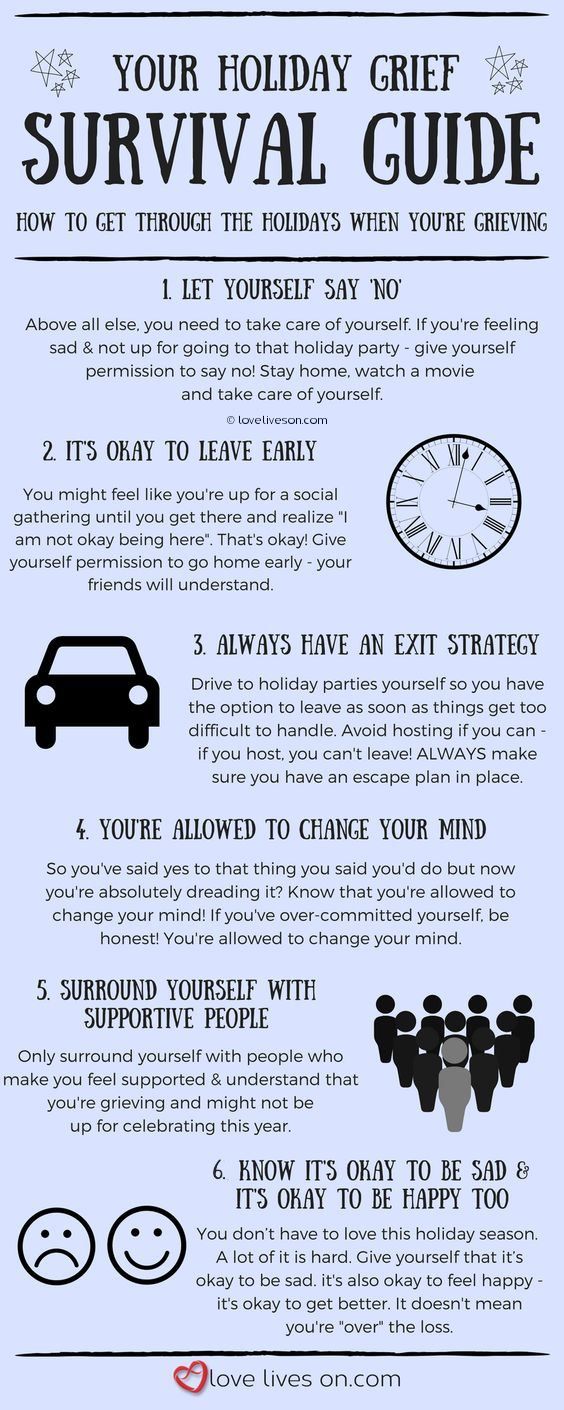
Holiday Grief Survival Guide

There are many days throughout the year that present special challenges to grieving parents.

Some are known only to their hearts and require escaping to the secret place where memories are stored and love is kept.

But others loom large on every calendar.

Thanksgiving. Christmas. Hanukkah.

Those require both invisible strength and a very visible public presence at family gatherings and other holiday events.

I’ve written lots of posts on how to make it through the holidays but I really like this succinct and easy-to-share Holiday Grief Survival Guide infographic. It covers the basics and is a helpful way to shepherd a hurting heart through the holidays. ❤

Reminder: It’s Important To Make Space For Grief During The Holidays


We are days away from plunging headfirst into the rough and tumble holiday season.  

Thursday is  Thanksgiving and I don’t know about you, but it seems that once I eat the turkey and dressing, the clock moves faster and the days crowd one another in a race to Christmas and the end of the year.

So I want to take a minute to think about how important it is to make and maintain space for grief during this busy season.

You have to do it.  

I know, I know-where to fit it in between family gatherings, social engagements, mandatory office parties and children’s pageants?

If you don’t, though, the grief will out itself one way or another.  

So may I offer the following practical suggestions for this upcoming holiday season?

Read the rest here: https://thelifeididntchoose.com/2018/11/19/the-importance-of-making-space-for-grief-during-holidays/

Grief Is As Individual As A Fingerprint

It’s a nearly universal human tendency to try to fit another’s experience into our own.

Even though I try hard not to, I still often find myself saying things like, “I know just how you feel” or, “This worked for me, it ought to work for you”.

Trouble is, grief is as individual as a fingerprint.

Image result for grief is as individual as a fingerprint

The life that was shared before loss, the circumstances surrounding the loss, family structure, support systems (or lack thereof!), age, social connections, faith, friends and fears all shape how a particular person experiences and processes loss.

  • Some of us have safe people in our circle and can talk things out with them.
  • Others need a professional counselor to work through specific trauma associated with loss.
  • Still others are internal processors and require lots and lots of time alone.
  • One heart finds comfort pouring over old photographs and watching old videos.
  • The next can’t bear to look at any of it.
  • Exercise strengthens him but drains her.
  • Social situations paralyze some of us and help pull others out of our shell.
  • Frequent graveside visits are a means of connection for one person and only a reminder of death to another.

The list could go on and on.

So I’ll say it again:

However you make it through this Valley is just fine. There’s no right way or wrong way to grieve.

As long as you are not harming yourself or others (physically or emotionally) then carry on, dear heart.

Image result for grief is as individual as a fingerprint

Holidays 2019: Practical Ideas for Dealing With Holidays After Child Loss

It cannot be overstated:  holidays are extremely hard after loss.  Every family gathering highlights the hole where my son SHOULD be, but ISN’T.

There is no “right way” or “wrong way” to handle the holidays after losing a child.

For many, there is only survival-especially the very first year.

These days also stir great internal conflict:  I want to enjoy and celebrate my living children and my family still here while missing my son that isn’t. Emotions run high and are, oh so difficult to manage.

So I’m including some ideas from other bereaved parents on how they’ve handled the holidays.  Many of these suggestions could be adapted for any “special” day of the year.

Not all will appeal to everyone nor will they be appropriate for every family.  But they are a place to start.

Read the rest here: https://thelifeididntchoose.com/2016/09/04/practical-ideas-for-dealing-with-the-holidays-after-child-loss/

Holidays 2019: What The Bereaved Need From Friends And Family

This is the most shared post on the site.

When I wrote it, I was writing my personal feelings after a couple of years trying to fumble through holidays with friends and family. It was an honest expression of how hard it was and continues to be to navigate the stress-filled season of Thanksgiving through New Year’s Day.

I’m not sure I’ve grown any more skillful in fitting all the pieces together-especially as our family grows and moves in different directions-but I continue striving to keep the lines of communication open and to try to acknowledge and accommodate everyone’s needs as best I can.


“I know it is hard.
  I know you don’t truly understand how I feel.  You can’t.  It wasn’t your child.

I know I may look and act like I’m “better”.  I know that you would love for things to be like they were:  BEFORE.  But they aren’t.

I know my grief interferes with your plans.  I know it is uncomfortable to make changes in traditions we have observed for years.  But I can’t help it I didn’t ask for this to be my life.

I know that every year I seem to need something different.  I know that’s confusing and may be frustrating.  But I’m working this out as I go.  I didn’t get a “how to” manual when I buried my son.  It’s new for me every year too.

Read the rest here: https://thelifeididntchoose.com/2016/09/03/grief-and-holidayswhat-the-bereaved-need-from-friends-and-family/

Why Can’t I Keep My House Clean? Grief and Everyday Responsiblities

I freely admit I was never a housecleaning fanatic.

With a busy family, a small farm and mountains of paper, pencils and books scattered around I was content if the most obvious dirt was swept up and the sink free of dishes.

But, I DID have a routine.  I DID clean my bathrooms and wash clothes and make beds and vacuum the rugs on a regular basis.

Not anymore.

Even all this time after Dominic ran ahead to heaven, I have not reestablished any kind of rhythm to keeping house, making meals or doing the most basic, necessary chores.

And I don’t really know why.

I’m not overly busy.  I’m not doing other things that keep me away from the necessary things.  

In fact, sometimes I actually sit down for what I think will be a few minutes only to find a couple hours have raced by while I was doing nothing.  That NEVER happened before.

Literally, never.

I was a dynamo from the time I woke in the morning until evening-moving, moving, moving.  I certainly still have plenty I COULD do, but not so much that I WANT to do.

I’ve pondered, “Why?” and only been able to come up with a single answer: Grief is WORK.  And apparently I only have so much energy to divide between what I need to do (grief work) and what I’d like to do (clean my house, etc.).

The hours I spend “doing nothing” are actually hours spent working through feelings, thoughts, spiritual conundrums and rediscovering who I am in light of what has happened.

So I’m learning to cut corners and give myself a break.  Because it doesn’t appear that my get-up-and-go is coming back anytime soon.

Here are some practical things I’ve been doing to make daily life work:

I’ve adjusted my standards.  I have a minimal acceptable standard and apply that to my home and myself instead of trying to live up to “what others want me to do/be”. For me, it means no germy surfaces, clutter free places to sit and eat, wiped down bathrooms and clean clothes for the day.  

Anything over that is a bonus!

I take shortcuts.  Paper goods for meals to cut down on dishes.  Easy menus for dinners (lots of crockpot recipes).  I keep paper towels and cleaner in each bathroom and wipe down when I’m in there for something else instead of making “clean the bathrooms” a separate chore.  

I have baskets to catch wayward items and carry them upstairs all at once or just leave them in the baskets.  I wash clothes but don’t worry if I get them folded.  I bought more underwear and socks so washing isn’t an emergency.

I don’t apologize when someone stops by and things aren’t as tidy as they used to be or I wish they were. 

I won’t waste emotional energy on worrying about what they think.  

And when I find that I’m sitting down, pondering some aspect of loss or life or love, I lean in and do it.  I grab my computer or a journal and write out what’s running through my head.  

Because that’s the more important work right now.  

Bereaved Parents Month: Self-Care For Families

Child loss is also often sibling loss.  

In addition to their own heartache, bereaved parents carry the heartache of their surviving children.  

The family everyone once knew is now a family no one recognizes.  Hurting hearts huddle together-or run and hide-and it is so, so hard to find a way to talk about that pain. 

Read the rest here:  Grief is a Family Affair