Things I CAN Control

When I opened the door to that deputy and received the news, my world suddenly spiraled out of control.

Over the next days, weeks months I would have to do things I never imagined I might do and certainly things I did not WANT to do.  So, so much I couldn’t change.  So many ways I lost the right to choose.  

And I hated it!  

Wasn’t long and that sense of helplessness permeated every corner.  Even when it didn’t belong there.  I began to feel as if I couldn’t control anything.

So in many ways I stopped trying.  

But then one day I woke from the fog of despair.  I remembered that there WERE some areas of life where I could still make choices.

And it was empowering!  

So here’s a list that I pray gives hope to other hurting hearts.

THINGS I CAN CONTROL

  • My attitude (how I react to what others say or do)
  • My thoughts (with great difficulty sometimes)
  • My perspective (when I’m careful to fill my mind, heart and eyes with truth)
  • If I’m honest (about ALL things-including my feelings)
  • Who my friends are (from my end-can’t stop people from walking away)
  • What books I read (I am choosy and only read things that feed my soul)
  • What media I consume (stay away from toxic people, topics and television)
  • What type of food I eat (healthy, appropriate amounts)
  • How often I exercise (a walk, gentle yoga, online video routines)
  • How many risks I take (not just physical ones, but also emotional and relational risks)
  • How kind I am to others (being wounded does not give me the right to wound)
  • How I interpret situations (do I assume the best or the worst?)
  • How kind I am to myself (extending the same grace to ME that I extend to others)
  • How often and to whom I say, “I love you”
  • How often and to whom I say, “Thank you”
  • How I express my feelings (I can learn healthy ways to speak my truth)
  • Whether or not I ask for help (no one gets “points” for playing the martyr)
  • How many times I smile in a day (smiling, by itself, lifts mood-even a “fake” smile)
  • The amount of effort I choose to put forth
  • How I spend my money
  • How much time I spend worrying (or praying or complaining)
  • How often I spend moments blaming myself or others for past actions
  • Whether or not I judge other people
  • Whether or not I try again when I suffer a setback or disappointment (success is getting up one more time than I fall down)
  • How much I appreciate the people and things in my life

Exercising control over the parts of my life where I CAN exercise control helps me deal more effectively with the many parts over which I have no control

It does not undo the sorrow and pain of child loss, but it does work to balance the emotional scales. 

It makes it easier to face a new day.  

It helps me hold onto hope.  

And that is a good thing.  ❤

whenyoucan27tcontrolthewindadjustyoursails


Child Loss and Secondary Losses

While I certainly had no real idea in the first hours or even weeks what losing a child entailed, I understood plainly that it meant I would not have Dominic to see, hold or talk to.

I wouldn’t be able to hug his neck or telephone him.  

He wouldn’t be sitting at my table any more.

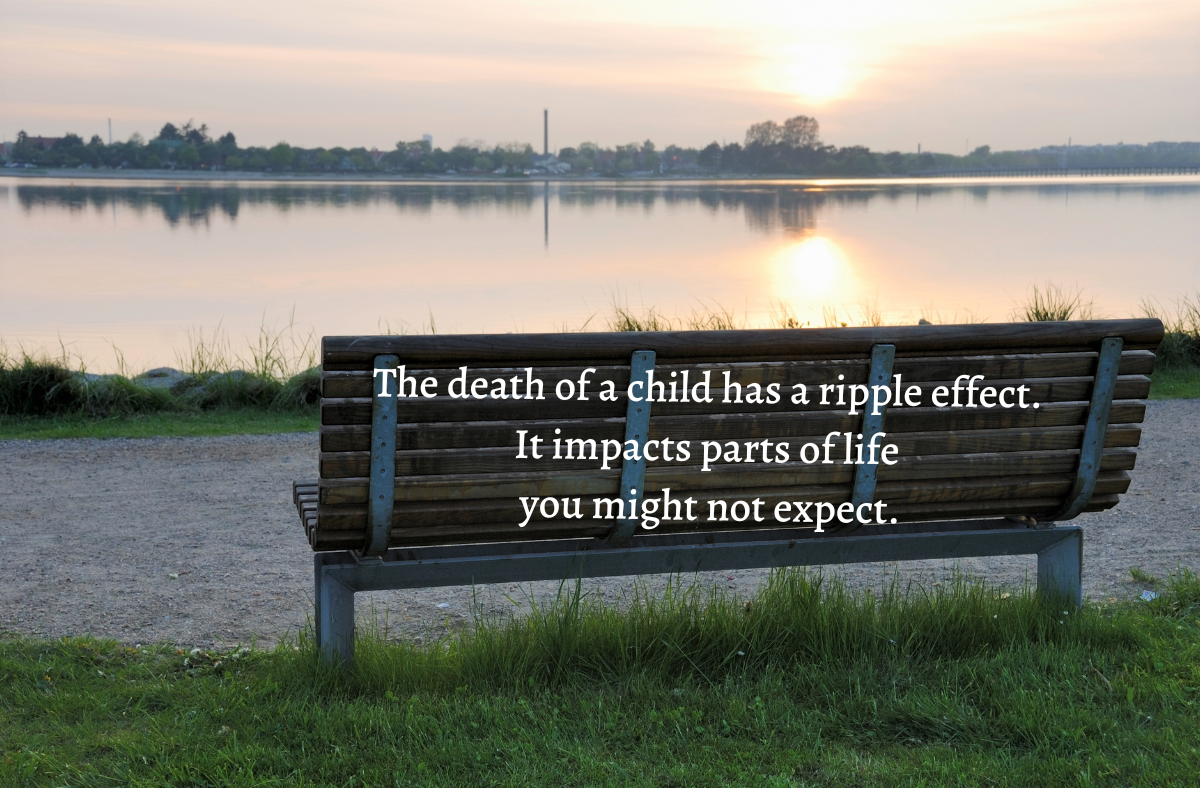
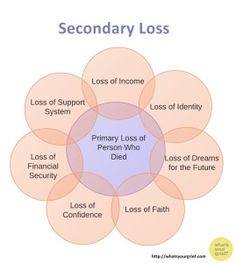
But the death of a child or other loved one has a ripple effect.  It impacts parts of life you might not expect.  As time went on, I was introduced to a whole list of losses commonly called “secondary losses”.

secondary losses

Here are just a few:

Loss of a large chunk of “self”.  Dominic possessed part of my heart and part of my life.  It was violently ripped away when he died.  There is part of me that was uniquely reflected from him-like a specialty mirror.  I can never access that part of me again.

Loss of identity.  Before Dominic died I was one kind of mother.  I was a mother of four living children who were making their way in the world as successful adults.  I was a mother looking forward with happy anticipation to the next years.  Now I am still a mother of four children but one whose heart has been changed by tragedy and sorrow. Tomorrow is still bright, but there’s a shadow just behind it.

desimones uab family

Loss of self-confidence.  I used to enter a room without a thought to how I’d be received or perceived.  That’s definitely not the case now.  I’m self-conscious-constantly wondering if I’m saying or doing the right thing.  I never know if a grief trigger will (at best) pull my attention away from conversation or (at worst) send me scurrying for the bathroom.

Loss of sense of security.  I think every parent has moments of fear over his or her child.  When they first go off someplace without us, when they get a driver’s license, travel abroad, go to college.  But all the awful things I imagined didn’t hold a candle to the reality of waking one morning to a knock on my door and the news that Dominic had been killed.  The bottom fell out of my (relatively) safe world.  Bad things, random things can and do happen.  Once it happened to ME, it changed how I processed everything.  The passing years have softened some of the anxiety but I will never be able to assume safety again.

Anxiety

Loss of faith.  I did not “lose” my faith.  I never once doubted that God was still working, was still loving and was still in control.  But I most certainly had to drag out every single thing I thought I knew about how I thought He worked, loved and superintended the world and examine it in light of my experience of burying my son.  It took a long time to work through all the pat answers I had been offered and myself doled out to others for years that didn’t fit with my new reality.  I am learning that doubt is not denial and that I have to live with unanswered questions.

Loss of family structure.  I’ve written before that a family is more than the arithmetic total of the number of members.  There were six of us.  But we were so much more than six when we were all together!  Our talents, personalities and energy were amplified in community.  When Dominic’s large presence was suddenly whisked away, every relationship got skewed.  We’ve fought our way back to a semblance of “whole” but still miss him terribly.  We can function, but we will never be the same.

empty chair

Loss of my past.  Memories are funny things.  They are plastic and subject to change.  And my recall of an event is limited to my own perspective.  For a memory to be rich and full, I need input from others who were there as well.  One vessel of family memories is no longer available to add his unique contribution.  Every time I pull out a photo or dig down deep in my heart to draw up a treasured moment, I realize I’ve lost something I can not recover.  The joke, the glance, the odd detail are all gone.

Loss of the future I anticipated.  I’m a planner by nature.  Not a detailed, OCD, got-everything-in-order kind of planner, but a “big picture” kind of planner.  When Dominic left us in 2014, things were going (pretty much) according to plan.  Each child was well on his or her way to the career path they had chosen.  I was easing into an empty nest and exploring options for life after homeschooling.  My husband was entering his last few years of a lengthy career.  It’s hard to explain to anyone who hasn’t experienced it, but when your world is shaken by child loss, everything gets scrambled.  You can’t just pick up where you left off and keep going with the pieces that remain. 

There’s a prolonged period of confusion and everyone is impacted differently and in ways you could never imagine.  All of us have changed dramatically in the years since Dominic left us.  He is not the only thing missing from the rest of our lives.  Holidays are altered.  Birthdays are different.  We have to plan special events around uncomfortable milestone dates that roll around every year whether we want them to or not.  It’s a constant readjustment to life as it IS instead of life as I thought it WOULD be.

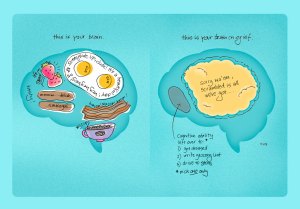
Loss of ability to focus and function.  Oh, how this surprised me!  I was in some kind of zone for the first month after Dominic left.  My other children were home, we had to make it through planning his funeral, two graduations and cleaning out his apartment.  I also had to handle paperwork for my husband to take short-term disability due to grief.  I cried a lot, wrote down dozens of notes but managed to do what I had to do.  Then I crashed. I couldn’t remember a thing.  I couldn’t read more than a couple sentences at a time.  I hated the telephone.  I could barely stand to hear the television.  I had to make a list of the most basic things like brushing my teeth, feeding my animals, turning off all the lights before bed.  It was awful!  And it didn’t really get better for well over a year.

I still suffer from a very short attention span, low tolerance for noise and an inability to accommodate last minute changes.  I don’t schedule anything back to back.  I live in a rural area and sometimes shop in the nearby town.  I will start the day with a long list and shorten it repeatedly as I go along because driving in traffic, crowds and random sounds ramp up my anxiety and make me want to go home with or without what I came for.  I have changed the way I do so many things.  My pre-loss memory has never returned.  

griefbrain1

Loss of patience.  I am at once impatient and long-suffering.  I have zero patience for petty grievances, whining and complaining.  Yet I have compassion for other people living hard and unhappy stories.  I berate myself for not being “better” and, at the same time, extend grace to others who aren’t “better” either.  I want to shake people who bowl over weak, hurting, desperate souls.   I don’t have time for moaning about rain when you were planning a picnic but will listen for hours to a mama tell me about her missing child.

Loss of health.  I had a number of chronic health conditions before Dominic ran ahead.  Within the first year of his departure, I was hospitalized twice.  My experience is not unique.  Some parents suffer immediate health effects (heart attack, blood sugar spikes, anxiety/depression) and some see a slow decline over time.  In part because child loss, like any stressor, will negatively impact health and also because sometimes bereaved parents stop doing the things that help them stay healthy.  At almost five years, I’ve learned how to manage the stress better although some of my health issues continue to get worse.  It’s hard to tease apart what is age, what is disease and what is grief.

When your child leaves this life before you do, it changes everything.  

Not only things you might expect, but many you’d never imagine.  

It’s a constant balancing act, readjusting every day to new challenges.  

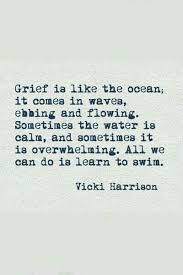
Struggling to keep my head above the waves.  

grief like the ocean learn to swim


Repost: Step Back, Don’t React

It is possible not to react to every single thing someone says or does.  It is possible to scroll past social media posts that get under your skin and not look back.  It is possible to ignore a snarky comment or an unhelpful piece of advice from someone who ACTS like they know what you’re going through but really has. no. idea.  

Now if you are new on this journey, you will read these first few lines and think, “Is this woman crazy????” 

I felt EXACTLY the same way in the first months and even through the first couple years in this Valley.

Read the rest here:  Step Back, Don’t React

Will It Ever Get Better?

I know that when I first stumbled onto a bereaved parent group, it was one of the things I was looking for: evidence that the overwhelming pain of child loss would not last forever.  

Some days I was encouraged as those who had traveled farther down this path posted comments affirming that they could feel something other than sorrow.

Some days I was devastated to read comments from parents who buried a child decades ago asserting that “it never gets better”.

Who is right?  

What’s the difference?

Do I have any control over whether or not this burden gets lighter?

It will be eight years in April since Dominic ran ahead to Heaven and I’ve learned a few things since then.

letting-go

Time, by itself, heals nothing.  But time, plus the work grief requires, brings a measure of healing.  

If I cling with both hands to my loss, I can’t take hold of the good things life still has in store for me.  

Longing for the past all the time only brings sorrow.  I cannot turn back time.  Days, weeks, years will keep coming whether or not I choose to participate in them.  I will rob my heart of potential joy by focusing exclusively on the sorrow I can’t undo.

Daily choices add up.  When I lean into the small things required each day, I build confidence that I can do the bigger things that might still frighten me.  Making phone calls eventually helps me show up to a meeting or to church.  I strengthen my “can do” muscle every time I use it.

Doubt doesn’t disappear. Facing my doubt forces me to explore the edges of my faith.  It does no good for me to stuff questions in a drawer and hope they go away.  They won’t.  I have to drag them into the light and examine them.  Doubt is not denial.  If God is God (and I believe that He is!) then my puny queries don’t diminish His glory.  He knows I’m made of dust and He invites me to bring my heart to Him-questions and all.

My mental diet matters more than I might think.  I have to be very careful what I feed my mind.  If I focus on sadness, tragic stories, hateful speech and media that feeds my fears and despair then those feelings grow stronger.  If instead I focus on hopeful stories, good conversation with faithful friends and inspiring quotes, verses and articles I feed the part of my heart that helps me hold onto hope.

I need a space where I can be completely honest about what this journey is like.  Bereaved parents’ groups have been that space for me and have been an important component of my healing.  But even there I must be cautious about how much time I spend reading other parents’ stories if I notice that I’m absorbing too much pain and not enough encouragement.

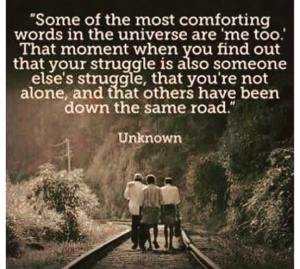
me too sharing the path

Grief is hard.  

It’s work. 

And that work is made up of dozens of daily choices that are also often difficult.  

I don’t expect to be healed and whole this side of eternity.  But I do know that if I consistently do the work grief requires I will be stronger, more whole and better able to lean into the life I have left than if I don’t.

I want to live. 

I want to honor my son by living a life that’s more than just limping along, barely making it, struggling for each step.  

So I do the work grief asks of me.  

Even when it’s hard.  

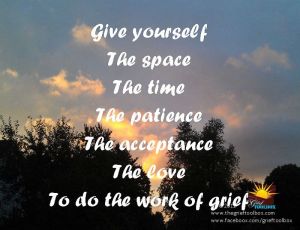
give yourself space to do the work grief requires

A Phone Call a Day [Almost] Keeps the Panic Away

A few days ago I wrote about how panic is always just a breath away for those of us who have suffered loss.  

Like a friend of mine recently said, “We are branded.  GRIEF is burned into our hearts and we are never the same.”

So how to live this altered life?  

How can I manage that emotional tension that saps energy and strength from my heart, mind and body?

Our family has adopted some practical protocols that help.  Sometimes they fail (as they did that night) but for the most part, they give all of us a margin of assurance that keeps panic to a minimum.

We carry our phones, all the time.  I was never THAT person before Dominic left us.  I used my phone mainly when away from the house or traveling.  Otherwise it might be left charging in the kitchen or tucked inside my purse from my last outing.

Not anymore.  When I wake up in the morning I grab it and my glasses from the bedside table and my phone is in my hand, in plain view or in my pocket until it is put back there at night.  I make sure it’s charged and if traveling or going somewhere a plug may not be available I carry a small power cell to charge on the go.

cell phone in hand huffpost

We tell one another of our plans and, if appropriate, of our route.  My kids are grown.  I’m not interested in supervising their lives.  But they understand my mama heart and graciously give me at least a general idea of where they are and what they are doing.  They text when they get back home no matter how late it is.

I don’t stay awake waiting for it, but when I wake in the wee hours or in the morning, I have the reassuring message to greet me. 

We answer texts/calls ASAP.  Obviously we don’t encourage texting and driving but each of us has learned to give a “thumbs up” icon quickly in response to a text message just so the person sending it can be reassured.  Then, when it’s convenient and/or safe, we respond more fully.

We keep each other informed when traveling.  We distribute itineraries and give periodic updates on flight status, traffic or other appropriate information so family members not only know where we are but also if our time of arrival has been altered due to flight or weather delays or traffic conditions.

road-maps

We share phone numbers of friends and coworkers which gives us alternate forms of communication should there be an emergency.  Family phone numbers are in “favorites” in our phones so if we are unable to call for ourselves, emergency personnel would know who to call.

Truth is, we can’t stop bad things from happening and we know that.  

But there’s no reason to create fear and panic when a quick phone call or text can avert it.  

Our hearts bear enough already.  ❤

wounded_heart-960x600


Emotional Overload and T.M.I.

There are so many ways child loss impacts relationships!

Some of the people you think will stand beside you for the long haul either never show up or disappear right after the funeral.

Some people you never expected to hang around not only come running but choose to stay.

And every. single. relationship. gets more complicated.  

When your heart is shattered, there are lots of sharp edges that end up cutting you and everyone around you.  It’s pretty much inevitable that one or more relationships will need mending at some point.

I know I said (still say!) things that wound others.  Most of the time it’s because I’m distracted or hurting myself and my mouth begins speaking before my brain is fully engaged.  Sometimes, though, it’s because I’m in pain and (frankly!) I want to transfer some of that pain to someone else.

Misery DOES love company!

Often other people in my life will say or do things that wound me.  Some of the folks are part of my inner grief circle and I know that it’s unintentional or they are having a pain-filled day like I am.

A few are extended family members who are either blissfully unaware of the ongoing pain and drama of child loss or are too caught up in their own lives to give it a thought.

Some of them are friends who think by now I should have toughened up and are no longer willing to extend extra grace and try harder to be tender.

Sometimes it’s acquaintances or strangers who don’t have a clue.

Whenever someone pierces my armor and inflicts pain, I have a choice:  Do I suck it up and take it or do I say something and try to reconcile?

There are days when I feel strong enough to just overlook it.  But I know if it represents a pattern, sooner or later the pressure will build and I’m going to blow.  And that’s not good for either one of us.

couple fighting

There are days when I absolutely, positively have to address it.  That’s when I need to be careful of overloading another heart with too much information (TMI).  See, it’s easy to make one person the target for all my strong feelings.  It’s easy to do an emotional and informational “dump” on whoever happens to be handy or whoever is the least intimidating.

That’s unfair and unhelpful-for them and for me.  

So when I decide to open my mouth and address a specific situation with a specific person, I need to keep my margins clean and only say the things that pertain to THAT instance.  I can’t bring up every single thing the person has done in the past or things that they haven’t said or done but which have made me more sensitive to certain words or actions.  I don’t need to burden them with all the details of MY bad day or week or month.

Instead I should talk about my own feelings in relationship to them and their actions or words. 

“I feel like _________when you say________” gives vent to my emotion without accusing another heart.  I need to leave room for them to share what they were/are thinking and feeling too.  It can’t be one-way conversation if I hope to have a two-way relationship.  

i statments graphic

Any stressful life circumstance makes us all more vulnerable to offense.  And child loss is certainly stressful.  It’s stressful in ways others can’t see or comprehend.  It alters the way a parent sees and experiences the world.

It makes everything harder.  

Relationships included.  

I want to be full of love, grace and mercy, not overrun with bitterness, anger and offense. 

So I have to be mindful of what I say, how much I say and when I choose to say it.

young man thought bubble

When Sleep Won’t Fix It

I learned early on to make do on less sleep than I really need.

Four children in six years will do that to you.

dominic and siblings little children at nannys

It’s not that I have a physical need for sleep these days-although there are many nights when sleep eludes me.

It’s more that I am soul weary. 

Worn down in ways that sleep won’t touch.  Frayed and frazzled and falling down tired.

I wake up hopeful every morning.  “Today is going to be a productive, encouraging day!”

Sometimes I make it as far as lunchtime before fatigue sets in and overwhelms my good intentions.

I wish it were just a matter of extra shut eye!  I wish I could crawl up in the bed for 24 hours and wake refreshed, renewed and ready to go.

But I can’t.

Sleep won’t fix what’s wrong with me.

It can help.

If I’m physically drained in addition to emotionally exhausted then that’s never a good thing.  My fuse is shorter by the minute when my body is crying for rest.

sleep night terrors

Lack of sunlight, gray days and added stress from holiday preparations and obligations deepens the weariness in my bones.  I feel guilty sometimes because I know my life is still full of many blessings.  I really, truly do NOT take them for granted.  (How could I when I know how quickly and unexpectedly they can be gone?)

Still, all the blessings in the world can’t undo this exhaustion.

I’m well aware that discouragement begets discouragement and try so very hard to strive against it.  But in the end, I’m not sure I’m successful.

When I say to someone, “I’m so very tired!” they nearly always suggest a nap.  Trust me, if a nap would erase this soul weariness, I’d take one every single day.

But it doesn’t, so I don’t.

Instead I go outside and breathe some fresh air, make a cup of hot tea and sit down with a good book, or just sit down and watch the Christmas lights or a candle with my cat in my lap.

hand-coffee-roosevelt

That seems to help. 

It resets my focus and refuels my soul.

Night closes in and I find I’ve made it through another day.  <3

glowing candles huff post


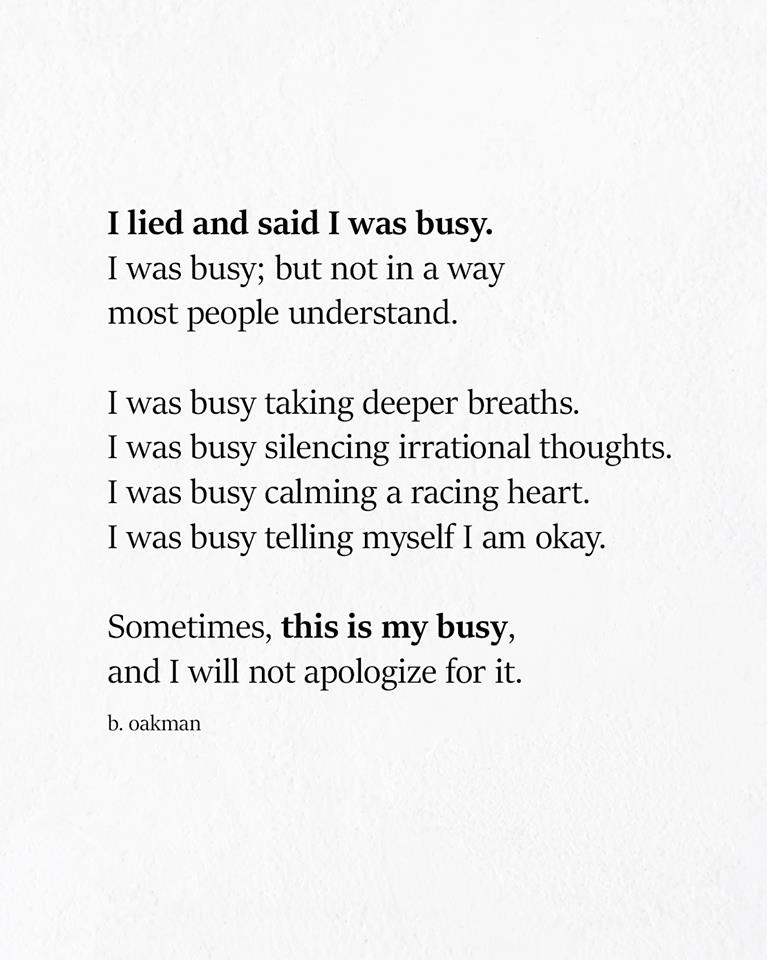
Busy

My empty nest means I’m rarely crazy busy even around the holidays.  

I no longer have to fit in shopping whenever I can manage it because little eyes might be watching or Christmas choir performances and church programs fill the calendar.  

No.  

Most of my shopping is online and I don’t even have to worry about whisking gifts off the porch before anyone sees them.

I’m a different kind of busy now.  

I’m busy making sure I’m not overexposed to Christmas commercials, Christmas movies or Christmas carols because they are likely to open the floodgates of tears I keep behind a dam of determination.

I’m busy drawing deep breaths when I pick up the phone and it’s a relative that never calls but needs an address for a Christmas card and, since I’m apparently the Keeper of the Addresses, always calls me.

I’m busy looking away from the childhood photos lining my upstairs hallway so I can stay focused on the vacuuming that needs doing.

I’m busy pinning down fruitless thoughts of “what if” or “if only” or “I wish”.

I’m busy getting things ready for the brief time my remaining family will be gathered around the dining room table.  I’m trying hard to accommodate schedules and preferences and favorite foods and treasured traditions.

I’m busy pushing back sadness that threatens to overwhelm me in the dark of the year when clouds and rain make it even darker, even earlier.  I’m lighting candles, plugging in lights and adding cheerful touches here and there to drive out the shadows that come creeping.

From the outside looking in, I’m awash in free time and easy choices.  

And some folks wonder why I don’t answer the phone or join in the party.  

But I am very, very busy.  

I was busy

Another Year, Another Christmas: 25 Practical Ways to Give Holiday Hope to the Grieving

This is the fifth Christmas without Dominic. There really are no words to describe the intersection of holiday cheer and another milestone in this journey of child loss.

I’m not sad all the time-far from it. Often I am very, very happy.

But I will never stop missing him, missing the family we used to be and missing our blissful ignorance of how quickly and utterly life can change in an instant.

And I will never outgrow the need to have others remember him as well, to encourage my heart and the hearts of my family members and to help us make it through another year, another Christmas.  ❤

Here are some great ways to do it:  25 Ways to Give Holiday Hope to the Grieving

Good Answers to Hard (Insensitive,Inappropriate) Questions

I was utterly amazed at the questions people plied me with not long after Dominic’s accident.

They ranged from digging for details about what happened (when we ourselves were still unsure) to ridiculous requests for when I’d be returning to my previous responsibilities in a local ministry.

Since then, many of my bereaved parent friends have shared even more questions that have been lobbed at them across tables, across rooms and in the grocery store.

Recently there was a post in our group that generated so many excellent answers to these kinds of questions, I asked permission to reprint them here (without names, of course!).

So here they are, good answers to hard (or inappropriate or just plain ridiculous) questions:

When asked to do something the week or month or even year after your child left:

  • No.  (It’s a complete sentence.  You do not have to give an explanation.)
  • Thank you for asking me.  I won’t be able to participate this time.
  • I’m so sorry.  This is a hard time of year for me and I just can’t do it.
  • Since my son’s accident, I don’t do well at holidays (or summer, or birthday month).  I can’t take on any extra responsibilities right now.
  • I’m sorry, we will be out of town. (If you really WILL be out of town.)

When asked about the details of your child’s death:

  • Why do you ask? (Stops them nearly every time.)
  • That’s an uncomfortable question that I’d rather not answer.
  • Does it matter?
  • We choose not to talk about his/her death and prefer to talk about his/her life.  Would you like to know something about him/her?
  • I prefer not to relive that trauma, thank you.

When asked, “How are you?”:

  • About as well as you would imagine given the circumstances.
  • Managing to do what must be done but very sad my son (or daughter) is no longer here with me.
  • Trying hard to put the pieces back together.  It’s a struggle every day.
  • Our family is loving one another through the hardest thing we’ve ever experienced.
  • How are YOU?  (Most won’t even notice you didn’t answer and will launch into their own discourse.)

When asked if you think you’re “back to normal” or “over it”:

  • No.  (It’s a complete sentence, see above.)
  • I’ll never be over my child. I’m not over any of my children.  How could I be?
  • My life has been shattered.  I can’t even find all the pieces much less assemble them into whatever normal used to be.
  • I don’t remember what “normal” is.
  • It’s a daily adjustment that I will be making for the rest of my life.

When asked anything at all that seems insensitive, inappropriate or just downright nosey:

  • I’m so sorry, I need to go.  Bye!
  • I can’t talk about that now.
  • Say nothing.  Absolutely nothing.  Until they change the subject for you.
  • How are you?  Your children?  (Or any other question back at them-ignoring theirs)

I am obligated (by my profession of faith) to be as kind and polite as I can be but I am not obligated to answer every question someone asks.  

I’ve found that having some of these pat answers in my pocket helps.  Many of them are good for just about any question that may come my way.  

I try to deflect, demur or redirect.  

But when that fails I’m just as likely to tell the truth, which is often not at all what the person really wants to hear.  

And then they are left scrambling for a way out of a conversation I never wanted to have in the first place. 

Which is fine with me.  

silent with heart