Navigating Grief: Transitioning From “Good-Bye” to Grief

A funeral or memorial service seems like a final chapter.  We close the coffin, close the doors and everyone goes home.

But for bereaved parents and their surviving children, it’s not an end, it is a beginning.

Much like a wedding or birth serves as the threshold to a new way of life, a new commitment, a new understanding of who you are, burying a child does the same.

I walked away from the cemetary overwhelmed by the finality of death–not in a theological sense–I believe firmly that my son lives with Jesus–but with the undeniable fact that he is no longer available to me on this earth.

And in the days afterward, I was struck by the inadequacy of a funeral or memorial service to make space for the deep and ongoing sense of loss and pain and sorrow.

There is a difference between mourning and grief.  Although before losing Dominic I never bothered to notice.

I think we confuse the two on a regular basis.  I know I did.

Mourning isdefined as “the outward signs and rituals associated with sorrow for a person’s death.  It is usually limited in time by social conventions or community expectations”.   

Mourning is the more or less public (depending on the family’s choices) “Good-bye” to their loved one.  It’s a circumscribed set of things we do and time we spend welcoming others into the space where we remember, make final arrangements for a body and celebrate the life that has left us.

In most North American communities, we have dispensed with the tradition of draping pictures, windows and ourselves for six months to a year to mark the home and heart of someone who has suffered loss.

What used to be a longer span of time allowing for special accommodations due to grief has now been squeezed into about two weeks.

Our hyper-drive world insists that even parents who bury a child show up to work, begin to participate and act like they have it “together” in public much sooner than our frail human bodies and broken hearts can manage.

Grief is more than a feeling.  It invades your heart, your mind, your body and your soul

Grief is the deep and poignant distress caused by bereavement..

It cannot be circumscribed by time and refuses to limit itself according to the expectations of others or even myself.  It will last (though perhaps not with the same intensity) as long as I live.

Because unlike a funeral, missing my son will not come to an end until I am reunited with him in heaven.

And we need to talk about this.

We need to help ourselves and others understand that grief changes who we are.  It changes how we perceive the world.  It alters our sense of self and impacts our relationships with others.

I am not as fragile as I was just weeks or months after Dominic’s death.  I have learned to put on a smile and pass by his favorite food in the grocery store without crying.  I can remember funny things he said or did without simultaneously experiencing gut-wrenching pain that he is no longer here to do them.

But I am still grieving.  

I am still working out how this missing is weaving itself into the fabric of who I am.

And it is WORK.

Much of the work I have to do on my own–I have to think about and feel and embrace the changes that have been thrust upon me.  But for some of the work, I need the help of others.  I need to be able to speak aloud my thoughts and feelings and receive feedback so that I’m not stuck in unfruitful inner dialogue.

It requires energy and resources.

While I am doing this grief work, my physical, mental, emotional and spiritual energy is largely consumed by it.  I am unavailable more often.  I have a smaller capacity to absorb sudden change and unexpected events. I’m uncomfortable in crowds.  I tire more easily.

And it takes TIME.  

I have discovered that no matter how much I want to speed up this process, it will not be hurried along.  And it proceeds in a “two-steps-forward-one-step-back” fashion so even when I feel I am making progress, I discover I’m not as far along as I think I am or would like to be.

So how to love well at this stage in my grief journey?  When I’m transitioning from “good-bye” to grief?  When I’m trying to understand this new life I never expected to live?

  • Acknowledge my ongoing pain and struggle.
  • Encourage me by allowing me to share honestly.
  • Be patient.  I want to heal but I don’t have control over how long it will take.
  • Don’t shut me out or shut me down.  Grief is uncomfortable for both of us.
  • Remember my son.  I need to know that others miss him too.

Rejoice with those who rejoice [sharing others’ joy], and weep with those who weep [sharing others’ grief].

Romans 12:15 AMP

Everyone’s Grief Journey is Unique

It’s a nearly universal human tendency to try to fit another’s experience into our own.

Even though I try hard not to, I still often find myself saying things like, “I know just how you feel” or, “This worked for me, it ought to work for you”.

Trouble is, grief is as individual as a fingerprint.

Read the rest here: Grief Is As Individual As A Fingerprint

What’s STILL Hard Eleven Years After Losing a Child

Since last October I’ve had the privilege of hosting three separate bereaved mom retreats.

Each one has been put together by God-weaving lives and stories and needs and strengths into a four-day weekend of life changing conversation, study and sharing.

What’s been particularly helpful for ME is that as I’ve poured out what the Lord has shown me over these past years is that He’s also helped my heart acknowledge what is STILL hard, what is STILL fresh and what, in all likelihood, will NEVER get easier.

The theme of each weekend is “Broken into Beautiful: Inviting Hope to Heal Our Hearts”.


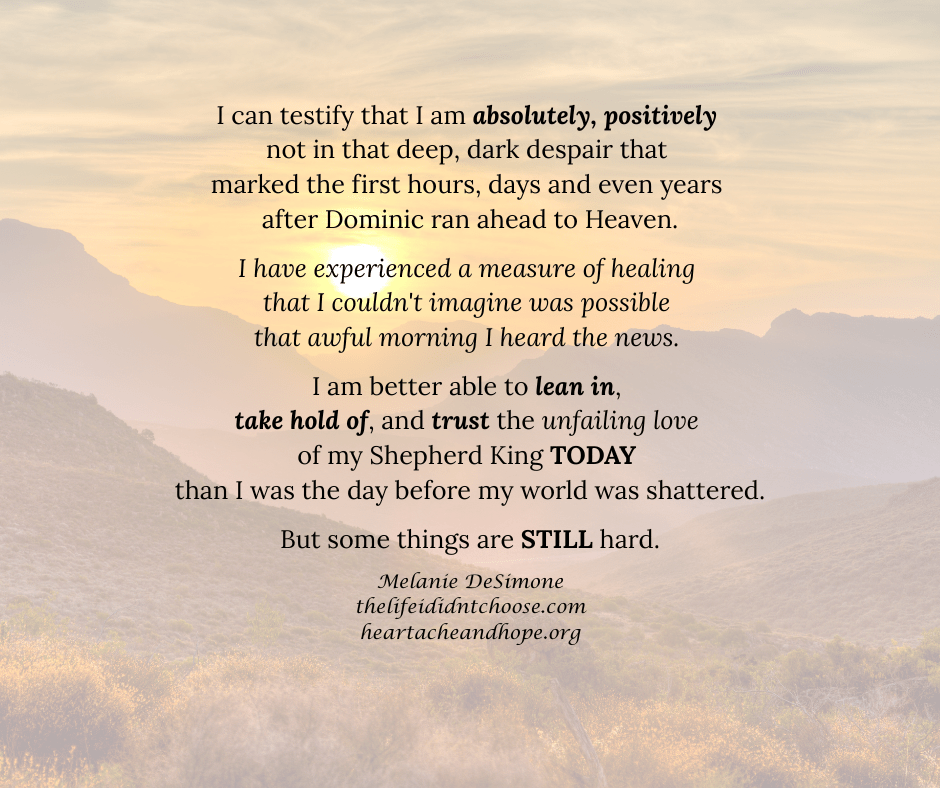
I can testify that I am absolutely, positively not in that deep, dark despair that marked the first hours, days and even years after Dominic ran ahead to Heaven.

I have experienced a measure of healing that I couldn’t imagine was possible that awful morning I heard the news.

I am better able to lean in, take hold of, and trust the unfailing love of my Shepherd King TODAY than I was the day before my world was shattered.

I am oh, so thankful for every heart that led the way in darkness, for the Word of God which is unchanging and ever true, and for Holy Spirit who refused to let me forget Jesus is the same yesterday, today and forever and in Him every promise of God is “yes” and “amen”.

But some things are STILL hard.

  • It’s still hard to see social media photos of intact families -not because I wish they weren’t-but because they remind me in living color that mine is not.
  • It’s still hard to hear of graduations from college (Dom was in law school when he left) and weddings and birth announcements of growing families of my son’s peers.
  • It’s still hard to face holidays when I need (and want to!) be fully present, yet part of my heart always marks the place Dominic should occupy but doesn’t, longs to hear his voice among the laughter and banter, wants desperately to buy HIM a present to put under the tree or for his birthday.
  • It’s still hard to hear of people’s petty “problems” elevated to the height of major issues when I want to scream, “IT’LL TAKE CARE OF ITSELF, TRUST ME!“.
  • It’s still hard to sing some songs about God’s goodness even though I have completely embraced the truth that His idea of goodness doesn’t necessarily conform to mine.
  • It’s still hard to deal with my own lack of energy and emotional reserve when other people expect me to be “back to my old self”-goodness, gracious, it’s been eleven years! Problem is, grief is always running in the background, sapping what little bit of extra I might have. I’m closer to the edge than anyone who loves me might want to know or admit.
  • It’s still hard to deal with the truth that there is no limit to pain in this earthly life. People I love will die. People I love will suffer. Life will not be what I want it or wish it to be. Pain is part of this broken world and burying a child doesn’t inoculate me from anything that might follow.
  • It’s still hard to watch my earthbound children deal with the aftermath of sibling loss. They make choices (some beautiful and some heartbreaking) that reflect an understanding of death and the precariousness of life that prick my heart.
  • It’s still hard to be courteous to those who continue to be ignorant (on purpose, not innocently) of other people’s struggles and pain. I have zero patience at this stage and phase of life for folks who judge others for paths they’ve never had to walk.
  • It’s still hard for me to sit through sermons and Sunday School lessons that suggest trusting Jesus makes life beautiful and “blessed” (in the Instagram coffee, journal and sunshine through the window way). Jesus walks through and strengthens us through the unbearable. He said, “in this life you will have trouble”. His early followers were persecuted, tortured and murdered. Why don’t we preach on that? At least then those of us living through hard times would have a model.
  • It’s still hard for me to accept that the Body of Christ is sometimes the most difficult place to be honest about our struggles.
  • It’s still hard for me to write every day, to show up every day, to choose every single day to expose my heart and share my story.

Dominic was a no nonsense kind of man.

He didn’t put up with anyone’s subterfuge or equivocation. He told it like it was. Even when it cost him friends.

I’m committed, as long as the Lord allows, to do the same.

I’ll advocate, educate, and shout from the rooftops what it’s like to live with loss and what toll it takes on body, mind and spirit.

I’ll share the hope and light of Jesus with whomever will listen.

And I’ll keep on keeping on, even when it’s hard.

Christmas 2024: Seven Practical Ways to Help Grieving Parents During the Holidays

Most parents feel a little stressed during the holidays.

For bereaved parents, the rush toward the “Season of Joy” is doubly frightening.

Constant reminders that this is the “most wonderful time of the year” make our broken hearts just that much more out of place. Who cares what you get for Christmas when the one thing your heart desires–your child, alive and whole–is unavailable…

It is so hard to find a way to trudge through the tinsel when what you really want to do is climb into bed and wake up when it’s all over.

Here are some practical ways family and friends can help grieving parents during the holidays:

  1. Don’t resist or criticize arrangements a bereaved parent makes to help him or her get through this season.If they are brave enough to broach the subject, receive their suggestions with grace and encourage them with love.  Do your best to accommodate the request.
  2. If the bereaved parent doesn’t approach you–consider thoughtfully, gracefully approaching him or her about what might make the holidays more bearable.But don’t expect a well-laid plan-I didn’t get a “how-to” book when I buried my child…this is new to me and very, very painful.  I am doing the best I can to keep my head above the waves and I cannot be expected to captain the boat through these turbulant waters.
  3. Don’t be surprised if a bereaved parent doesn’t want to exchange gifts (or at least, not receive gifts). No one can rewind time or restore my family circle to wholeness and I just can’t think of anything else that I want or need.
  4. Don’t assume that the bereaved parent should be relieved of all meal duties around the holiday.For some of us, doing the routine things like baking and cooking are healing.  For others, there just isn’t energy for anything other than the most fundamental daily tasks. ASK if they want to contribute.
  5. Don’t corner surviving children for a private update on their parent’s state of mind.My children are grieving too.  When you expect them to give an update on me you diminish their pain and put them in a difficult position.  If you want to know, ask me.
  6. If there are young children in the family, it might be helpful to offer to take them to some of the parties/gatherings/church services that their parent may not be up to attending. Ask, but don’t be upset if they say “no”–it might still be too traumatic for either the child or the parent to be separated from one another.
  7. Ask them to share about the one they miss.  One of my greatest fears as a grieving parent is that my child will be forgotten.  But we might not speak up because we don’t want to make others feel uncomfortable.

I know that life goes on, the calendar pages keep turning and I can’t stop time in its tracks.  I greet each day with as much faith and courage as I can muster. This season requires a little more-and I will need help to make it through.

Please Don’t Let the Outside Fool You

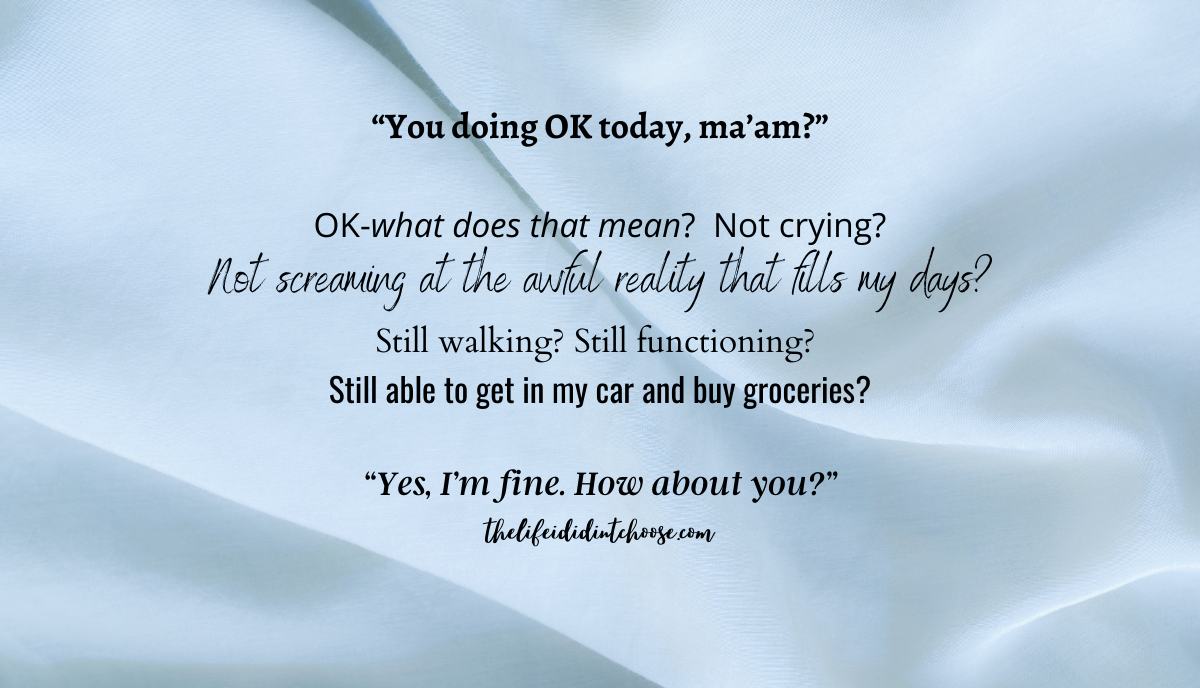
From the outside-very soon after all the formal visiting, meal bringing and memorial service or funeral-most bereaved parents look “fine”.

We have to.

The world doesn’t stop turning because our world imploded.

Work, life, family duties, household chores, and all the ordinary things determined by hours and calendars keep rolling along.

But on the inside, every bit of who we are, how we feel, what we think has been devastatingly poked, prodded, ripped apart and rearranged.

And just like there is no substitute for TIME in physical healing, there is no substitute for TIME in emotional, mental or spiritual healing either.

So if you are fresh on this path, new to the rigors of trying to “do life” while mourning your precious child, recognize that there is oh, so much damage where people can’t see.

Read the rest here: Don’t Let The Outside Fool You